
The main message of John 12:1–8 is that extravagant devotion to Jesus Christ is the rightful response to who He is and what He came to do — die for our sins and be buried and raised again. In the passage, Mary anoints Jesus’s feet with costly perfume, and Jesus defends her act as preparation for His burial, revealing that true worship recognizes and honors His sacrificial death and coming resurrection.
There are moments in Scripture that stop us in our tracks—not because they are confusing, but because they reveal something so beautiful, so costly, and so deeply about the heart of Jesus Christ that we cannot rush past them. John 12:1–8 is one of those moments. It is a passage that centers entirely on Jesus, lifts up His lordship, and invites every believer—young or mature in the faith—to consider what it truly means to devote our lives without reservation to Him.
In this passage, Mary of Bethany does something extravagant: she anoints the feet of Jesus with costly perfume and wipes them with her hair. On the surface, this appears to be a simple act of hospitality, but as we unpack john 12 1 8, we will see that this event powerfully foreshadows Jesus’s coming burial, reveals His absolute authority in the face of criticism, and responds with grace to those who doubt His worth. As we study this text together, we will see how every detail—Mary’s love, Judas’s objection, and Jesus’s defense—ultimately points to the cross, the resurrection, and the unshakable truth that Jesus is the risen Son of God who deserves all of our worship, now and forever.
The Setting and Key Figures in John 12:1–8
Six days before the Passover celebration began, Jesus arrived in Bethany, the village where Lazarus lived—the same man Jesus had raised from the dead (John 12:1, NLT). A dinner was held in Jesus’s honor. Martha served, and Lazarus sat at the table among the guests. This family had experienced the miraculous hand of God firsthand, and their home became the setting for one of the most profound acts of worship recorded in Scripture.
Several key figures appear in this passage, each playing a distinct role:
- Jesus — the Son of God, fully divine and fully human, who had recently raised Lazarus from the dead and was now preparing for His own death and resurrection.
- Mary of Bethany — The sister of Lazarus and Martha, who performed an astonishing act of worship by anointing Jesus’s feet with costly perfume.
- Lazarus — The man Jesus raised from the dead, now seated at the table as a living testimony to Jesus’s power over death.
- Martha — Mary’s sister, who served at the meal, continuing the pattern of hospitality seen earlier in Luke 10:40.
- Judas Iscariot — The disciple who objected to Mary’s act and who would soon betray Jesus for thirty pieces of silver (Matthew 26:15).
This gathering in Bethany was more than a social event. It was a moment charged with prophetic significance. Jesus’s public ministry was drawing to a close. The cross was only days away. John carefully records this event to show that Jesus was not caught off guard by His death—He knew what was coming and accepted this act of worship as a preparation for His burial (John 12:7).
Mary’s Act of Worship
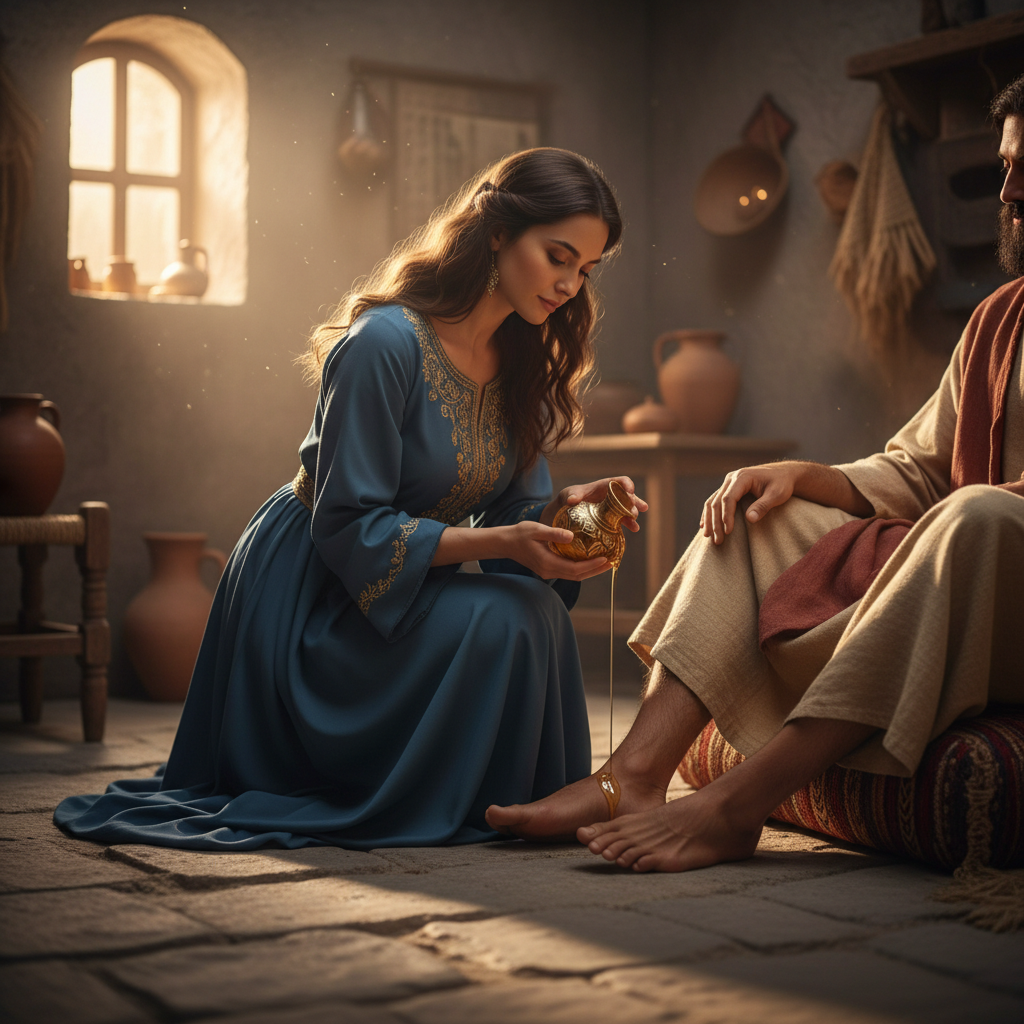
Then Mary took a twelve-ounce jar of expensive perfume made from pure nard and anointed Jesus’s feet with it, wiping them with her hair (John 12:3, NLT). This was no ordinary gesture. The perfume was worth nearly a year’s wages for a common laborer. Mary held nothing back.
Her worship was extravagant, personal, and sacrificial. She did not pour the perfume on His hands or His head—she anointed His feet, then lowered herself to wipe them with her own hair. This was the posture of a heart completely surrendered to the Lord.
- Her worship was costly. She gave something of enormous value, showing that true devotion to Jesus cannot be measured by convenience.
- Her worship was humble. Kneeling at His feet, she demonstrated that worship begins with recognizing who Jesus truly is.
- Her worship was focused on Jesus alone. She did not worry about expense or the opinions of others. Christ was her singular focus.
This moment teaches us that the greatest act of worship is giving Jesus the most precious thing we have. As Jesus Himself said, “Wherever this Good News is preached throughout the world, this woman’s deed will be remembered and discussed” (Matthew 26:13, NLT). Mary’s worship still speaks to every believer today.
Judas’s Objection and Jesus’s Response
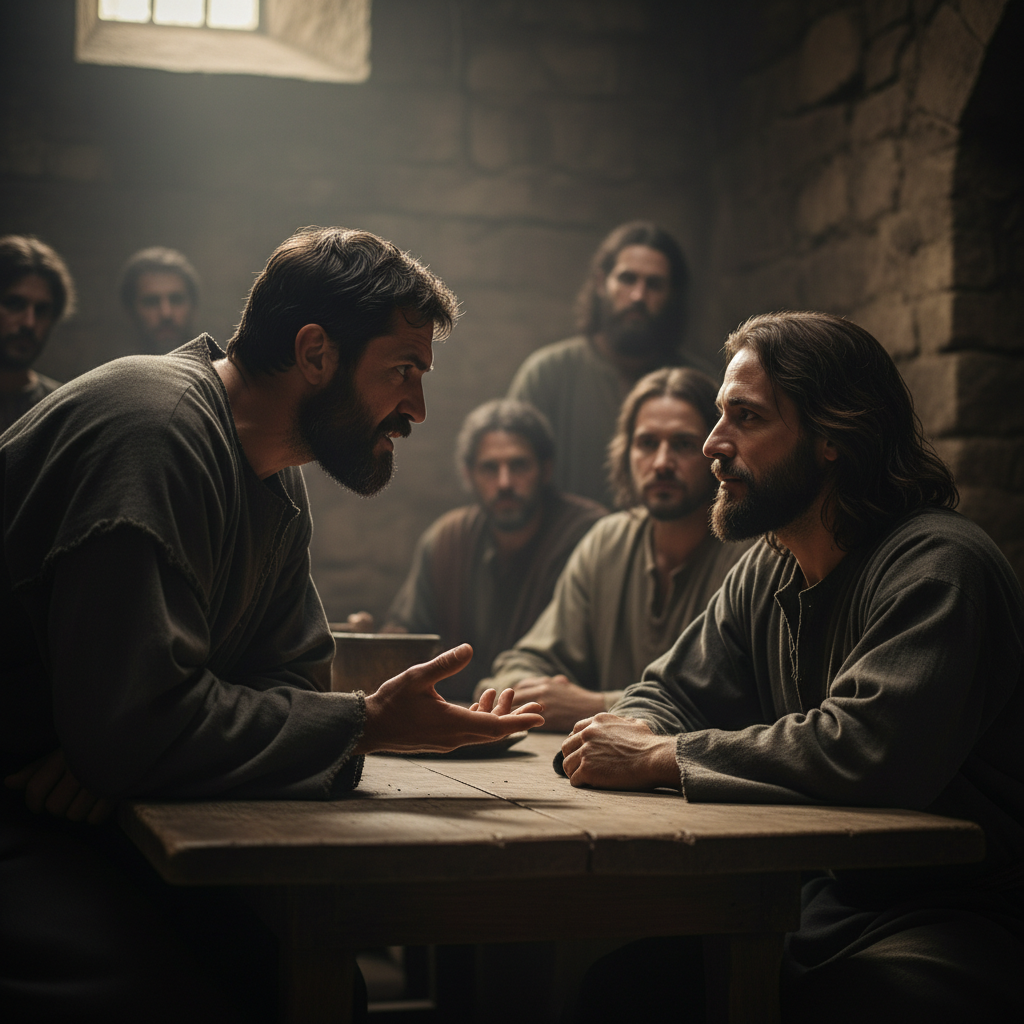
Not everyone in that room was moved by genuine love for Jesus. Judas Iscariot immediately objected: “Why wasn’t this perfume sold? It was worth a year’s wages. The money could have been given to the poor” (John 12:5, NLT). Judas claimed to care about the poor, but John reveals the truth—Judas did not care about the poor. He was a thief who often stole from the disciples’ funds (John 12:6).
Judas’s reaction represents a dangerous counterfeit of righteousness. He used a noble cause to criticize true worship. There will always be voices that question extravagant devotion to Jesus. Some will suggest that money would be better spent elsewhere.
Jesus responded with unmistakable clarity and authority: “Leave her alone,” Jesus replied. “She has kept this perfume to be used in the preparation of my body for burial” (John 12:7, NLT). He then added, “You will always have the poor among you, but you will not always have me” (John 12:8, NLT).
What does Jesus’s response teach us?
- Jesus affirmed Mary’s worship. He defended her against criticism. Our Lord honors a heart that seeks to glorify Him.
- Jesus knew His time was short. He understood that His earthly mission was nearing its fulfillment. Mary sensed this in her spirit and responded with urgency.
- Jesus did not dismiss caring for the poor. Scripture is clear that believers are called to serve those in need (Proverbs 19:17; James 2:15–16). However, Jesus made it clear that worship of Him must never be sacrificed for any other cause, no matter how noble it may seem.
Judas’s objection came from a corrupt heart. Mary’s worship came from a surrendered one. The contrast is striking. It reveals that the true main message of John 12:1–8 is this: Jesus Christ is worthy of our wholehearted, sacrificial, and extravagant devotion. He is not one priority among many. He is the priority above all priorities. As Scripture declares, “For from him and through him and for him are all things. To him be the glory forever! Amen” (Romans 11:36, NIV).
How John 12:1–8 Points to the Death and Resurrection of Jesus

Beneath the surface of this dinner scene, John 12:1–8 is deeply prophetic. It points directly to the most important events in all of human history: the death and resurrection of Jesus Christ.
When Jesus said Mary had kept the perfume “for the day of my burial” (John 12:7), He made a stunning declaration. His death was not an accident or a tragedy—it was God’s intentional plan. Mary’s devotion aligned perfectly with the Father’s purpose. Her act of worship was exactly what God had planned.
The parallels between Mary’s act and Christ’s sacrifice are striking:
- Both involved total giving. Mary held nothing back. Jesus held nothing back.
- Both were acts of love. Mary loved Jesus deeply. Jesus loved humanity deeply.
- Both were misunderstood by those around them. Judas criticized Mary. The world misunderstood Jesus.
- Both pointed to burial and death. The perfume prepared Jesus’s body. The cross accomplished salvation.
There is another powerful detail pointing to resurrection. Lazarus was present at this dinner—the man Jesus had raised from the dead just days earlier (John 11:1–44). His very presence was a living testimony that death does not have the final word. The One who conquered death in Lazarus’s life would soon conquer it for all humanity through His own resurrection. As Jesus declared, “I am the resurrection and the life. The one who believes in me will live, even though they die” (John 11:25, NIV).
Some have questioned whether Jesus truly knew He would die, or whether the crucifixion was an unexpected tragedy. This passage makes it abundantly clear: Jesus knew exactly what was coming. He was not a victim of circumstances. He was the sovereign Son of God walking willingly toward the cross. When He said, “You will not always have me,” He spoke with divine authority. He laid down His life willingly—no one took it from Him (John 10:18, NIV).
John 12:1–8 stands as a powerful reminder that the death and resurrection of Jesus were not afterthoughts. They were the central mission of His life. Every step He took led to Calvary. And beyond Calvary lay the empty tomb—the proof that He is exactly who He claimed to be: the risen Lord and Savior of the world.
What John 12:1–8 Teaches About True Devotion to Christ
John 12:1–8 paints a vivid picture of what true devotion to Jesus looks like—and what counterfeit devotion looks like. Mary and Judas stand on opposite ends of the spectrum, and their contrasting hearts reveal essential truths about worship.
Mary’s extravagant love was costly, personal, and wholehearted. She gave her most valuable possession without reservation. She knelt at Jesus’s feet and wiped them with her hair. Her worship was intimate, humble, and rooted in a clear understanding of who Jesus was and what He was about to do.
Judas’s false concern appeared righteous on the surface. He spoke of helping the poor. But his heart was far from God. He cared more about money than about Jesus. His objection reveals a heart filled with greed masquerading as compassion.
Jesus’s defense of Mary teaches us several essential truths about true devotion:
- True devotion is costly. Mary gave something extremely valuable. She did not offer Jesus her leftovers. She gave Him her best.
- True devotion is personal. Mary knelt at Jesus’s feet. Her worship was intimate and humble.
- True devotion sees who Jesus really is. Mary understood Jesus’s mission. She anointed Him for burial. Her worship was rooted in truth.
- True devotion cannot be silenced by criticism. Judas criticized Mary. Yet Jesus defended her. God honors a heart that seeks Him above all else.
True devotion is not about outward appearances. Judas looked concerned about the poor, but his heart was corrupt. God looks at the heart (1 Samuel 16:7). He sees our motives and knows whether our worship is genuine.
Jesus is worthy of everything we have. He is not just a good teacher or a prophet. He is the Son of God who died on the cross for our sins and rose from the dead on the third day. Because of who He is, we should give Him our best—our time, our resources, our hearts. As Romans 12:1 urges, we should offer our bodies as living sacrifices, which is our true and proper worship.
John 12:1–8 challenges us to examine our own hearts. Are we like Mary, giving Jesus our best? Or are we like Judas, holding back while pretending to care? True devotion is not about perfection. It is about direction—a heart that says, “Jesus, You are Lord. I am Yours.”
Frequently Asked Questions About John 12:1–8
What is happening in John 12:1–8?
Six days before Passover, Jesus dined at Bethany in the home of Lazarus, whom He had raised from the dead. Mary of Bethany anointed Jesus’s feet with costly perfume worth a year’s wages and wiped them with her hair. Judas Iscariot objected, claiming the money should have gone to the poor, but Jesus defended Mary, saying she had done this in preparation for His burial.
How does John 12:1–8 point to Jesus’s death?
Jesus explicitly said Mary’s act was “for the day of my burial” (John 12:7). Her anointing foreshadowed His coming death and burial. The costly perfume poured out without reservation foreshadowed Jesus pouring out His life for the sins of the world. The presence of Lazarus at the table—a man Jesus had raised from the dead—further pointed to the resurrection power that would conquer the cross.
What is the main message of John 12:1–8?
The main message is that Jesus Christ is worthy of our wholehearted, sacrificial, and extravagant devotion. Mary’s act of worship, Jesus’s defense of her, and Judas’s corrupt objection together reveal that true worship costs us something real, focuses entirely on Christ, and cannot be silenced by criticism. Jesus is not one priority among many—He is the priority above all priorities.
Conclusion: The Heart of Worship in John 12:1–8
John 12:1–8 is far more than a brief story about a dinner in Bethany. It is a powerful portrait of what it means to worship Jesus with everything we have. Mary’s act of pouring out costly perfume was not wasteful. It was the most meaningful thing she could have done. She recognized who Jesus truly is and responded with a heart full of love and gratitude.
This passage calls each of us to examine our own hearts. Are we holding back from Jesus? Or are we giving Him our very best? True worship is not about following a set of rules. It is about a living, personal relationship with the Son of God. It is about surrendering our lives completely to Him.
Jesus made it clear that Mary’s worship was not in vain. He said, “Leave her alone. She did this in preparation for the day of my burial” (John 12:7, NLT). Her devotion pointed directly to His sacrifice on the cross. In the same way, our worship today points to the finished work of Christ. It declares that His death and resurrection are the foundation of our hope.
As you reflect on John 12:1–8, remember these truths:
- Worship is our highest calling. Nothing we offer to Jesus is ever wasted.
- Jesus deserves our best. He gave His life for us. We can give Him our whole hearts in return.
- Every act of devotion matters. What we do for Christ echoes into eternity.
Let this passage inspire you to draw near to Jesus. Whether through prayer, praise, or acts of service, give Him the honor He deserves. He is worthy of all our worship. He is the risen Savior, the Lamb of God who takes away the sin of the world (John 1:29). May your life be a fragrant offering to Him, just as Mary’s was in that quiet home in Bethany.