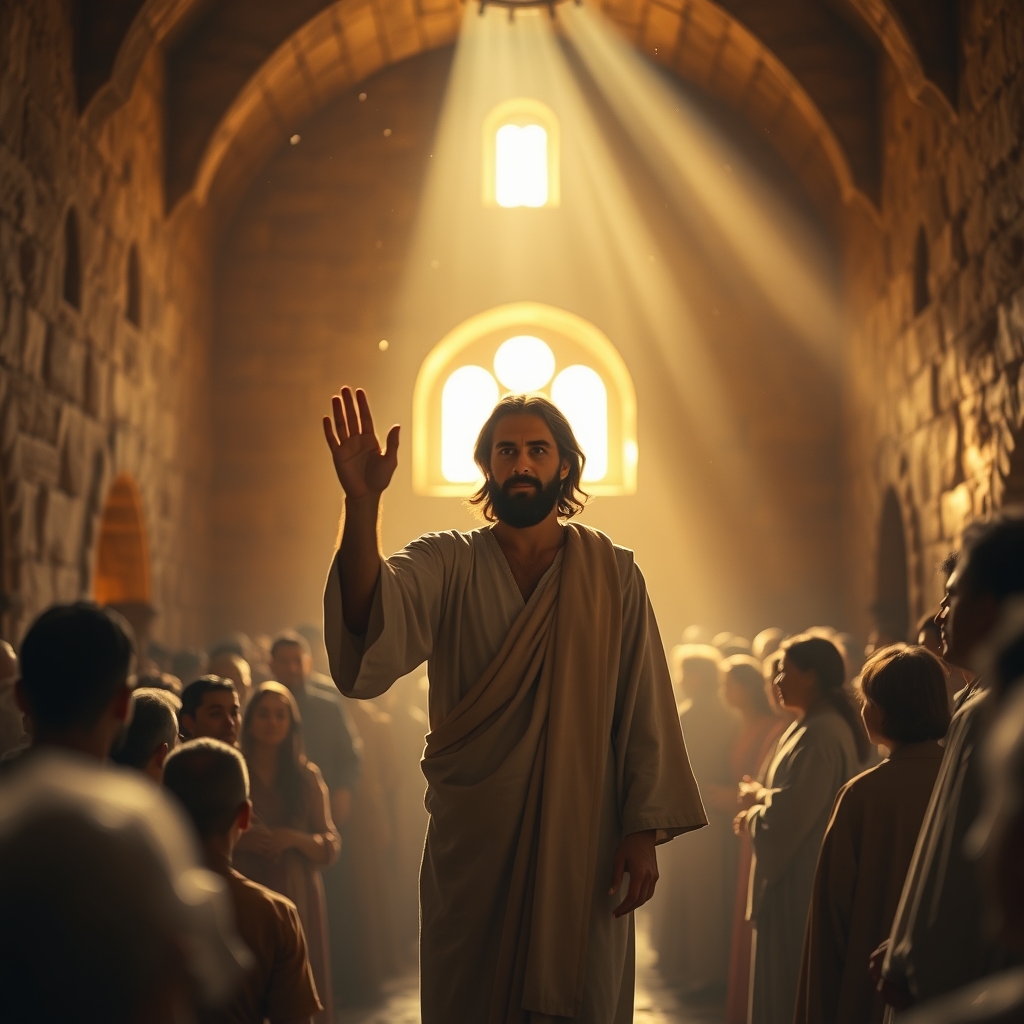
Mark 1:21-28 teaches that Jesus Christ has divine authority over all spiritual forces, including demons. In this passage, Jesus teaches in the synagogue at Capernaum with undeniable power and commands an unclean spirit to leave a man — and it obeys. This reveals that Jesus is not merely a teacher but the Son of God, with complete dominion over both the natural and spiritual realms.
One of the most powerful moments in all of Scripture unfolds in a small synagogue in Capernaum, where everything the people thought they knew about God, religion, and authority was about to be turned upside down. In Mark 1:21-28, we witness Jesus stepping into a place of worship and doing something that left an entire crowd speechless — He taught with an authority no one had ever seen before, and then He confronted a demon-possessed man with a single, commanding voice. This passage is far more than a miraculous encounter; it is a profound revelation of exactly who Jesus Christ is and what He came to accomplish on this earth.
In this article, we will carefully walk through the meaning of Mark 1:21-28, examining every scene from Jesus entering the synagogue to the spread of His fame across all of Galilee. We will explore the staggering truth that Jesus possesses absolute authority — over disease, over demons, over death itself, and over every soul who calls upon His name. We will also confront an important question that this passage naturally raises: what is the true religion according to Jesus? Whether you are a new believer taking your first steps in faith or a longtime follower of Christ seeking deeper understanding, this study will strengthen your confidence in the risen Lord who still speaks with authority today.
What does Mark 1:21-28 mean?
What does Mark 1:21-28 mean? At its core, this powerful passage reveals a foundational truth of the Christian faith: Jesus Christ possesses absolute authority, not only over human minds and hearts but also over the spiritual realm. This narrative showcases a clear, undeniable demonstration of Jesus’ divine power as He steps into a synagogue, teaches with unparalleled wisdom, and then instantaneously liberates a man from demonic oppression. Through this single event, we learn that the Kingdom of God is not a distant concept; it is actively breaking into our world through the person of Jesus.
The Meaning of Jesus’ Teaching Authority
Mark 1:21-28 meaning begins with a contrast. When Jesus enters the synagogue in Capernaum, the people are immediately “astounded at his teaching, for he taught them as one who had authority, not as the scribes” (Mark 1:22). The scribes and religious leaders of the day constantly relied on past traditions and the opinions of previous rabbis to justify their rulings. Jesus, however, spoke directly from the authority of God the Father. He did not need to cite others to validate His message; He simply declared the truth. When we follow Christ, we are submitting to a leadership that is rooted in divine certainty rather than human speculation.
The Confrontation in the Synagogue
As Jesus begins His ministry, He immediately faces spiritual opposition. A man with an unclean spirit cries out, “What have you to do with us, Jesus of Nazareth? Have you come to destroy us? I know who you are—the Holy One of God” (Mark 1:24). The demon knew exactly who Jesus was. Consequently, this was not a misunderstanding; it was a desperate attempt to undermine Jesus’ mission. However, Jesus immediately commands the spirit to silence and then casts it out of the man. This act proves that the power of Jesus is absolute. He does not negotiate with evil; He conquers it.
The Lesson for Today
So, what does Mark 1:21-28 mean for believers today? It serves as a vivid reminder that no darkness is too powerful for our Savior. John 1 tells us that the “light shines in the darkness, and the darkness has not overcome it” (John 1:5). When we struggle with sin, fear, or spiritual oppression, this passage reminds us that we serve a God who has already won the victory. We do not have to fight alone, because Jesus is already fighting for us. Ultimately, the authority of Jesus brings complete freedom to all who surrender their lives to Him.
- Jesus cannot be fake: The immediate recognition of Jesus by the forces of darkness proves His authentic divine nature.
- Jesus is the Son of God: He possesses the inherent power to command unclean spirits and they must obey Him.
- Our Refuge: Believers can trust that the authority of Christ extends over every area of our lives, bringing peace and deliverance.
Mark 1:21-28 Breakdown: Jesus Teaches in Capernaum
Let’s break down the beginning of Mark 1:21-28 to understand how Jesus began His public ministry with a powerful display of divine authority. This passage is a turning point that shows who Jesus really is.
Jesus Enters the Synagogue (Mark 1:21)
The verse says, “They went to Capernaum, and when the Sabbath came, Jesus went into the synagogue and began to teach.” Even in this first detail, we see something important. Jesus did not wait for an invitation. He entered the place of worship and teaching, and He began to speak. This shows that Jesus came with a clear purpose. He was not a passive observer but an active, authoritative teacher. [1]
Furthermore, the setting matters. The Sabbath was the most important day of worship for the Jewish people. By teaching on this day in the synagogue, Jesus stepped into the very heart of the community’s spiritual life. He did not start His ministry on the fringes. He went straight to the center where people gathered to hear God’s Word.
Capernaum, meanwhile, would become a central location for Jesus’ ministry in Galilee. It was not a grand city like Jerusalem, but it was a thriving town near the Sea of Galilee. In other words, Jesus began where ordinary people lived and gathered.
The People Are Amazed at His Teaching (Mark 1:22)
Mark 1:22 tells us, “The people were amazed at his teaching, because he taught them as one who had authority, not as the teachers of the law.” This verse is critical. It reveals something that those listening immediately noticed. Jesus did not teach like anyone else.
The teachers of the law, also known as scribes, primarily taught by quoting earlier rabbis and scholars. Their authority came from referencing other authorities. For example, one would say, “Rabbi Hillel taught this,” and another would add an opinion on top of that. However, Jesus spoke entirely differently. He said things like, “You have heard that it was said… but I tell you” (Matthew 5:21-22). He spoke on His own authority.
| Teachers of the Law | Jesus Christ |
|---|---|
| Quoted earlier rabbis and traditions | Spoke with His own divine authority |
| Relied on human scholarship | Revealed the truth directly from God |
| Taught through layers of interpretation | Taught with clarity and power |
In short, Jesus’ words carried the weight of God Himself. This is what astonished the crowd. They had never heard anyone teach like this. For those who had ears to hear, this was evidence that God was present among them in a new and powerful way.
This passage lays the foundation for the dramatic event that follows, the encounter with the demon-possessed man. However, even before that miracle, the teaching itself revealed Jesus’ authority. His words were not empty. They carried spiritual power. As we continue through Mark 1:21-28, we will see that this authority extends not only over human understanding but over the spiritual realm itself.
The Man with an Unclean Spirit (Mark 1:23-26)
Jesus had just begun teaching in the synagogue at Capernaum. His words carried a weight and authority that stunned everyone present. However, the most dramatic evidence of that authority came when a man with an unclean spirit suddenly interrupted the gathering.
The Demon Recognizes Jesus’ True Identity (Mark 1:24)
As Jesus taught, a man tormented by an unclean spirit cried out in anguish. Mark records the demon’s words in Mark 1:24:
“What have you to do with us, Jesus of Nazareth? Have you come to destroy us? I know who you are — the Holy One of God.”
Several powerful truths emerge from this brief but startling encounter:
- The demon knew exactly who Jesus was. Even though the crowd was still trying to understand Jesus’ identity, the demon immediately recognized Him as “the Holy One of God.” Spiritual forces cannot hide from the truth of Christ’s divine nature.
- The recognition was born of fear, not faith. The demon’s question — “Have you come to destroy us?” — reveals terror, not trust. It understood that Jesus had power over the spiritual realm.
- Evil acknowledges what humanity often denies. Throughout the Gospels, demons consistently identify Jesus accurately. Meanwhile, many religious leaders refused to believe. This is a sobering reminder that knowing facts about God is not the same as surrendering to Him in faith.
- The title “Holy One of God” is profound. In the Old Testament, God alone is called holy (Isaiah 6:3). By using this title, the demon affirmed Jesus’ unique, divine character and His intimate relationship with the Father.
There is a deep irony here. The demon confessed the truth about Jesus more clearly than most people in the synagogue. Yet confession without submission changes nothing. As James 2:19 tells us:
“You believe that God is one; you do well. Even the demons believe — and shudder!”
This encounter reminds us that true faith involves far more than acknowledging who Jesus is. It requires placing your life under His lordship.
Jesus Commands the Demon to Be Silent and Come Out (Mark 1:25-26)
The Command of Authority
Jesus did not plead with the demon or negotiate with it. He did not perform rituals or ceremonies. Instead, Mark 1:25-26 records His direct command:
But Jesus rebuked him, saying, “Be silent, and come out of him!” And the unclean spirit, convulsing him and crying out with a loud voice, came out of him.
The Greek word translated “rebuked” (epitimaō) carries enormous weight. It implies an authoritative command, not a suggestion. Jesus spoke to the demon the way a commanding officer speaks to a subordinate.
Key Lessons from Jesus’ Response
Several lessons stand out from this moment of deliverance:
- Jesus silenced the demon’s testimony. Though the demon spoke the truth about Jesus’ identity, He refused to allow an evil spirit to be His witness. God does not need the endorsement of Satan’s forces.
- Jesus spoke with absolute authority. His words alone were enough. There was no struggle, no prolonged battle. One sentence from Christ was all it took to free this man from spiritual bondage.
- The deliverance was immediate and complete. The demon did not linger or resist. It convulsed the man in its final act of cruelty but ultimately obeyed Jesus’ irresistible command.
- Jesus demonstrated compassion, not cruelty. He did not ignore the suffering of this man in the synagogue. He acted decisively and lovingly to restore a person who had been tormented.
This event foreshadows the central mission of Jesus’ earthly ministry. Later, in Luke 4:18, He declared:
“The Spirit of the Lord is upon me, because he has anointed me to proclaim good news to the poor. He has sent me to proclaim liberty to the captives and recovering of sight to the blind, to set at liberty those who are oppressed.”
Jesus came to defeat every form of evil that holds humanity captive. His authority over demons is proof that no force of darkness can stand against Him.
What This Means for Us Today
This passage from Mark 1:23-26 remains deeply relevant for every believer. It teaches us that:
- Jesus Christ has authority over every spiritual force of evil.
- His power is not limited by time, geography, or circumstance.
- Deliverance comes through Christ alone, not through human effort or religious tradition.
- Those who belong to Jesus are under His protection and care.
As the apostle John wrote in 1 John 4:4:
“Little children, you are from God and have overcome them, for he who is in you is greater than he who is in the world.”
The unclean spirit in Mark’s Gospel encountered the living Lord — and it had no choice but to obey. When we face spiritual darkness in any form, we can trust the same Jesus who spoke with authority in that synagogue at Capernaum. His power has not diminished. His compassion has not faded. And His authority over every enemy remains absolute and unshaken.
What is the meaning of Mark 1:23-28?
The Crowd’s Reaction: Astonishment and Amazement (Mark 1:27)
After Jesus cast out the unclean spirit, the people in the synagogue were left utterly stunned. Mark 1:27 records their reaction: “They were all amazed, so that they questioned among themselves, saying, ‘What is this? A new teaching with authority! He commands even the uncleen spirits, and they obey him.'”
This moment reveals something profound about the difference between human religious instruction and the living authority of Jesus Christ. The crowd recognized that what they had just witnessed was unlike anything they had seen or heard before.
Consider the key elements of their amazement:
- They questioned among themselves. The encounter was so extraordinary that it demanded reflection and discussion. Faith often begins with wrestling with who Jesus truly is.
- They recognized His teaching was new. Not new in the sense of being modern, but new in its power. Jesus did not merely quote other rabbis. He spoke and acted with divine authority rooted in who He is.
- He commands even the unclean spirits. Notice the word “even.” The demons obey His voice. No ceremony was required. No ritual was needed. A single word from Jesus was enough.
This is the heart of Mark 1:23-28. The passage reveals that Jesus is not merely a good teacher or a moral example. He is the Son of God, possessing absolute authority over every realm of existence including the spiritual world. As Colossians 2:9 reminds us, “For in Him the whole fullness of deity dwells bodily.”
The people’s astonishment should challenge us today. Do we approach Jesus with the same sense of wonder? Or have we become so familiar with His name that we forget the unmatched power behind it?
Jesus’ Fame Spreads Throughout Galilee (Mark 1:28)
Mark 1:28 tells us what happened next: “At once the news about him spread everywhere into all the surrounding region of Galilee.” This single verse captures something extraordinary about how the gospel advances.
The spread of Jesus’ fame happened in three important ways:
- It happened at once. There was no delay. The power of Jesus could not be contained or hidden. True encounters with Christ always bear fruit that is visible and immediate.
- The word spread everywhere. People talked. Those who witnessed His authority could not stay silent. Their testimony carried the message far beyond the walls of that synagogue.
- It covered all the surrounding region. The impact of one faithful act of worship exploded outward. A single encounter with Jesus in a small town reached an entire region.
This pattern still holds true today. When someone genuinely encounters the living Christ, they cannot keep it to themselves. Their life becomes a testimony. Just as the people who witnessed Jesus’ power in Capernaum could not stop talking about Him, every believer today carries the responsibility and privilege of sharing what Jesus has done.
Acts 1:8 promises, “You will receive power when the Holy Spirit has come upon you, and you will be my witnesses.” The spreading of Jesus’ fame in Mark 1:28 is not simply a historical fact. It is a picture of how the gospel continues to advance through the faithful witness of those who have experienced His authority firsthand.
Mark 1:23-28 is ultimately about this: Jesus Christ is not like anyone else. His authority is absolute. His power over darkness is complete. And His fame deserves to spread to every corner of the earth. The question it leaves us with is simple and personal: have you surrendered your life to the One whose voice even demons obey?
The True Religion According to Jesus
Religion Built on Human Tradition vs. God’s Authority
When we study Mark 1:21-28, we discover something revolutionary. The people of Capernaum were used to a certain kind of religion. They gathered in the synagogue every Sabbath to hear the Law read. Yet something was fundamentally missing from their spiritual experience. Jesus stepped into that synagogue and everything changed. Why? Because He taught “as one who had authority, and not as the scribes” (Mark 1:22).
The religious leaders of that day relied heavily on tradition. They quoted previous rabbis. They built layers of human interpretation over God’s Word. As a result, the teaching felt hollow and distant. It was religion without power. It was knowledge without transformation.
Jesus exposed this空虚 entirely. His words carried the very breath of God. The difference between religion and the Gospel is not subtle. It is the difference between hearing about God and encountering God personally. The scribes could recite the Law from memory. However, they could not cast out a demon with it. Jesus did both — and He did it effortlessly.
The Religious Traditions of Jesus’ Day
The scribes and Pharisees had developed an elaborate system of rules. Many of these rules had good intentions originally. Yet over time, they became substitutes for a living relationship with God. Jesus addressed this directly:
“You hypocrites! Well did Isaiah prophesy of you, when he said: ‘This people honors me with their lips, but their heart is far from me. In vain do they worship me, teaching as doctrines the commandments of men.'”
— Matthew 15:7-9
This pattern repeats throughout human history. It is tempting to substitute external rituals for internal transformation. People may attend church faithfully, yet their hearts remain unchanged. They may know every verse of Scripture, yet never surrender to the authority of Christ.
Religion built on human tradition typically shares certain characteristics:
- It relies on performance. People believe that doing enough religious acts will make them acceptable to God.
- It creates systems of hierarchy. Leaders gain power rather than servant-hearted authority through Christ.
- It produces shame rather than healing. People feel guilty but never truly free.
- It lacks supernatural power. There is no evidence of transformation that only God can produce.
The Authority That Changes Everything
In Mark 1:23, a man with an unclean spirit suddenly cries out in the synagogue. This man may have been a regular attendee. He may have heard every sermon that week. But he was still in bondage. Tradition could not save him. Ritual could not set him free. Only the authoritative voice of Jesus Christ could break those chains.
Notice the progression in Mark 1:21-28 carefully:
- Jesus came. He entered the place where people gathered for religion.
- Jesus taught. His words were different from anything the people had heard before.
- Jesus commanded. He did not merely discuss the demon. He gave a direct, authoritative order.
- The demon obeyed. The unclean spirit had no choice but to submit.
- The man was set free. Religion had failed. Jesus succeeded instantly.
The people’s reaction reveals the depth of this contrast. “What is this? A new teaching with authority! He commands even the unclean spirits, and they obey him” (Mark 1:27). They had never seen anything like it. All their years of religious tradition had not produced this kind of result.
This remains true today. Human effort cannot break the bondage of sin. Self-improvement cannot deliver the soul. Only Jesus Christ, with absolute divine authority, has the power to transform a human life from the inside out.
The Gospel: Salvation Through Christ Alone
If religion cannot save, what can? The Gospel — the Good News of Jesus Christ — stands entirely apart from every human effort at righteousness. The Gospel is not a message about what we must do. It is a message about what Christ has already done.
Mark 1:21-28 is not merely a story about an exorcism. It is a vivid picture of the Gospel itself. The demon-possessed man represents every human being. We are all, in some way, held captive by sin and spiritual darkness. No amount of religious observance can break that grip. We need a Savior with authority.
And that Savior is Jesus Christ.
Why “Christ Alone” Matters
The phrase “solus Christus” (Christ alone) was central to the early church’s understanding of salvation. Furthermore, it remains essential today. Consider these foundational truths:
- Jesus Christ is fully God and fully man. He was not merely a good teacher or a prophet. He is the eternal Son of God who took on human flesh (John 1:1-14).
- Jesus lived a sinless life on our behalf. Where every other human being has fallen short, He succeeded perfectly (Hebrews 4:15).
- Jesus died on the cross as the perfect sacrifice for sin. His death paid the full penalty that we deserved (Romans 5:8).
- Jesus rose from the dead, conquering sin, death, and hell. His resurrection is the guarantee of our own resurrection (1 Corinthians 15:17-20).
- Salvation comes through faith in Christ alone, not through works, rituals, or human effort (Ephesians 2:8-9).
The cross of Jesus Christ is the only bridge between a holy God and sinful humanity. There is no alternate path. Jesus Himself declared:
“Jesus said to him, ‘I am the way, and the truth, and the life. No one comes to the Father except through me.'”
— John 14:6
How the Gospel Answers Every Need
Think about the man in Mark 1:23-26. He came to the synagogue broken and bound. He did not know how to free himself. Religion could not help him. But Jesus walked into that room and spoke — and everything changed.
This is the Gospel in action. Jesus enters the rooms of our lives where we have struggled in silence. He speaks to the darkness and commands it to leave furthermore. He sets us free, not because we earned it, but because of His mercy and His authority.
The Book of Hebrews captures this powerfully. “For the word of God is living and active, sharper than any two-edged sword, piercing to the division of soul and of spirit, of joints and of marrow, and discerning the thoughts and intentions of the heart” (Hebrews 4:12). Jesus’ words in Mark 1 were not mere suggestions. They were divine commands backed by infinite power.
The Invitation of Mark 1:21-28
The passage ends with a brief but profound statement. “And at once his fame spread everywhere throughout all the surrounding region of Galilee” (Mark 1:28). News of Jesus’ authority spread rapidly. People could not keep quiet about what they had witnessed.
The Gospel works the same way today. When Jesus transforms a life, people notice. There is a freedom, a joy, and a peace that religion alone cannot produce. This power spreads through faithful testimony of believers.
The true religion according to Jesus is not a set of rules. It is not a building, a denomination, or a tradition. It is a relationship with the living Christ. It is surrendering every area of life to His authority. It is trusting completely in His finished work on the cross.
If you are tired of religion without power, Jesus offers something entirely different. He offers Himself. He offers forgiveness, freedom, and eternal life. The question is not whether you have been religious enough. The question is whether you have submitted your life to the authority of Jesus Christ.
The demons already know who He is. He is “the Holy One of God” (Mark 1:24). The question now is — will you acknowledge Him and receive the salvation He freely offers?
Key Themes and Lessons from Mark 1:21-28

Jesus Has Absolute Authority
The passage of Mark 1:21-28 reveals a foundational truth: Jesus Christ possesses absolute authority over all creation. Unlike the scribes who taught with human tradition, Jesus spoke with the direct authority of God Himself. His words were not suggestions or interpretations; they were commands that even demons obeyed instantly.
This authority is not limited to spiritual realms. Jesus’ power extends over sickness, nature, sin, and death itself. As believers, we can rest in the assurance that the One who holds all authority is the same One who loves us and intercedes for us (Hebrews 7:25).
- Jesus taught with divine authority, not as the scribes did (Mark 1:22)
- Demons recognized and submitted to His authority immediately (Mark 1:24)
- His authority brings freedom and restoration to the oppressed (Mark 1:26)
When we submit to Jesus’ authority in our lives, we experience true freedom. His lordship is not oppressive but liberating, as He leads us into abundant life (John 10:10).
Jesus Came to Destroy the Works of the Devil
One of the central purposes of Jesus’ earthly ministry was to confront and destroy the works of the devil. In Mark 1:23-26, we see this mission in action as Jesus casts out an unclean spirit. This was not an isolated event but a demonstration of His ultimate victory over Satan’s kingdom.
The apostle John later wrote, “The reason the Son of God appeared was to destroy the devil’s work” (1 John 3:8). Every miracle of healing, every demon cast out, and ultimately His death and resurrection were part of this cosmic battle against evil.
Today, believers participate in this victory through faith in Christ. We are not fighting for victory but from a place of victory already won at the cross (Colossians 2:15). When we face spiritual opposition, we can stand firm knowing that Jesus has already defeated every power of darkness.
- Jesus’ miracles demonstrated His power over demonic forces
- His death and resurrection secured final victory over Satan (Hebrews 2:14)
- Believers share in this victory through faith in Christ
The Gospel Spreads Through Faithful Testimony
After the miraculous deliverance in Mark 1:27-28, the news about Jesus spread rapidly throughout Galilee. This pattern continues today: when people encounter the transforming power of Jesus, they cannot help but share what they have witnessed.
The early church grew not through human strategies but through the faithful testimony of those who had experienced Christ’s power. As Acts 1:8 reminds us, believers are called to be witnesses “in Jerusalem, and in all Judea and Samaria, and to the ends of the earth.”
Our testimonies of God’s work in our lives remain one of the most powerful tools for spreading the Gospel. When we share how Jesus has transformed us, we participate in His mission of reaching the lost and setting captives free.
- The crowd’s amazement led to widespread proclamation of Jesus’ deeds (Mark 1:27-28)
- Personal testimonies continue to be powerful witnesses to Christ’s transforming power
- Every believer is called to share the good news of Jesus with others (Matthew 28:19-20)
As we reflect on Mark 1:21-28, we are reminded that Jesus Christ is not merely a historical figure or moral teacher. He is the Son of God with absolute authority over all creation, the One who came to destroy the works of the devil, and the Savior whose Gospel continues to transform lives today. May we live under His authority, share in His victory, and faithfully testify to His power in our world.
Frequently Asked Questions
What does Mark 1:21-28 mean?
Mark 1:21-28 records one of the earliest public demonstrations of Jesus’ divine authority after He began His ministry in Galilee. In this passage, Jesus enters the synagogue in Capernaum and teaches with an authority that astonished everyone present. Furthermore, He confronts a man tormented by an unclean spirit, commands the demon to come out, and the demon obeys without hesitation. The deeper meaning of this passage is that Jesus is not merely a teacher or a prophet. He is the Son of God with absolute authority over every spiritual force.
This passage reveals several fundamental truths:
- Jesus’ teaching carries divine authority. Unlike the scribes, who relied on quoting other scholars and religious leaders, Jesus taught directly on God’s behalf. His words were truth itself (Mark 1:22).
- Demons recognized who Jesus truly is. The unclean spirit cried out, “I know who you are — the Holy One of God!” (Mark 1:24). The spiritual realm understood Jesus’ identity even when many human hearts were still blind to it.
- Jesus has total authority over the kingdom of darkness. He did not need elaborate rituals or lengthy prayers. A single command was enough to set the man free (Mark 1:25-26).
- The spread of the Gospel begins with eyewitness testimony. After witnessing this miracle, the people’s amazement led to Jesus’ fame spreading throughout the surrounding region (Mark 1:27-28).
In addition, this passage illustrates that Jesus did not come to establish a religious system built on human traditions. Instead, He came to bring the good news of God’s kingdom and to destroy the works of the devil (1 John 3:8). The story in Mark 1:21-28 is an invitation for every reader to recognize Jesus’ authority and place their faith in Him alone.
What is the meaning of Mark 1:23-28?
Mark 1:23-28 focuses on the dramatic encounter between Jesus and a man possessed by an unclean spirit in the synagogue at Capernaum. This account is rich with meaning for anyone seeking to understand who Jesus is and why He came.
First, the passage reveals that the spiritual world is real and that demonic forces actively oppose God’s purposes. The unclean spirit that tormented the man was not a symbol or a metaphor. It was a real person with its own voice and awareness. When the demon confronted Jesus, it asked, “Have you come to destroy us?” (Mark 1:24). Even the forces of darkness acknowledged that Jesus’ arrival was a direct threat to their power.
Second, this passage shows that Jesus’ mission includes deliverance from spiritual bondage. Throughout the Gospels, Jesus consistently confronted demons, cast them out, and set people free. He did this not only to demonstrate compassion but also to confirm His identity as the promised Messiah who would crush the serpent’s head (Genesis 3:15).
Third, the crowd’s reaction was one of astonishment. They asked one another, “What is this? A new teaching with authority! He commands even the unclean spirits, and they obey him” (Mark 1:27). Their question reveals that they had never seen anyone operate with this kind of power before. As a result, Jesus’ fame spread rapidly throughout Galilee, and people began seeking Him out.
The meaning of Mark 1:23-28 remains alive for believers today. Jesus still has authority over every dark force, every fear, and every spiritual oppression. His power has not diminished since the day He stood in that synagogue.
What is the true religion according to Jesus?
Jesus never endorsed any religious system as “the true religion” in the way that world religions are categorized. Instead, He made it clear that salvation comes through a personal relationship with Him, not through religious rituals, works, or traditions. He declared, “I am the way, the truth, and the life. No one comes to the Father except through me” (John 14:6).
In Mark 1:21-28, we see a powerful contrast between traditional religion and the authority of Christ. The people in the synagogue were familiar with the religious teachings of the scribes. Yet they were astonished because Jesus taught with an authority they had never encountered. His authority was not borrowed from institutions or inherited through religious lineage. It was inherent in who He is — the Son of God.
The Bible consistently teaches the following about what God truly desires instead of mere religious performance:
- Faith in Christ alone. For by grace you have been saved through faith, and that not of yourselves; it is the gift of God (Ephesians 2:8-9).
- Repentance and belief in the Gospel. Jesus said, “The time is fulfilled, and the kingdom of God is at hand. Repent and believe in the gospel” (Mark 1:15).
- A transformed heart, not just outward rituals. God desires truth in the inward parts (Psalm 51:6), not merely external religious conformity.
- Love for God and neighbor. Jesus summarized the entire law in two commands: to love God with all your heart and to love your neighbor as yourself (Matthew 22:37-39).
True faith, according to Jesus, is not about belonging to the right group or following the right list of rules. It is about surrendering your life to the Lord who has authority over everything — including death itself. Anyone who calls on the name of the Lord will be saved (Romans 10:13).
Who is the woman in red in the Bible?
There is no specific “woman in red” identified as a major biblical character. However, the woman most commonly associated with the color red in popular culture and in biblical interpretation is the Great Prostitute (or “Babylon the Great”) described in Revelation 17. She is depicted wearing purple and scarlet clothing, sitting on a scarlet beast, and holding a golden cup filled with abominations (Revelation 17:3-4).
This woman is not a literal, historical individual in the sense of a person named or described in the Gospels. Instead, she is a symbolic representation of false religious and corrupt worldly systems that lead people away from the true worship of God. Many Bible scholars interpret her as representing a counterfeit spiritual system that seduces the nations away from the Gospel. [2]
It is important to distinguish this symbolic figure from faithful women in Scripture who served God faithfully, such as:
- Mary, the mother of Jesus, who bore the Son of God in humble obedience (Luke 1:38).
- Mary Magdalene, from whom Jesus cast out seven demons, and who became the first witness of His resurrection (Mark 16:9; John 20:16).
- The woman of Samaria, whom Jesus revealed His identity as the Messiah to, leading to the salvation of an entire village (John 4:25-26, 39-42).
- Lydia, the first known convert in Europe, who opened her home to Paul and the early church (Acts 16:14-15).
The Bible’s message is never about a mysterious “woman in red” as an object of devotion or veneration. Scripture’s focus is always on Jesus Christ — His life, His sacrifice, and His resurrection. He alone opens the way to the Father. When you seek the truth, you will find it not in symbolic speculation but in a loving Savior who died for your sins and rose again so that you could have eternal life (Romans 5:8).
Living Under the Authority of Jesus Christ

Jesus demonstrated absolute authority over evil spirits in Mark 1:21-28. This miracle was not an isolated event. It revealed His ongoing lordship over every domain of life. As believers, we are invited to live daily under that same authority.
What It Means to Submit to His Authority
Living under the authority of Jesus means recognizing Him as Lord over every area of your life. It is not merely agreeing with a doctrine. It is surrendering your will, decisions, and fears to His leadership. Romans 12:1 calls us to present our bodies as a living sacrifice, holy and acceptable to God. This is our reasonable act of worship and the first step toward a life shaped by Christ’s rule.
- Confess Jesus as Lord daily in prayer and in practice.
- Submit your plans to His Word and His leading.
- Obedience is the evidence of genuine faith and trust.
- His authority brings freedom, not oppression.
Experiencing Freedom from Spiritual Oppression
In Mark 1, the man was oppressed by an unclean spirit. Jesus did not negotiate with the demon. He commanded it to be silent and to come out. The same power that set that man free is at work in every believer today. Jesus said, “So if the Son sets you free, you will be free indeed” (John 8:36).
Freedom under Christ’s authority includes liberation from:
- Fear and anxiety about the future
- Bondage to sinful habits and addictions
- Condemnation from past failures
- Strongholds of spiritual darkness
Walking in the Power of His Name
The demons recognized the name of Jesus and trembled. Believers have access to that same powerful name through prayer. Philippians 2:9-11 declares that God has highly exalted Him and given Him the name above every name, so that at the name of Jesus every knee should bow.
This does not mean we use His name as a magic formula. Rather, we come before God in prayer, trusting in who Jesus is. Acts 4:12 affirms that salvation is found in no one else. There is no other name under heaven given to mankind by which we must be saved. As we pray, worship, and declare His name, we stand on the authority He has given us as His children.
The Call to Faithful Witness
After Jesus cast out the demon, the news spread rapidly throughout Galilee. The people’s amazement became a testimony to Christ’s power. Likewise, once you experience the transforming authority of Jesus, your life becomes a living witness.
Jesus commanded His followers in Acts 1:8, “You will be my witnesses.” Living under His authority means:
- Sharing your testimony of His power and grace boldly
li>Loving others in a way that points them to Jesus
li>Standing firm in truth when the world offers lies
li>Trusting that God uses imperfect people for His perfect purposes
Responding in Wholehearted Surrender
We cannot control the demons or circumstances around us. We can surrender ourselves fully to the One who does. Mark 1:21-28 reveals a Jesus who speaks with unmatched authority and acts with unmatched compassion. He is the same Jesus who died for your sins and rose again. He invites you now to trust Him completely.
2 Corinthians 5:17 assures us, “If anyone is in Christ, the new creation has come: The old has gone, the new is here!” Today, choose to respond in wholehearted surrender. Bow before Him in prayer. Acknowledge that He is Lord over all. He stands ready to set you free and lead you into a life of purpose, peace, and power.