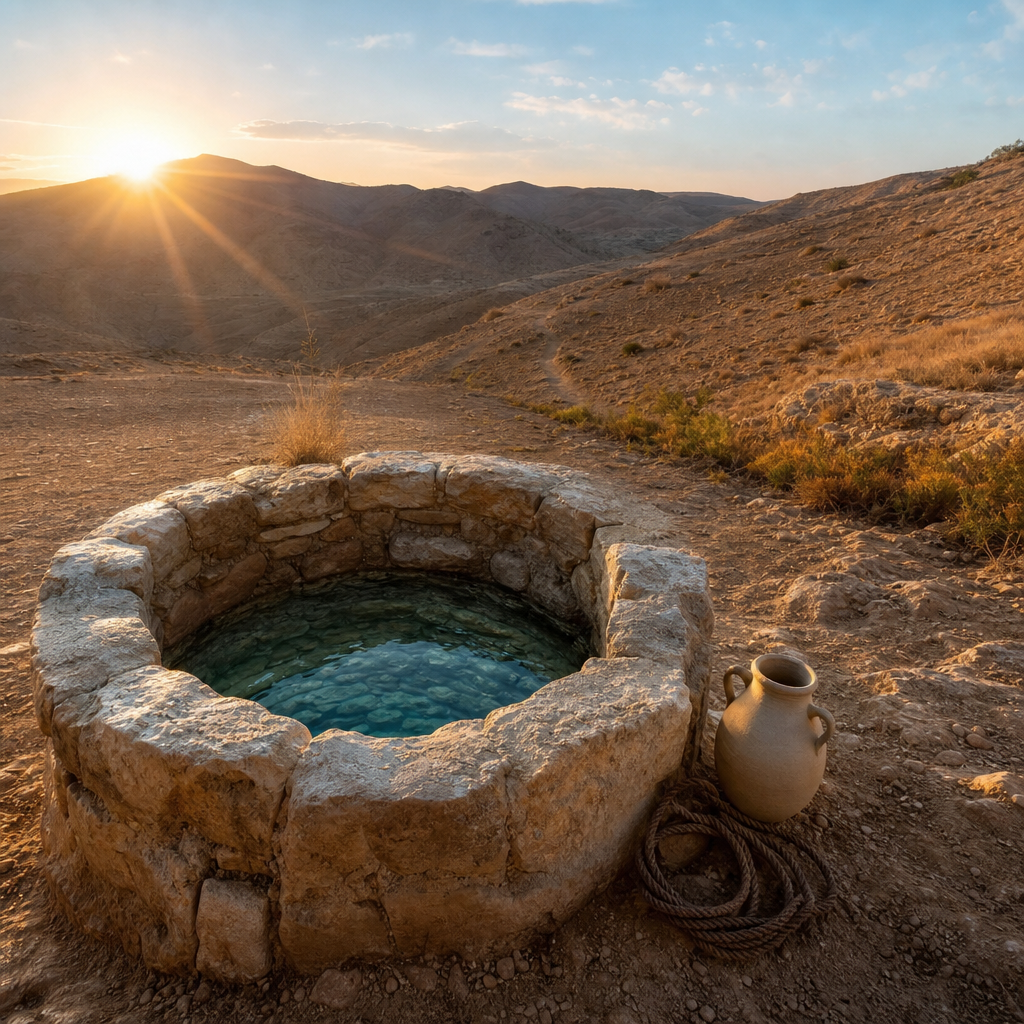
Living water scripture refers especially to Jesus’ promise in John 4:14 that whoever drinks the water He gives will never thirst, because it becomes “a spring of water welling up to eternal life.” Jesus, the Son of God who died and rose again, gives eternal life and the Holy Spirit to all who come to Him in faith.
Every human heart knows what it means to thirst—not only for physical water, but for peace, forgiveness, purpose, and life with God. In the Bible, water often points to the life only God can give, and in John 4 Jesus speaks directly to that deeper need when He tells the Samaritan woman, “If thou knewest the gift of God… he would have given thee living water” (John 4:10). This living water scripture is not a vague religious idea; it is a clear and gracious invitation from Jesus Christ, the Son of God, who gives eternal life to all who come to Him in faith.
In this article, we will look at what Jesus meant by “living water” in John 4, how John 7:37-39 connects this promise to the Holy Spirit, and how Revelation shows the final hope of the water of life flowing from God’s throne. We will also see why the Samaritan woman needed more than well water, how Jesus revealed Himself as the Messiah, and what this means for believers today. Above all, we will keep our eyes on Christ—crucified, risen, and Lord—because only He can satisfy the soul forever: “Whosoever drinketh of the water that I shall give him shall never thirst” (John 4:14).
What Does Living Water Scripture Mean in the Bible?
Why water is a powerful biblical picture of life
In the Bible, water often points to life, cleansing, refreshment, and God’s faithful provision. This makes the phrase living water scripture deeply meaningful. It is not only about physical water. It points to the life God gives to the soul.
From the first pages of Scripture, water is connected with God’s creative power. In Genesis, the Spirit of God was “hovering over the face of the waters” before God formed the world by His word (Genesis 1:2). Later, God provided water for Israel in the wilderness when His people were thirsty (Exodus 17:6). As a result, water became a strong biblical picture of God sustaining His people.
However, the Bible also uses thirst to describe a deeper spiritual need. Human beings need more than food and drink. We need God Himself. Psalm 42:1-2 says, “As the deer pants for the water brooks, so pants my soul for You, O God. My soul thirsts for God, for the living God.” This is a holy longing. It shows that the soul was made to be satisfied in the Lord.
Water is such a powerful biblical image because it speaks to needs every person understands:
- Life: Without water, physical life cannot continue. Likewise, without God, the soul remains spiritually dead.
- Cleansing: Water often points to purification, reminding us that sinners need God’s mercy and cleansing.
- Refreshment: Water restores the weary body. In the same way, God restores the weary heart.
- Provision: Water in dry places shows that the Lord provides where human strength fails.
- Hope: Streams and rivers in Scripture often picture blessing, fruitfulness, and renewed life.
Furthermore, the physical importance of water helps us understand the spiritual picture. The human body depends on water for survival and normal function [1]. In a similar way, the human soul depends on the Lord for true life. Jesus makes this clear when He offers living water that satisfies forever.
How living water points to Jesus Christ
Living water points directly to Jesus Christ. He is not merely a teacher using a beautiful metaphor. He is the Son of God, the promised Messiah, and the Savior who gives eternal life. The authority of His promise rests on who He is.
In John 4, Jesus speaks with a Samaritan woman at Jacob’s well. She came for ordinary water. However, Jesus used that moment to reveal her deeper need. He said, “If you knew the gift of God, and who it is who says to you, ‘Give Me a drink,’ you would have asked Him, and He would have given you living water” (John 4:10).
This means the living water is God’s gift through Christ. It cannot be earned. It cannot be bought. In addition, it cannot be found in religion without a living relationship with Jesus. The Samaritan woman needed more than a better life. She needed the Savior.
Jesus later revealed Himself plainly to her. When she spoke of the coming Messiah, Jesus said, “I who speak to you am He” (John 4:26). Therefore, the living water is inseparable from the identity of Jesus. He is the Messiah who came to seek and save the lost.
The whole message of living water rests on the gospel:
- Jesus is fully divine: He has authority to give eternal life because He is the Son of God (John 1:1, John 1:14).
- Jesus came to save sinners: He entered our broken world to rescue us from sin and death (Luke 19:10).
- Jesus died for our sins: His death on the cross paid the price sinners could never pay (1 Corinthians 15:3).
- Jesus rose again: His resurrection proves His victory over sin, death, and the grave (1 Corinthians 15:4).
- Jesus gives eternal life: All who believe in Him receive life that never ends (John 3:16).
As a result, living water is not a vague spiritual feeling. It is the saving life of God received through faith in Jesus Christ. Furthermore, Jesus connects this promise with the Holy Spirit, who dwells in believers and satisfies the soul.
Key verses to include: John 4:10, John 4:14, John 7:37-39
Several key passages help explain the meaning of living water in Scripture. These verses should be read together. Each one shows a different part of the same glorious truth.
| Scripture | What It Says | What It Teaches About Living Water |
|---|---|---|
| John 4:10 | Jesus says He would give “living water” to the one who asks Him. | Living water is the gift of God, given through Jesus Christ. |
| John 4:14 | Jesus says His water becomes “a fountain of water springing up into everlasting life.” | Living water satisfies the soul and leads to eternal life. |
| John 7:37-39 | Jesus invites the thirsty to come to Him and drink. John explains that He spoke of the Spirit. | Living water is connected to the Holy Spirit, whom believers receive through Christ. |
John 4:10 shows that living water begins with grace. Jesus says, “If you knew the gift of God…” This is important. Salvation is not first about human achievement. Instead, it is about God’s mercy. Jesus offers what sinners cannot produce for themselves.
John 4:14 shows the lasting power of Christ’s gift. Ordinary water must be drawn again and again. However, the water Jesus gives becomes a fountain within the believer. It springs up into everlasting life. This does not mean Christians never feel sorrow, weakness, or spiritual struggle. Rather, it means Christ gives a life that cannot be destroyed.
John 7:37-39 gives further clarity. Jesus cried out, “If anyone thirsts, let him come to Me and drink” (John 7:37). Then He said that rivers of living water would flow from the heart of the one who believes in Him (John 7:38). John explains, “But this He spoke concerning the Spirit” (John 7:39).
Therefore, the Bible’s teaching on living water can be summarized clearly:
- The thirsty person is the sinner who needs God.
- The source of living water is Jesus Christ.
- The gift is eternal life through faith in Him.
- The inner fountain is the work of the Holy Spirit.
- The result is a renewed life that glorifies God.
In short, living water scripture reveals the heart of the gospel. Jesus Christ, the crucified and risen Lord, gives eternal life to all who come to Him in faith. He alone satisfies the thirst of the soul.
What did Jesus mean by the living water?
Jesus offers more than physical refreshment
When Jesus spoke of living water, He was not only talking about water for the body. He was speaking about the deepest need of the human soul.
In John 4, Jesus met a Samaritan woman at Jacob’s well. She came to draw ordinary water. However, Jesus used that moment to reveal something far greater. He said, “If thou knewest the gift of God, and who it is that saith to thee, Give me to drink; thou wouldest have asked of him, and he would have given thee living water” (John 4:10).
This living water scripture shows that Jesus was offering a gift. It was not earned by religion, heritage, effort, or moral performance. Instead, it came from Him. Jesus Christ, the Son of God, was offering spiritual life to a thirsty soul.
- Physical water refreshes the body for a short time.
- Living water satisfies the soul through Jesus Christ.
- Well water must be drawn again and again.
- Christ’s gift gives eternal life that never runs dry.
Therefore, Jesus was lovingly showing the woman that her need was greater than thirst. She needed forgiveness, truth, and salvation. In the same way, every person needs more than temporary comfort. We need the life that only Christ can give.
Living water is eternal life through Christ
Jesus explained the meaning more clearly in John 4:14: “Whosoever drinketh of the water that I shall give him shall never thirst; but the water that I shall give him shall be in him a well of water springing up into everlasting life.”
Here, Jesus connects living water with everlasting life. This is the life God gives to sinners who trust in His Son. It is not a vague spiritual feeling. It is salvation through Jesus Christ, who died for our sins and rose again.
The Bible teaches that eternal life is found in Jesus alone. John 3:16 says that God gave His only begotten Son so that whoever believes in Him should not perish but have everlasting life. In addition, Jesus declared, “I am the way, the truth, and the life: no man cometh unto the Father, but by me” (John 14:6).
| What Jesus Offered | What It Means |
|---|---|
| Living water | Spiritual life given by Christ |
| Never thirsting again | A soul satisfied in God |
| A well within | God’s life at work in the believer |
| Everlasting life | Salvation through faith in Jesus Christ |
As a result, living water is not a ritual or a symbol detached from Christ. It is centered on Him. Jesus is the giver of eternal life because He is Lord, Savior, and God the Son. His cross and resurrection are the foundation of this promise.
The Holy Spirit satisfies the soul of the believer
Jesus also connected living water with the Holy Spirit. Later, in John 7:37-39, He cried out, “If any man thirst, let him come unto me, and drink.” Then Scripture explains that He spoke of the Spirit, whom believers would receive.
This helps us understand the promise more fully. The living water is eternal life through Christ, and it is experienced by the believer through the Holy Spirit. The Holy Spirit does not replace Jesus. Rather, He glorifies Christ and makes His life real in the believer’s heart.
- The Spirit brings new birth, as Jesus taught in John 3:5-8.
- The Spirit reminds believers of Christ’s truth, as Jesus promised in John 14:26.
- The Spirit bears witness to Jesus, as John 15:26 teaches.
- The Spirit strengthens believers to walk in faith, holiness, and love.
However, this satisfaction does not mean Christians never face sorrow, temptation, or hardship. Rather, it means Christ remains our true source in every season. The believer may suffer, yet still have hope. The believer may grieve, yet still be held by God.
In simple terms, Jesus meant this: come to Me, believe in Me, and receive the life only I can give. The living water is God’s gracious gift to thirsty sinners. It flows from Christ, is secured by His death and resurrection, and is poured into believers by the Holy Spirit.
What does John 4:14 say about living water?
John 4:14 explained in simple terms
John 4:14 says, “But whosoever drinketh of the water that I shall give him shall never thirst; but the water that I shall give him shall be in him a well of water springing up into everlasting life” (John 4:14).
In simple terms, Jesus is saying that He gives something no earthly water can provide. Physical water keeps the body alive for a short time. However, the “living water” Jesus gives brings eternal life to the soul.
This living water scripture points directly to the saving work of Jesus Christ. He is not offering a temporary feeling, a religious ritual, or human self-improvement. Instead, He is offering Himself as the source of life. As the Son of God, Jesus gives eternal life to all who believe in Him.
Jesus later said, “If any man thirst, let him come unto me, and drink” (John 7:37). John explains that Jesus was speaking of the Holy Spirit, whom believers would receive (John 7:39). Therefore, living water is closely connected to salvation, eternal life, and the Spirit of God dwelling in the believer.
| What Jesus Mentions | What It Means |
|---|---|
| “The water that I shall give” | Salvation is a gift from Jesus, not something we earn. |
| “Shall never thirst” | Christ satisfies the deepest need of the human heart. |
| “In him a well of water” | God’s life works within the believer by the Holy Spirit. |
| “Springing up into everlasting life” | The gift of Christ leads to eternal life with God. |
As a result, John 4:14 is not mainly about physical thirst. It is about the soul’s need for forgiveness, new life, and fellowship with God. Only Jesus can meet that need.
- Living water is given by Jesus. He alone has authority to give eternal life (John 10:28).
- Living water satisfies the soul. The world cannot provide what only Christ can give.
- Living water leads to everlasting life. This promise is rooted in the gospel of Jesus’ death and resurrection (1 Corinthians 15:3-4).
Why the Samaritan woman needed more than well water
The Samaritan woman came to Jacob’s well to draw ordinary water. However, Jesus knew her deeper thirst. She needed more than water for her body. She needed grace, truth, forgiveness, and eternal life.
John 4 shows that Jesus intentionally spoke with her. This matters because Jews and Samaritans had a long history of religious and social division. The New Testament notes this tension directly in John 4:9. For historical background, Samaritans were a distinct community connected to ancient Israel and Mount Gerizim worship traditions [2].
Yet Jesus crossed that barrier with compassion and holiness. He did not ignore her sin. However, He also did not treat her as beyond mercy. Instead, He lovingly exposed her need and offered her living water.
Her life showed the emptiness of trying to satisfy the soul apart from God. Jesus revealed that she had experienced broken relationships (John 4:16-18). Still, His purpose was not to shame her. His purpose was to save her.
- She had physical thirst. She came to the well for water.
- She had spiritual thirst. Her soul needed the life only God can give.
- She had religious questions. She asked about worship in John 4:20.
- She needed the Messiah. Jesus revealed Himself to her in John 4:26.
In addition, her story reminds every believer that outward needs often reveal deeper spiritual needs. People may seek comfort, success, relationships, or religion. However, the heart remains thirsty until it comes to Jesus Christ.
This is why the living water scripture in John 4 is so precious. Jesus does not merely improve the Samaritan woman’s circumstances. He offers her eternal life. Furthermore, He leads her into true worship, saying that true worshipers will worship the Father “in spirit and in truth” (John 4:23).
That same truth stands today. No person is too broken for Christ. No past is too stained for His grace. Because Jesus died for sinners and rose again, He can fully save all who come to Him in faith.
How Jesus reveals Himself as the Messiah in John 4
John 4 reaches its glorious center when the Samaritan woman speaks about the coming Messiah. She says, “I know that Messias cometh, which is called Christ” (John 4:25). Then Jesus answers, “I that speak unto thee am he” (John 4:26).
This is one of the clearest moments in the Gospels where Jesus directly reveals Himself as the Messiah. He is not merely a teacher, prophet, or moral example. He is the Christ, the promised Savior, the Son of God.
Throughout the Gospel of John, the Bible presents Jesus as divine. John begins by saying, “In the beginning was the Word, and the Word was with God, and the Word was God” (John 1:1). Then John says, “the Word was made flesh” (John 1:14). Therefore, when Jesus offers living water, He speaks with the authority of God Himself.
| John 4 Moment | What It Reveals About Jesus |
|---|---|
| Jesus asks for water | He is truly human and entered our daily world. |
| Jesus offers living water | He is the divine giver of eternal life. |
| Jesus knows her past | He sees the truth of every heart. |
| Jesus teaches true worship | He reveals how sinners may rightly come to God. |
| Jesus says He is the Messiah | He identifies Himself as the promised Christ. |
As a result, the Samaritan woman’s response changes. She leaves her waterpot and goes back to the city, saying, “Come, see a man, which told me all things that ever I did: is not this the Christ?” (John 4:29). Her testimony points others to Jesus.
Furthermore, many Samaritans believed because of her witness. Then, after hearing Jesus themselves, they said, “we know that this is indeed the Christ, the Saviour of the world” (John 4:42). This confirms the message of John 4: Jesus is not Savior for one nation only. He is the Savior of the world.
- Jesus reveals truth. He knows our sin and speaks with perfect wisdom.
- Jesus gives grace. He offers living water to undeserving sinners.
- Jesus fulfills Scripture. He is the promised Messiah.
- Jesus saves. His death and resurrection bring eternal life to all who believe.
Therefore, John 4:14 is more than a comforting image. It is a gospel promise from the Lord Jesus Christ. The living water is found in Him alone. Whoever drinks by faith will receive the life that springs up into everlasting life.
Where Is the Living Water Verse with the Samaritan Woman?
John 4 living water: the setting at Jacob’s well
The living water scripture with the Samaritan woman is found in John 4:1-42. The key verses are John 4:10 and John 4:14. In this passage, Jesus meets a Samaritan woman at Jacob’s well and offers her “living water.”
John writes, “Jesus answered her, If thou knewest the gift of God, and who it is that saith to thee, Give me to drink; thou wouldest have asked of him, and he would have given thee living water” (John 4:10).
Then Jesus explains further: “But whosoever drinketh of the water that I shall give him shall never thirst; but the water that I shall give him shall be in him a well of water springing up into everlasting life” (John 4:14).
The setting matters. Jesus was traveling through Samaria and stopped near the city of Sychar. John says the place was near the field Jacob gave to his son Joseph, and Jacob’s well was there (John 4:5-6). Many identify this location with the area near modern Nablus in the West Bank, where a traditional site of Jacob’s Well is still known today [3].
However, the main point is not the geography. The main point is the glory of Christ. Jesus, the eternal Son of God, sits beside a physical well and reveals Himself as the only One who can satisfy the human soul.
| Detail in John 4 | Why It Matters |
|---|---|
| Jesus was weary from His journey | This shows His real humanity. He truly came in the flesh. |
| Jesus offered living water | This shows His divine authority to give eternal life. |
| The woman came for well water | She needed something deeper than physical refreshment. |
| Jesus revealed Himself as Messiah | He openly declared that He is the Christ in John 4:26. |
Therefore, John 4 is not merely a story about kindness at a well. It is a revelation of who Jesus is. He is the promised Messiah, the Savior of the world, and the giver of eternal life.
Why Jesus spoke to the Samaritan woman
Jesus spoke to the Samaritan woman because He came to seek and save the lost (Luke 19:10). He did not avoid her because of her background, her ethnicity, her gender, or her past. Instead, He drew near with truth and grace.
At that time, Jews and Samaritans had deep religious and social hostility. John notes plainly, “For the Jews have no dealings with the Samaritans” (John 4:9). Yet Jesus crossed that barrier with holy purpose.
In addition, Jesus knew her life completely. He knew her sin, her shame, and her spiritual thirst. Still, He did not speak to crush her. He spoke to bring her to repentance, faith, and life.
- Jesus spoke to reveal her need. She needed more than water from Jacob’s well. She needed forgiveness and eternal life.
- Jesus spoke to reveal true worship. He taught that true worshipers worship the Father “in spirit and in truth” (John 4:23-24).
- Jesus spoke to reveal Himself. When she mentioned the coming Messiah, Jesus said, “I that speak unto thee am he” (John 4:26).
- Jesus spoke to show His saving mission. His grace was not limited to one nation or one social group.
However, we must not reduce this moment to a lesson about social kindness alone. It is far more than that. Jesus was revealing that salvation comes through Him. As He later declared, “I am the way, the truth, and the life: no man cometh unto the Father, but by me” (John 14:6).
This living water scripture also shows the compassion of Christ. He did not excuse the woman’s sin. Yet He lovingly exposed it so she could see her need for the Savior. That is how grace works. It tells the truth, and then it points us to Jesus.
What her testimony teaches believers today
After meeting Jesus, the Samaritan woman left her waterpot and went back to the city. She told the people, “Come, see a man, which told me all things that ever I did: is not this the Christ?” (John 4:29).
As a result, many Samaritans came to Jesus. John says, “And many of the Samaritans of that city believed on him for the saying of the woman” (John 4:39). Then, after hearing Jesus for themselves, they confessed, “This is indeed the Christ, the Saviour of the world” (John 4:42).
Her testimony teaches believers several important truths:
- A changed life points people to Jesus. She did not make herself the center. She said, “Come, see.”
- Simple testimony can be powerful. She shared what Jesus had done and invited others to meet Him.
- Jesus uses unlikely witnesses. Her past did not stop Christ from showing mercy and using her witness.
- True faith leads to proclamation. When the soul receives living water, it cannot remain silent.
- The goal of witness is Christ Himself. The people eventually believed because they heard Jesus’ word directly.
Furthermore, her story encourages every believer who feels disqualified. Jesus is not limited by your past. His grace is greater than sin. His blood cleanses all who come to Him in repentance and faith (1 John 1:7).
Most importantly, the Samaritan woman’s testimony points us to the true identity of Jesus. He is not merely a teacher, prophet, or moral example. He is the Christ, the Son of God, who died for our sins and rose again on the third day according to the Scriptures (1 Corinthians 15:3-4).
Therefore, the living water scripture in John 4 calls every reader to come to Jesus personally. Physical water can satisfy the body for a moment. However, only Jesus Christ can give eternal life, forgive sin, and satisfy the soul forever.
Where Does the Bible Say, “I Will Give You Living Water”?
John 4:10 and the gift of God
The clearest living water scripture begins with Jesus speaking to the Samaritan woman at Jacob’s well. She came for ordinary water. However, Jesus offered her something far greater: eternal life in Him.
Jesus said, “If you knew the gift of God, and who it is that is saying to you, ‘Give me a drink,’ you would have asked him, and he would have given you living water” (John 4:10). [4]
This verse teaches several beautiful truths:
- Living water is a gift. Jesus calls it “the gift of God.” It is not earned by religious works.
- Living water comes from Jesus. He says He is the One who gives it.
- Living water must be received by faith. Jesus says, “you would have asked him.”
- Living water satisfies the soul. It points to the eternal life only Christ can give.
In other words, Jesus was not only talking about water from a well. He was revealing Himself as the Savior. He is the Son of God, the promised Messiah, and the source of eternal life.
John 4 also shows the compassion of Christ. The Samaritan woman was spiritually thirsty. She had sin, shame, confusion, and brokenness. Yet Jesus did not turn away from her. Instead, He came near, spoke truth, and offered grace.
As a result, this passage gives hope to every sinner. No one is too broken for Jesus. No one is too far from His mercy. He died for sinners, rose again in victory, and gives eternal life to all who believe in Him.
| Phrase in John 4:10 | Meaning |
|---|---|
| “The gift of God” | Salvation is given by grace, not earned by human effort. |
| “Who it is” | The woman needed to recognize Jesus as the Messiah. |
| “You would have asked” | Faith responds to Jesus by coming to Him in need. |
| “He would have given you living water” | Jesus gives eternal life and spiritual satisfaction. |
Revelation 21:6 and the water of life
The promise of living water does not end in John 4. It appears again near the end of the Bible. In Revelation 21:6, the risen and reigning Lord declares, “To the thirsty I will give from the spring of the water of life without payment”. [5]
This verse is powerful because it comes in the setting of God’s final victory. Revelation 21 describes the new heaven and new earth. God will dwell with His people. Death, mourning, crying, and pain will be no more.
Therefore, the “water of life” points to the fullness of salvation in Christ. It is life that begins now by faith. In addition, it will be enjoyed forever in God’s presence.
Notice the words “without payment.” This does not mean salvation was cheap. It means Jesus paid the price completely. He shed His blood on the cross. He rose from the dead. Because of Him, the thirsty are invited to receive life freely.
- The thirsty are those who know they need God’s mercy.
- The spring shows that God is the endless source of life.
- The water of life points to eternal life in Christ.
- Without payment reminds us that salvation is by grace.
Furthermore, Revelation 21:6 identifies the One speaking as “the Alpha and the Omega, the beginning and the end.” This is a divine title. It shows the eternal authority of the Lord. Jesus is not merely a teacher or prophet. He is Lord, Savior, and King.
Revelation 22:17 and the invitation to come to Christ
Revelation 22:17 gives one of the most tender invitations in all of Scripture: “Let the one who is thirsty come; let the one who desires take the water of life without price”. [6]
This verse is not cold or distant. Instead, it is personal and urgent. The Spirit and the Bride say, “Come.” The Bible ends with an open invitation to receive life from God through Christ.
This invitation is for every person who knows their soul is thirsty. Some thirst for forgiveness. Others thirst for peace, hope, truth, or freedom from sin. However, the deepest thirst of the human heart is for God Himself.
Jesus alone answers that thirst. He does not offer temporary comfort only. He offers Himself. He gives eternal life, forgiveness of sins, and the indwelling presence of the Holy Spirit.
- Come to Jesus if you are burdened by guilt.
- Come to Jesus if you are tired of empty promises.
- Come to Jesus if you are searching for truth.
- Come to Jesus if you know you need salvation.
The message of living water is consistent from John to Revelation. Jesus gives what the world cannot give. He gives life with God now and forever.
| Scripture | What It Says About Living Water | Main Hope |
|---|---|---|
| John 4:10 | Jesus offers living water as the gift of God. | Come to Christ in faith. |
| Revelation 21:6 | God gives the water of life freely to the thirsty. | Salvation is by grace. |
| Revelation 22:17 | The thirsty are invited to take the water of life. | The gospel invitation is open. |
So, where does the Bible say, “I will give you living water”? The exact wording is commonly used to summarize Jesus’ promise in John 4:10. The same truth is also proclaimed in Revelation 21:6 and Revelation 22:17. Together, these passages declare one glorious message: Jesus Christ gives eternal life to all who come to Him in faith.
Is “I Am the Living Water” a Bible Verse?
How the Phrase Summarizes Jesus’ Teaching
The exact phrase “I am the living water” does not appear word-for-word in most Bible translations. However, it is a faithful summary of what Jesus teaches in the living water scripture passages, especially in John 4 and John 7.
Jesus does say, “I am” in many powerful ways throughout the Gospel of John. For example, He says, “I am the bread of life” (John 6:35), “I am the light of the world” (John 8:12), and “I am the resurrection and the life” (John 11:25). These statements reveal His divine identity and saving mission.
So, while “I am the living water” is not a direct Bible quote, it expresses a biblical truth. Jesus is the One who gives living water. He is the source of eternal life. He alone satisfies the thirsty soul.
- Jesus gives living water: “He would have given you living water” (John 4:10).
- Jesus satisfies forever: “Whoever drinks of the water that I shall give him will never thirst” (John 4:14).
- Jesus invites the thirsty to come: “If anyone thirsts, let him come to Me and drink” (John 7:37).
- Jesus gives the Holy Spirit: John explains that Jesus was speaking about the Spirit (John 7:39).
Therefore, Christians can say that Jesus is the source of living water. Yet, when quoting Scripture, it is best to use the Bible’s exact wording. This honors the authority of God’s Word and helps avoid confusion.
Why John 4:14 and John 7:37-39 Are Often Connected to This Phrase
John 4:14 and John 7:37-39 are often connected because both passages describe the spiritual life Jesus gives. In both places, Jesus speaks to people who need more than earthly water. They need salvation, forgiveness, and the life of God within them.
| Scripture | What Jesus Says | What It Means |
|---|---|---|
| John 4:14 | “The water that I shall give him will become in him a fountain of water springing up into everlasting life.” | Jesus gives eternal life to those who believe in Him. |
| John 7:37 | “If anyone thirsts, let him come to Me and drink.” | Jesus invites spiritually thirsty people to come to Him. |
| John 7:38-39 | “Out of his heart will flow rivers of living water.” John says this refers to the Spirit. | The Holy Spirit dwells in believers and produces new life. |
In John 4, Jesus speaks to the Samaritan woman at Jacob’s well. She came for physical water. However, Jesus offered her something greater. He offered living water that leads to everlasting life.
In John 7, Jesus speaks during a public feast. He cries out, “If anyone thirsts, let him come to Me and drink” (John 7:37). Then Scripture explains, “This He spoke concerning the Spirit” (John 7:39). As a result, we learn that living water is closely connected to the gift of the Holy Spirit.
These passages belong together because they show the fullness of Christ’s promise:
- Jesus is the giver: Living water comes from Him, not from human effort.
- Eternal life is the gift: The water He gives springs up into everlasting life.
- The Holy Spirit is involved: The Spirit lives in believers and bears witness to Christ.
- The invitation is open: Jesus says, “If anyone thirsts,” showing His mercy toward all who come.
This living water is not a symbol of religion without Christ. It is not merely emotional comfort. Rather, it is the saving life of God given through Jesus Christ, who died for our sins and rose again.
How to Explain This Clearly Using Scripture
A simple and faithful explanation is this: “I am the living water” is not an exact Bible verse, but it is a biblical summary of Jesus’ teaching. Jesus gives living water, which means eternal life through Him and the Holy Spirit’s life within believers.”
To explain it clearly, begin with the words of Jesus. Then connect the verses in their proper order.
-
Start with John 4:10.
Jesus tells the Samaritan woman, “If you knew the gift of God, and who it is who says to you, ‘Give Me a drink,’ you would have asked Him, and He would have given you living water” (John 4:10).
-
Explain John 4:14.
Jesus says that the water He gives becomes “a fountain of water springing up into everlasting life” (John 4:14). Therefore, living water points to eternal life from Christ.
-
Connect John 7:37-39.
Jesus invites the thirsty to come to Him and drink. Then John explains that Jesus was speaking about the Holy Spirit (John 7:37-39).
-
Keep Jesus at the center.
The point is not the phrase itself. The point is the Savior. Jesus Christ is Lord, the Son of God, crucified and risen for sinners.
Here is a clear way to say it:
“The Bible may not say the exact words, ‘I am the living water,’ but Jesus clearly teaches that He gives living water. In John 4:14, this water is eternal life. In John 7:37-39, it is connected to the Holy Spirit. So the phrase is a good summary, as long as we understand it through Scripture.”
This matters because Christians are called to handle God’s Word with care. The Bible is our final authority. Therefore, we should distinguish between an exact quotation and a faithful summary.
- Exact quote: “Whoever drinks of the water that I shall give him will never thirst” (John 4:14).
- Faithful summary: Jesus is the source of living water.
- Core truth: Only Jesus gives eternal life and the Holy Spirit to those who believe.
Ultimately, the living water scripture points us to the glory of Christ. He is not merely a teacher using a helpful image. He is the Son of God, the promised Messiah, and the risen Lord. All who come to Him in faith receive the life that this world can never give.
What Are the Benefits of the Living Water in the Bible?
eternal life through faith in Jesus Christ
The first and greatest benefit of the living water is eternal life through faith in Jesus Christ. In John 4:14, Jesus says, “Whoever drinks of the water that I will give him will never be thirsty again.” He then adds that this water becomes “a spring of water welling up to eternal life.”
This is the heart of the living water scripture. Jesus is not offering a temporary blessing. He is offering salvation. He is offering life with God that begins now and continues forever.
The Bible teaches that eternal life is not earned by religious effort. Rather, it is received by faith in Christ. Jesus said, “For God so loved the world, that he gave his only Son, that whoever believes in him should not perish but have eternal life” (John 3:16).
Therefore, the living water points us directly to the gospel:
- Jesus Christ is the Son of God. He is not merely a teacher or prophet. He is Lord (John 1:1, John 20:28).
- Jesus died for sinners. He gave His life on the cross to pay the penalty for sin (Romans 5:8).
- Jesus rose from the dead. His resurrection proves His victory over sin and death (1 Corinthians 15:3-4).
- Jesus gives eternal life to all who believe. Salvation is a gift of grace, received through faith (Ephesians 2:8-9).
As a result, the living water is not a vague spiritual feeling. It is the life of God given through Jesus Christ. Whoever comes to Him in faith is forgiven, made new, and brought into everlasting fellowship with God.
Spiritual satisfaction that the world cannot give
Another benefit of the living water is deep spiritual satisfaction. The Samaritan woman came to the well for ordinary water. However, Jesus exposed a deeper thirst in her soul. She needed more than physical refreshment. She needed the Savior.
This is true for every person. The world offers many things that promise satisfaction. Yet none of them can heal the soul or remove sin. Money, relationships, success, pleasure, and human approval cannot give lasting peace with God.
Jesus alone satisfies the deepest thirst of the human heart. In John 6:35, He says, “I am the bread of life; whoever comes to me shall not hunger, and whoever believes in me shall never thirst.”
In other words, the living water satisfies because it brings us to Christ Himself. He gives what the world cannot provide:
- Forgiveness for sin through His shed blood (Ephesians 1:7).
- Peace with God through faith in Him (Romans 5:1).
- Rest for the weary soul through His gentle and gracious care (Matthew 11:28-30).
- Hope beyond suffering because He has overcome the world (John 16:33).
- Joy that remains because it is rooted in Him, not in changing circumstances (John 15:11).
Furthermore, this satisfaction does not mean believers never face hardship. Christians still experience sorrow, temptation, and trials. However, in Christ, they have a fountain that does not run dry. His grace is sufficient, and His presence is real.
| What the World Offers | What Jesus Gives |
|---|---|
| Temporary pleasure | Lasting joy in Him |
| Approval from people | Acceptance by God through grace |
| Temporary comfort | Peace that surpasses understanding |
| False identity | New life as a child of God |
| Hope that fades | Eternal hope through the risen Christ |
The indwelling presence of the Holy Spirit
The living water also points to the gift of the Holy Spirit. In John 7:37-39, Jesus says, “If anyone thirsts, let him come to me and drink.” Then Scripture explains that He was speaking about the Spirit, whom believers would receive.
This is a beautiful truth. When a person trusts in Jesus Christ, God does not merely improve that person from the outside. Instead, the Holy Spirit comes to dwell within the believer.
The Holy Spirit is not an impersonal force. He is God. He convicts, teaches, comforts, strengthens, and helps believers follow Christ. Jesus promised His disciples, “I will ask the Father, and he will give you another Helper, to be with you forever” (John 14:16).
Because of the Holy Spirit, the believer is never spiritually abandoned. In addition, the Spirit applies the work of Christ to the heart and helps the Christian walk in obedience.
The indwelling presence of the Holy Spirit brings many blessings:
- Assurance of belonging to God because the Spirit bears witness with our spirit (Romans 8:16).
- Power to resist sin and walk in newness of life (Romans 8:13).
- Understanding of God’s Word as the Spirit leads believers into truth (John 16:13).
- Spiritual fruit such as love, joy, peace, patience, and self-control (Galatians 5:22-23).
- Comfort in suffering because God is present with His people (2 Corinthians 1:3-4).
Therefore, the living water is not only about a future promise. It is also about God’s present work in His people. The Holy Spirit makes the life of Christ real in the believer day by day.
A renewed life that bears witness to others
The living water also produces a renewed life. In John 4, the Samaritan woman came to the well burdened and spiritually thirsty. After meeting Jesus, she left her water jar and went into the town to tell others about Him (John 4:28-29).
Her story shows what living water does. It changes the heart, and then it moves the believer to witness. When someone truly receives Christ, that person begins to see life differently. Sin is no longer cherished. Shame is no longer the final word. Jesus becomes the treasure.
This renewed life is not self-made. It is the result of grace. Second Corinthians 5:17 says, “If anyone is in Christ, he is a new creation. The old has passed away; behold, the new has come.”
As a result, believers become living witnesses to the mercy and power of Jesus Christ. Their words and actions begin to point others to Him.
- A renewed heart loves Christ and desires to obey His Word.
- A renewed mind learns to think according to Scripture.
- A renewed mouth speaks of the grace and truth of Jesus.
- A renewed life bears fruit that glorifies God.
- A renewed witness invites others to come to Christ and receive life.
Furthermore, Jesus said that those who believe in Him would have “rivers of living water” flowing from their hearts (John 7:38). This means the life He gives is not meant to remain hidden. It overflows in worship, obedience, love, and gospel witness.
The benefits of the living water are therefore rich and eternal. Through Jesus Christ, believers receive eternal life, true satisfaction, the Holy Spirit, and a renewed life that points others to the Savior. This is why the invitation of Scripture is so urgent and gracious: “Let the one who is thirsty come; let the one who desires take the water of life without price” (Revelation 22:17).
Are There Streams of Living Water in Psalms?
Psalm 1:3 and the tree planted by streams of water
Yes, the Psalms do speak of streams of water. While the phrase “living water” is made clearest in the words of Jesus, the Psalms prepare us to understand it. They show us the blessed life of a person rooted in God.
Psalm 1 describes the righteous person this way:
“He is like a tree planted by streams of water that yields its fruit in its season, and its leaf does not wither.” Psalm 1:3
This is a beautiful picture of spiritual life. A tree planted near water does not depend on dry ground for survival. Its roots are nourished by a steady source. In the same way, the believer lives by the Word of God and the grace of God.
Psalm 1 begins by contrasting two paths:
- The way of the righteous: delighting in the law of the Lord and meditating on it day and night (Psalm 1:2).
- The way of the wicked: rejecting God’s wisdom and becoming like chaff blown away by the wind (Psalm 1:4).
Therefore, the streams in Psalm 1 point to more than natural blessing. They show the spiritual stability God gives to those who trust Him. His Word nourishes the soul. His presence strengthens the heart. His grace produces lasting fruit.
However, Psalm 1 also points us forward. No believer becomes fruitful by self-effort alone. We need the life that comes from God. In the fullness of Scripture, that life is found in Jesus Christ, the Son of God, who died for sinners and rose again in victory.
Jesus said, “Whoever drinks of the water that I will give him will never be thirsty again” (John 4:14). As a result, Christians can read Psalm 1 with deeper joy. The blessed person is not merely morally improved. He is spiritually alive because God has given him life.
| Psalm 1 Image | Spiritual Meaning | Fulfilled in Christ |
|---|---|---|
| Tree planted by streams | A life rooted in God’s Word | Jesus gives eternal life and true stability |
| Fruit in season | God produces righteousness in His people | The Holy Spirit bears fruit in believers |
| Leaf that does not wither | Enduring strength through God’s presence | Christ sustains His people forever |
Psalm 42:1-2 and thirsting for the living God
Psalm 42 gives another powerful picture of spiritual thirst. It says:
“As a deer pants for flowing streams, so pants my soul for you, O God. My soul thirsts for God, for the living God.” Psalm 42:1-2
Here, the psalmist is not simply asking for relief from trouble. He is longing for God Himself. His soul is dry, weary, and desperate for the presence of the Lord.
This matters deeply for understanding living water scripture. The Bible does not treat human beings as only physical creatures. We have souls. We were made for fellowship with God. Therefore, no earthly pleasure can fully satisfy us.
Psalm 42 teaches several important truths:
- Spiritual thirst is real. The heart aches when it is distant from God.
- God is the true source of life. The psalmist thirsts for “the living God,” not empty religion.
- God welcomes honest prayer. The psalmist brings his sorrow and longing before the Lord.
- Hope belongs to those who seek Him. The psalm repeats, “Hope in God” (Psalm 42:5, 11).
In addition, Psalm 42 helps us understand why Jesus’ words in John 4 are so gracious. When Jesus offered living water to the Samaritan woman, He was offering Himself as the answer to the deepest thirst of the human soul.
She had come to draw water from a well. However, Jesus exposed a deeper need. She needed forgiveness. She needed truth. She needed the Messiah. Then Jesus revealed Himself to her, saying, “I who speak to you am he” (John 4:26).
This is the mercy of Christ. He does not merely diagnose our thirst. He satisfies it. He does not merely point toward life. He is the giver of life. Because He died and rose again, all who believe in Him receive eternal life (John 3:16).
How the Psalms prepare the heart to understand Jesus’ promise
The Psalms help us feel the weight of Jesus’ promise. They teach us what it means to be thirsty, rooted, weary, restored, and satisfied in God. Therefore, when Jesus speaks of living water, He is not introducing a random image. He is fulfilling a theme already woven through Scripture.
Throughout the Bible, water often points to life, cleansing, refreshment, and God’s provision. The Psalms especially train the heart to desire the Lord above all else.
- Psalm 1:3 shows the blessed person nourished by streams of water.
- Psalm 23:2 says the Lord leads His people beside still waters.
- Psalm 36:8-9 speaks of drinking from the river of God’s delights, because with Him is “the fountain of life.”
- Psalm 42:1-2 describes the soul thirsting for the living God.
- Psalm 63:1 cries, “My soul thirsts for you,” in a dry and weary land.
Then, in the Gospel of John, Jesus brings this longing into full light. He says:
“If anyone thirsts, let him come to me and drink.” John 7:37
John then explains that Jesus was speaking about the Holy Spirit, whom believers would receive (John 7:39). This means the living water is not a vague feeling or human inspiration. It is the life-giving work of God through Christ and by the Holy Spirit.
As a result, the Psalms and the Gospel of John belong together. The Psalms awaken the thirst. Jesus satisfies it. The Psalms show the longing heart. Jesus gives the promised water of eternal life.
| Psalm Theme | Human Need | Jesus’ Fulfillment |
|---|---|---|
| Streams of water | Stability and nourishment | Jesus gives life that does not run dry |
| Thirst for God | Deep spiritual longing | Jesus invites the thirsty to come to Him |
| Fountain of life | True satisfaction | Jesus gives eternal life through faith |
| Rest beside waters | Peace and restoration | Jesus is the Good Shepherd who restores His people |
Therefore, the answer is yes: the Psalms contain streams, thirst, fountains, and rivers that point us toward the fuller promise of living water in Christ. They show that the soul was made for God. They also show that only God can satisfy it.
For Christians, this is not only poetry. It is truth grounded in the authority of Scripture. Jesus Christ is Lord, the eternal Son of God. He gave His life on the cross for sinners, rose from the dead, and now gives living water to all who come to Him in faith.
How Does Revelation Describe the Living Water?

Revelation brings the theme of living water scripture to its glorious fulfillment. In John 4, Jesus promised living water to a thirsty soul. In Revelation, that promise is seen in its eternal fullness among the redeemed people of God.
Importantly, Revelation does not present living water as a vague spiritual idea. Rather, it shows that everlasting life flows from God Himself. It also shows that Jesus Christ, the Lamb who was slain and risen, is the One who leads His people into this eternal satisfaction.
Revelation 7:17 and the Lamb Leading His People
Revelation 7:17 says, “For the Lamb which is in the midst of the throne shall feed them, and shall lead them unto living fountains of waters” (Revelation 7:17).
This verse is deeply comforting. The “Lamb” is Jesus Christ. He is called the Lamb because He gave Himself as the perfect sacrifice for sinners. John the Baptist also declared, “Behold the Lamb of God, which taketh away the sin of the world” (John 1:29).
Therefore, Revelation 7:17 shows us several beautiful truths:
- Jesus is at the center of the throne. He is not a created helper. He is Lord, Savior, and King.
- Jesus shepherds His people. He does not abandon those He saves.
- Jesus leads believers to living fountains of waters. This points to eternal life, comfort, and full satisfaction in God.
- God wipes away every tear. Revelation 7:17 ends with the promise that God will remove sorrow from His people.
As a result, the living water in Revelation is not only about life continuing forever. It is about life made whole in the presence of Christ. The believer will no longer thirst for peace, forgiveness, hope, or joy. In Christ, every holy longing will be satisfied.
Revelation 21:6 and the Spring of the Water of Life
Revelation 21:6 says, “I am Alpha and Omega, the beginning and the end. I will give unto him that is athirst of the fountain of the water of life freely” (Revelation 21:6).
This verse echoes the invitation of Jesus in John 4. The Samaritan woman came to a well for physical water. However, Jesus offered her a gift far greater. He offered water that becomes “a well of water springing up into everlasting life” (John 4:14).
In Revelation 21:6, the promise is even clearer. God gives the water of life freely. This matters because salvation cannot be earned. It is not purchased by good works, religious effort, or personal merit. It is the gift of God through Jesus Christ.
The Bible teaches this same truth in Ephesians 2:8-9: “For by grace are ye saved through faith; and that not of yourselves: it is the gift of God: not of works”.
Revelation 21:6 teaches three essential truths about the water of life:
- It comes from God. He is the source of eternal life.
- It is given to the thirsty. Those who know their need are invited to come.
- It is free. Jesus paid the cost through His death and resurrection.
Furthermore, the title “Alpha and Omega” affirms God’s eternal authority. Jesus also uses this divine title in Revelation 22:13, declaring, “I am Alpha and Omega, the beginning and the end, the first and the last.” This confirms the majesty and divinity of Christ.
Revelation 22:1-2 and the River of Life from God’s Throne
Revelation 22:1-2 gives one of the most breathtaking pictures in all of Scripture. John writes that he saw “a pure river of water of life, clear as crystal, proceeding out of the throne of God and of the Lamb” (Revelation 22:1).
This river flows from the throne of God and of the Lamb. Therefore, the source of eternal life is not human wisdom, worldly religion, or earthly power. The source is God Himself, revealed through Jesus Christ.
In addition, Revelation 22:2 describes the tree of life beside the river. This points back to Eden in Genesis. Humanity lost access to the tree of life because of sin. However, through Jesus Christ, God restores what sin ruined.
The river of life shows the complete victory of Christ:
- Sin is defeated. Jesus died for sinners and rose again in victory.
- Death is overcome. Eternal life belongs to all who trust in Christ.
- God’s people are restored. The curse is removed, as Revelation 22:3 declares.
- Fellowship with God is complete. His servants will see His face, according to Revelation 22:4.
So, the living water in Revelation is the final answer to the thirst of the human soul. Every person thirsts for life, meaning, forgiveness, and hope. Yet only Jesus can satisfy that thirst forever.
| Revelation Passage | Description of Living Water | What It Teaches About Jesus |
|---|---|---|
| Revelation 7:17 | The Lamb leads His people to living fountains of waters. | Jesus is the risen Lamb and faithful Shepherd. |
| Revelation 21:6 | God gives the water of life freely to the thirsty. | Jesus gives salvation by grace, not by human effort. |
| Revelation 22:1-2 | The river of life flows from the throne of God and of the Lamb. | Jesus reigns with divine authority and gives eternal life. |
Together, these passages show that the living water promised by Jesus in John 4 reaches its fullness in the new creation. The same Savior who met the Samaritan woman at the well will one day bring His people into perfect joy before His throne.
Therefore, Revelation calls every thirsty soul to look to Christ. He is the crucified and risen Lord. He is the Lamb on the throne. He is the giver of the water of life.
How Can Christians Receive and Share the Living Water Today?
Come to Jesus in repentance and faith
The first way to receive the living water is simple and serious: come to Jesus. He is not offering a religious habit only. He is offering Himself. In John 7:37, Jesus said, “If anyone thirsts, let him come to me and drink.” This invitation is personal, gracious, and urgent.
Repentance means turning from sin and turning to God. Faith means trusting Jesus Christ as Lord and Savior. Therefore, receiving the living water is not about earning salvation. It is about receiving the gift of God through Christ.
- Come honestly: Bring your sin, need, shame, and spiritual thirst to Jesus.
- Come humbly: Admit that you cannot save yourself or satisfy your own soul.
- Come believing: Trust that Jesus is the Son of God, crucified and risen for sinners.
- Come personally: Do not only admire Jesus from a distance. Receive Him by faith.
This is the heart of living water scripture. Jesus gives eternal life to those who believe in Him. As He told the Samaritan woman, “Whoever drinks of the water that I will give him will never be thirsty again” (John 4:14).
However, this does not mean Christians never face sorrow, temptation, or weakness. Rather, it means the deepest thirst of the soul is met in Christ. He gives forgiveness, new life, and the Holy Spirit to all who belong to Him.
Trust His death and resurrection for salvation
The living water flows from the saving work of Jesus Christ. He is not merely a teacher of spiritual ideas. He is God the Son, who came in the flesh, died for our sins, and rose again in victory.
The Bible says, “Christ died for our sins in accordance with the Scriptures,” and “he was raised on the third day” (1 Corinthians 15:3-4). Therefore, Christians receive the living water by trusting in what Jesus has done, not in their own goodness.
| What Jesus Has Done | Why It Matters for the Believer |
|---|---|
| He lived without sin | He is the perfect Savior who fulfilled righteousness. |
| He died on the cross | He paid the penalty for sin and shed His blood for our forgiveness. |
| He rose from the dead | He conquered death and gives eternal life to all who believe. |
| He gives the Holy Spirit | He satisfies, strengthens, and leads His people from within. |
In addition, Romans 10:9 teaches, “If you confess with your mouth that Jesus is Lord and believe in your heart that God raised him from the dead, you will be saved.” This is not empty religion. It is the living hope of every Christian.
As a result, the believer can rest in Christ’s finished work. The living water is not earned by performance. It is received through faith in the crucified and risen Lord.
Abide in His Word and walk by the Spirit
After receiving the living water, Christians are called to keep drinking deeply from Christ. We do this by abiding in His Word and walking by the Holy Spirit. Jesus said, “If you abide in my word, you are truly my disciples” (John 8:31).
To abide means to remain, continue, and depend on Jesus daily. Therefore, the Christian life is not a one-time emotional moment. It is a steady life of communion with Christ.
- Read Scripture daily: God’s Word renews the mind and reveals Christ clearly.
- Pray with honesty: Speak to the Lord with reverence, trust, and dependence.
- Confess sin quickly: Do not hide from God. Return to Him in humility.
- Obey Jesus faithfully: Love for Christ is shown through obedience to His commands.
- Depend on the Holy Spirit: The Spirit strengthens believers to live for God.
Furthermore, John 7:38-39 connects rivers of living water with the Holy Spirit. Jesus said that those who believe in Him would have “rivers of living water” flowing from within them. John then explains, “Now this he said about the Spirit” (John 7:39).
This means the Christian life is not lived by human strength alone. The Holy Spirit indwells believers, points them to Christ, and produces spiritual fruit. Galatians 5:22-23 describes this fruit as love, joy, peace, patience, kindness, goodness, faithfulness, gentleness, and self-control.
However, believers must not grieve the Spirit or ignore Scripture. God’s Word and God’s Spirit work together. The Spirit never leads Christians away from the Bible. Instead, He helps them understand, believe, and obey the truth.
Share the gospel as a witness of Christ’s grace
Living water is not meant to be hidden. When Jesus saved the Samaritan woman, she went back to her town and told others about Him. Her testimony pointed people to Christ, and many came to hear Him for themselves (John 4:28-30, John 4:39-42).
Likewise, Christians today are called to share the gospel with humility and courage. We do not offer ourselves as the answer. We point people to Jesus, the only Savior.
- Tell what Jesus has done: Share His death, resurrection, mercy, and power to save.
- Use Scripture: Let the Bible speak with authority, because God’s Word is true.
- Speak with compassion: Remember that thirsty souls need grace, not pride.
- Invite people to Christ: Call them to repent, believe, and receive eternal life.
- Live as a witness: A changed life can open doors for gospel conversations.
In addition, Christians should be ready to answer questions with gentleness and respect. First Peter 3:15 says to honor Christ the Lord as holy and to be prepared to give a reason for the hope within us. Therefore, our witness should be both clear and loving.
Here is a simple way to share the message of living water:
- Explain the thirst: Every person needs forgiveness, life, and peace with God.
- Point to Jesus: He is the Son of God who came to save sinners.
- Proclaim the cross: Jesus died for sin and rose again from the dead.
- Call for response: Invite the person to repent and trust Christ.
- Encourage ongoing faith: Urge them to read Scripture, pray, and follow Jesus.
Ultimately, Christians receive and share the living water by staying close to Jesus. He is the source, the Savior, and the Lord. His grace satisfies the soul, and His gospel gives hope to the world.
Frequently Asked Questions
What did Jesus mean by the living water?
When Jesus spoke of living water, He was speaking of the eternal life and spiritual satisfaction that only He can give. In John 4:10, Jesus told the Samaritan woman, “If thou knewest the gift of God… he would have given thee living water.” This was not ordinary water from Jacob’s well. Instead, Jesus was revealing Himself as the Savior who gives life to thirsty souls.
In the Bible, water often points to life, cleansing, and refreshment. However, Jesus goes deeper than physical need. He addresses the deepest thirst of the human heart: the need to be forgiven, restored, and made alive to God.
- Living water is God’s gift. Jesus said it is given, not earned (John 4:10).
- Living water satisfies the soul. Jesus said those who drink will never thirst in the same way again (John 4:14).
- Living water points to the Holy Spirit. John 7:37-39 connects rivers of living water with the Spirit given to believers.
- Living water comes through Christ alone. Jesus is the Son of God, crucified and risen, and salvation is found in Him (John 14:6; Acts 4:12).
Therefore, the meaning of living water scripture is centered on Jesus Christ. He gives eternal life to all who come to Him in repentance and faith.
What does John 4:14 say about living water?
John 4:14 says, “But whosoever drinketh of the water that I shall give him shall never thirst; but the water that I shall give him shall be in him a well of water springing up into everlasting life.”
This verse teaches that Jesus gives a life that cannot be produced by the world. Physical water satisfies for a moment. However, the living water Jesus gives becomes a lasting spring within the believer.
| Phrase in John 4:14 | Meaning |
|---|---|
| “The water that I shall give him” | Salvation is a gift from Jesus, not a reward for human effort. |
| “Shall never thirst” | Christ satisfies the deepest need of the soul. |
| “A well of water” | The life Jesus gives remains within the believer. |
| “Springing up into everlasting life” | The gift of Christ leads to eternal life with God. |
As a result, John 4:14 is one of the clearest living water scriptures in the Bible. It shows that Jesus does not merely improve life. He gives new life.
What is Ephesians 3:19?
Ephesians 3:19 says, “And to know the love of Christ, which passeth knowledge, that ye might be filled with all the fulness of God.”
This verse is not directly about living water. However, it beautifully supports the same truth. The soul that comes to Jesus is not left empty. Instead, the believer is filled with the love, presence, and fullness of God through Christ.
Paul is praying that Christians would understand the love of Jesus more deeply. Yet he also says this love “passeth knowledge.” In other words, Christ’s love is greater than we can fully measure. Still, by faith, we can truly know it.
- Christ’s love is personal. He loved sinners enough to die for them (Romans 5:8).
- Christ’s love is sacrificial. He gave Himself on the cross for our salvation (Galatians 2:20).
- Christ’s love is victorious. He rose again, proving His power over sin and death (1 Corinthians 15:3-4).
- Christ’s love is satisfying. Those who belong to Him are filled with the fullness of God (Ephesians 3:19).
Therefore, Ephesians 3:19 helps us understand what the living water produces in the heart. It fills believers with the love and life of God through Jesus Christ.
What is Proverbs 14:23 saying?
Proverbs 14:23 says, “In all labour there is profit: but the talk of the lips tendeth only to penury.”
This verse teaches that faithful action matters. Empty talk does not produce lasting fruit. Instead, diligent labor brings profit. In its immediate meaning, this proverb speaks about work, wisdom, and responsibility.
However, we should not confuse this with earning salvation. The Bible is clear that sinners are saved by grace through faith, not by works (Ephesians 2:8-9). Good works are the fruit of salvation, not the root of salvation.
- Proverbs 14:23 warns against empty words. Talk without obedience leads nowhere.
- It encourages faithful diligence. God values honest, fruitful labor.
- It does not teach works-based salvation. Only Jesus saves through His death and resurrection.
- It reminds believers to live out their faith. Those who have received living water should bear witness through faithful lives.
In addition, this proverb can remind Christians that faith should not remain only on the lips. Those who have been changed by Christ should walk in obedience, love, and truth.
What are the benefits of the living water in the Bible?
The benefits of the living water in the Bible are rich and eternal. Because living water comes from Jesus, its blessings reach far beyond temporary comfort. It brings salvation, satisfaction, and the presence of God.
- Eternal life: Jesus said the water He gives springs up into everlasting life (John 4:14).
- Forgiveness of sin: Through His blood, believers are redeemed and forgiven (Ephesians 1:7).
- Spiritual satisfaction: Christ satisfies the soul in a way the world cannot (John 6:35).
- The gift of the Holy Spirit: Jesus connected living water with the Spirit given to believers (John 7:37-39).
- New life in Christ: Anyone in Christ is a new creation (2 Corinthians 5:17).
- Hope for eternity: Revelation describes the water of life given freely to the thirsty (Revelation 21:6; Revelation 22:17).
- A witness to others: Like the Samaritan woman, believers can testify that Jesus is the Christ (John 4:28-30).
Most importantly, living water is not an idea separated from Jesus. It is found in Him. He is the eternal Son of God, the promised Messiah, the crucified Savior, and the risen Lord. Therefore, every living water scripture points us back to Christ, who alone can save and satisfy the soul.
How Should This Article Conclude?
Affirm that Jesus Christ is Lord and Savior
The message of living water scripture must conclude with Jesus Himself. He is not merely a teacher, prophet, or example. He is the eternal Son of God, the promised Messiah, and the Savior of the world.
In John 4, Jesus did not point the Samaritan woman to a religious system. Instead, He pointed her to Himself. When she spoke of the coming Messiah, Jesus answered, “I who speak to you am he” (John 4:26). Therefore, the living water is not found in human effort, tradition, or empty religion. It is found in Christ alone.
Scripture clearly affirms who Jesus is:
- Jesus is Lord: “Every tongue confess that Jesus Christ is Lord, to the glory of God the Father” (Philippians 2:11).
- Jesus is God the Son: “The Word was God” and “the Word became flesh” (John 1:1, John 1:14).
- Jesus is the only way to the Father: “I am the way, and the truth, and the life” (John 14:6).
- Jesus gives eternal life: “Whoever believes in him should not perish but have eternal life” (John 3:16).
As a result, any faithful conclusion must lead the reader back to Christ. He is the fountain of life. He is the living water. He alone satisfies the thirst of the soul.
Declare that He died and rose again for sinners
The living water Jesus gives is not earned. It is a gift of grace. However, that gift came at a great cost. Jesus Christ died on the cross for sinners and rose again in victory.
The Bible says, “Christ died for our sins in accordance with the Scriptures, that he was buried, that he was raised on the third day” (1 Corinthians 15:3-4). This is the heart of the gospel. Without the cross and resurrection, there is no salvation, no forgiveness, and no living water.
Jesus’ death was not a tragic accident. Rather, it was the loving plan of God to redeem His people. On the cross, Christ bore sin. In His resurrection, He conquered death. Therefore, everyone who turns to Him in faith receives eternal life.
| Gospel Truth | What Scripture Teaches |
|---|---|
| We are sinners in need of grace | “All have sinned and fall short of the glory of God” (Romans 3:23). |
| Jesus died for sinners | “While we were still sinners, Christ died for us” (Romans 5:8). |
| Jesus rose from the dead | “He is not here, for he has risen” (Matthew 28:6). |
| Salvation is received by faith | “Believe in the Lord Jesus, and you will be saved” (Acts 16:31). |
Furthermore, the resurrection proves that Jesus is not merely remembered by Christians. He is alive. He reigns. He saves. Because He lives, His promise still stands: “Whoever drinks of the water that I will give him will never be thirsty again” (John 4:14).
Invite readers to come to Christ, the true source of living water
This article should end with a clear and loving invitation. If you are thirsty in your soul, come to Jesus. If you are weary from sin, shame, fear, or spiritual emptiness, come to Jesus. He does not turn away those who seek Him in faith.
Jesus said, “If anyone thirsts, let him come to me and drink” (John 7:37). In addition, Revelation gives the same invitation: “Let the one who is thirsty come; let the one who desires take the water of life without price” (Revelation 22:17).
To come to Christ means to respond to Him with repentance and faith:
- Turn from sin: Confess your need for mercy before God.
- Trust in Jesus: Believe that He died and rose again for you.
- Receive His grace: Salvation is a gift, not a reward for good works.
- Follow Him daily: Abide in His Word and walk by the Holy Spirit.
- Share His goodness: Like the Samaritan woman, tell others what Christ has done.
Therefore, the conclusion should not leave readers with information alone. It should call them to faith. The living water scripture is not only a beautiful biblical theme. It is a personal invitation from the risen Lord.
Jesus Christ is Lord and Savior. He died for sinners. He rose again. He offers eternal life to all who believe. So come to Him today, and drink deeply from the only water that truly satisfies.
Sources
- https://www.cdc.gov/healthy-weight-growth/water-healthy-drinks/index.html
- https://www.britannica.com/topic/Samaritan
- https://www.britannica.com/place/Nablus
- https://www.biblegateway.com/passage/?search=John%204%3A10&version=ESV
- https://www.biblegateway.com/passage/?search=Revelation%2021%3A6&version=ESV
- https://www.biblegateway.com/passage/?search=Revelation%2022%3A17&version=ESV