
John 13:1-17 teaches that Jesus Christ, the divine Son of God, showed His unfailing love through humble service by washing His disciples’ feet. He calls His followers to receive His cleansing, serve one another sacrificially, and obey His example, while the passage points forward to His saving death and victorious resurrection.
In John 13:1-17, Jesus does something astonishing: the Son of God rises from the table, takes a towel, and washes His disciples’ feet. Knowing that the cross is near, Jesus reveals the depth of His love “to the end” (John 13:1). This humble act is far more than a lesson in good manners—it points to His holy character, His cleansing power, and the self-giving love He would display through His death and resurrection.
The meaning of John 13 1 17 reaches every believer. Jesus teaches that true greatness is found in humble service, that we must receive His cleansing by faith, and that knowing His truth should lead to obedient living. As we examine why Jesus washed the disciples’ feet, we will see how this passage reveals the heart of Christ, the authority of the Bible, and the saving mission of the Lord who came “not to be served but to serve” (Mark 10:45).
What Is the Meaning of John 13:1-17?
Jesus Loved His Own to the End
John 13:1-17 begins with a powerful statement about Jesus’ love. The Passover was near, and Jesus knew that His hour had come. He was about to suffer, die on the cross, and rise again. Yet His attention remained on His disciples.
John writes that Jesus “having loved his own which were in the world, he loved them unto the end” (John 13:1, KJV). This love was not temporary or dependent on the disciples’ strength. Jesus knew their weaknesses, their confusion, and even Peter’s coming denial. Still, He loved them faithfully.
Therefore, the foot washing reveals the heart of Christ. He did not love His people only in comfortable moments. He loved them as He moved toward the cross. His humility was not weakness. It was the willing obedience of the Son of God, who came to save sinners.
This truth agrees with the wider testimony of Scripture:
- Jesus “loved us, and gave himself for us” (Ephesians 5:2).
- “God commendeth his love toward us, in that, while we were yet sinners, Christ died for us” (Romans 5:8).
- “Greater love hath no man than this, that a man lay down his life for his friends” (John 15:13).
The Lord Takes the Place of a Servant
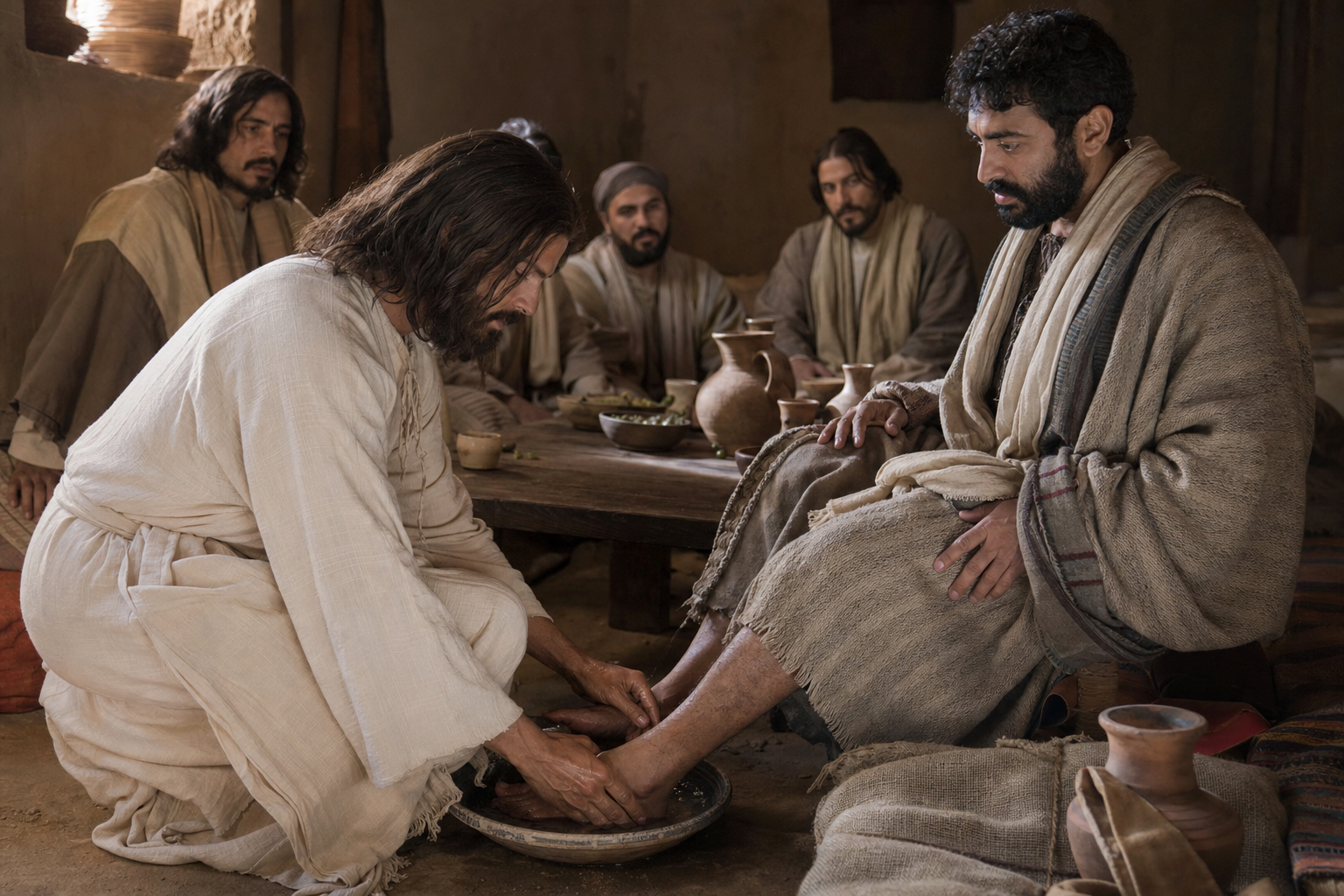
During the meal, Jesus rose, laid aside His outer garments, and wrapped a towel around Himself. Then He poured water into a basin and began washing the disciples’ feet (John 13:4-5). This was a servant’s task. Dusty roads made foot washing necessary, but the responsibility usually belonged to the lowest servant in a household.
Jesus, however, willingly took that place. He was not merely a teacher demonstrating good manners. He is the eternal Son of God. John’s Gospel identifies Him as the Word who was with God and who was God (John 1:1). The Lord of glory stooped to serve those He had chosen.
As a result, John 13:1-17 shows that biblical greatness is different from worldly status. Jesus possessed all authority, yet He used His position to bless others. His example teaches believers to reject pride and pursue humble service.
Christian humility does not deny Christ’s authority. Instead, it reflects His character. Because Jesus is Lord, His people should gladly serve one another in love.
Jesus Cleanses and Restores His Disciples
Peter resisted when Jesus approached him. He asked, “Lord, dost thou wash my feet?” (John 13:6). Peter recognized that Jesus was greater than he was. However, he did not yet understand why the Lord was serving him.
Jesus answered, “If I wash thee not, thou hast no part with me” (John 13:8). His words point beyond physical washing. The disciples needed spiritual cleansing, and only Christ could provide it. Washing the feet became a visible picture of the cleansing Jesus would accomplish through His sacrificial death.
Peter then asked for his hands and head to be washed too. Jesus replied, “He that is washed needeth not save to wash his feet, but is clean every whit” (John 13:10). This illustrates the difference between salvation and daily restoration:
- Salvation: Christ cleanses the believer from sin and brings the believer into fellowship with Him.
- Daily restoration: Christians still need to confess sin and receive the Lord’s ongoing cleansing (1 John 1:9).
- Faithful discipleship: Those cleansed by Christ should walk in humble obedience.
Jesus also knew that one disciple, Judas Iscariot, would betray Him (John 13:10-11). Even so, He completed the act of service. This reveals both His patience and His sovereign knowledge. John 13:1-17 therefore means more than “be kind.” It reveals Jesus as the divine Savior who loves His own, humbles Himself, and cleanses those who come to Him by faith.
Why Did Jesus Wash the Disciples’ Feet in John 13:1-17?

A Living Picture of Humility
Jesus washed the disciples’ feet because He wanted to display true humility. In that culture, people walked dusty roads in sandals. Foot washing was usually the work of a servant. Yet Jesus, the Lord and Teacher, took the servant’s position.
John emphasizes the contrast. Jesus knew that the Father had given all things into His hands. He also knew where He came from and where He was going. Still, He “laid aside his outer garments” and began washing the disciples’ feet (John 13:3–5).
This was not weakness or a loss of authority. Instead, it revealed the character of divine love. The Son of God willingly served those He had created. His humility pointed forward to the cross, where He would give His life for sinners. Philippians 2:6–8 teaches that Christ humbled Himself and became obedient to death, even death on a cross.
Therefore, John 13:1–17 teaches that Christian greatness does not come from status, recognition, or control. It comes through loving service.
- Jesus served without seeking praise. He performed a lowly task in a private setting.
- Jesus served people who still needed spiritual growth. The disciples did not yet understand everything He was doing.
- Jesus served with full awareness of His identity. His humility flowed from secure confidence in the Father.
Believers can follow this example by serving others with patience, compassion, and selflessness. Humility does not deny Christ’s authority. Rather, it submits to His authority and reflects His love.
A Lesson in Receiving Christ’s Cleansing
Peter resisted when Jesus came to wash his feet. He asked, “Lord, do you wash my feet?” (John 13:6). Peter understood that Jesus was his Master. However, he struggled to accept the humility of the One he followed.
Jesus answered, “If I do not wash you, you have no share with me” (John 13:8). This statement points beyond physical cleanliness. It teaches that sinners must receive Christ’s cleansing. We cannot make ourselves acceptable before God through effort, morality, or religious performance.
Jesus later said, “The one who has bathed does not need to wash, except for his feet” (John 13:10). This image helps distinguish salvation from a believer’s daily need for confession and restoration. Christ cleanses His people completely through His saving work. Yet believers still need to bring their daily sins to Him.
- Salvation is received from Jesus. We do not save ourselves.
- Christ’s cleansing is necessary. Without Him, we have no fellowship with God.
- Daily repentance remains important. Those who belong to Christ should continue walking in the light.
First John 1:9 promises that God forgives and cleanses those who confess their sins. The foot washing, therefore, points to the grace of Jesus. He is not merely an example of kindness. He is the divine Savior who cleanses His people through His death and resurrection.
An Example for Christian Service
After washing the disciples’ feet, Jesus said, “I have given you an example, that you also should do just as I have done to you” (John 13:15). He called His followers to practice humble, sacrificial service.
The main command is not simply to repeat the outward ceremony. It is to adopt the heart and posture of Christ. His people should willingly meet real needs, honor others, and serve without demanding recognition.
- Serve family members with patience and love.
- Help fellow believers who are struggling.
- Welcome those who feel overlooked or unworthy.
- Use spiritual gifts for the good of the church.
- Forgive others and seek peace when conflict arises.
Jesus added, “If you know these things, blessed are you if you do them” (John 13:17). Knowledge alone is not enough. The truth of Scripture must shape our actions.
In John 13:1–17, Jesus washes feet because He is the humble Lord, the cleansing Savior, and the perfect example of Christian service. His followers serve others because He first loved them and gave Himself for them.
What Are the Main Points of John 13?
Jesus’ Love Before the Cross
One of the central points of John 13:1-17 is the steadfast love of Jesus. He knew that His suffering was near. He also knew that Judas would betray Him and that His disciples would soon scatter. Nevertheless, Jesus loved His own “to the end” (John 13:1).
This love was not based on the disciples’ strength or faithfulness. It came from Christ’s gracious character. He loved them while knowing their weaknesses. More importantly, His humble service pointed toward the greater act of love at the cross. Jesus would soon give His life for sinners and rise again in victory.
Therefore, John 13 shows that the cross was not an accident. Jesus knowingly moved toward His appointed hour. He served His disciples because He loved them, and He gave Himself because He came to save. As He said, “Greater love has no one than this, that someone lay down his life for his friends” (John 15:13).
Jesus’ Authority and Humility
A second main point is the perfect combination of Christ’s authority and humility. Jesus knew that the Father had given all things into His hands (John 13:3). He was not merely a teacher performing a kind gesture. He is the eternal Son of God, Lord over all creation.
Yet Jesus rose from the meal, wrapped a towel around Himself, and washed the disciples’ feet (John 13:4-5). His authority did not produce pride. Instead, His divine greatness was displayed through willing service.
This scene corrects human ideas about power. The world often connects greatness with status, control, or recognition. Jesus reveals a better way:
- He knew who He was. His humility did not come from insecurity.
- He knew where He came from. He had come from the Father.
- He knew where He was going. He was returning to the Father through the cross and resurrection.
- He used His position to serve. His authority became an expression of love.
Because Jesus is Lord, His humility carries divine authority. He does not merely suggest a helpful example. He commands His followers to learn from Him.
The Call to Follow His Example
The third main point of John 13 is the call to humble obedience. After washing the disciples’ feet, Jesus said, “I have given you an example, that you also should do just as I have done to you” (John 13:15).
Jesus was not teaching that every Christian practice must copy the exact setting of that meal. He was commanding a servant-hearted way of life. His followers must put love into action, especially when service is unnoticed or inconvenient.
- Serve others without seeking applause.
- Welcome opportunities to meet genuine needs.
- Refuse to treat fellow believers as beneath you.
- Let biblical truth produce practical obedience.
However, Christian service does not earn salvation. We serve because Christ has first loved and saved us. His grace changes the heart, and that changed heart begins to serve others.
In summary, John 13:1-17 reveals Jesus as the loving Savior, the authoritative Lord, and the humble Servant. His washing of feet points beyond moral example to His saving mission. The One who knelt before His disciples is the Son of God who died for sinners, rose again, and calls His people to follow Him in faithful love.
What Is the Lesson of John 13:1-17?
True Greatness Is Found in Humble Service
The lesson of John 13:1-17 begins with Jesus’ definition of greatness. The disciples often struggled with questions of status and importance. However, Jesus showed that greatness is not measured by position, recognition, or power. It is revealed through humble love.
Jesus was their Lord and Teacher, yet He took a servant’s place and washed their feet. His authority did not prevent humility. Instead, His divine authority made His humble service even more remarkable. He willingly served the people He had created and loved.
Jesus then said, “For I have given you an example, that you also should do just as I have done to you” (John 13:15, ESV). He was not merely teaching a ritual. He was revealing the heart of godly leadership. Those who follow Christ must be willing to serve without demanding applause.
- True greatness seeks God’s glory rather than personal attention.
- True greatness notices the needs of others.
- True greatness serves even when the task seems lowly.
- True greatness reflects the character of Jesus Christ.
Therefore, John 13:1-17 calls Christians to reject pride. We serve because Christ first served us. His humility points us toward the self-giving love He would fully display through His death on the cross.
Believers Are Called to Serve One Another
Jesus applied this lesson directly to His disciples: “If I then, your Lord and Teacher, have washed your feet, you also ought to wash one another’s feet” (John 13:14, ESV). His command teaches believers to care for one another with practical, sacrificial love.
Christian service is not limited to public ministry. It can include ordinary acts of faithfulness that meet real needs. In addition, service should be offered with compassion rather than superiority.
- Encourage someone who is discouraged.
- Help a believer carrying a difficult burden.
- Welcome those who feel overlooked or forgotten.
- Use spiritual gifts to strengthen the church.
- Forgive, pray, and care for others in Christ’s name.
Jesus does not call His people to serve only those who can repay them. Instead, He calls us to love as He loved. This kind of service demonstrates that the Gospel is changing the heart.
Knowing the Truth Must Lead to Obedience
Jesus concluded, “If you know these things, blessed are you if you do them” (John 13:17, ESV). This statement shows that biblical knowledge must produce faithful action. It is possible to understand Christ’s teaching without practicing it. However, genuine faith responds with obedience.
The blessing Jesus describes is not a promise of ease or earthly success. It is the joy of walking in fellowship with Him. As believers obey His Word, they display their love for the Savior. Jesus said, “If you love me, you will keep my commandments” (John 14:15, ESV).
Accordingly, the lesson of John 13:1-17 is both comforting and challenging:
- Receive Christ’s cleansing with humble faith.
- Follow His example by serving others.
- Practice obedience instead of merely admiring His teaching.
- Trust Jesus as the divine Lord who gave His life to save sinners.
Jesus Christ is not only an example of humility. He is the Son of God and the Savior who died for our sins and rose again. His command to serve flows from His saving work. Because He lives, His people can follow Him in humble, faithful obedience.
How John 13:1-17 Points to Jesus’ Saving Mission
The One Who Washed Feet Is the Son of God
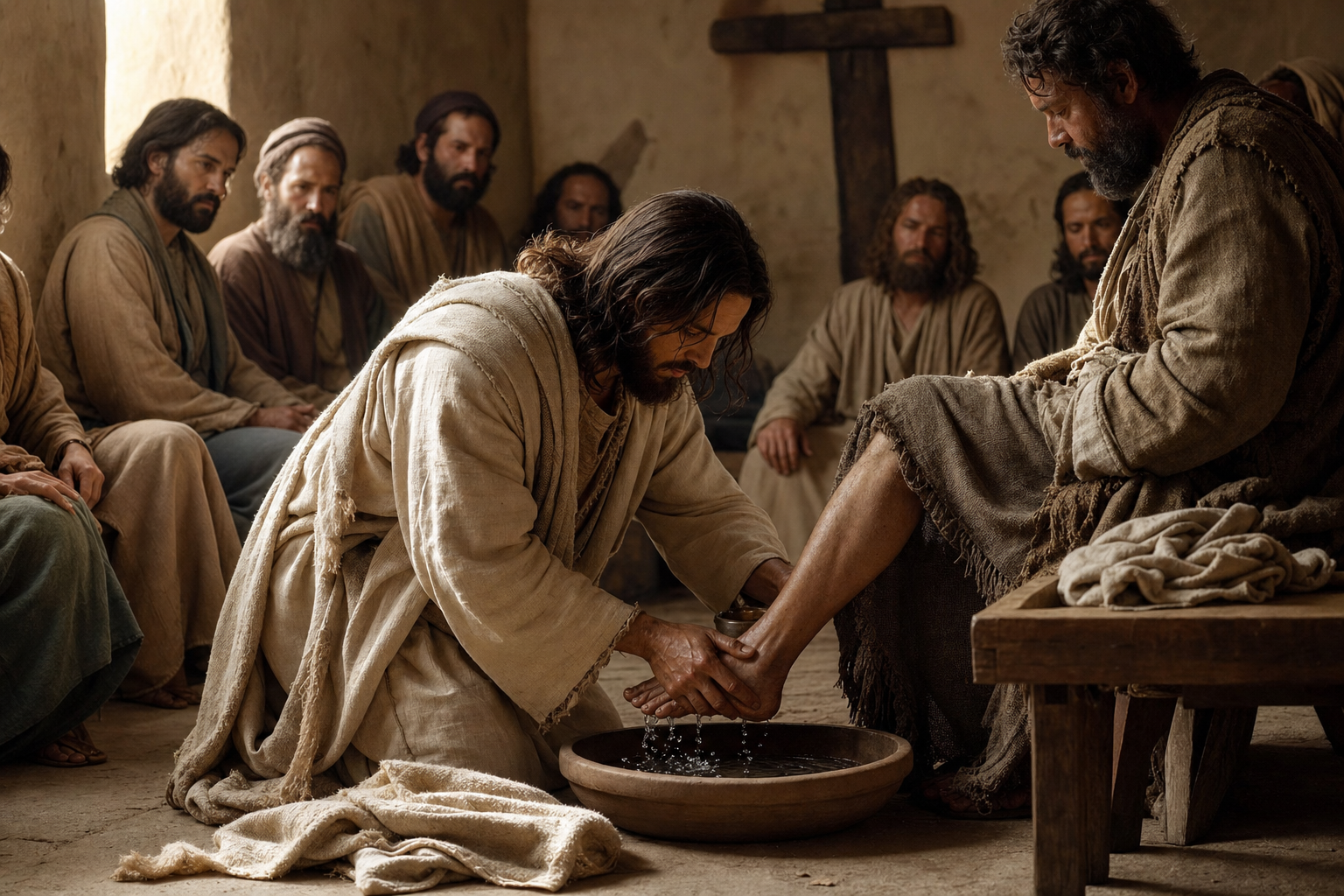
John 13:1-17 reveals a profound truth: the One who kneels to wash feet is not merely a moral teacher. He is Jesus Christ, the eternal Son of God. Jesus knew that the Father had given all things into His hands (John 13:3). His humility did not weaken His authority. Instead, it displayed the greatness of His divine love.
Jesus remained fully aware of who He was. He was Lord and Teacher, yet He took the position of a servant (John 13:13-14). Therefore, His action was not an admission of inferiority. It was a willing expression of holy love. The Creator stooped to serve His creatures.
This points beyond the basin and towel. Jesus came from the Father and would soon return to the Father. His entire mission involved humble obedience. As Philippians 2:6-8 teaches, the Son humbled Himself and became obedient to the point of death—even death on a cross.
Accordingly, John 13:1-17 calls us to see Jesus rightly:
- He is the Lord: Jesus possesses divine authority and deserves our worship.
- He is the Servant: He willingly serves those He came to save.
- He is the Savior: His humility leads toward the cross, where He gives His life for sinners.
The Cross and Resurrection Fulfill His Love
Foot washing was a visible sign of the love Jesus would soon display in its fullest form. John says that Jesus loved His own “to the end” (John 13:1). That love reached its appointed goal at Calvary.
Jesus did not come only to provide an inspiring example. He came to bear sin and bring salvation. The clean feet of the disciples could not remove guilt from the heart. Only Christ’s sacrifice could reconcile sinners to God. As Isaiah 53:5 declares, He was pierced for our transgressions and crushed for our iniquities.
The cross was not the end of His mission. Jesus rose from the dead in victory. His resurrection confirmed that His sacrifice was accepted and that death could not hold Him (1 Corinthians 15:3-4). Therefore, the love shown in John 13 is saving love. It moves from the upper room to the cross, and from the empty tomb to new life.
Jesus’ words to Peter also point to the need for spiritual cleansing. “If I do not wash you, you have no share with me” (John 13:8). This teaches that sinners must receive Christ’s cleansing by faith. Salvation is not earned through service, morality, or religious effort. It is received through Jesus, who cleanses us from sin (1 John 1:7).
Jesus Calls His People to Faith and Faithful Living
After washing the disciples’ feet, Jesus commanded them to follow His example (John 13:14-15). This command does not mean that believers save themselves through good works. Rather, those cleansed by Christ are called to live as humble servants.
Faith in Jesus produces a changed life. Because He has loved and forgiven us, we can serve others without seeking status or praise. His saving grace becomes the source of our obedience.
- Receive Christ’s cleansing with humility.
- Trust His death and resurrection for salvation.
- Serve fellow believers with practical love.
- Obey His Word, even when humble service costs something.
John 13:1-17 therefore points directly to the heart of the Gospel. Jesus Christ is the divine Lord who became a servant, died for sinners, and rose again. He saves all who trust Him and calls His people to reflect His love through faithful, humble service.
Frequently Asked Questions
What is the lesson of John 13:1-17?
The central lesson of John 13:1-17 is that followers of Jesus must serve others with humble, self-giving love. Jesus knew He was the Son of God, yet He took the place of a servant and washed His disciples’ feet.
His example teaches that spiritual greatness is not measured by status, recognition, or authority. Instead, it is shown through loving obedience and practical service. Jesus said, “If I then, your Lord and Teacher, have washed your feet, you also ought to wash one another’s feet” (John 13:14).
Therefore, believers should look for faithful ways to serve one another:
- Serve without demanding praise or attention.
- Put the needs of others before personal comfort.
- Follow Jesus’ example with humility.
- Obey what Christ teaches, not merely admire it.
However, this passage also teaches that we must receive Christ’s cleansing. Peter initially resisted Jesus, but the Lord explained that receiving Him was necessary (John 13:8). This points beyond washed feet to the cleansing Jesus provides from sin. His death on the cross and resurrection are the foundation of that salvation. As Jesus said, “Whoever believes in him is not condemned” (John 3:18).
What are the main points of John 13?
John 13 presents several connected truths about Jesus and His disciples. The main points include:
- Jesus loved His disciples to the end. His love remained steadfast even as His suffering approached and betrayal was near (John 13:1).
- Jesus is Lord and Servant. He possessed divine authority, yet He willingly performed a servant’s task (John 13:3-5).
- Jesus cleanses those who belong to Him. The exchange with Peter shows the need to receive Christ’s cleansing rather than depend on personal righteousness (John 13:6-10).
- Jesus calls His followers to humble service. His disciples must follow His example by serving one another (John 13:12-15).
- Knowing truth must lead to obedience. Jesus said, “If you know these things, blessed are you if you do them” (John 13:17).
In addition, John 13 prepares us to understand the cross. The One who kneels before His disciples is not merely a moral teacher. He is the eternal Son of God who willingly gave His life for sinners and rose again in victory.
Why did Jesus wash the disciples’ feet in John 13:1-17?
Jesus washed the disciples’ feet for several reasons. First, He gave them a visible lesson in humility. Foot washing was a lowly task, yet Jesus performed it willingly. He showed that love serves, even when the work appears unnoticed.
Second, Jesus demonstrated that His authority does not resemble worldly power. He is Lord and Teacher, but He did not use His position to avoid humble service. Instead, He used His authority to bless others.
Third, the washing pointed to the cleansing Jesus alone provides. Peter wanted Jesus to wash more than his feet. Jesus responded, “The one who has bathed does not need to wash, except for his feet” (John 13:10). This illustrates the believer’s need for Christ’s saving grace and continuing cleansing.
Finally, Jesus gave His disciples a pattern for Christian living. He did not command empty religious performance. He called His people to imitate His humble love in daily life. This includes serving family, strengthening fellow believers, helping those in need, and forgiving others.
What does John 13:1-17 mean?
John 13:1-17 means that Jesus’ love is both humble and saving. He loved His disciples to the end, even though He knew the cross was near. He then acted out that love by washing their feet.
The passage also reveals Jesus’ divine identity. He knew that the Father had given all things into His hands (John 13:3). Therefore, His humility was not weakness or a denial of His glory. It was a willing expression of His holy character and mission.
For Christians, the passage has two essential applications:
- Receive Jesus’ cleansing. Sin cannot be removed through good works. We need the forgiveness Christ purchased through His death and confirmed through His resurrection.
- Serve others in Jesus’ name. Those who have received His grace should display that grace through humble obedience and love.
Jesus concludes, “If you know these things, blessed are you if you do them” (John 13:17). Thus, the meaning of John 13:1-17 is not limited to understanding humility. It calls us to trust Jesus Christ, the divine Son of God, who died for our sins, rose again, and now leads His people in a life of faithful service.