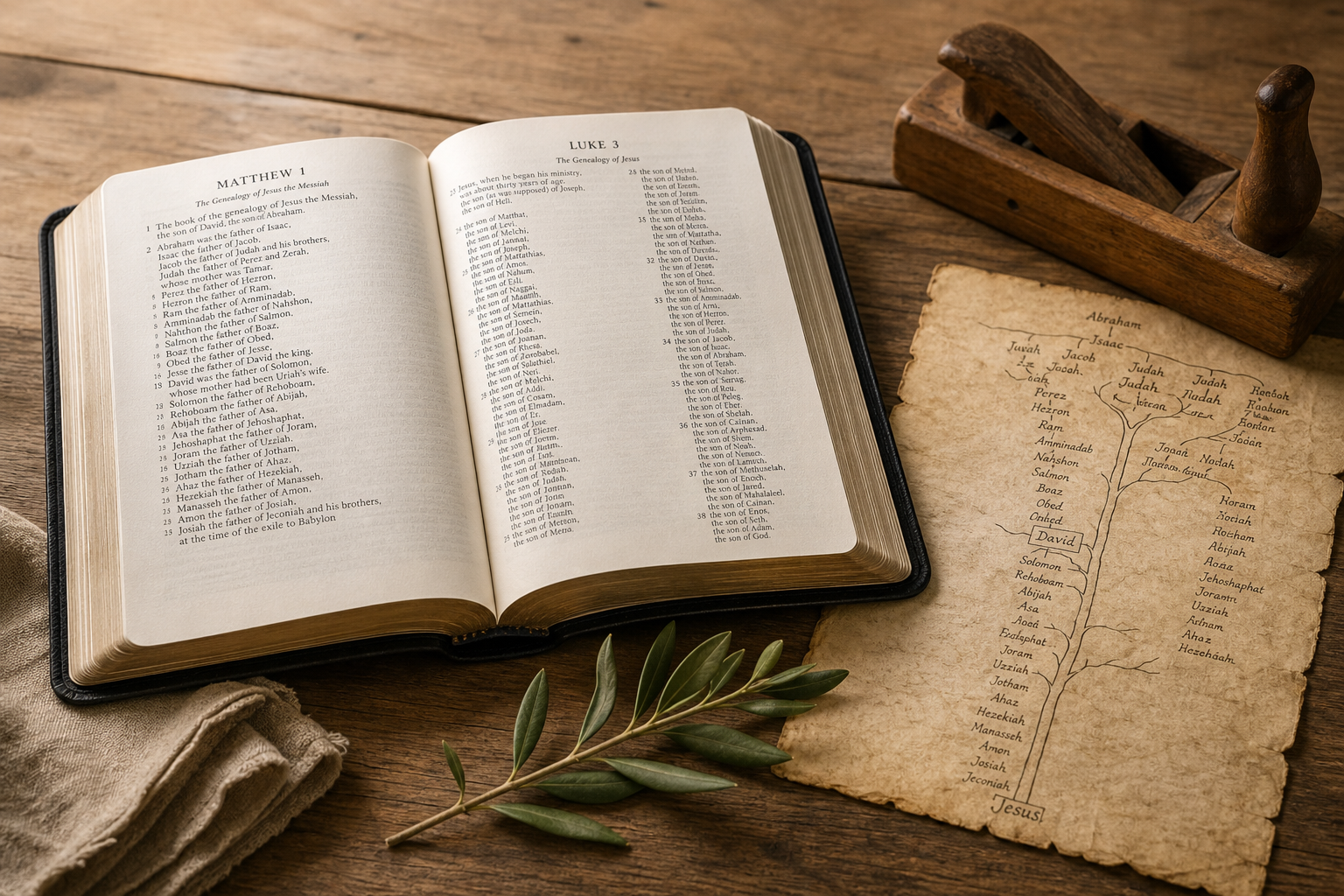
Jesus’ earthly family included His mother Mary, His guardian Joseph, and siblings or close family members mentioned in the Gospels. The Bible presents Jesus as truly human within a family, while also affirming that He is the eternal Son of God who died for sinners and rose again, as declared in John 1:1 and 1 Corinthians 15:3-4.
When we look at the Jesus family in Scripture, we see more than names in a family tree—we see God faithfully working through real people and real history to accomplish His saving plan. Mary cared for Jesus, Joseph protected and provided for Him, and Jesus grew up within a Jewish household shaped by God’s promises. Yet even as Jesus truly entered human history as a child, He remained the eternal Son of God, conceived by the Holy Spirit and born to save His people (Matthew 1:20–23).
This article examines what the Bible teaches about Mary, Joseph, Jesus’ relatives and siblings, His genealogies, and His earthly life. These details point beyond ancestry to Christ’s divine mission: “the Word became flesh” (John 1:14), and God gave His Son so that all who believe in Him may have eternal life (John 3:16).
Who Was Part of Jesus’ Earthly Family?

Mary, the Mother of Jesus
Mary was the woman God chose to bear Jesus Christ. The angel Gabriel announced that she would conceive by the power of the Holy Spirit. Jesus’ birth was therefore miraculous, and He is truly human and truly God’s Son (Luke 1:26–35). [1]
Mary responded in humble faith: “Behold, I am the servant of the Lord” (Luke 1:38). She gave birth to Jesus in Bethlehem, cared for Him during His childhood, and witnessed important moments of His ministry. At Cana, she directed the servants to obey Him (John 2:5). Scripture honors Mary as Jesus’ human mother while directing worship to Christ, the one mediator between God and humanity (1 Timothy 2:5). [2]
Joseph, His Earthly Guardian
Joseph was Mary’s husband and Jesus’ legal guardian during His earthly childhood. He belonged to David’s family line and accepted his responsibility after God revealed that Mary’s child was conceived by the Holy Spirit. Joseph protected Jesus from Herod by taking Him and Mary to Egypt, then returning with them to Nazareth (Matthew 1:18–25; 2:13–23). [3]
Joseph worked as a carpenter, and Jesus was known in Nazareth as a carpenter’s son. His humble household did not diminish His glory. The child raised in Joseph’s home was the eternal Word who became flesh (Matthew 13:55–56; John 1:1–14). [4]
Relatives and Extended Family
Mary was related to Elizabeth, the mother of John the Baptist. When Mary visited Elizabeth, both women praised God, and Elizabeth called Mary “the mother of my Lord” (Luke 1:5–45). The Gospels also mention Jesus’ brothers and sisters, showing that He lived within genuine human relationships. [5]
What Type of Family Did Jesus Have?
A Jewish Family Rooted in God’s Promises
Jesus was born into a Jewish household within Israel’s covenant history. His early life included circumcision, presentation at the temple, Passover observance, Scripture, and synagogue worship (Luke 2:21–24, 41–42; Luke 4:16). These details confirm that He truly entered human history as the promised Messiah.
Jesus was more than a Jewish teacher or descendant of David. He is “the Christ, the Son of the living God” (Matthew 16:16). His human heritage served God’s covenant purposes, while His identity rests in His eternal divine nature.
His Home in Nazareth
Jesus grew up in Nazareth of Galilee and was commonly called Jesus of Nazareth (Matthew 2:23; Luke 2:39–40). Although the town was viewed as insignificant—Nathanael asked, “Can anything good come out of Nazareth?”—God’s purposes are not measured by worldly status (John 1:46).
Luke says that Jesus “increased in wisdom and in stature and in favor with God and man” (Luke 2:52). His hidden years were part of His real human life and preparation for the mission given by His Father.
Care During His Early Life
Mary cared for Jesus, and Joseph protected and provided for the household. The Gospels do not record every detail of His childhood, but they show a working home shaped by worship, Scripture, community life, and obedience. This setting did not make Jesus divine; He was already the eternal Son of God. It was part of the human life He willingly accepted for our salvation.
Jesus’ Family in the Bible
Birth and Childhood
Matthew and Luke present Jesus’ birth as the fulfillment of God’s saving promise. He was born in Bethlehem during Herod’s reign, and angels announced Him as “a Savior, who is Christ the Lord” (Matthew 1:18–2:12; Luke 2:1–20). [6]
At twelve years old, Jesus went with His household to Jerusalem for Passover. When His parents found Him in the temple, He said, “Did you not know that I must be in my Father’s house?” Yet He returned to Nazareth and was submissive to them (Luke 2:41–52). This moment shows both His divine identity and His obedient humanity.
During His Public Ministry
Mary was present at Cana when Jesus performed His first recorded miracle and revealed His glory to His disciples (John 2:1–11). Jesus’ brothers were also mentioned during His ministry; John states that they did not initially believe in Him (John 7:3–5). His mission, however, was determined by the Father rather than by family expectations.
Jesus taught that spiritual relationship with God is greater than physical ancestry: “Whoever does the will of my Father in heaven is my brother and sister and mother” (Matthew 12:50). He was not dishonoring Mary or His relatives; He was explaining that all who trust and obey God belong to the family of faith.
At the Cross and Resurrection
Mary stood near the cross, and Jesus entrusted her care to John (John 19:25–27). His death was not a defeat: “Christ died for our sins” and was raised on the third day (1 Corinthians 15:3–4). After His resurrection, Mary and Jesus’ brothers gathered with the apostles in prayer (Acts 1:14), and James became a witness to the risen Christ (1 Corinthians 15:7). [7]
Did Jesus Have Biological Siblings?
Brothers and Sisters Mentioned in Scripture
In Nazareth, people identified Jesus’ brothers as James, Joses, Simon, and Judas. They also referred to His sisters, although Scripture does not give their names or number (Matthew 13:55–56; Mark 6:3). [8]
The clearest reading of these passages is that Jesus had close family members described as brothers and sisters. Some Christian traditions understand them as Mary’s later children; others understand them as Joseph’s children from an earlier marriage or as close relatives. The Bible does not explain every relationship, so Christians should distinguish clearly between Scripture and later tradition.
- We can affirm that four brothers are named and that sisters are mentioned.
- We cannot claim that Scripture gives the total number of siblings.
- We must remember that these relationships do not lessen Jesus’ divine identity.
Jesus’ brothers initially did not believe in Him, but their response changed after the resurrection. James became a leader in the early church (John 7:5; Acts 1:14; Galatians 1:19). Their testimony points beyond familiarity with Jesus according to the flesh to faith in Him as the risen Lord.
Jesus was uniquely conceived by the Holy Spirit, truly God and truly man. His earthly relationships reveal genuine humanity, while His sinless life, sacrificial death, and bodily resurrection reveal His saving mission.
Jesus’ Family Tree

The Genealogies and David’s Line
Scripture connects the Messiah with Abraham, Judah, and David. God promised David an enduring kingdom (2 Samuel 7:12–16), and Gabriel declared that Jesus would receive David’s throne and reign forever (Luke 1:32–33). [9]
The New Testament gives two genealogies:
- Matthew 1:1–17 emphasizes Jesus’ legal and royal connection to David through Solomon.
- Luke 3:23–38 traces the line back through David to Adam, highlighting Jesus’ connection with humanity.
Joseph was not Jesus’ biological father, but he was His legal guardian and connected Him to David’s household. Mary conceived Jesus through the Holy Spirit (Matthew 1:18–23). Jesus is therefore David’s promised Son according to the flesh and the divine Son according to His eternal nature (Romans 1:3–4).
A Simple Biblical Outline
| Family connection | Biblical significance |
|---|---|
| Abraham | God promised blessing through his offspring (Genesis 12:1–3). |
| Isaac and Jacob | The covenant promise continued through them. |
| Judah | The royal promise continued through Judah’s tribe (Genesis 49:10). |
| David | God promised an enduring kingdom through his line. |
| Joseph and Mary | They provided Jesus’ earthly family setting; Joseph supplied legal connection to David’s house. |
| Jesus Christ | He is the promised Messiah, Son of God, and Savior. |
Abraham → Isaac → Jacob → Judah → David → Joseph and Mary’s household → Jesus Christ
This outline does not replace Matthew 1:1–17 and Luke 3:23–38. It shows God preserving His promise across generations and fulfilling it in Christ. Jesus is not merely another member of the human family; He is the Word made flesh, who died for sinners and rose bodily from the grave.
What Can Christians Learn From Jesus’ Family?
Faithfulness in Ordinary Circumstances
Mary and Joseph lived humble lives, yet God entrusted them with a holy purpose. Their example teaches that faithfulness does not require fame or status. God calls His people to trust Him, obey His Word, and serve where He has placed them (1 Corinthians 1:27).
The household also faced uncertainty, danger, hardship, and misunderstanding. God remained faithful through every season. Christian families can therefore pursue Scripture, love, worship, and obedience while trusting God with circumstances they cannot see clearly.
Jesus’ Obedience to the Father
The central lesson is Jesus’ perfect obedience to His heavenly Father. He honored His earthly guardians, yet His ultimate allegiance was always to God (Luke 2:49, 51). This obedience reached its climax at the cross, where He gave His life for sinners, and in the resurrection, which confirmed Him as the Son of God and promised Savior (Romans 1:4).
The Family of God Through Faith
Physical ancestry does not determine a person’s place in God’s household. “To all who did receive him, who believed in his name, he gave the right to become children of God” (John 1:12). Through faith in Christ, people from every nation receive forgiveness, new life, and a place among God’s people.
The true significance of the Jesus family is therefore hopeful: God keeps His promises, Christ entered human history, and everyone who trusts in Him becomes part of God’s eternal family.
Frequently Asked Questions
How many children did Mary have apart from Jesus?
The Bible names Jesus’ brothers James, Joses, Simon, and Judas, and mentions His sisters without giving their names or number (Matthew 13:55–56). Christians interpret these relationships differently, but Scripture does not provide a definite total. [10]
How many siblings did Jesus have?
Four brothers are named, and one or more sisters are mentioned. The total number is not stated (Mark 6:3). [11]
Did Jesus have biological siblings?
The New Testament calls certain people Jesus’ brothers and refers to His sisters. Some Christians understand these as biological siblings, while others identify them as close relatives or Joseph’s children from an earlier marriage. Scripture confirms the family terms but does not explain every relationship. This question does not alter the truth of Jesus’ miraculous conception by the Holy Spirit (Matthew 1:18–23). [12]
What is Jesus’ family tree?
Matthew 1 and Luke 3 present Jesus’ genealogies, connecting Him with Abraham, David, and ultimately humanity through Adam. These records establish Him as the promised Messiah and Son of David, not merely an unrelated teacher (Matthew 1:1; Romans 1:3–4). [13]
Jesus Christ is the divine Son who became man, died on the cross for our sins, rose bodily from the grave, and reigns as Lord. Everyone who trusts in Him receives forgiveness and everlasting life (John 3:16; Romans 10:9). [14]
Sources
- https://www.biblegateway.com/passage/?search=Luke%201%3A26-35&version=ESV
- https://www.biblegateway.com/passage/?search=Luke%202%3A1-20%2CLuke%202%3A41-52%2CJohn%202%3A1-11%2C1%20Timothy%202%3A5&version=ESV
- https://www.biblegateway.com/passage/?search=Matthew%201%3A18-25%2CMatthew%202%3A13-23&version=ESV
- https://www.biblegateway.com/passage/?search=Matthew%2013%3A54-56%2CJohn%201%3A1-14&version=ESV
- https://www.biblegateway.com/passage/?search=Luke%201%3A5-45%2CMatthew%2013%3A55-56&version=ESV
- https://www.biblegateway.com/passage/?search=Luke%202%3A1-20&version=ESV
- https://www.biblegateway.com/passage/?search=Acts%201%3A14%3B%201%20Corinthians%2015%3A7&version=ESV
- https://www.biblegateway.com/passage/?search=Matthew%2013%3A55-56%2CMark%206%3A3&version=ESV
- https://www.biblegateway.com/passage/?search=Luke%201%3A32-33&version=ESV
- https://www.biblegateway.com/passage/?search=Matthew%2013%3A55-56&version=ESV
- https://www.biblegateway.com/passage/?search=Mark%206%3A3&version=ESV
- https://www.biblegateway.com/passage/?search=Matthew%201%3A18-23&version=ESV
- https://www.biblegateway.com/passage/?search=Matthew%201%3A1%3BRomans%201%3A3-4&version=ESV
- https://www.biblegateway.com/passage/?search=John%203%3A16%3BRomans%2010%3A9&version=ESV