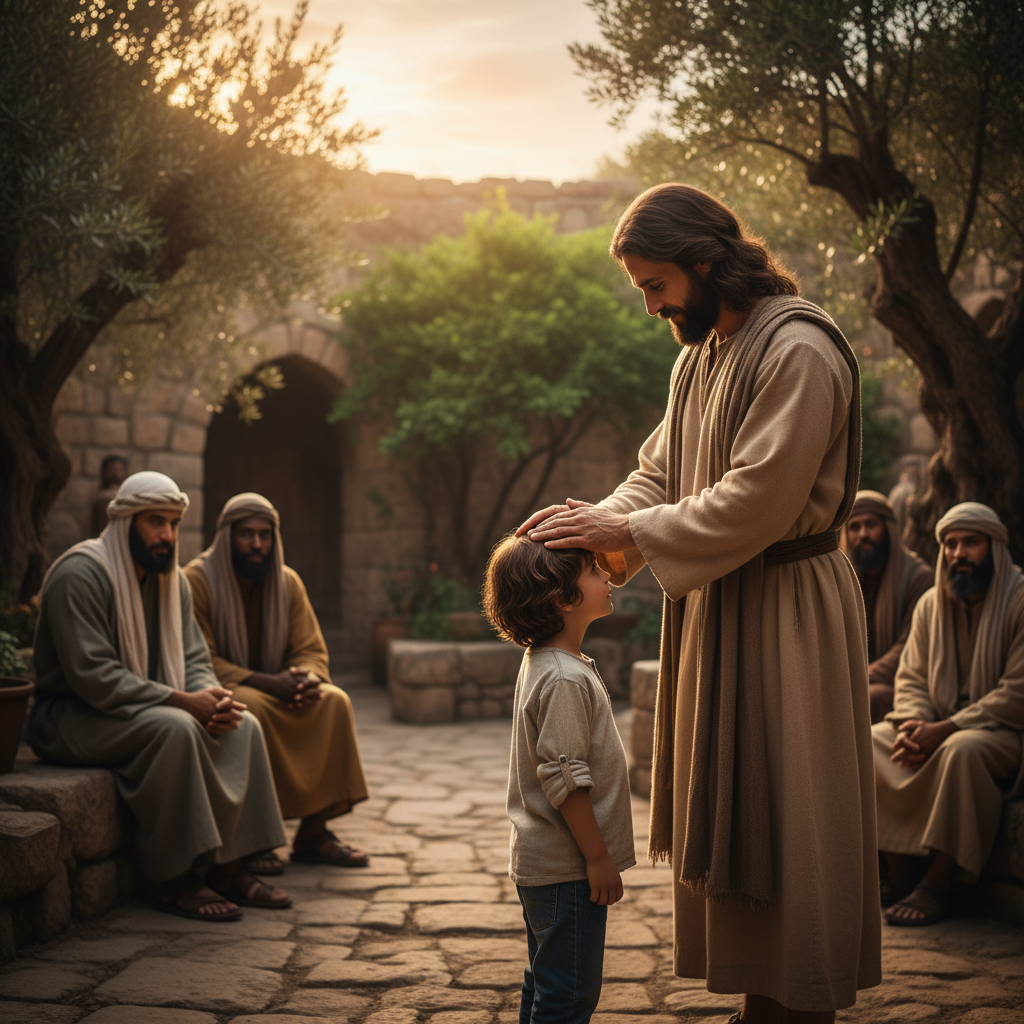
Mark 10:13-16 describes the moment when people brought little children to Jesus for a blessing, but the disciples rebuked them. Jesus was greatly displeased and told them to let the children come, declaring that the Kingdom of God belongs to those who receive it with the humble, trusting faith of a child.

In a world that often measures worth by achievement, influence, and status, Jesus did something utterly radical during His time on earth. When little children were brought to Him and His own disciples tried to send them away, Jesus responded not with indifference, but with a holy and beautiful indignation. The scene recorded in Mark 10:13-16 is one of the most tender and powerful moments in all of Scripture — a passage that reveals the very heart of our Savior and the nature of the Kingdom He came to establish.
In this article, we will explore seven beautiful lessons that emerge from Mark 10:13-16, unpacking what Jesus meant when He said, “let the little children come to me, and do not hinder them, for the Kingdom of God belongs to such as these.” Whether you have known Christ for decades or are just beginning your journey with Him, these truths will challenge you, encourage you, and draw you deeper into the childlike faith that Jesus calls every believer to embrace. Let us open our hearts together and discover what our Lord wants us to learn from this unforgettable moment with the children.
What is the meaning of Mark 10:13-16?

The meaning of Mark 10:13-16 is profound and transformive. In this passage, Jesus reveals the heart of God toward the vulnerable. He also shows us what it truly means to enter the Kingdom of God. Far from a simple story about children, this passage carries deep spiritual truths about faith, humility, and the unconditional love of Jesus Christ. Let us walk through the scene carefully and allow the Holy Spirit to speak through God’s Word.
The Scene: People Bringing Little Children to Jesus
Mark 10:13 tells us that people were bringing little children to Jesus. They wanted Him to touch them and bless them. In the ancient world, children were not always given the honor we might expect today. Yet these parents, and perhaps others in the crowd, recognized something extraordinary about Jesus. They believed that His touch carried power, grace, and blessing.
This is a beautiful picture of faith in action. These people did not come with empty hands. They came bringing what mattered most to them: their children. They approached Jesus without hesitation. They trusted that He cared about the smallest and seemingly most insignificant among us.
Consider what this tells us about who Jesus is. He was known throughout the region as a teacher, healer, and miracle worker. Crowds followed Him everywhere. Yet He made time for children. He never turned away anyone who came to Him in faith. This is consistent with everything Scripture reveals about the character of Christ. As He said in Matthew 11:28, “Come to me, all you who are weary and burdened, and I will give you rest.”
The scene also reveals an important truth about approaching Jesus. We do not need to bring Him great deeds or impressive qualifications. We simply need to come. Just as these parents brought their children, we are invited to bring ourselves to Jesus just as we are.
The Disciples’ Mistake: Turning the Children Away
Mark 10:13 also records a troubling reaction. the disciples rebuked those who brought the children. They saw the children as a distraction. They likely believed Jesus had more important matters to attend to. From their perspective, they were perhaps trying to protect Jesus’ time and energy.
However, their actions reveal a serious misunderstanding. They did not yet grasp the heart of their Master. They measured importance by worldly standards. Influence, status, and social standing shaped their thinking. Children had none of these things. So the disciples assumed children did not belong in the presence of the Son of God.
This mistake is more common than we might think. Even today, believers can fall into the same error. We may unintentionally create barriers between people and Jesus. We may send the message that someone is too young, too broken, too sinful, or too insignificant to come to Christ. This is never the heart of God.
Luke 18:16, a parallel account of this event, records Jesus saying, “Let the little children come to me, and do not hinder them.” The word “hinder” is critical. It means to block, to prevent, or to put an obstacle in someone’s path. When we turn away anyone who seeks Jesus, we place ourselves in direct opposition to His expressed will.
The disciples’ error teaches us a vital lesson. Our role is never to be gatekeepers who decide who deserves access to Jesus. Instead, His disciples are called to be guides who lead others into His presence.
Jesus Gets Indignant: A Righteous Anger for the Innocent
Mark 10:14 records one of the most striking moments in all of Scripture. When Jesus saw what the disciples had done, He was indignant. The original Greek word here carries deep emotional weight. It conveys a strong sense of displeasure and righteous anger. This was not a casual moment of mild irritation. Jesus was genuinely upset.
This detail matters greatly. It reveals the depth of God’s love for the vulnerable. Jesus does not stand at a distance when the innocent are pushed aside. He does not remain passive when His people are turned away. He responds with the full authority and passion of God Himself.
Jesus then spoke words that have echoed through the centuries: “Let the little children come to me, and do not hinder them, for the kingdom of God belongs to such as these.” This declaration is extraordinary. Jesus did not merely tolerate the children. He welcomed them with open arms. He declared that the Kingdom of God belongs to those who have a childlike heart.
Jesus went even further in Mark 10:15: “Truly I tell you, anyone who will not receive the kingdom of God like a little child will never enter it.” In this statement, Jesus established a requirement for entering the Kingdom. It is not enough to admire God from a distance. We must receive His Kingdom with humility, trust, and dependence, just as a child relies completely on a loving parent.
Mark 10:16 closes the passage with a tender image: “He took the children in his arms, placed his hands on them and blessed them.” Jesus did not merely speak about children in abstract terms. He physically held them. He laid His hands on them. He blessed them personally and individually. This is the Jesus who knows your name, who sees your tears, and who longs to draw you close to His heart.
The meaning of Mark 10:13-16 is ultimately a revelation of who Jesus Christ truly is. He is the Lord of the Universe who pauses for children. He is the King of Kings who welcomes the overlooked and the humble. He is the Son of God whose anger burns against anything that blocks someone from coming to Him. And He is the Savior who takes us in His arms and blesses us with His grace.
If you are reading this today, Scripture makes a promise to you. John 3:16 declares, “For God so loved the world that he gave his one and only Son, that whoever believes in him shall not perish but have eternal life.” Jesus Christ died on the cross for your sins, was buried, and rose again on the third day. He is alive today. And He is inviting you to come to Him, just as you are, with the simple faith of a child.
7 Powerful Lessons from Mark 10:13-16

Mark 10:13-16 is one of the most tender and instructive passages in all of Scripture. In these four short verses, Jesus reveals truths about His character, the nature of the Kingdom of God, and what it truly means to come to Him in faith. Let us walk through seven powerful lessons that emerge from this beloved passage.
1. Jesus Has a Special Love for the Vulnerable
The passage begins with people bringing little children to Jesus. In the ancient world, children held little social status. They were often overlooked and undervalued. Yet Jesus did not see them that way. He welcomed them with open arms.
This tells us something beautiful about the heart of Christ. Jesus has a special, tender love for those whom the world considers insignificant. He sees the overlooked. He draws near to the humble. As Psalm 68:5 declares, God is “a father to the fatherless, a defender of widows.” Jesus embodies that truth perfectly.
If you have ever felt small, forgotten, or unimportant, take heart. Jesus sees you. He cares for you deeply. His love is not reserved for the powerful or the accomplished. It extends to every humble heart that turns to Him.
2. The Kingdom of God Belongs to Those Who Are Like Little Children
In Mark 10:14, Jesus says, “Let the little children come to me, and do not hinder them, for the kingdom of God belongs to such as these.” This is a stunning statement. Jesus is not merely being kind. He is making a profound theological declaration.
The Kingdom of God does not belong to the self-sufficient. It does not belong to those who trust in their own strength or wisdom. It belongs to those who come with the humble, trusting posture of a child. A little child does not earn a parent’s love. They simply receive it. In the same way, the Kingdom of God is received, not achieved.
Jesus is teaching us that spiritual pride is the greatest barrier to entering God’s Kingdom. humility is the doorway. When we recognize our complete dependence on God, we position ourselves to receive His grace.
3. We Must Receive the Kingdom with Childlike Faith
Childlike faith is not childish faith. There is an important difference. Childish faith is immature and uninformed. Childlike faith, on the other hand, is marked by trust, openness, and a willingness to receive what God offers without reservation.
Jesus calls us to this kind of faith. In Mark 10:15, He says, “Truly I tell you, anyone who will not receive the kingdom of God like a little child will never enter it.” This is a serious and sobering word. Jesus is saying that the posture of our hearts matters deeply to God.
Childlike faith looks like this:
- Complete trust — believing that God is who He says He is and that He will do what He promises
- Honest dependence — acknowledging that we cannot save ourselves and that we need Jesus
- Open receptivity — being willing to receive God’s gifts with gratitude rather than earning them through effort
- Simple obedience — following Jesus without overcomplicating the Gospel with human conditions
This kind of faith pleases the heart of God. It is the faith that unlocks the treasures of His Kingdom.
4. Do Not Hinder Those Who Come to Jesus
One of the most convicting lessons from this passage is the rebuke Jesus gave to His own disciples. They tried to turn the children away. They likely thought they were protecting Jesus’ time and energy. But Jesus was indignant with them.
The word “indignant” in Mark 10:14 carries deep emotional weight. Jesus was not mildly annoyed. He was deeply grieved and angered by their actions. This reveals how seriously God takes anything that blocks someone from coming to Him.
We must ask ourselves an important question: Are we ever guilty of hindering others from coming to Jesus? Sometimes we do this through:
- Adding unnecessary requirements to the Gospel
- Creating an unwelcoming environment for newcomers
- Judging those who come to faith from difficult backgrounds
- Making the Christian life seem more about rules than about relationship with Christ
Jesus’ rebuke is a warning to every believer and every church. Our role is to open the door to Jesus, never to block it. We are called to be bridges, not barriers.
5. Jesus Physically Blessed the Children
Mark 10:16 gives us a beautiful detail that is easy to overlook. It says, “He took the children in his arms, placed his hands on them and blessed them.” Jesus did not simply speak a blessing from a distance. He physically held them. He touched them. He drew them close.
This action reveals the personal, intimate nature of Jesus’ love. He is not a distant deity who observes from afar. He is Immanuel, “God with us” (Matthew 1:23). He draws near. He touches. He holds. He blesses with His own hands.
This is the same Jesus who touched lepers to heal them (Mark 1:41). This is the same Jesus who took little children in His arms. He is not afraid of our mess, our weakness, or our need. He moves toward us with compassion.
Furthermore, the act of laying hands on the children was a meaningful gesture in Jewish culture. It signified the imparting of blessing, favor, and identity. Jesus was not performing a ritual. He was expressing the very heart of the Father toward every soul that comes to Him.
6. Salvation is a Gift, Not a Reward for Achievement
This passage powerfully illustrates one of the most important truths in all of Scripture: salvation is a gift. Little children cannot earn anything. They cannot work, achieve, or prove their worth. They can only receive. And yet Jesus says the Kingdom of God belongs to them.
This directly contradicts the human tendency to think we must earn God’s favor. We often approach God as if we need to clean ourselves up first. We think we need to be good enough, strong enough, or faithful enough. But the Gospel tells a different story.
Ephesians 2:8-9 makes this crystal clear: “For it is by grace you have been saved, through faith — and this is not from yourselves, it is the gift of God — not by works, so that no one can boast.” Salvation is not a paycheck for good behavior. It is a gift from a loving Savior.
Just as the children in Mark 10 came to Jesus with nothing to offer, we come to Him the same way. We bring our empty hands and our open hearts. And He fills them with His grace, His forgiveness, and His eternal life.
7. Jesus Welcomes Everyone, Regardless of Age or Status
The final lesson from this passage is one of radical, unconditional welcome. Jesus did not ask the children to meet certain qualifications before He blessed them. He did not check their background, their behavior, or their understanding. He simply welcomed them.
This is the heart of the Gospel. Jesus welcomes everyone. He welcomes the young and the old. He welcomes the broken and the searching. He welcomes those who have walked with Him for decades and those who are hearing His name for the very first time.
John 6:37 records Jesus’ own words: “Whoever comes to me I will never drive away.” Not one person who comes to Jesus will be rejected. Not one. This is the promise of our Savior, and it is as true today as the day He spoke it.
The disciples saw children as interruptions. Jesus saw them as invitations to display the Kingdom of God. May we learn to see every person the way Jesus does — not as a burden, but as a beloved soul worthy of His blessing.
Conclusion: The Heart of Christ Revealed
Mark 10:13-16 is far more than a sweet story about Jesus and children. It is a window into the very heart of God. In this passage, we see that Jesus is tender toward the humble, passionate about welcoming the lost, and unwavering in His love for every soul.
These seven lessons call us to examine our own hearts. Do we come to Jesus with childlike faith? Do we welcome others the way He welcomes us? Do we trust in His gift of salvation rather than our own efforts?
Jesus Christ is the same yesterday, today, and forever (Hebrews 13:8). The Savior who took little children in His arms two thousand years ago is the same Savior who holds you today. Come to Him with the simple, trusting faith of a child. He is waiting with open arms.
Mark 10:13-16 in Different Bible Translations
One of the most helpful ways to understand a Bible passage is to read it in multiple translations. Each version brings out slightly different nuances of the original Greek text. Below, you will find Mark 10:13-16 in five popular Bible translations. Reading them side by side can deepen your appreciation for what Jesus said and did on that remarkable day.
Mark 10:13-16 KJV (King James Version)
The King James Version, first published in 1611, remains one of the most widely read English translations. Its language is formal and poetic. Here is how it renders this beloved passage:
13 And they brought young children to him, that he should touch them: and his disciples rebuked those that brought them.
14 But when Jesus saw it, he was much displeased, and said unto them, Suffer the little children to come unto me, and forbid them not: for of such is the kingdom of God.
15 Verily I say unto you, Whosoever shall not receive the kingdom of God as a little child, he shall not enter therein.
16 And he took them up in his arms, put his hands upon them, and blessed them.
Notable features of the KJV rendering include the phrase “he was much displeased,” which conveys Jesus’ strong reaction. The word “suffer” here means “allow” or “permit.” The phrase “of such is the kingdom of God” emphasizes that the Kingdom belongs to those with childlike hearts.
Mark 10:13-16 NIV (New International Version)
The New International Version, first published in 1978, is one of the most popular modern English translations. It aims for clarity and readability while remaining faithful to the original languages. Here is the NIV rendering:
13 People were bringing little children to Jesus for him to place his hands on them, but the disciples rebuked them.
14 When Jesus saw this, he was indignant. He said to them, “Let the little children come to me, and do not hinder them, for the kingdom of God belongs to such as these.”
15 Truly I tell you, anyone who will not receive the kingdom of God like a little child will never enter it.
16 And he took the children in his arms, placed his hands on them and blessed them.
The NIV uses the word “indignant” to describe Jesus’ response, which captures a righteous anger. The phrase “do not hinder them” is a clear and direct command. Additionally, “the kingdom of God belongs to such as these” makes the meaning immediately accessible to modern readers.
Mark 10:13-16 NKJV (New King James Version)
The New King James Version, published in 1982, updates the language of the original KJV while preserving its traditional style. Here is the NKJV rendering:
13 Then they brought little children to Him, that He might touch them; but the disciples rebuked those who brought them.
14 But when Jesus saw it, He was greatly displeased and said to them, “Let the little children come to Me, and do not forbid them; for of such is the kingdom of God.”
15 Assuredly, I say to you, whoever does not receive the kingdom of God as a little child will by no means enter it.”
16 And He took them up in His arms, laid His hands on them, and blessed them.
The NKJV retains much of the KJV’s structure while using more contemporary language. “Greatly displeased” is similar to the KJV’s “much displeased.” The phrase “will by no means enter it” in verse 15 is a strong double negative in the Greek, emphasizing the absolute necessity of childlike faith.
Mark 10:13-16 NLT (New Living Translation)
The New Living Translation, first published in 1996, uses a thought-for-thought translation approach. It prioritizes natural, everyday English. Here is the NLT rendering:
13 Some people brought their little children to Jesus so that he would touch and bless them, but the disciples scolded the parents for bothering him.
14 When Jesus saw this, he was angry. He said to them, “Let the children come to me. Don’t stop them! For the Kingdom of God belongs to those who are like these children.”
15 I tell you the truth, anyone who doesn’t receive the Kingdom of God like a child will never enter it.”
16 Then he took the children in his arms and placed his hands on their heads and blessed them.
The NLT is perhaps the most conversational of these translations. It uses “angry” for Jesus’ emotional response, which is direct and unambiguous. The phrase “scolded the parents for bothering him” adds context to the disciples’ actions. Furthermore, “those who are like these children” makes the comparison explicit and easy to grasp.
Mark 10:13-16 ESV (English Standard Version)
The English Standard Version, published in 2001, is known for its “essentially literal” translation philosophy. It seeks to be as word-for-word as possible while still being readable. Here is the ESV rendering:
13 And they were bringing children to him that he might touch them, and the disciples rebuked them.
14 But when Jesus saw it, he was indignant and said to them, “Let the children come to me; do not hinder them, for to such belongs the kingdom of God.”
15 Truly, I say to you, whoever does not receive the kingdom of God like a child shall not enter it.”
16 And he took them in his arms and blessed them, laying his hands on them.
The ESV closely mirrors the structure of the original Greek. The word “indignant” is the same word used in the NIV. The phrase “to such belongs the kingdom of God” is a precise rendering of the Greek. The ESV’s rendering of verse 16 is notably concise, capturing the tenderness of the moment in just a few words.
Comparing the Translations
While each translation uses different words, the core message remains the same across all five versions. Here is a quick comparison of key phrases:
| Element | KJV | NIV | NKJV | NLT | ESV |
|---|---|---|---|---|---|
| Jesus’ Emotion | Much displeased | Indignant | Greatly displeased | Angry | Indignant |
| Command to Disciples | Suffer the little children to come | Let the little children come | Let the little children come | Let the children come | Let the children come |
| Warning | Forbid them not | Do not hinder them | Do not forbid them | Don’t stop them | Do not hinder them |
| Kingdom Belongs To | Of such is the kingdom of God | Belongs to such as these | Of such is the kingdom of God | Those who are like these children | To such belongs the kingdom of God |
| How Jesus Blessed | Took them up in his arms | Took the children in his arms | Took them up in his arms | Took the children in his arms | Took them in his arms |
As you can see, the differences are primarily in word choice and sentence structure. The meaning is consistent: Jesus welcomes children, commands His disciples not to turn them away, and declares that the Kingdom of God belongs to those who receive it with childlike faith.
Reading Mark 10:13-16 in multiple translations is a wonderful way to meditate on this passage. Each version highlights a different facet of Jesus’ love and His invitation to come to Him with humble, trusting hearts. No matter which translation you read, the message is clear: Jesus welcomes all who come to Him in faith, and He calls us to do the same for others.
Mark 10:13-16 Reflection
Applying Childlike Faith to Your Daily Life
Mark 10:13-16 is not just a passage about children. It is a call for every believer to examine the posture of our hearts before Jesus. Jesus made it clear that the Kingdom of God belongs to those who receive it like a little child. But what does that actually look like in our everyday lives?
Childlike faith is not childish faith. It is not about being naive or uninformed. Instead, it is about trust, humility, and complete dependence on Jesus. A child does not earn a parent’s love. They simply receive it. In the same way, we do not earn God’s grace. We receive it through faith in Christ alone (Ephesians 2:8-9).
Here are some practical ways to cultivate childlike faith each day:
- Come to Jesus with honesty. Children do not hide their feelings from their parents. Bring your fears, doubts, and struggles to God in prayer. He already knows your heart and welcomes you just as you are.
- Release your need to control. Children trust their parents to provide. They do not worry about tomorrow. Jesus taught us the same in Matthew 6:34. Surrender your plans and trust His timing.
- Receive God’s love without earning it. Many of us try to perform for God’s approval. But His love is a gift. Rest in the finished work of Jesus on the cross (Romans 5:8).
- Stay teachable. Children are eager to learn. Approach Scripture with a hungry heart. Let the Holy Spirit guide you into all truth (John 16:13).
- Hold loosely to worldly status. Children care nothing for titles or achievements. In God’s Kingdom, the last shall be first (Matthew 20:16). Let go of pride and embrace humility.
When we live with this kind of faith, we experience the freedom Jesus described in Mark 10:15. We stop striving and start trusting. We stop performing and start receiving. This is the abundant life Jesus promised in John 10:10.
How to Stop Hindering Others from Coming to Christ
In Mark 10:13-16, the disciples made a serious mistake. They tried to turn people away from Jesus. Jesus responded with indignation. He was deeply grieved by their actions. This should cause every believer to pause and ask an important question: Am I hindering anyone from coming to Christ?
Sometimes we do not realize how our words, attitudes, and actions push people away from Jesus. The disciples likely thought they were protecting Jesus’ time and energy. But in reality, they were blocking the very people Jesus came to save. We can make the same mistake today in many ways.
Here are common ways believers may unintentionally hinder others from coming to Christ:
- Judging others for their appearance or background. Jesus welcomed everyone. We must do the same. No one should feel unwelcome in the presence of a Christian (James 2:1-4).
- Making faith feel complicated or exclusive. The Gospel is simple. Jesus died, was buried, and rose again (1 Corinthians 15:3-4). We should never add unnecessary barriers to the message of salvation.
- Living a hypocritical life. When our actions do not match our words, people see through the inconsistency. Let your life reflect the transforming power of Jesus (Matthew 5:16).
- Being dismissive of sincere seekers. Some people are just beginning their journey with God. They may have questions or doubts. Welcome them with patience and love, just as Jesus welcomed the children.
- Prioritizing programs over people. Church activities are important. But they should never replace genuine care for individuals. Jesus always made time for the one, even in a crowd.
So how do we actively remove these barriers? It starts with self-examination and prayer. Ask the Holy Spirit to reveal any attitude or behavior that may be pushing others away. Then, make a deliberate choice to open doors instead of closing them.
Here are practical steps to help others come to Christ:
- Listen before you speak. People need to feel heard before they are ready to hear the Gospel. Show genuine interest in their story.
- Share your own testimony. Your personal experience with Jesus is powerful. It is hard to argue with a transformed life (Revelation 12:11).
- Invite without pressure. Extend a warm invitation to church, a Bible study, or a conversation about faith. Let the Holy Spirit do the convicting (John 16:8).
- Pray for the people in your life. Prayer opens hearts in ways we cannot. Commit to praying daily for those who do not yet know Jesus.
- Model the love of Christ. People are drawn to authentic love. Let them see Jesus through your kindness, generosity, and compassion (John 13:35).
Mark 10:13-16 reminds us that Jesus’ arms are open to all who come to Him. Our role is not to stand in the way. Instead, we are called to be bridges that lead others directly to the Savior. As Jesus declared in John 12:32, “And I, when I am lifted up from the earth, will draw all people to myself.”
Let us be people who lift up Jesus in every word and deed. Let us welcome the vulnerable, the seeking, and the broken. For the Kingdom of God belongs to all who come to Him with the trusting heart of a child. And there is no greater joy than helping someone take that first step toward eternal life in Christ.
Mark 10:13-16 for Children’s Bible Study

A Simple Explanation for Young Believers
Have you ever felt like you were too small or too young to matter to Jesus? If so, this story from Mark 10:13-16 is just for you!
One day, lots of people brought their little children to Jesus. They wanted Jesus to touch them and pray for them. But the disciples, Jesus’ own helpers, tried to send the children away. They probably thought Jesus was too busy for little kids.
But Jesus saw what was happening. And He was not happy about it. The Bible says He was “indignant,” which means He felt strong, righteous anger. Jesus looked at His disciples and said something very important:
“Let the little children come to Me, and do not hinder them, for the kingdom of God belongs to such as these.” — Mark 10:14
Jesus then took the children in His arms. He placed His hands on them and blessed them. He held them close and showed them love. This tells us something beautiful: Jesus wants YOU to come to Him, no matter how young you are.
Here are some simple truths from this passage that every young believer should know:
- Jesus loves children. He has always had a special place in His heart for the young and vulnerable.
- You are never too young to come to Jesus. He welcomes you just as you are.
- Childlike faith is powerful. Jesus said the Kingdom of God belongs to those who trust Him the way a child trusts.
- Jesus blesses those who come to Him. He doesn’t just tolerate you — He actively pours out His love on you.
- Nothing should keep you from Jesus. Not your age, not your mistakes, and not what anyone else says.
Think about it this way: when a little child runs to their parent, they don’t worry about being good enough. They just know their parent loves them. That is exactly how Jesus wants you to come to Him — with open arms and a trusting heart.
So the next time you feel too small to matter, remember this story. Jesus stopped everything to welcome children. He laid His hands on them. He blessed them. And He is doing the same for you today.
Activity Ideas for Teaching This Passage
Teaching Mark 10:13-16 to children can be a wonderful experience. Here are some hands-on activities that will help young believers understand and remember this powerful passage.
1. “Come to Jesus” Role Play
Have the children act out the story. Assign roles: some can be the parents bringing children, some can be the disciples trying to turn them away, and one child can be Jesus welcoming everyone. After the role play, ask the children how it felt to be welcomed by Jesus. This helps them experience the story, not just hear it.
2. “Jesus Loves Me” Handprint Craft
Give each child a piece of paper and paint. Have them make a handprint on the page. Above it, write: “Jesus laid His hands on them and blessed them — Mark 10:16.” This simple craft reminds them that Jesus’ hands are full of blessing for them.
3. Memory Verse Treasure Hunt
Hide cards around the room with words from Mark 10:14 on each card. The children must find all the cards and put the verse in the correct order. This makes learning Scripture fun and interactive.
4. “Who Can Come to Jesus?” Discussion Circle
Sit in a circle and ask the children: “Who do you think can come to Jesus?” Write down every answer. Then read Mark 10:14 together and discuss how Jesus said everyone — especially those with childlike faith — is welcome.
5. Blessing Prayer Activity
Pair the children up. Have one child place their hands gently on the other’s head or shoulders while saying a simple blessing prayer, such as: “Jesus loves you. Jesus blesses you. You are never too small for God’s Kingdom.” This mirrors what Jesus did in Mark 10:16 and teaches children that they can pray for others too.
6. Coloring Page with Scripture
Provide a coloring page that shows Jesus holding children. Include the verse Mark 10:14 at the bottom. As the children color, talk about how Jesus felt when He saw the disciples turning the children away. Explain that Jesus always makes time for those who come to Him.
7. “Childlike Faith” Object Lesson
Ask a child to come to the front and simply receive a gift from your hand — no strings attached. Explain that receiving God’s love and salvation is like that. We don’t earn it. We simply receive it with open, trusting hearts, just like a child receives a gift.
Each of these activities reinforces the same beautiful truth from Mark 10:13-16: Jesus welcomes you, Jesus blesses you, and the Kingdom of God belongs to those who come to Him with childlike faith.
As you teach this passage, remind the children that Jesus is not just a character in a story. He is alive today. He is the Son of God who died on the cross and rose again. And He is still welcoming children — and all of us — into His arms of love.
Frequently Asked Questions
What is the meaning of Mark 10:13-16?
The meaning of Mark 10:13-16 is both tender and deeply challenging. On the surface, it tells the story of people bringing little children to Jesus. The disciples, however, tried to send them away. Jesus responded with righteous anger and welcomed the children into His arms. He then declared that the Kingdom of God belongs to those who receive it with childlike faith.
At its core, this passage reveals several foundational truths:
- Jesus welcomes the vulnerable. He did not consider children a distraction or a burden. Instead, He drew them close.
- The Kingdom of God is received, not earned. Children cannot offer achievements or status to gain God’s favor. They can only receive what is given to them in faith.
- “Childlike” does not mean “childish.” Jesus was calling for humble, trusting, and open hearts. He was calling for full dependence on God.
- We must never hinder anyone from coming to Christ. Turning people away from Jesus through pride, exclusivity, or distraction contradicts His own heart.
- Matthew 18:3 (KJV): “Verily I say unto you, Except ye be converted, and become as little children, ye shall not enter into the kingdom of heaven.”
- Luke 9:48 (KJV): “He that receiveth this child in my name receiveth me: and he that receiveth me receiveth him that sent me.”
This passage, recorded in Mark’s Gospel, echoes across the New Testament:
Together, these Scriptures teach that the essence of following Jesus is humble dependence, not human strength or reputation.