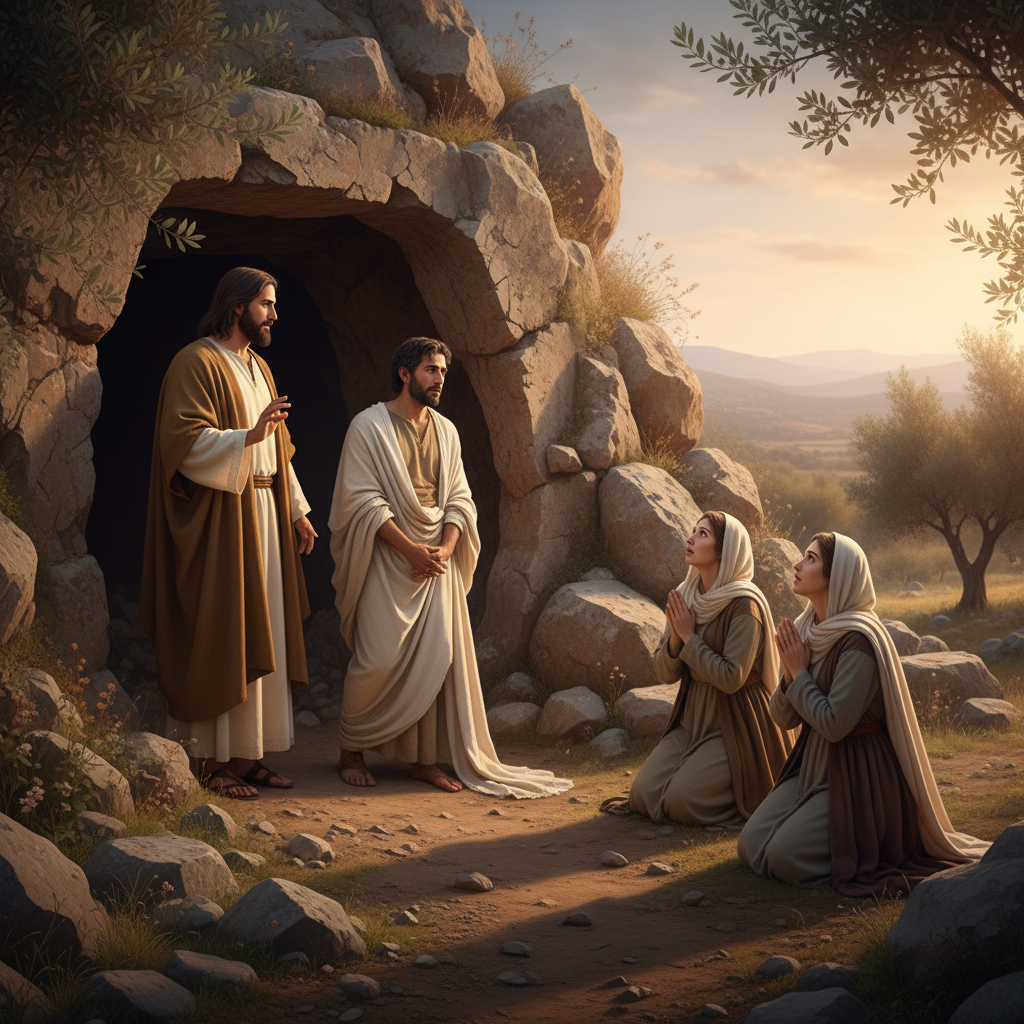
Lazarus of Bethany was a man from the town of Bethany, the brother of Mary and Martha, and a dear friend of Jesus Christ. He is known for being the subject of one of Jesus’s most profound miracles: being raised from the dead four days after his burial, as recorded in the Gospel of John, chapter 11. This event stands as a powerful testament to Jesus’s divinity and His power over death.
In a world where death casts its long shadow, the biblical account of Lazarus of Bethany stands as a beacon of profound hope and divine power. A man lay entombed for four days, his body already succumbing to decay. Into this scene of ultimate grief, Jesus Christ, the Son of God, stepped forth to demonstrate an eternal truth: He alone holds the keys to life and death.
This article invites you to explore the story of Lazarus in the village of Bethany. We will uncover who he was, his cherished relationship with our Lord, and the awe-inspiring details of the miracle that forever marked him as a living testimony to Christ’s absolute authority. This story is not merely a historical anecdote; it is a vivid demonstration that Jesus is “the resurrection and the life” (John 11:25). He proved He could conquer the grave itself, offering the promise of eternal life to all who believe.
To truly grasp the magnitude of this event and its enduring lessons for believers today, we must first understand the man at its heart. Let us begin by answering the fundamental question: Who was Lazarus of Bethany?
Who Was Lazarus of Bethany?

A Close Friend of Jesus
Lazarus of Bethany stands out in the Gospels as a deeply cherished friend of Jesus Christ. Scripture clearly shows their special bond, highlighting a relationship that was far more than a casual acquaintance.
The Bible states, “Jesus loved Martha and her sister and Lazarus” (John 11:5), underscoring His deep affection for the family. This closeness is further emphasized when Lazarus’s sisters, sending an urgent message about his illness, referred to him as “he whom You love” (John 11:3).
Jesus shared a genuine, human friendship with Lazarus, which reveals the compassionate heart of our Savior. This relationship reminds us that Jesus fully experienced human emotions, and His profound grief over Lazarus’s death is a powerful testament to their bond (John 11:35-36).
This personal connection underscores Jesus’ humanity without diminishing His divine power. In fact, it sets the stage for one of His most astounding miracles. Through this friendship, we see Jesus as both fully God and fully man—a Savior who cares intimately for His people.
The Brother of Mary and Martha
Lazarus was the beloved brother of Mary and Martha. The family lived in Bethany, a village near Jerusalem [1], and their home was a frequent place of rest and hospitality for Jesus and His disciples.
The sisters had distinct personalities. Martha was known for her diligence and service, often handling the practicalities of hosting (Luke 10:38-40). Mary, in contrast, showed her devotion by sitting at Jesus’ feet to listen to His words (Luke 10:41-42) and later anointing them with costly perfume (John 12:3).
The family’s devotion to Jesus was evident in how they welcomed Him into their lives and believed in His power. As a result, their home in Bethany became a spiritual haven where faith flourished. These unique family dynamics are important, as they set the stage for one of the most powerful stories in the Bible.
The Biblical Account of Lazarus’s Death and Resurrection (John 11)

The Message of Sickness
The Gospel of John reveals a deeply personal relationship between Jesus and a family in Bethany: Lazarus and his sisters, Mary and Martha. The story begins when Lazarus fell gravely ill. His anxious sisters sent a simple yet powerful message to Jesus: “Lord, behold, he whom You love is sick” (John 11:3).
At this time, Jesus was not in Bethany but across the Jordan River. Upon hearing the news, He made a remarkable statement, declaring, “This sickness is not unto death, but for the glory of God, that the Son of God may be glorified through it” (John 11:4). This response reveals Jesus’s divine perspective. He saw beyond the immediate pain, knowing His ultimate purpose was to reveal God’s glory.
However, Jesus did not rush to Bethany. Instead, He remained where He was for two more days (John 11:6). This intentional delay was not a sign of indifference but a crucial part of God’s perfect plan. His timing would ensure a greater miracle and undeniably demonstrate His power over death, setting the stage for one of history’s most astonishing events.
Jesus Weeps: The Compassion of Our Savior
When Jesus finally arrived in Bethany, Lazarus had already been in the tomb for four days (John 11:17), meaning any hope of natural recovery was gone. Martha, ever practical, met Jesus first. Her words echoed the family’s grief and underlying faith: “Lord, if You had been here, my brother would not have died” (John 11:21).
Jesus responded with one of the most profound statements in Scripture: “I am the resurrection and the life. He who believes in Me, though he may die, he shall live. And whoever lives and believes in Me shall never die. Do you believe this?” (John 11:25-26). This powerful declaration affirmed His divinity and offered hope beyond the grave.
Mary then arrived, falling at Jesus’s feet with the same heartbroken lament. Seeing her and the others weeping, Jesus was deeply moved and troubled (John 11:33). He asked where they had laid Lazarus, and as they led Him to the tomb, Jesus wept (John 11:35). This short verse speaks volumes about His humanity. His tears were not a sign of doubt but a revelation of His profound compassion and empathy for human suffering. He grieved with those He loved, even while knowing the miracle He was about to perform.
The Command: ‘Lazarus, Come Forth!’
At the somber tomb, Jesus commanded, “Take away the stone” (John 11:39). Martha, concerned about the smell after four days, protested. But Jesus gently reminded her, “Did I not tell you that if you believe, you will see the glory of God?” (John 11:40). Her wavering faith was rekindled, and the stone was moved.
Before performing the miracle, Jesus looked to heaven and prayed aloud, thanking His Father for hearing Him (John 11:41). This prayer served a dual purpose: it affirmed His unity with God the Father and allowed the crowd to witness His direct connection to the Almighty. Then, with a loud voice, Jesus issued the electrifying command: “Lazarus, come forth!” (John 11:43).
Immediately, an impossible sight unfolded. Lazarus, still wrapped in grave clothes, emerged from the tomb alive (John 11:44). Jesus then instructed, “Loose him, and let him go.” This miracle was undeniable proof of Jesus’s absolute authority over death itself. He did not merely heal Lazarus; He brought him back from death’s grip—an act only the Son of God could perform.
The Aftermath of the Miracle
The resurrection of Lazarus sent shockwaves throughout Bethany and Jerusalem. Many who witnessed this astounding event came to believe in Jesus (John 11:45), their faith ignited by the powerful demonstration of God’s glory. However, not everyone reacted with belief. Some witnesses went and reported the miracle to the Pharisees (John 11:46).
This miracle, intended for God’s glory, ironically became the catalyst for the religious leaders’ plot against Jesus. The chief priests and Pharisees convened the Sanhedrin (John 11:47). Fearing they would lose their authority, they worried that widespread belief in Jesus would cause the Romans to intervene and destroy their nation. Caiaphas, the high priest that year, then made a chilling declaration, stating it was “expedient for us that one man should die for the people, and not that the whole nation should perish” (John 11:50). Unknowingly, he prophesied Jesus’s atoning death for all humanity.
Ultimately, the raising of Lazarus solidified Jesus’s identity as the Son of God and Master of life and death. The event served as a powerful foreshadowing of Jesus’s own resurrection from the dead and remains a cornerstone of the Christian promise, assuring all believers of eternal life through faith in Him. Jesus Christ is truly Lord over all, including death itself.
What was Lazarus of Bethany known for?
Being Raised from the Dead by Jesus
Lazarus of Bethany is best known for one of the most astonishing miracles in the Gospels: being raised from the dead by Jesus Christ. This event, detailed in John chapter 11, was a profound demonstration of Jesus’ authority over life and death. Lazarus had been dead for four days, and his body was already in the tomb and beginning to decay (John 11:39).
When Jesus arrived in Bethany, He first comforted Lazarus’s sisters, Martha and Mary. He then declared, “I am the resurrection and the life. The one who believes in me will live, even though they die” (John 11:25). This powerful statement set the stage for the miracle to come. Jesus then went to the tomb and showed His deep compassion by weeping with those who mourned (John 11:35).
With a loud voice, Jesus commanded, “Lazarus, come out!” (John 11:43). Immediately, Lazarus emerged from the tomb, still wrapped in his burial cloths. This public display of divine power affirmed Jesus’ identity as the Son of God. It was not a simple resuscitation but a true resurrection after death had taken hold. This miracle served as a powerful sign that confirmed Jesus’ words and led many to believe in Him (John 11:45).
A Living Testimony to Christ’s Power
Lazarus’s fame did not end with his return from the grave. He became a living testament to the power of Jesus Christ, and his presence was undeniable proof of the miracle. As a result, people flocked to Bethany not only to see Jesus but also to see Lazarus himself (John 12:9). He was a tangible, walking sign of God’s glory and Jesus’ authority over death.
The impact of this miracle was twofold. On one hand, it deepened the faith of many believers. On the other, it strengthened the resolve of the religious authorities to kill both Jesus and Lazarus (John 12:10-11). They feared the widespread belief in Jesus that Lazarus’s story inspired. Their hostile reaction only underscored the reality and influence of the miracle. Simply by living, Lazarus became an unshakeable witness for Christ. His life after death provided irrefutable evidence that Jesus is the Lord of all, offering eternal life to everyone who believes (John 3:16).
What happened to Lazarus of Bethany after his resurrection?
The Plot to Kill Lazarus (John 12:9-11)
Lazarus’s resurrection was a monumental event that undeniably affirmed Jesus Christ’s divine power. This miracle drew immense attention, with large crowds coming not only to see Jesus but also Lazarus himself—the man who had been raised from the dead (John 12:9).
As a result, many people began to believe in Jesus. Lazarus served as a living, breathing testimony, and his presence strengthened the faith of the people. The chief priests and Pharisees, however, saw this growing belief as a grave threat. With hardened hearts, they refused to acknowledge Jesus as the Son of God, fearing instead that they would lose their power and influence (John 11:48).
John 12:10-11 reveals their wicked plan:
“So the chief priests made plans to put Lazarus to death as well, because on account of him many of the Jews were going away and believing in Jesus.”
This desperate act shows their spiritual blindness, as they sought to eliminate the evidence of Jesus’s miracle by silencing a living witness to God’s glory. The plot not only highlights their opposition to Christ but also underscores the profound impact of Lazarus’s resurrection. It served as a catalyst for belief for many and foreshadowed the intense hostility Jesus would face, which ultimately led to His own crucifixion. Yet, even in this darkness, Jesus’s power was undeniable, for Lazarus continued to live, bearing witness to Him.
Traditions About His Later Life
The Bible provides no further details about Lazarus of Bethany after the plot to kill him. For this reason, his life after the events in John 12 is a subject of Christian tradition. While these accounts are not part of inspired Scripture, they offer insight into how early believers honored his memory and celebrated his unique role in Christ’s ministry.
Two main traditions exist concerning Lazarus’s later life:
- Bishop of Kition, Cyprus: One prominent tradition states that Lazarus fled Judea to escape persecution and traveled to Cyprus. There, he was ordained by the Apostles Paul and Barnabas as the first Bishop of Kition (modern-day Larnaca) [2]. This tradition claims he lived for another 30 years and died a natural death, thus experiencing it twice. His tomb in Larnaca is a revered site that continues to draw pilgrims.
- Preaching in Gaul (France): Another tradition, more prevalent in Western Christianity, suggests Lazarus traveled to Gaul, where he is said to have preached the Gospel. Specifically, he is associated with Marseille, France. This account often links him with his sisters, Mary and Martha, in evangelizing the region, showing how early followers carried Christ’s message far and wide.
While these traditions are fascinating, they are not scriptural facts. Nevertheless, Lazarus’s story remains powerful. His resurrection serves as an eternal testament to Jesus Christ’s ultimate authority over death and sin, forever pointing to Jesus as the giver of eternal life.
Was Lazarus of Bethany a real person?
The Historical and Biblical Evidence
Many wonder if Lazarus of Bethany was a real person. The answer is an unwavering yes. The most authoritative evidence for his existence comes directly from the Bible, specifically the Gospel of John.
The Gospel of John presents a detailed account of Lazarus, his sisters Mary and Martha, and their close friendship with Jesus. This story is not a vague allegory; it provides specific details like geographical locations, personal relationships, and emotional responses that point to its historical accuracy. For instance, the narrative identifies Lazarus’s home in Bethany, a village near Jerusalem, and describes Jesus’s journey to get there [3].
Key details from John chapter 11 that confirm he was a real person include:
- Specific Family Ties: He is identified as the brother of Mary and Martha (John 11:1-2). This family connection makes the account more tangible and human.
- Jesus’s Affection: The scripture clearly states, “Now Jesus loved Martha and her sister and Lazarus” (John 11:5). This personal connection highlights a real, tangible relationship.
- Eyewitness Details: The account describes Jesus weeping (John 11:35), Martha’s direct questioning (John 11:21), and the stone being rolled away from the tomb (John 11:39). These are specific actions of real people, not generic descriptions.
- Public Spectacle: The resurrection of Lazarus was a public event. It was witnessed by many people who had come to mourn with Mary and Martha (John 11:19, 45), making it impossible to dismiss as a rumor.
- Consequential Reactions: The miracle had profound consequences. While many believed in Jesus because of it (John 11:45), it also intensified the plot by religious leaders to kill Jesus and even Lazarus (John 11:47-53; John 12:10). These strong reactions suggest the miracle was a real, disruptive event that could not be ignored.
Therefore, from the perspective of biblical authority, Lazarus is presented as a real historical figure. The Bible, as the inspired Word of God, affirms his existence.
Why the Account of Lazarus is Central to Christian Faith
The story of Lazarus is more than just a compelling narrative—it is a cornerstone of the Christian faith. The miracle is one of the most powerful demonstrations of Jesus’s divine nature and authority because, in this event, He did not just heal a sickness; He conquered death itself.
Furthermore, the account of Lazarus serves several vital theological purposes:
- Affirmation of Jesus’s Divinity: Before raising Lazarus, Jesus declares, “I am the resurrection and the life. The one who believes in me will live, even though they die” (John 11:25). By following this bold statement with the raising of a man dead for four days, Jesus powerfully demonstrates His claim to be God. His power over death is unique to the Creator.
- Confirmation of God’s Power Over Death: The miracle clearly shows that Jesus Christ has ultimate power over life and death. He simply spoke, and Lazarus came out of the grave (John 11:43-44). This reminds believers that no situation is too difficult for God.
- A Foreshadowing of Jesus’s Own Resurrection: Lazarus’s return to life was a powerful preview of Jesus’s own resurrection and His ultimate victory over death. Just as Lazarus came out of the tomb, Jesus would also rise, securing salvation for all who believe (1 Corinthians 15:20-22).
- Promise of Eternal Life for Believers: The story offers immense hope and comfort by underscoring the Christian promise that death is not the end. Believers are assured of a future resurrection and eternal life with Him (John 11:26), a hope that anchors their faith.
- Demonstration of Jesus’s Compassion: Despite knowing He would raise Lazarus, Jesus still wept at the tomb (John 11:35). This reveals His deep compassion and empathy for human suffering. Even with all power, He shares in our grief as a compassionate Savior.
Ultimately, the story of Lazarus offers powerful proof of Jesus’s identity as the Son of God, the Lord of life, and the giver of eternal hope. It strengthens our faith in His resurrection and in our own future with Him. As Jesus said, He is the Way, the Truth, and the Life (John 14:6), and through Him, death loses its final sting.
What Does the Story of Lazarus Teach Christians Today?

Jesus Christ Has Ultimate Power Over Death
The story of Lazarus serves as a profound demonstration of Jesus Christ’s absolute authority over death. When Jesus arrived in Bethany, Lazarus had already been in the tomb for four days (John 11:17). This detail is crucial because it removed any doubt that Lazarus was truly dead; his body was already decaying, a fact Martha confirmed when she noted the stench (John 11:39).
Jesus’s command, “Lazarus, come forth!” (John 11:43), was not a plea but a divine order that immediately brought a decomposing man back to vibrant life. This miracle showcased His power as the Giver of life and affirmed His unique connection to God the Father. In this act, Jesus revealed His true identity: not just a prophet or teacher, but God Incarnate, with dominion over all creation—including the ultimate enemy, death.
This event powerfully confirmed what Jesus had declared to Martha: “I am the resurrection and the life” (John 11:25). His statement was not a future promise but a present reality, demonstrated through His immediate and undeniable power. While this demonstration bolstered the faith of many, it also solidified the opposition of some religious leaders (John 11:47-53). Nevertheless, the truth was evident: Jesus holds the keys to life and death (Revelation 1:18).
A Foreshadowing of Jesus’s Own Resurrection
While Lazarus’s resurrection was a powerful miracle, it was also a significant prophetic act that foreshadowed an even greater event: Jesus’s own resurrection from the grave. A vital distinction exists between the two. Lazarus was raised *by* Jesus and would eventually die again. In contrast, Jesus raised *Himself* (John 2:19-21), conquering death eternally in a complete triumph over sin and the grave.
The raising of Lazarus helped prepare the disciples for this ultimate victory by showing them that death had no hold on their Master. Although Jesus often spoke of His impending death and resurrection (Matthew 16:21), the miracle of Lazarus offered a tangible, living example. It demonstrated that what Jesus promised, He could surely perform. His power over Lazarus’s tomb served as confirmation of His power over His own, a foundational truth that gives hope to all believers.
Jesus’s resurrection is unique; it is the very cornerstone of the Christian faith (1 Corinthians 15:13-14). In this context, Lazarus’s return to life was a sign pointing directly to the unparalleled glory and eternal nature of Christ’s ultimate triumph. It confirmed His divine identity as the only one with the power to lay down His life and take it up again (John 10:18).
The Promise of Eternal Life for All Believers
Perhaps the most comforting lesson from the story of Lazarus is the promise of eternal life, a promise Jesus explicitly linked to Himself. He told Martha, “Whoever believes in me, though he die, yet shall he live, and everyone who lives and believes in me shall never die” (John 11:25-26). This powerful declaration, which is central to the Gospel, offers profound hope.
For Christians today, the story of Lazarus offers immense assurance. Although physical death is a reality for everyone, it is not the end for those who put their faith in Jesus Christ. Instead, it is merely a transition into eternal life with Him. The promise of a glorious resurrection (1 Corinthians 15:51-54) is a truth that changes everything, removing the sting of death (1 Corinthians 15:55-57).
Through Jesus’s sacrifice on the cross and His subsequent resurrection, the path to eternal life has been opened. As John 3:16 states, “For God so loved the world, that he gave his only Son, that whoever believes in him should not perish but have eternal life.” The miracle in Bethany serves as a powerful reminder of this divine gift, reaffirming Jesus Christ as Lord and Savior. He is the Way, the Truth, and the Life (John 14:6), the only one who offers the true hope of everlasting life, secured by His victory over the grave.
Frequently Asked Questions About Lazarus of Bethany
Frequently Asked Questions About Lazarus of Bethany
Was Lazarus of Bethany wealthy?
While the Bible does not explicitly state that Lazarus of Bethany was wealthy, several details in the Gospels suggest his family had significant resources.
- Hosting Jesus and His Disciples: Lazarus and his sisters, Mary and Martha, owned a home in Bethany where they frequently hosted Jesus and His disciples (Luke 10:38-42). Owning a home large enough for such hospitality points to financial stability.
- A Costly Gift of Perfume: After Jesus resurrected Lazarus, his sister Mary anointed Jesus’s feet with pure nard, a very expensive perfume (John 12:1-3). The value of this perfume was 300 denarii—equal to a laborer’s annual wages [4]. To own and use such a valuable item suggests the family was quite well-off.
Although the family clearly had resources, Scripture emphasizes their faith and relationship with Jesus Christ, not their material possessions. Their true wealth was their spiritual connection to the Lord.
What is Bethany called today?
The ancient village of Bethany, home to Lazarus, Mary, and Martha, is known today as al-Eizariya (or al-Azariya), a name with deep historical significance.
- Location: Today, the village of al-Eizariya is located on the eastern slope of the Mount of Olives, about two miles from Jerusalem.
- Meaning: The name itself is a living testament to the town’s history. In Arabic, “al-Eizariya” means “The Place of Lazarus,” directly preserving the memory of Jesus raising Lazarus from the dead [5].
Thus, the very name of the modern village continues to echo the profound miracle recorded in the Gospel of John.
What was Lazarus of Bethany’s cause of death?
The Bible states that Lazarus died from an illness, but it does not specify the exact nature of his sickness.
- An Unspecified Illness: The Gospel of John simply says, “Now a certain man was sick, Lazarus of Bethany…” (John 11:1).
- A Message to Jesus: His sisters sent a message to Jesus, telling Him, “Lord, behold, he whom You love is sick” (John 11:3).
- A Divine Purpose: Although Jesus knew Lazarus was ill, He intentionally delayed His arrival. He explained that the situation was for God’s glory, stating, “This sickness is not to end in death, but for the glory of God, so that the Son of God may be glorified by it” (John 11:4).
So, while Lazarus’s death resulted from a natural illness, it was part of a divine plan. It created the opportunity for Jesus to demonstrate His power over death and reveal Himself as “the resurrection and the life” (John 11:25).
Which Bible verses tell the story of Lazarus?
The primary account of Lazarus’s sickness, death, and resurrection is powerfully told in the Gospel of John.
- The Main Story (John 11:1-44): This passage details the core narrative, including:
- Lazarus falling ill and his sisters sending for Jesus.
- Jesus’s intentional delay and His teaching on being the Resurrection and the Life.
- His compassion and weeping with Mary and Martha.
- The miraculous moment He commands, “Lazarus, come forth!” and raises him from the tomb.
- The Aftermath (John 12:1-11): These verses describe what happened next, such as:
- A dinner held in Bethany with the resurrected Lazarus present.
- Mary anointing Jesus’s feet with expensive perfume.
- A plot by the chief priests to kill Lazarus, because his resurrection was causing many people to believe in Jesus.
Together, these chapters powerfully affirm Jesus’s divine authority, demonstrating His power over death and offering the promise of eternal life to all who believe.
Sources
- https://www.biblegateway.com/resources/hastings-dictionary/Bethany
- https://www.johnsanidopoulos.com/2009/10/lazarus-friend-of-christ-and-first.html
- https://www.biblicalarchaeology.org/daily-bible-dig/new-light-on-bethany/
- https://www.biblicalarchaeology.org/daily-dig/anointing-jesus-with-nard/
- https://www.bethany-placeoflazarus.com/the-town-of-bethany