
The Pool of Bethesda scripture is found in John 5:1-15. It describes Jesus encountering a large crowd of disabled people waiting for the stirring of the waters. There, He sovereignly chose to heal a man who had been an invalid for 38 years, demonstrating His power and compassion.
Have you ever felt like you’ve been waiting your whole life for an answer that never seems to come? In the fifth chapter of the Gospel of John, the Pool of Bethesda scripture reveals one of the most moving and deeply personal miracles Jesus ever performed. In the heart of Jerusalem, beside five covered porches, a great multitude of sick, blind, lame, and paralyzed people lay waiting — hoping that the next stirring of the water might finally bring healing. Among them was one man at the pool of Bethesda who had been suffering for thirty-eight years, longing for relief but never quite reaching it in time. Then Jesus walked into the scene and changed everything.
This miraculous encounter recorded in John 5 is far more than an ancient story — it is a living testament to the power, compassion, and sovereignty of Jesus Christ over every affliction and every hopeless situation. In this complete guide, we will explore what the pool of Bethesda scripture truly means, examine who the man at the pool of Bethesda was, and uncover the rich spiritual truths this passage holds for every believer today. Whether you are a mature Christian seeking deeper understanding or someone just beginning to explore the claims of Jesus, this passage has a powerful message waiting for you. Let us dive into God’s Word together and discover what Jesus wants us to learn from this extraordinary moment in Scripture.
What Does the Pool of Bethesda Scripture Tell Us?
The Pool of Bethesda scripture reveals one of the most powerful encounters between Jesus and a suffering individual in the New Testament. Found in John chapter 5, this passage offers profound insights into the character of Jesus Christ and His mission on earth.
Let us consider what this remarkable passage communicates to us today.
The Account of the Man at the Pool of Bethesda
The story begins with Jesus traveling to Jerusalem. Near the Sheep Gate, He encounters a pool called Bethesda, surrounded by five covered colonnades. A great number of disabled people lay in these porches, including the blind, the lame, and those with withered limbs (John 5:2-3).
Among them was a man who had been an invalid for thirty-eight years. This detail is significant. For nearly four decades, this man had suffered physically, emotionally, and spiritually. Furthermore, he had no one to help him into the pool when the water stirred (John 5:5-7).
Jesus Takes the Initiative
What makes this scripture so transformative is that Jesus approached the man first. The man did not request healing. He did not cry out for help. In fact, the man explained his hopeless situation by saying, “Sir, I have no one to put me into the pool when the water is stirred. While I am trying to get in, someone else goes down ahead of me” (John 5:7, NIV).
Jesus did not wait for an invitation. He saw the man’s suffering and acted. In the same way, God sees our struggles. He does not wait for us to have perfect faith before He moves. As a result, this story reveals a God of compassion who pursues us.
The Divine Command to Be Healed
Jesus spoke three commands directly to the man:
- “Get up!” — A call to action and faith
- “Pick up your mat!” — Evidence of restoration
- “Walk.” — The result of obedience to Jesus
Immediately, the man was healed. He picked up his mat and walked (John 5:8-9). This miraculous healing in a single moment demonstrates the absolute authority of Jesus Christ over sickness and disability. In addition, it reveals that no condition is beyond His power.
What This Passage Teaches About Jesus Christ
The Pool of Bethesda scripture tells us several essential truths:
- Jesus is the true healer. No ritual, pool tradition, or human effort could restore this man. Only the direct command of Jesus brought wholeness.
- Jesus sees individual suffering. Amid a great multitude of needy people, Jesus singled out one man. He knows each person by name and cares about their specific pain.
- Jesus has authority over time. Thirty-eight years of sickness were reversed instantly. For God, no problem is too old or too deep to resolve.
- Jesus calls us to obedience. The man was asked to do something impossible in his own strength. Yet when he obeyed Jesus, the healing followed.
The Deeper Meaning of the Encounter
Beyond the physical healing, this passage carries deep spiritual significance. Throughout scripture, water pools often symbolize waiting for human or ceremonial solutions. However, Jesus superseded every system of healing by His own divine power.
The reading of the Bible reveals a consistent truth: humankind cannot save itself. Regardless of how long someone waits or how much effort they exert, only Jesus Christ provides deliverance. As Jesus told the man at Bethesda, recovery and wholeness come through a personal encounter with the Son of God [1].
Our Response to This Scripture
The man at the Pool of Bethesda represents every person who feels stuck, forgotten, or hopeless. Perhaps you have been waiting for decades in your own struggle. Meanwhile, the truth of this passage remains: Jesus is calling to you today.
His command to the invalid applies to us as well. Get up. Take what defined your weakness and walk forward by faith. A willingness to obey Jesus opens the door to complete transformation. If you find yourself in a season of waiting, take heart. The same Jesus who commanded a paralyzed man to rise is alive and active in our world today.
“For I know the plans I have for you,” declares the Lord, “plans to prosper you and not to harm you, plans to give you hope and a future” (Jeremiah 29:11, NIV).
Who Was the Man at the Pool of Bethesda?
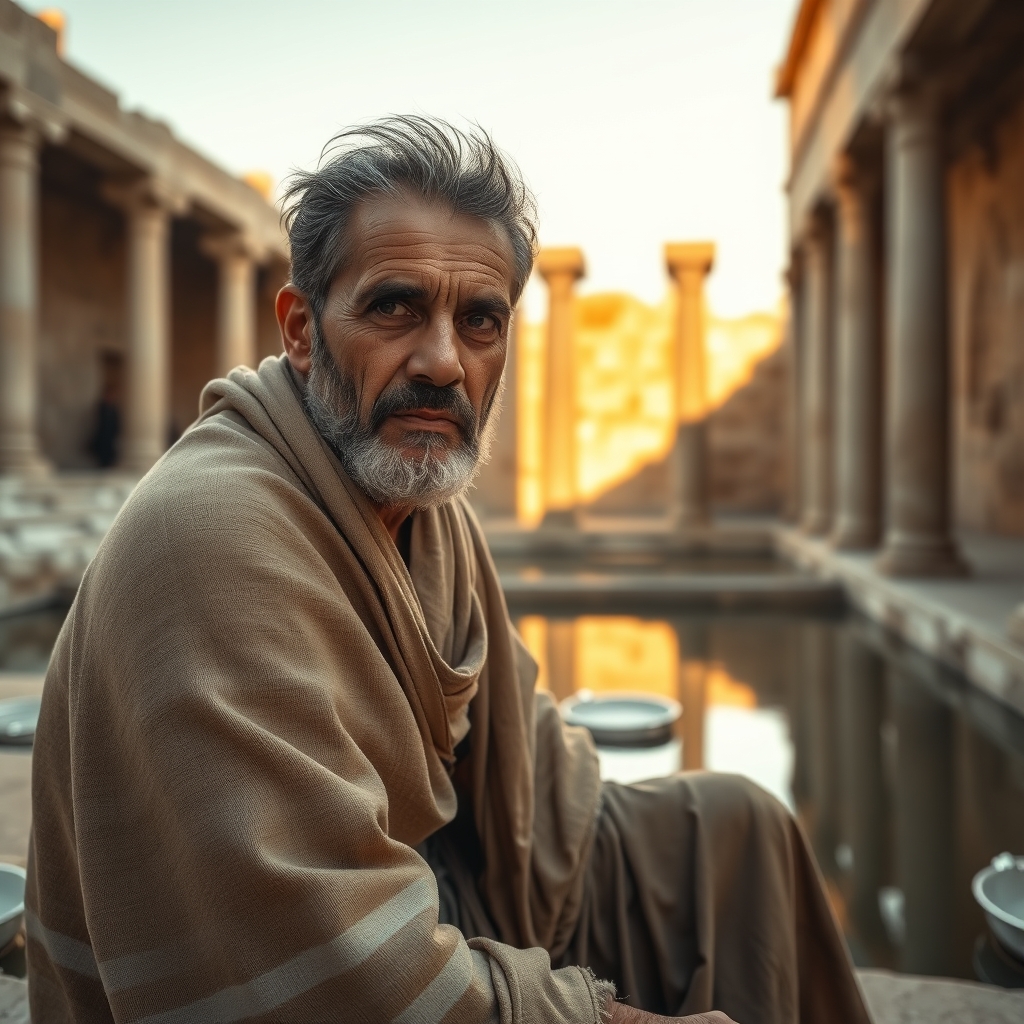
The Pool of Bethesda scripture, found in John 5:1-15, introduces us to one of the most remarkable encounters in the entire New Testament. At the heart of this powerful narrative stands an unnamed man. His condition reveals the depth of human suffering. Yet his encounter with Jesus reveals the limitless power of God’s healing grace.
The Identity of the Man
This man remains unnamed in Scripture. However, his identity is revealed through his condition rather than his name. He was a paralytic—completely unable to move or walk. He had been disabled for 38 years. This was nearly a lifetime of suffering.
Furthermore, this man was not alone at the pool. He was among many others who suffered from various ailments (John 5:3). The text describes a crowd of blind, lame, and paralyzed people. All of them waited for the stirring of the water. Yet Jesus chose to approach this one specific man.
The selection of this man carries profound theological weight. His 38-year affliction parallels Israel’s wandering in the wilderness. God healed that generation after they finally obeyed His voice. In the same way, this man’s healing pointed to a greater spiritual restoration that only God could provide.
His Condition and His Hopelessness
The man at the pool of Bethesda lived in profound hopelessness. His condition had not improved in nearly four decades. He had no one to help him into the pool when the waters stirred. This detail is critically important.
Jesus approached him and asked a pointed question: “Wilt thou be made whole?” (John 5:6, KJV). On the surface, this seems like an obvious question. However, it carried deep spiritual significance. Sometimes our greatest barrier to healing is not the illness itself. It is our resignation to it.
The man responded with an explanation of his circumstances:
- He had no helper: No one would carry him to the water in time.
- Others always went first: He was perpetually pushed aside by those who could move faster.
- He had accepted his fate: After 38 years, his hope had largely faded.
This paints a vivid picture of despair. The man was physically paralyzed, socially marginalized, and emotionally depleted. He represents every human being who feels forgotten by God.
The Duration of His Suffering
The fact that he suffered for 38 years is theologically significant. In the Old Testament, the Israelites wandered in the wilderness for 40 years due to their disobedience (Numbers 14:33-34). The number 38 suggests prolonged suffering under the weight of a fallen world.
Furthermore, diseases and chronic afflictions in Scripture often symbolize the deeper condition of sin. This man’s paralysis was not merely physical. It represented humanity’s inability to save itself. He could not heal himself. He could not even drag himself to the water. He was utterly dependent on external intervention.
This is precisely where Jesus enters the story.
Jesus Sees Him Personally
One of the most beautiful truths in this passage is that Jesus sought out this man personally. The Bible says, “A certain man was there” (John 5:5). This phrasing highlights a specific individual among a crowd. In a sea of suffering people, Jesus focused His attention on one man.
This reveals a foundational truth about our Savior:
- Jesus does not see crowds—He sees individuals. He knew this man by name.
- He knows the details of our suffering. Christ knew about the 38 years of waiting.
- He came intentionally. Jesus went to where this man was. He did not wait for the man to come to Him.
This is consistent with the entire testimony of Scripture. Jesus came “to seek and to save that which was lost” (Luke 19:10). He pursued the lepers, touched the unclean, fed the hungry, and comforted the broken. The man at the pool of Bethesda experienced this firsthand.
What His Healing Revealed About Jesus
The healing of this man demonstrated several profound truths about who Jesus is. Jesus did not wait for the water to stir. He did not need an angel to trouble the pool. He spoke a word, and paralysis ended.
Consider what happened:
- Jesus spoke to him. This was the first personal attention this man had received in decades.
- Jesus commanded him: “Rise, take up thy bed, and walk” (John 5:8).
- The man obeyed instantly. He responded to the voice of Christ.
- He was made completely whole. Nothing else was needed. One word from Jesus accomplished what 38 years of waiting could not.
This miracle affirmed that Jesus is God incarnate. Only God holds absolute authority over the human body. Physical healing is miraculous but temporary. Spiritual healing through Christ is eternal. Jesus Himself confirmed this truth throughout His ministry (Matthew 9:6).
The Man as a Symbol for All Humanity
This man’s story transcends his individual experience. It serves as a metaphor for the human condition before Christ. Consider the parallels:
| The Man’s Physical Condition | Our Spiritual Condition |
|---|---|
| He was paralyzed and could not move toward healing on his own | We are spiritually dead in sin and unable to save ourselves (Ephesians 2:1) |
| He waited 38 years without relief | Humanity waited thousands of years for the coming of the Messiah (Galatians 4:4) |
| He had no one to help him into the water | No human effort, ritual, or work can bring us to God for salvation (Ephesians 2:8-9) |
| Jesus found him where he was | While we were still sinners, Christ died for us (Romans 5:8) |
| One word from Christ brought complete healing | One moment of faith in Christ brings eternal life (John 3:16) |
Ultimately, the unnamed man was a real individual who truly suffered. His experience was not imaginary or symbolic at the same time. It was both. God frequently used specific events to teach His greatest spiritual truths.
The Savior Who Seeks the Suffering
The passage concludes with Jesus finding the man later in the temple. He gave him a sobering warning: “Sin no more, lest a worse thing come unto thee” (John 5:14). This confirmed that his affliction was connected to sin.
Furthermore, this warning reveals that physical healing, while great, is not our greatest need. Our deepest need is reconciliation with God. Jesus healed this man’s body. However, He also cared about his eternal soul.
The man at the pool of Bethesda teaches us that Jesus sees those whom the world forgets. He knows those whom society overlooks. He reaches out to those wallowing in despair. If you feel neglected by heaven, the Pool of Bethesda scripture reminds you that Christ came for you personally. He sees you. He knows your name. And He has the power to heal you completely.
For the greatest truth of this passage is not found in a pool or stirred waters. It found its fulfillment in the person of Jesus Christ Himself. He is the living water that never runs dry (John 4:14). He does not merely treat our symptoms. He removes the root cause of all suffering—the devastating power of sin in our lives—through His atoning sacrifice on the cross.
“But God commendeth His love toward us, in that, while we were yet sinners, Christ died for us” (Romans 5:8).
What is the Spiritual Meaning of the Pool of Bethesda?

The Pool of Bethesda scripture in John chapter 5 reveals one of the most spiritually rich encounters in the entire Bible. At first glance, it is simply a miraculous healing story. But beneath the surface, the Pool of Bethesda speaks to every soul who has been waiting for hope, for change, for a breakthrough that never seems to come.
Understanding the spiritual meaning of this account transforms how we read it. It becomes far more than history. It becomes a living message from Jesus Christ to you today.
A Place of Waiting
When we examine the Pool of Bethesda, we find a powerful picture of human desperation.
In Jesus’ day, the pool sat just inside the walls of Jerusalem, near the Sheep Gate. A large crowd of sick people gathered there. The blind, the lame, and the paralyzed all lay on the stone porches surrounding the water, hoping for healing. Ancient tradition held that an angel would stir the waters, and the first person to enter would be healed.
However, think about what this scene truly represents:
- People abandoned by society and forgotten by the world
- Human effort and striving without guarantee of results
- Competition, where the strong pushed past the weak
- A culture built on “the first to act gets the blessing”
Furthermore, this mirrors our own lives. We all have seasons of waiting. We wait for healing. We wait for answers. We wait for God’s promises to unfold. Sometimes we feel forgotten. Sometimes we wonder if God even sees us.
In addition, the man at the pool of Bethesda endured this wait for thirty-eight years. For nearly four decades, he reached for the water and failed. Others always arrived before him. His condition seemed permanent. His hope had grown thin.
Yet into this place of failure and neglect, Jesus walked. He did not avoid the broken. He sought them out. And His very presence transformed the meaning of Bethesda forever.
As a result, “Bethesda” means “house of mercy” or “house of grace” in Hebrew. Before Jesus arrived, mercy was scarce. People competed selfishly for a single healing. After Jesus revealed Himself, mercy became personal, powerful, and freely given.
The spiritual lesson here is clear. Our waiting is never wasted in God’s eyes. He enters our hardest moments with purpose. What we cannot do for ourselves, Christ accomplishes for us.
Jesus as the True Healer
The Pool of Bethesda scripture moves beyond physical restoration. It reveals a deeper question. Where do we place our faith for healing and wholeness?
During Jesus’ time, many believed the angel in the water held the power. The man at the pool of Bethesda relied on an outside force. He needed the water. He needed other people. And after thirty-eight years, those dependencies had failed him completely.
In contrast, Jesus introduced something radically different. He did not ask the man about the water. He did not speak of the angel. Instead, He asked one profound question:
“Wilt thou be made whole?” (John 5:6, KJV)
This question pierces every heart. Will you truly receive what I offer? Or will you cling to old systems that never delivered?
Jesus then issued a simple command. “Rise, take up thy bed, and walk.” No ritual was required. No water was stirred. No angel appeared. The power of Christ alone restored a broken body completely.
Consider what this reveals about our own lives:
- We often exhaust ourselves on systems that cannot save us
- Christ alone holds authority over every sickness and bondage
- His word carries power to accomplish what no human effort can
- True healing comes through obedient faith in Christ alone
In addition, the man at the pool of Bethesda responded immediately. He did not argue with Jesus. He did not request proof. He rose, gathered his mat, and walked. His obedience followed instantly.
This account reminds us that faith means trusting Jesus in action. Faith means stepping forward even when circumstances remain unchanged. We walk because Christ has spoken. His word never fails.
Furthermore, Jesus is not limited to physical restoration. The true healing He offers reaches the deepest wounds of the human soul. Sin separates us from God. Brokenness consumes our peace. Despair clouds our future.
Yet Jesus meets every need. He heals our relationship with God through the cross. He restores our identity as children of the Almighty. He gives purpose to lives once marked by failure.
The Pool of Bethesda scripture points us to one undeniable truth. Jesus Christ is the source of all mercy and healing. We do not merely hope in moving water. We trust in the living Son of God.
As you reflect on this passage, remember that Christ is near today. He asks you the same question He asked so long ago. Will you receive His grace?
Why Did Jesus Only Heal One Man at the Pool of Bethesda?
The pool of Bethesda scripture tells a fascinating story. John chapter 5 describes a large crowd of disabled, blind, lame, and paralyzed people waiting by the pool. Yet, Jesus approached and healed only one man. Some readers wonder why our Lord did not heal everyone present that day. This moment actually reveals profound truths about how Jesus works in our lives. Understanding His purpose deepens our faith and trust in His plan.
Healing the Crowd Was Not God’s Primary Purpose That Day
Jesus is always compassionate toward those who suffer. However, His first coming was not meant to heal every sick person on earth. Instead, He came to bring eternal salvation through His death and resurrection. In addition, His miracles served to confirm His identity as the Son of God. Each sign pointed people to faith in Him as Lord and Savior.
Jesus Sought This Man Intentionally
The text shows that Jesus asked the man, “Do you want to be made whole?” (John 5:6). This question may seem unusual. Yet, it reveals that the Savior wanted to engage the man personally. Jesus did not merely perform a random act of kindness. He sought a real encounter. Furthermore, Jesus later found the same man in the temple and warned him to sin no more (John 5:14). This follow up demonstrates that spiritual restoration mattered more than physical relief alone.
The Man Had Long Believed That His Healing Depended on Something Else
For thirty eight years, this man believed he needed someone to put him into the troubled water. He placed his hope in the pool rather than seeking the Lord directly. Many people today look to careers, money, relationships, or circumstances for hope. However, true freedom is found only in Christ. Jesus wanted to redirect the man’s faith from empty rituals to His living Word.
Jesus Values Personal Encounters Over Spectacular Crowd Events
Throughout the Gospels, Jesus often chose personal encounters over large scale displays. For example, He spoke with Nicodemus privately at night (John 3). He also spoke with the Samaritan woman alone at the well (John 4). Likewise, He stopped for blind Bartimaeus while a whole crowd walked by (Mark 10:46 52). None of these people earned His attention because of their worthiness. In each case, Jesus broke cultural norms to show His love. The Savior still seeks us one by one today.
God’s Sovereignty in Choosing Who to Heal
Scripture teaches that the Lord works according to His perfect will. He is sovereign over all things, including sickness and healing. Therefore, we may not always understand why He heals some and not others. The apostle Paul himself prayed three times for his thorn in the flesh to be removed. The Lord answered, “My grace is sufficient for you” (2 Corinthians 12:9).
This does not mean the Lord is uncaring. On the contrary, His silence often serves a greater purpose. He may use trials to build perseverance and deepen trust. Only eternity will reveal the full reasons behind every decision.
| What Might Seem Unfair | What God May Be Doing |
|---|---|
| One man healed while others waited | Demonstrating Christ’s personal call to repentance |
| Prayers for healing go unanswered | Strengthening faith and producing eternal reward |
| Suffering remains in life | Displaying God’s power through human weakness |
Every Miracle Points to Our Need for Salvation
It is also important to remember that even the man at the pool of Bethesda would eventually grow old and die one day. Physical healing offered in this life is temporary. Eternal life in Jesus is forever. The Lord uses temporary miracles to reveal a permanent reality. Only Christ can save the soul for all eternity.
For this reason, the greatest miracle is not a healed body. It is a transformed heart. When we trust in Jesus as our personal Savior, we receive forgiveness and everlasting life (Ephesians 2:8 9). No earthly body can offer that promise.
The Savior Still Sees and Cares for You Today
If you have ever felt overlooked, the pool of Bethesda scripture offers tremendous comfort. Jesus knew every person gathered around that pool. Nothing escapes His sight. He knows your name, your pain, and your situation. In Matthew 10:30, He reminds us that “the very hairs of your head are all numbered.”
Therefore, place your full confidence in the Lord Jesus Christ. He is always working for your good, whether through healing, provision, or sustaining grace. Trust in His perfect timing and sovereign plan. Above all, rest in the finished work of Jesus on the cross and through His glorious resurrection. He alone offers hope that will never fade.
The Angel at the Pool of Bethesda
The Angel at the Pool of Bethesda
The story of the man at the pool of Bethesda is one of the most powerful healing miracles recorded in scripture. Yet woven into this account is a mysterious element that has intrigued believers for centuries. An angel is said to stir the waters of the pool. For those studying the pool of bethesda scripture, understanding this detail deepens our faith. It also reveals the sovereign hand of God at work in every circumstance.
Who Was the Angel at the Pool of Bethesda?
The Gospel of John describes a tradition that many people believed about the pool of Bethesda. According to John 5:4 (KJV), “For an angel went down at a certain season into the pool, and troubled the water: whosoever then first after the troubling of the water stepped in was made whole of whatsoever disease he had.”
Several important truths emerge from this passage:
- The identity of the angel: The Bible does not name this angel. Some Bible scholars suggest the angel could have been a messenger sent by God to demonstrate His compassion. Others believe this was part of a tradition among the people that may or may not have been based on actual angelic activity.
- The purpose of the angel’s action: Whether the angel literally stirred the water or this was a common belief among those who gathered there, the account reveals something important. God’s people were looking for healing. They were desperate and waiting for any sign of divine intervention.
- God’s consistent nature: Throughout scripture, God has always shown compassion toward the suffering. From the plagues of Egypt to the ministries of the prophets, God repeatedly demonstrated His power to heal. The idea that an angel would minister at this pool aligns with God’s character.
- The limited nature of the tradition: Under this belief, only one person could be healed each time the water stirred. The first person in received the blessing. Everyone else left disappointed. This sets the stage perfectly for what Jesus would do next.
Here is where the miracle becomes truly powerful. The man at the pool of Bethesda had been waiting 38 years. Others always beat him to the water. The tradition offered hope but never reached him. Then Jesus arrived with something far greater than stirred water.
Jesus did not wait for an angel. He did not require the man to race to the pool. Instead, He spoke directly to the suffering man and healed him instantly. This shows us that Jesus is not limited by tradition, timing, or any human system. He is the source of all healing and wholeness.
“Jesus saith unto him, Rise, take up thy bed, and walked. And immediately the man was made whole, and took up his bed, and walked.” — John 5:8-9 (KJV)
Why is Verse 4 Missing from John 5?
One of the most common questions about the pool of bethesda scripture concerns a textual mystery. Many modern Bible translations do not include John 5:4. Several translations place this verse in a footnote or set it apart from the main text. This leads many readers to wonder why.
The answer lies in the field called textual criticism. Scholars compare ancient manuscripts of the Bible to determine the most accurate reading. Here is a clear explanation of what is happening:
| Factor | Explanation |
|---|---|
| Manuscript Evidence | John 5:4 and part of verse 3 do not appear in some of the oldest and most reliable Greek manuscripts. Key early manuscripts like Papyrus 66, Papyrus 75, Codex Sinaiticus, and Codex Vaticanus do not contain these verses. |
| Later Manuscripts | These verses do appear in later Greek manuscripts and in early translations such as the Latin Vulgate. This is why the King James Version, published in 1611, includes the passage. |
| Scholarly Consensus | Most modern Bible scholars believe the passage was added by a scribe as an explanatory note. It was likely inserted to explain why so many sick people gathered at the pool. Over time, the note became part of the biblical text. |
| Impact on Doctrine | This textual variation does not affect any core Christian teaching. The message of John 5 remains complete. Jesus is the divine Healer. He has authority over sickness. He shows compassion to the broken. These truths stand firm regardless of this verse. |
Some translations that include John 5:4 are:
- The King James Version (KJV)
- The New King James Version (NKJV)
Translations that omit or footnote John 5:4 include:
- The New International Version (NIV)
- The English Standard Version (ESV)
- The New American Standard Bible (NASB)
The variation reflects a longstanding tradition among Bible translators and manuscript experts rather than any change to the core message of scripture. [2]
The Greater Truth Beyond the Verse
The absence of verse 4 from certain manuscripts should not trouble the faithful reader. The Bible’s message is remarkably preserved across thousands of manuscripts. Scholars have documented over 5,800 Greek manuscripts of the New Testament. This gives us extraordinary confidence in the reliability of scripture. [3]
Furthermore, the central miracle of the man at the pool of Bethesda is never in question regardless of which Bible version you read. Jesus healed the man. That miracle is recorded clearly and consistently across all manuscripts. The strong, Bible-based truth is this: Jesus did not need an angel to do what only He could do. He is the Healer. He is the Savior. He came not to offer a tradition but to offer transformation.
This section of scripture ultimately points us away from rituals, pools, and traditions. It points us directly to Jesus Christ. He is the same yesterday, today, and forever (Hebrews 13:8). Whether an angel troubled the water or not, Jesus remains the one true source of healing, hope, and eternal life for all who believe in Him.
Key Lessons from the Man at the Pool of Bethesda

God’s Perfect Timing
The story of the man at the pool of Bethesda, found in John 5, teaches us a powerful lesson about God’s perfect timing. Verse 6 tells us this man had been suffering for 38 years. Think about that for a moment. Thirty-eight years is an incredibly long time to wait for healing.
Yet Jesus came to the pool at exactly the right moment. Not a day too early. Not a day too late. This truth reminds us that God’s timing is not our timing. Isaiah 55:8–9 says, “For my thoughts are not your thoughts, neither are your ways my ways.”
Here is what we can learn about God’s timing from this passage:
- God never forgets you. Even after 38 years, Jesus sought this man out. He had not been overlooked or abandoned.
- Your waiting is not wasted. God often uses seasons of hardship to prepare our hearts for His purpose.
- Jesus acts when it matters most. His timing is always perfect, even when it does not feel perfect to us.
Ecclesiastes 3:11 assures us that God “has made everything beautiful in its time.” Whatever you are waiting for today, trust that Jesus is working all things together for your good. His plan includes you, and His timing will never fail.
Faith and Obedience
One of the most important lessons from the man at the pool of Bethesda is the connection between faith and obedience. Jesus asked him a direct question in John 5:6: “Do you want to get well?” Now, this might seem like an obvious question. But Jesus was not asking to gather information. He was stirring the man’s heart toward faith and action.
The man did not simply talk about his condition. He was given a command in John 5:8: “Get up! Pick up your mat and walk.” At that moment, the man had to make a choice. Would he obey? Would he trust that Jesus truly had the authority and power to set him free?
He chose to obey. And instantly, he was healed. John 5:9 records, “Instantly the man became well; and he picked up his mat and began to walk.”
This powerful moment teaches us several things about faith and obedience:
- Faith without obedience is incomplete. James 2:17 tells us that “faith by itself, if it is not accompanied by action, is dead.”
- Obeying Jesus leads to breakthrough. The man had to act before he felt the full evidence. Stepping out in faith unlocked the miracle.
- Jesus never asks us to do the impossible alone. His command on John 5:8 came with the power to fulfill it. When Jesus calls us to obey, He always provides the strength to follow through.
Today, Jesus still calls us to step out in faith. Whether it is forgiveness, surrender, or trusting Him in a difficult season, our obedience opens the door for God to move in our lives in powerful ways.
Jesus Sees You
Perhaps the most comforting lesson from this passage is this: Jesus sees you. John 5:6 says, “When Jesus saw him lying there, and He already knew that he had been in that condition a long time…” Jesus knew the man. He knew his pain, his struggle, and the full weight of 38 years of suffering.
This was not a random encounter. The pool of Bethesda was crowded with many sick people, as Verse 3 describes. There were the blind, the lame, and the paralyzed. Yet Jesus walked directly to one man. He saw him as an individual. He saw beyond the crowd and focused on someone the world might have overlooked.
This truth applies to every one of us. Consider the following:
- Jesus knows your story. He understands what you have been through, what you are going through, and what you will face. Psalm 139:1–4 declares, “You have searched me, Lord, and you know me. You know when I sit and when I rise.”
- Jesus comes to you personally. He is not distant or detached. He pursues you with love and intentionality, even in your darkest seasons.
- Jesus offers what no one else can. Others at the pool were focused on waiting for an angel or moving water. But Jesus offered immediate, complete healing. He is the only source of true transformation and lasting hope.
No matter what you are facing today, know this with absolute certainty: Jesus sees you. And He cares deeply. 1 Peter 5:7 reminds us to cast all our anxiety on Him, because He cares for you. You are never forgotten, never invisible, and never beyond the reach of His saving grace.
The man at the pool of Bethesda waited 38 years to encounter Jesus. But when that encounter came, everything changed. Jesus Christ is the same yesterday, today, and forever (Hebrews 13:8). He is still healing, still reaching out, and still calling you by name. Will you respond to Him today?
Frequently Asked Questions
What generation will not pass away?
This question comes from Jesus’ words in Matthew 24:34, where He says, “Verily I say unto you, This generation shall not pass, till all these things be fulfilled.” Many readers connect this to end-times prophecy. However, it is important to understand the context. Jesus was speaking to His disciples about signs that would precede His return. The word “generation” can refer to a specific group of people living at a time, or it can mean a kind of people. In this case, Jesus was assuring His followers that the events He described would happen within the lifetime of those listening. Furthermore, some scholars believe this points to the Jewish people as a whole, who would endure until Christ’s return. Ultimately, this verse reminds us that every word of Jesus is trustworthy and will come to pass exactly as He declared.
What does the year 2026 mean biblically?
The Bible does not assign specific prophetic meaning to the year 2026. Scripture warns against date-setting. In Matthew 24:36, Jesus said, “But of that day and hour knoweth no man, no, not the angels of heaven, but my Father only.” While it is natural to wonder about the times we live in, we must be careful not to build doctrine around speculation. Instead, believers are called to be watchful and ready at all times. The focus should always be on faithfulness to Christ, not on calculating dates. As we study passages like the Pool of Bethesda scripture, we learn that God works according to His perfect timing, not ours. Therefore, rather than seeking hidden meanings in specific years, we should devote ourselves to prayer, obedience, and sharing the Gospel of Jesus Christ.
What is significant about the man at the pool of Bethesda, KJV?
The account of the man at the Pool of Bethesda, as recorded in the King James Version of John 5, is one of the most powerful healing narratives in all of Scripture. This man had been sick for thirty-eight years. He had no one to help him into the pool. Yet Jesus saw him, knew his condition, and chose to heal him. The significance is profound:
- Jesus initiates the encounter. The man did not seek Jesus out. Jesus came to him, showing that God’s grace reaches us even when we cannot reach Him.
- Jesus asks a penetrating question. “Wilt thou be made whole?” (John 5, KJV). This question goes beyond physical healing. It speaks to the man’s deepest need and desire.
- Jesus heals with a single command. “Rise, take up thy bed, and walk” (John 5:8, KJV). There was no ritual, no waiting period. The healing was immediate and complete.
- The man’s life was transformed instantly. After nearly four decades of suffering, he stood up and walked. This miracle testifies to the absolute authority of Jesus over sickness, time, and human limitation.
This story reveals that Jesus is not distant or indifferent. He is the God who sees, who cares, and who acts with sovereign power to restore broken lives.
What are the lessons from the man at the Pool of Bethesda?
The story of the man at the Pool of Bethesda offers rich spiritual lessons for every believer. Here are the key takeaways:
- God’s perfect timing: Jesus came to the man at exactly the right moment. Even when we feel forgotten, God has not forgotten us. His timing is always perfect (Ecclesiastes 3:11).
- Faith and obedience: The man responded to Jesus’ command immediately. He did not argue or hesitate. True faith is demonstrated through obedience, even when the command seems impossible.
- Jesus sees you: Among the “great multitude of impotent folk” (John 5:3, KJV), Jesus noticed one man. He knows your name, your pain, and your story. You are never invisible to Him (Psalm 139:1–3).
- Jesus is the true source of healing: The man had been waiting by the pool for years. But the pool could not heal him. Only Jesus could. This teaches us to place our hope in Christ, not in circumstances or human solutions.
- Transformation leads to testimony: After his healing, the man carried his bed and glorified God. When Jesus changes your life, it becomes a testimony to His power and goodness.
Meaning of Bethesda in the Bible
The name Bethesda comes from the Hebrew and Aramaic languages. It means “House of Mercy” or “House of Grace.” This meaning is deeply significant when we consider the events recorded in John 5. The Pool of Bethesda was located near the Sheep Gate in Jerusalem. It was surrounded by five porches where the sick, blind, lame, and withered waited for healing. The very name of this place points to the character of God. He is a God of mercy and grace. And it was at this “House of Mercy” that Jesus demonstrated the fullness of God’s compassion by healing the man who had suffered for thirty-eight years. In a beautiful way, the name Bethesda foreshadows the greater truth that all healing, all mercy, and all grace flow from Jesus Christ Himself. He is the ultimate “House of Mercy” — the living embodiment of God’s lovingkindness toward humanity (Titus 3:5).