
Mark 6:30–44 recounts Jesus feeding five thousand men with five loaves and two fish after teaching a hungry crowd. The passage reveals Jesus’ compassion, divine authority, and abundant provision, pointing to Him as the Son of God and Savior who gives Himself for the life of the world.
In Mark 6:30–44, Jesus meets the spiritual and physical needs of a weary, searching crowd. After the apostles return from ministry, Jesus invites them to rest, teaches people who are like sheep without a shepherd, and feeds more than five thousand with five loaves and two fish. This miracle is not merely a story about bread; it reveals the compassion, authority, and divine identity of Jesus Christ, the Son of God.
This passage teaches Christians to return to Jesus with their service and burdens, trust Him when resources seem insufficient, and recognize Him as the true Shepherd and Provider. The miracle also points beyond temporary food to Christ’s greater saving mission: He gave Himself for sinners, died on the cross, and rose again in victory.
What Is the Meaning of Mark 6:30–44?
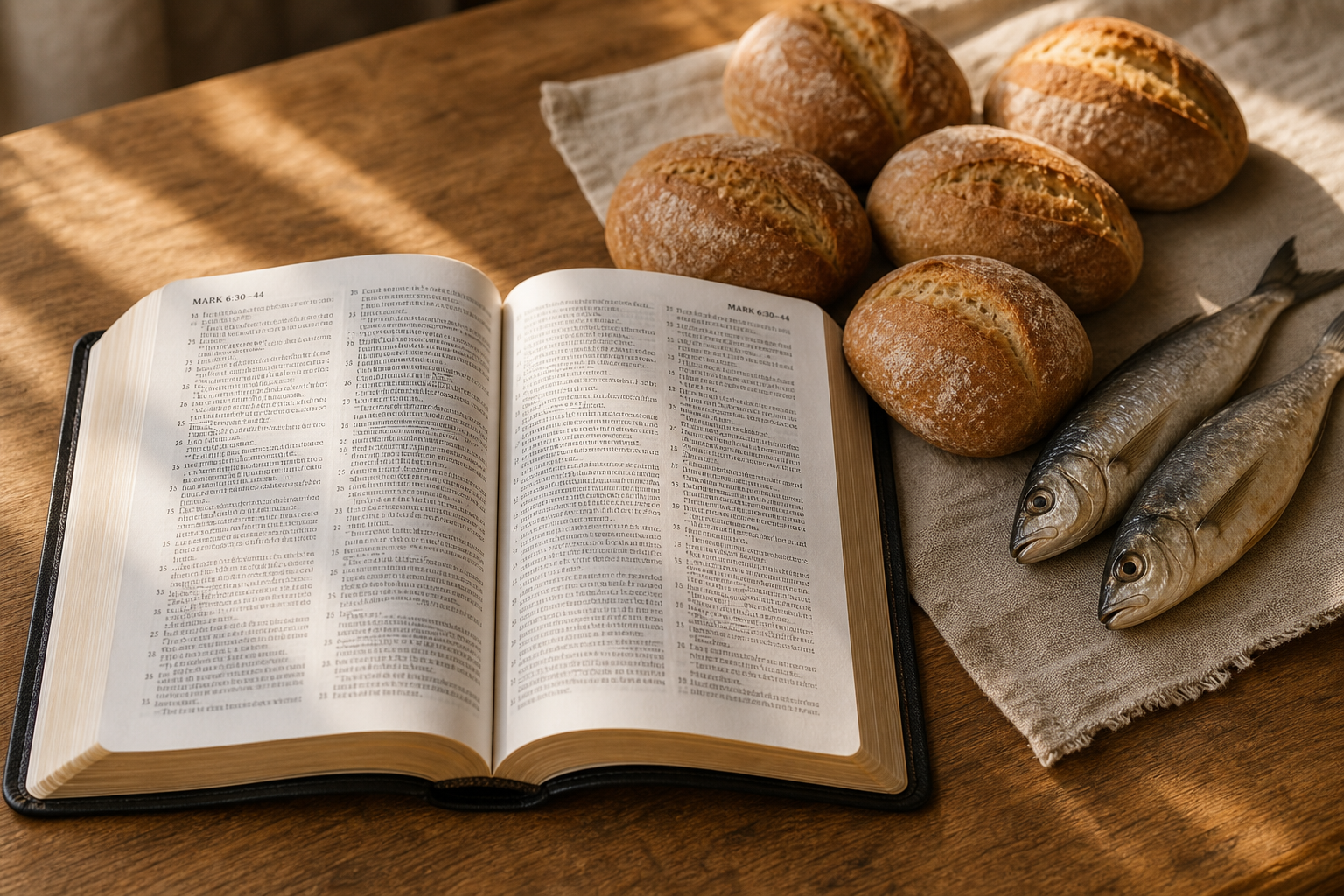
Mark 6:30–44 reveals Jesus as the compassionate Lord who receives His servants, teaches the spiritually needy, and provides abundantly for His people.
The Apostles Report to Jesus
“The apostles gathered around Jesus and reported to him all they had done and taught” (Mark 6:30). Their return shows that Christian ministry begins and ends with Christ. The apostles served because He sent them, and they remained dependent on Him after their work was finished.
Believers should likewise bring their ministry, successes, failures, burdens, and questions to Jesus. Christian service is not independent human achievement; it is work performed under the authority and grace of the Lord.
Jesus Invites His Disciples to Rest
Jesus said, “Come with me by yourselves to a quiet place and get some rest” (Mark 6:31). The disciples had been serving constantly and had little time even to eat. Jesus understood their human limitations and cared for their need for renewal.
Rest under Christ’s care is not a rejection of ministry or an excuse for laziness. It is an expression of trust. The kingdom does not depend on human strength, and Jesus remains sovereign while His servants pause, pray, and receive renewal.
Jesus Has Compassion on the Crowd
When Jesus saw the crowd, “he had compassion on them, because they were like sheep without a shepherd” (Mark 6:34). He did not treat them as an interruption. He recognized their spiritual helplessness and first taught them many things.
Jesus’ compassion included truth. He is the promised Shepherd who guides the lost and brings people to God. He is more than a teacher or miracle worker: He is the Son of God who came to seek and save the lost (Luke 19:10), giving His life for sinners and rising again in victory.
The passage’s central meaning is therefore clear: Jesus lovingly shepherds His people, strengthens His servants, teaches the needy, and provides according to His abundant power.
How Does Mark 6:30–34 Prepare Us for the Miracle?

Mark 6:30–34 establishes the setting and reveals why the feeding miracle matters. The apostles return from ministry, Jesus recognizes their weariness, and a crowd pursues Him into a desolate place.
The crowd’s pursuit shows its hunger for Jesus’ presence and teaching. When Jesus sees the people, He has compassion because they are like sheep without a shepherd. He responds first by giving them God’s truth. This order is significant: the miracle of bread must be understood alongside Christ’s concern for spiritual hunger.
The opening verses prepare us to see that:
- Ministry begins and ends with Jesus. The apostles report to Him rather than acting independently.
- Christ cares for weary servants. He invites His disciples to rest.
- Humanity needs a Shepherd. The crowd’s condition reflects spiritual helplessness.
- Jesus knows the need before the disciples do. The desolate setting makes the coming provision unmistakably dependent on Him.
As Matthew 6:8 teaches, the Father knows what His people need before they ask. Jesus is never surprised by the circumstances in which He calls His followers to trust Him.
What Does Mark 6:33–44 Mean?
The Five Loaves and Two Fish
As evening approached, the disciples wanted Jesus to send the crowd away to buy food. Instead, He told them, “You give them something to eat” (Mark 6:37). They had only five loaves and two fish, so the situation appeared impossible.
Jesus deliberately brought their limited resources into the situation. The disciples could not meet the crowd’s need through human strength, but what was insufficient in their hands became sufficient when surrendered to Christ.
- Jesus welcomes faithful service. He involved the disciples even though the power belonged to Him.
- Human resources are limited. The disciples could not solve the problem alone.
- Small offerings matter to God. Jesus used what was available under His authority.
- Christ is the Provider. The disciples distributed the food, but Jesus supplied it.
This account does not teach that positive thinking creates miracles. It reveals Jesus’ authority over creation as the divine Son of God.
Jesus Gives Thanks and Satisfies the Crowd
Jesus commanded the people to sit in groups. He took the loaves and fish, looked toward heaven, blessed the food, broke the loaves, and gave them to the disciples for distribution (Mark 6:39–41). His thanksgiving shows perfect dependence upon the Father, while the multiplication displays His divine authority.
“They all ate and were satisfied” (Mark 6:42). Jesus provided a complete meal, not a symbolic portion. Afterward, the disciples collected twelve baskets of leftovers. The abundance emphasizes that Christ’s provision is complete and sufficient.
The twelve baskets do not promise earthly abundance in every circumstance. They proclaim that Jesus lacks nothing needed to accomplish His saving purpose. The miracle points forward to His declaration, “I am the bread of life” (John 6:35). Physical bread meets a temporary need, but Jesus gives eternal life to those who believe in Him.
What Does Mark 6:30 Say in the New Living Translation?
Mark 6:30 in the New Living Translation says, “Then the apostles returned to Jesus from their ministry tour and told him all they had done and taught” (Mark 6:30, NLT).
The apostles had been sent by Jesus to preach repentance, cast out demons, and heal the sick (Mark 6:7–13). Their return demonstrates that faithful ministry includes both actions and words, and that all Christian service remains accountable to Christ.
This verse also gives believers a pattern for ministry. We should bring our work, results, struggles, and questions to Jesus. Such dependence guards against pride and reminds us that every opportunity and spiritual result comes from Him. As Jesus taught, “apart from me you can do nothing” (John 15:5).
In this passage, the apostles’ report leads into Jesus’ care for both servants and crowd. He is not merely a supervisor of ministry but the divine Son of God, the true Shepherd, and the Savior who died for sinners and rose again.
How Can Mark 6:30–44 Shape a Christian’s Faith Today?
Bring Every Need to Jesus
The apostles returned to Jesus with their experiences, and Christians should do the same. Bring spiritual weakness, daily needs, grief, anxiety, decisions, successes, and failures to the Lord. “Cast all your anxiety on him because he cares for you” (1 Peter 5:7).
Trust Christ When Resources Seem Insufficient
The five loaves and two fish remind believers to place limited time, strength, wisdom, and possessions in Christ’s hands. Faith does not deny the seriousness of a problem; it recognizes that Jesus is greater than the problem. Our responsibility is obedience and faithfulness, while the outcome remains under His authority. “My grace is sufficient for you, for my power is made perfect in weakness” (2 Corinthians 12:9).
Serve Others With Compassion
Jesus saw people who needed a shepherd, not an inconvenience. Christians should therefore serve neighbors with practical kindness while directing them to the truth of the gospel. Christian compassion reflects Christ’s character and seeks the good of people made in God’s image.
Rest Under the Care of the Lord
Jesus invited His disciples to rest because faithful servants are not limitless. Prayer, worship, Scripture, and quiet trust help believers remember that the kingdom depends on Christ rather than human effort. Jesus still says, “Come to me, all you who are weary and burdened, and I will give you rest” (Matthew 11:28).
Frequently Asked Questions About Mark 6:30–44
What is the message of Mark 6:30–44?
The message is that Jesus is compassionate, sufficient, and worthy of complete trust. He receives weary servants, teaches spiritually needy people, and feeds the crowd through His divine authority. The disciples participate, but Jesus provides the abundance.
Why does Mark describe the crowd as sheep without a shepherd?
The description shows the people’s spiritual helplessness and identifies Jesus as the faithful Shepherd promised in Scripture. He responds by teaching them and caring for their physical hunger. His compassion reaches beyond one meal to the salvation He gives.
How does Mark 6:30–44 point to the gospel?
The bread satisfies temporary hunger, but Jesus is the true Bread of Life (John 6:35). He later gave His life for sinners, was buried, and rose again on the third day (1 Corinthians 15:3–4). The miracle therefore calls people not merely to admire Jesus’ power but to trust Him for eternal life.
Conclusion: Jesus, the Shepherd and Provider in Mark 6:30–44

Mark 6:30–44 reveals Jesus as the compassionate Shepherd and sovereign Provider. He receives His servants, understands their weariness, teaches people who are spiritually lost, and feeds the hungry with abundant power.
The five loaves and two fish remind Christians to bring their limited resources to Christ and trust Him with the results. The twelve baskets of leftovers show that Jesus is completely sufficient for His saving purposes. His provision is not a promise of earthly abundance in every situation, but it is a declaration that He will never lack the power or grace needed to care for His people.
The miracle points beyond physical bread to Jesus Himself, the Bread of Life. He did not come only to meet temporary needs. He came to save sinners by bearing sin on the cross, dying in their place, and rising bodily from the grave. As Paul writes, “Christ died for our sins, just as the Scriptures said. He was buried, and he was raised from the dead on the third day” (1 Corinthians 15:3–4).
Therefore, Mark 6:30–44 calls us to trust Jesus with our weakness, follow Him as our Shepherd, and receive Him as Savior. He is the divine Son of God, the compassionate Provider, the risen Lord, and the only source of eternal life (John 3:16).