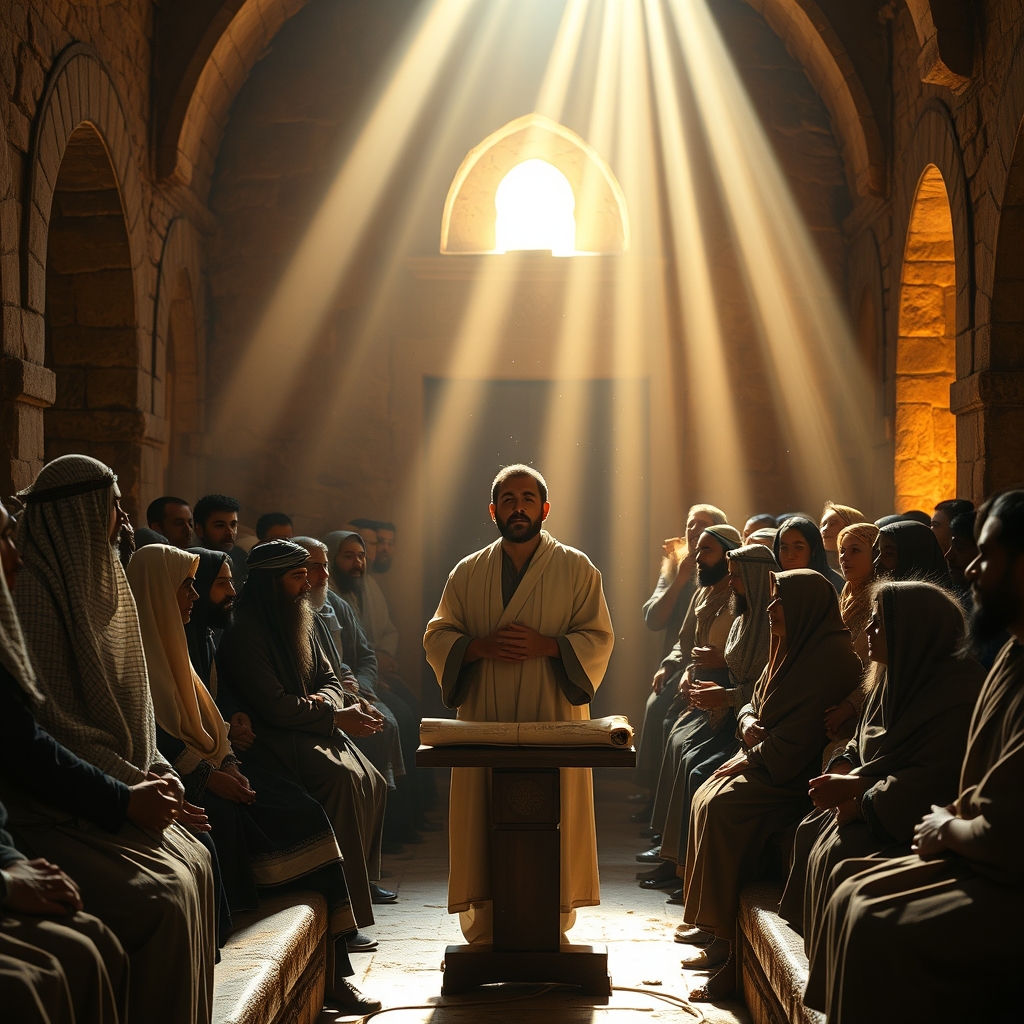
Luke 4:16 describes Jesus going to the synagogue in Nazareth on the Sabbath, as was His custom, and standing up to read from the scroll of the prophet Isaiah. This verse reveals Jesus’ faithful practice of worship and sets the stage for His powerful declaration that He is the fulfillment of Isaiah’s prophecy—the Anointed One sent by God to bring good news to the poor, liberty to the captives, and freedom to the oppressed.
When Jesus stepped into the synagogue in Nazareth on an ordinary Sabbath day, He was about to make an extraordinary declaration—one that would echo through the centuries and change everything we understand about God’s plan for humanity. Luke 4:16 captures this pivotal moment, recording not just a routine act of worship, but the very instant when the Son of God stood up, unrolled the scroll of Isaiah, and announced that the long-awaited promises of Scripture were being fulfilled in Him. This single verse opens the door to a profound truth: Jesus did not come to abolish the hopes of His people but to fulfill them completely.
In this article, we will explore the rich meaning behind Luke 4:16, examining why Jesus honored the Sabbath, what it meant for Him to read from the scroll of Isaiah, and how His words in that Nazareth synagogue revealed His divine mission to bring good news to the poor, liberty to the captives, and freedom to the brokenhearted. Whether you are a new believer seeking to understand the foundations of your faith or a mature Christian hungry to go deeper into God’s Word, this passage has something powerful to teach us about who Jesus is, why He came, and how we should respond to His life-changing message. Let us open our hearts and discover what happens when Jesus stands up to read.
What Does Luke 4:16 Say?

`html
Luke 4:16 KJV and NKJV Text
Luke 4:16 records a pivotal moment in the ministry of Jesus Christ. In this verse, we find Jesus in His hometown of Nazareth, stepping into the synagogue on the Sabbath day. Let us look at the text in two trusted translations.
| Translation | Luke 4:16 Text |
|---|---|
| KJV (King James Version) | “And he came to Nazareth, where he had been brought up: and, as his custom was, he went into the synagogue on the sabbath day, and stood up for to read.” |
| NKJV (New King James Version) | “So He came to Nazareth, where He had been brought up. And as His custom was, He went into the synagogue on the Sabbath day, and stood up to read.” |
Both translations convey the same powerful truth. Jesus, the Son of God, entered the synagogue as was His custom. He did not neglect the gathering of God’s people. Instead, He honored the Sabbath and participated in worship alongside His community.
The phrase “as His custom was” is deeply significant. It tells us that attending the synagogue was not a one-time event for Jesus. It was His regular practice. Jesus, who is fully God and fully man, valued the gathering of believers and the reading of Scripture. If the Lord Himself made worship a habit, how much more should we?
The Context of Jesus’ Visit to Nazareth
To fully understand Luke 4:16, we must consider the events that led Jesus to this moment. Luke chapter 4 opens with Jesus being led by the Spirit into the wilderness, where He was tempted by the devil for forty days. Jesus resisted every temptation, standing firm on the Word of God. After this victory, Jesus returned to Galilee “in the power of the Spirit” (Luke 4:14).
News about Jesus spread throughout the region. He taught in many synagogues, and all who heard Him glorified His words. Nazareth was the town where Jesus grew up. It was home to Mary and Joseph. The people there had watched Jesus from childhood. They knew His family. They knew His trade as a carpenter.
However, familiarity can sometimes breed unbelief. The people of Nazareth struggled to see Jesus as anything more than the son of a carpenter. They could not accept that the Messiah had come from their own streets. This sets the stage for one of the most dramatic moments in the Gospels.
When Jesus stood up to read in the synagogue, He was handed the scroll of the prophet Isaiah. What He read next would change everything. He declared that the ancient prophecy was being fulfilled in their very hearing. The long-awaited Messiah was standing right in front of them.
Luke 4:16 is more than a simple historical note. It is a window into the heart of Jesus Christ. He is a Savior who values worship. He is a Teacher who honors Scripture. And He is the promised Messiah who came to fulfill every word God had spoken.
As we study this verse, let us remember that Jesus is the same yesterday, today, and forever (Hebrews 13:8). He invites us into His presence, just as He entered that synagogue in Nazareth. Will we receive Him with faith, or will we turn away? The choice, as it was then, remains ours today.
`
What Is the Meaning of Luke 4:16?

Jesus’ Custom of Sabbath Worship
Luke 4:16 reveals something beautiful about the character of Jesus. It tells us that Jesus went into the synagogue on the Sabbath day “as His custom was.” This was not a one-time event. It was His regular practice. Jesus, the Son of God, made worship a priority in His daily life.
Furthermore, this verse shows us that Jesus honored the Sabbath. He did not treat worship as optional. He gathered with God’s people week after week. In addition, His example teaches us that faith is not only about private prayer. It is also about gathering together with other believers.
Consider what this means for us today. If Jesus Himself valued corporate worship, how much more should we? Hebrews 10:25 encourages us not to neglect meeting together. Jesus modeled this truth perfectly. He showed that worship is not a burden. It is a joy and a necessity for every believer.
The Significance of the Synagogue
The synagogue was the heart of Jewish community life in Jesus’ day. It served as a place of teaching, prayer, and fellowship. When Jesus entered the synagogue in Nazareth, He stepped into a sacred space where God’s Word was read and proclaimed.
Moreover, the synagogue represented something deeper. It was a place where God’s promises were remembered. The people gathered to hear the Scriptures. They longed for the fulfillment of prophecy. In this very setting, Jesus would soon declare that those promises were being fulfilled in Him.
Today, the church carries forward this same purpose. Believers gather to hear God’s Word. They worship together and encourage one another. Just as the synagogue was central to Jewish life, the local church is central to the Christian life. It is where faith is nourished and strengthened.
Jesus Reading from the Scroll of Isaiah
One of the most powerful details in Luke 4:16 is that Jesus stood up to read. He was handed the scroll of the prophet Isaiah. When He unrolled it, He found the place where Isaiah 61:1–2 was written. This was no accident. God had ordained this moment.
The passage Jesus read spoke of the Spirit of the Lord being upon Him. It proclaimed good news to the poor, freedom for the broken, and sight for the blind. As a result, Jesus made a stunning declaration. He said, “Today this Scripture is fulfilled in your hearing” (Luke 4:21, NKJV).
This moment reveals the very heart of Luke 4:16. Jesus was not simply attending a service. He was announcing His identity as the promised Messiah. He was declaring that God’s plan of salvation had arrived. Every word pointed to His mission to seek and save the lost (Luke 19:10).
In conclusion, Luke 4:16 is far more than a simple statement about Jesus attending a service. It is a window into His character, His mission, and His fulfillment of God’s eternal plan. Jesus honored worship. He valued God’s Word. And He boldly proclaimed that He is the Savior the world had been waiting for.
Did Jesus Go to the Temple on the Sabbath?
Jesus’ Pattern of Sabbath Observance
Luke 4:16 reveals something beautiful about the life of Jesus. It tells us that Jesus went into the synagogue on the Sabbath day “as His custom was.” This was not a one-time event. It was His regular practice. Jesus, the Son of God, made it a habit to gather with God’s people for worship every single Sabbath.
Throughout the Gospels, we see this pattern repeated again and again. Jesus consistently honored the Sabbath. He gathered in synagogues. He read Scripture. He taught the people. This was not mere routine for Jesus. It was an expression of His deep love for the Father and His commitment to the community of faith.
Consider these aspects of Jesus’ Sabbath practice:
- Consistency: Jesus did not attend worship only when it was convenient. Luke tells us it was His custom. He made it a priority every week.
- Humility: Though Jesus is Lord of the Sabbath (Mark 2:28), He chose to sit among the people and participate in communal worship.
- Teaching: Jesus used the Sabbath gatherings as opportunities to open the Scriptures and reveal the truth about God’s Kingdom.
- Healing: Jesus also performed acts of compassion and healing on the Sabbath, showing that worship and mercy go hand in hand (Luke 13:10–17).
Some may wonder whether Jesus went to the temple specifically on the Sabbath, or to the synagogue. The answer is both. During major Jewish festivals, Jesus traveled to the temple in Jerusalem to worship (John 7:14). In His everyday life, however, He attended the local synagogue in Nazareth and other towns. Both were acts of faithful worship. Both honored the Father.
Jesus never treated worship as optional. He never treated gathering with God’s people as something to skip. If the Son of God Himself valued regular worship, how much more should we?
What This Teaches Us About Worship
Jesus’ example on the Sabbath teaches us profound truths about what it means to worship God. His life shows us that worship is not just a suggestion. It is a vital part of the Christian life. When we gather together, we follow in the very footsteps of Jesus.
Here are key lessons we can draw from Jesus’ pattern of Sabbath worship:
- Worship is a priority, not an afterthought. Jesus did not wait until He had free time to worship. He made it His custom. In the same way, we should place worship at the center of our weekly rhythm, not at the margins.
- Gathering with other believers matters. The writer of Hebrews urges us not to neglect meeting together (Hebrews 10:25). Jesus modeled this truth. He could have worshiped alone in the wilderness. Instead, He chose to gather with His community.
- Scripture is at the heart of true worship. In Luke 4:17, Jesus stood up to read from the scroll of Isaiah. True worship always centers on the Word of God. It is through Scripture that we encounter the living voice of Christ.
- Worship transforms us. When Jesus read from Isaiah and declared, “Today this Scripture is fulfilled in your hearing” (Luke 4:21), the people were amazed. Worship is not passive. It is the place where God speaks, convicts, and fills us with His presence.
Furthermore, Jesus’ Sabbath worship reminds us that rest and worship are deeply connected. God designed the Sabbath as a gift. It is a day to cease from our labors, to draw near to Him, and to remember His faithfulness. Jesus honored this gift. He invites us to do the same.
In a world that is always busy, always distracted, and always pulling us in a thousand directions, the example of Jesus calls us back to what matters most. Worship is not a burden. It is a joy. It is where we meet with the One who loves us more than we can imagine.
As you reflect on Luke 4:16, let the custom of Jesus inspire your own. Make worship a regular part of your life. Gather with God’s people. Open His Word. And discover the fullness of joy that comes from being in the presence of Christ.
What Does Luke 4:16–21 Say?
The Prophecy of Isaiah 61:1–2
When Jesus stood up to read in the synagogue that day, He opened the scroll to Isaiah 61. This passage was a well-known Messianic prophecy. It described the mission of God’s chosen Servant. Jesus read these words aloud:
“The Spirit of the Lord is upon Me, because He has anointed Me to preach the gospel to the poor; He has sent Me to heal the brokenhearted, to proclaim liberty to the captives and recovery of sight to the blind, to set at liberty those who are oppressed; to proclaim the acceptable year of the Lord.” — Luke 4:18–19 (NKJV)
This prophecy from Isaiah was written roughly 700 years before Jesus was born. [1] It pointed forward to the coming of the Messiah. The Messiah would be anointed by the Holy Spirit. His mission would bring hope, healing, and freedom.
Let us consider what this prophecy reveals about Jesus’ purpose:
- He was anointed by the Spirit: Jesus did not rely on human strength. The Holy Spirit empowered His ministry from the very beginning.
- He came to preach good news: The gospel is the message of God’s grace. It is for the poor, the broken, and the forgotten.
- He came to bring freedom: Jesus liberates people from sin, shame, and spiritual bondage. He opens blind eyes and heals wounded hearts.
- He came to declare God’s favor: The “acceptable year of the Lord” speaks of a time of salvation. Through Jesus, God’s grace is made available to all who believe.
Isaiah’s words were not merely poetic. They were a divine promise. God had a plan to redeem His people. That plan was fulfilled in Jesus Christ.
Jesus Declares the Fulfillment of Scripture
After reading from Isaiah, Jesus did something astonishing. He rolled up the scroll and sat down. Every eye in the synagogue was fixed on Him. Then He spoke words that would change everything:
“Today this Scripture is fulfilled in your hearing.” — Luke 4:21 (NKJV)
With this simple statement, Jesus made a bold claim. He declared that He was the Messiah. The prophecy of Isaiah was no longer future. It was happening right then, right there, in their presence.
Consider the weight of what Jesus said:
- He identified Himself as the Anointed One: The word “Messiah” means “anointed.” Jesus claimed to be the one Isaiah foretold.
- He declared the arrival of God’s kingdom: The “acceptable year of the Lord” had begun. Salvation was no longer a distant hope. It was present in Christ.
- He claimed divine authority: Only God’s chosen Servant could fulfill this prophecy. Jesus spoke with the authority of the One who sent Him.
This moment was not accidental. Jesus chose this passage deliberately. He wanted the people to understand who He truly was. He is the fulfillment of every promise God ever made. As the apostle Paul later wrote, “For all the promises of God in Him are Yes, and in Him Amen” (2 Corinthians 1:20, NKJV).
Furthermore, Jesus’ declaration was rooted in the authority of Scripture. He did not invent a new message. He revealed the meaning of God’s Word. The Bible is the foundation of our faith. Jesus honored it, fulfilled it, and proclaimed it as truth.
The Reaction of the People in the Synagogue
At first, the people responded with amazement. Luke tells us they “bore witness to Him, and marveled at the gracious words which proceeded out of His mouth” (Luke 4:22, NKJV). They were struck by the beauty and power of His words.
However, their wonder quickly turned to doubt. They asked, “Is this not Joseph’s son?” They knew Jesus as a carpenter’s son. They had watched Him grow up in their town. How could this ordinary man be the Messiah?
Their familiarity with Jesus became a barrier to faith. They could not see past His humanity to recognize His divinity. This is a sobering reminder for us today. We must not let our assumptions blind us to the truth of who Jesus is.
Jesus responded by addressing their unbelief. He said, “No prophet is accepted in his own country” (Luke 4:24, NKJV). He reminded them of two Old Testament stories:
- Elijah and the widow of Zarephath: During a severe famine, God sent Elijah to a Gentile widow, not to the many widows in Israel (1 Kings 17:8–16).
- Elisha and Naaman the Syrian: Naaman, a foreign military commander, was healed of leprosy, while many lepers in Israel remained unclean (2 Kings 5:1–14).
These examples revealed a hard truth. God’s blessings often bypass those who reject His messengers. The people in the synagogue were outraged. They drove Jesus to the edge of a cliff, intending to throw Him off. But Jesus “passing through the midst of them, went His way” (Luke 4:30, NKJV). His time had not yet come.
This passage teaches us a vital lesson. Hearing the truth is not enough. We must respond to Jesus with faith and surrender. He is the Christ, the Son of the living God. He is the fulfillment of every prophecy. And He offers salvation to all who will receive Him.
As we reflect on Luke 4:16–21, let us not be like those who rejected Jesus. Instead, let us bow before Him in worship. He is Lord. He is Savior. And His Word stands forever.
Luke 4:16–30 Explained – The Full Passage
Jesus Reads and Applies the Prophecy
When Jesus stood up to read in the synagogue, He was handed the scroll of the prophet Isaiah. He unrolled it and found the place where Isaiah 61:1–2 was written. The words He read were powerful and full of promise:
“The Spirit of the Lord is upon Me, because He has anointed Me to preach the gospel to the poor; He has sent Me to heal the brokenhearted, to proclaim liberty to the captives and recovery of sight to the blind, to set at liberty those who are oppressed; to proclaim the acceptable year of the Lord.” (Luke 4:18–19, NKJV)
After reading these words, Jesus did something no one expected. He rolled up the scroll, sat down, and declared, “Today this Scripture is fulfilled in your hearing” (Luke 4:21, NKJV). In that moment, Jesus made an extraordinary claim. He was saying that He was the One Isaiah had prophesied about centuries before.
This was not a general message about social justice or political reform. Jesus was announcing His divine mission. He had come to:
- Preach the gospel to the poor — bringing the good news of salvation to all who recognize their spiritual need (Matthew 5:3).
- Heal the brokenhearted — restoring those crushed by sin, grief, and despair (Psalm 147:3).
- Proclaim liberty to the captives — freeing those bound by sin, addiction, and spiritual darkness (John 8:36).
- Give sight to the blind — both physically and spiritually opening eyes to the truth of God (John 9:39).
- Set the oppressed free — delivering those under the weight of guilt, shame, and the enemy’s lies (Romans 8:1–2).
Furthermore, Jesus was declaring that the “acceptable year of the Lord” — a reference to the Year of Jubilee in Leviticus 25 — was being fulfilled in His presence. In the Old Testament, the Year of Jubilee was a time when debts were forgiven, slaves were freed, and land was restored. Jesus was announcing that He Himself was the ultimate Jubilee. Through His death and resurrection, He would cancel the debt of sin, free the enslaved, and restore all things.
At first, the people in the synagogue responded with amazement. Luke tells us that “all bore witness to Him, and marveled at the gracious words which proceeded out of His mouth” (Luke 4:22, NKJV). They were struck by the beauty and authority of His teaching. However, their amazement would not last.
The People’s Rejection of Jesus
What began as wonder quickly turned to doubt, and doubt turned to anger. The people of Nazareth could not accept that the son of Joseph — a man they had watched grow up — could be the fulfillment of Isaiah’s prophecy. Their familiarity with Jesus became a barrier to faith.
They asked among themselves, “Is this not Joseph’s son?” (Luke 4:22, NKJV). This question revealed the heart of the problem. They saw Jesus as merely human. They could not see past His earthly family to His divine identity. As Jesus Himself said, “A prophet is not without honor except in his own country” (Luke 4:24, NKJV).
Jesus then gave two powerful examples from the Old Testament to show them that God’s blessings often bypassed those who should have received them first:
- Elijah and the widow of Zarephath: During a severe famine, God sent Elijah not to any of the many widows in Israel, but to a Gentile woman in Sidon (1 Kings 17:8–16). She received miraculous provision because she responded in faith.
- Elisha and Naaman the Syrian: Though there were many lepers in Israel, God chose to heal Naaman, a Syrian military commander, because he humbled himself and believed (2 Kings 5:1–14).
These examples were deeply offensive to the people of Nazareth. Jesus was telling them that their unbelief would cause them to miss what God was doing. Meanwhile, those they considered outsiders — Gentiles, foreigners, the undeserving — would receive God’s grace because they responded with faith.
The reaction was swift and violent. Luke records that “all those in the synagogue, when they heard these things, were filled with wrath” (Luke 4:28, NKJV). They rose up, dragged Jesus out of the city, and led Him to the brow of the hill on which Nazareth was built, intending to throw Him off a cliff. This was not a misunderstanding. This was an attempted murder — the first recorded attempt on the life of Jesus in Luke’s Gospel.
Their rejection teaches us a sobering lesson: familiarity with Jesus is not the same as faith in Jesus. The people of Nazareth had grown up with Jesus. They knew His family. They had seen Him in the marketplace. Yet they refused to believe He was who He claimed to be. As Scripture warns, “They are always learning and never able to come to the knowledge of the truth” (2 Timothy 3:7, NKJV).
Jesus Escapes and Continues His Ministry
Despite their murderous intent, Jesus did not fight back. He did not call down fire from heaven. He did not summon angels to defend Him. Instead, Luke tells us simply that “passing through the midst of them, He went His way” (Luke 4:30, NKJV).
This miraculous escape demonstrates the sovereign authority of Jesus Christ. No one could take His life from Him. As He later declared, “I lay down My life that I may take it again. No one takes it from Me, but I lay it down of Myself” (John 10:17–18, NKJV). Jesus would not die at the hands of an angry mob in Nazareth. He would die at the appointed time, in the appointed way, on the cross at Calvary — as the perfect sacrifice for the sins of the world (1 Peter 3:18).
After leaving Nazareth, Jesus went down to Capernaum, where He continued teaching and performing miracles. Luke 4:31–44 records that He cast out demons, healed Peter’s mother-in-law, and healed many others who were sick. The news about Him spread throughout the surrounding region.
This moment in Luke 4:16–30 reveals several profound truths about Jesus and His mission:
- Jesus is the fulfillment of all Old Testament prophecy. Every promise God made pointed to Him (Luke 24:27).
- Jesus came for all people. His mission was never limited to one nation or one group. He came to save the whole world (John 3:16–17).
- Rejection of Jesus has eternal consequences. Those who refuse to believe in Him remain in their sins (John 8:24).
- Jesus’ authority cannot be stopped. No amount of opposition can thwart the purposes of God (Isaiah 55:11).
The story of Luke 4:16–30 ultimately points us to the cross. The same Jesus who was rejected in Nazareth would later be rejected in Jerusalem. He would be betrayed, beaten, mocked, and nailed to a wooden cross. But through that rejection, God accomplished the greatest act of salvation the world has ever known. “For God so loved the world that He gave His only begotten Son, that whoever believes in Him should not perish but have everlasting life” (John 3:16, NKJV).
Today, every person faces the same choice the people of Nazareth faced. Will we receive Jesus as Lord and Savior? Or will we reject Him because He does not fit our expectations? The invitation of the gospel remains open. Jesus still stands and declares that the Scripture is fulfilled. The question is — how will you respond?
What Bible Verse Says Ask Until Your Joy Is Full?
Connecting Luke 4:16 to the Fullness of Joy in Christ
When we read Luke 4:16, we see Jesus walking into a synagogue on the Sabbath. He stands up to read from the scroll of Isaiah. Furthermore, He declares that the Scripture is fulfilled in their hearing. This moment is powerful. However, it also points us to a deeper truth about the joy that only Christ can give.
Many believers wonder which Bible verse speaks about asking until joy is full. The answer is found in John 16:24. Jesus said, “Ask, and you will receive, that your joy may be full.” This promise is directly connected to the mission Jesus announced in Luke 4:16–21. He came to bring good news, freedom, and healing. As a result, those who ask Him for these things receive a joy that nothing else in this world can provide.
The Source of True Joy
True joy does not come from circumstances. It comes from a living relationship with Jesus Christ. In Luke 4, Jesus reads from Isaiah 61:1–2. He proclaims that He has come to:
- Preach good news to the poor
- Heal the brokenhearted
- Proclaim liberty to the captives
- Give sight to the blind
- Set the oppressed free
Each of these acts brings deep, lasting joy. Furthermore, Jesus fulfills every one of them for those who come to Him in faith. The joy He offers is not temporary. It is eternal and unshakable.
Asking in Faith Leads to Fullness of Joy
In John 15:11, Jesus says, “These things I have spoken to you, that My joy may remain in you, and that your joy may be full.” His words in Luke 4:16 are part of that same message. He came so that we would have life abundantly. This abundance includes spiritual joy that overflows.
However, this joy requires a response. We must ask. We must seek. We must come to Him just as the people in the Nazareth synagogue came to hear the Word. Some rejected Jesus that day. Others believed. The difference was faith.
Consider the following truths about asking and receiving joy in Christ:
| Scripture | Promise |
|---|---|
| John 16:24 | Ask and receive, so your joy may be full |
| Psalm 16:11 | In God’s presence there is fullness of joy |
| Romans 15:13 | God fills us with joy and peace through believing |
| Luke 4:18–19 | Jesus came to bring good news and freedom |
Jesus Is the Answer to Every Need
The people in the synagogue that Sabbath day heard the Word of God spoken by the Son of God Himself. Yet many turned away. They let familiarity and pride block their hearts. As a result, they missed the joy that was standing right in front of them.
Today, Jesus stands before every person in the same way. He offers freedom from sin. He offers healing for the broken heart. Furthermore, He offers a joy that is complete and everlasting. All we must do is ask Him in faith.
Luke 4:16 reminds us that Jesus is faithful to show up where His Word is proclaimed. He is present in every gathering of believers. He is present in every quiet moment of prayer. And He is ready to fill your joy to overflowing when you come to Him with a sincere heart.
If you are searching for joy, look no further than Jesus Christ. He is the fulfillment of every promise in Scripture. Ask Him today. He will not turn you away. Instead, He will welcome you and fill you with a joy that lasts forever.
Key Lessons from Luke 4:16 for Believers Today

The Importance of Gathering for Worship
Luke 4:16 reveals a beautiful truth about the life of Jesus. It says, “And he came to Nazareth, where he had been brought up: and, as his custom was, he went into the synagogue on the sabbath day, and stood up for to read.” Even though Jesus is the Son of God, He made it His custom to gather with God’s people. He did not isolate Himself. Instead, He valued the fellowship of worship.
As believers today, we are called to follow His example. The writer of Hebrews encourages us, “Not forsaking the assembling of ourselves together, as the manner of some is; but exhorting one another” (Hebrews 10:25). Gathering together is not merely a tradition. It is a vital part of our spiritual growth. When we come together, we encourage one another. We lift each other up in prayer. We study God’s Word side by side.
Furthermore, corporate worship reminds us that we are part of a larger body. We are not alone in our faith. In addition, gathering allows us to use our spiritual gifts to serve others. Whether we sing, pray, teach, or simply show up with a listening heart, we contribute to the health of the church. Therefore, let us never underestimate the power of gathering in Jesus’ name. It is where faith is strengthened and joy is renewed.
Jesus as the Fulfillment of God’s Promises
One of the most powerful lessons from Luke 4:16 is that Jesus is the fulfillment of God’s promises. When Jesus stood in the synagogue, He read from the scroll of Isaiah. He declared, “This day is this scripture fulfilled in your ears” (Luke 4:21). Every promise God made throughout the Old Testament pointed directly to Jesus. He is the long-awaited Messiah.
Consider the promises God has made to His people:
- Promise of a Savior: God promised to send a Redeemer to save humanity from sin (Genesis 3:15).
- Promise of a Covenant: God established a covenant with Abraham, promising blessings through his seed (Genesis 12:1-3).
- Promise of a Prophet: God promised to raise up a prophet like Moses to speak His words (Deuteronomy 18:15).
- Promise of a King: God promised David an everlasting kingdom through his lineage (2 Samuel 7:12-16).
Jesus fulfilled every single one of these promises. He is the Savior, the Seed of Abraham, the Prophet, and the eternal King. As Paul wrote, “For all the promises of God in him are yea, and in him Amen” (2 Corinthians 1:20). This means that every “yes” from God is found in Jesus Christ. When we place our trust in Him, we can be confident that God will keep His word.
Therefore, when you read the Old Testament, look for Jesus. He is woven into every page. From the sacrificial system to the prophecies of Isaiah, everything points to His coming. As a result, our faith is not built on wishful thinking. It is built on the sure foundation of God’s fulfilled promises in Christ.
Responding to Jesus with Faith, Not Rejection
Luke 4:16 also teaches us how we should respond to Jesus. After He read from Isaiah, the people in the synagogue initially marveled at His words. However, their amazement quickly turned to rejection. They could not accept that a local carpenter’s son could be the Messiah. As a result, they drove Him out of the city (Luke 4:28-29).
This is a sobering reminder. It is possible to be near Jesus and still reject Him. The people in Nazareth heard His words. They saw His presence. Yet, their hearts were hardened by unbelief. They allowed familiarity to breed contempt. They could not see past His humanity to recognize His divinity.
Today, we must guard against the same attitude. It is easy to hear the Gospel and remain unchanged. It is easy to attend church and never truly encounter Christ. However, Jesus calls us to more than passive listening. He calls us to active faith. He invites us to believe in Him, receive His grace, and follow Him wholeheartedly.
How should we respond to Jesus?
- With humility: Acknowledge that we need a Savior and that only Jesus can save us (John 14:6).
- With repentance: Turn away from sin and turn toward God in faith (Acts 3:19).
- With obedience: Follow His commands and live according to His Word (John 14:15).
- With worship: Honor Him as Lord and Savior of our lives (Philippians 2:9-11).
Jesus Christ is the same yesterday, today, and forever (Hebrews 13:8). He stands before us today, just as He stood in the synagogue in Nazareth. He offers us salvation, hope, and eternal life. The question is, how will we respond? Will we reject Him like the people of Nazareth? Or will we receive Him with open hearts and lives transformed by His grace?
Let us choose faith. Let us choose Jesus. For in Him, we find the fullness of joy and the assurance of God’s unfailing love.
Frequently Asked Questions
What is the meaning of Luke 4:16?
Luke 4:16 describes Jesus entering the synagogue in Nazareth on the Sabbath. He stood up to read from the scroll of Isaiah. This moment reveals Jesus’ custom of regular worship. It also shows His identity as the promised Messiah. Jesus read Isaiah 61:1–2 and declared, “Today this Scripture is fulfilled in your hearing” (Luke 4:21). The meaning is profound: Jesus is the fulfillment of God’s promises. He came to bring good news to the poor, freedom to the broken, and sight to the blind. This verse reminds us that Jesus is Lord of the Sabbath and the center of all Scripture.
Did Jesus go to the temple on the Sabbath?
Yes, Jesus regularly attended the synagogue on the Sabbath. Luke 4:16 says, “as His custom was, He went into the synagogue on the Sabbath day.” This shows that Jesus valued corporate worship. He did not neglect gathering with God’s people. In addition, Jesus also visited the temple in Jerusalem during feast days (Luke 2:41–42; John 2:13). His pattern teaches us the importance of worship. Believers today are encouraged to gather faithfully. Hebrews 10:25 urges us not to forsake assembling together. Jesus modeled a life centered on the Father’s house.
What does Luke 4:16–21 say?
Luke 4:16–21 records a pivotal moment in Jesus’ ministry. He entered the synagogue, stood to read, and was handed the scroll of Isaiah. He read:
- “The Spirit of the Lord is upon Me, because He has anointed Me to preach the gospel to the poor; He has sent Me to heal the brokenhearted, to proclaim liberty to the captives and recovery of sight to the blind, to set at liberty those who are oppressed; to proclaim the acceptable year of the Lord.” (Luke 4:18–19, NKJV)
After reading, Jesus sat down and said, “Today this Scripture is fulfilled in your hearing.” This declaration shocked the people. They knew Him as Joseph’s son. Yet Jesus claimed to be the Anointed One. This passage reveals that Jesus is the fulfillment of Old Testament prophecy. He is the Savior who brings true freedom and healing.
What Bible verse says ask until your joy is full?
The phrase “ask until your joy is full” is not a direct Bible verse. However, it reflects the truth of John 16:24. Jesus said, “Ask, and you will receive, that your joy may be full.” This promise connects to Luke 4:16–21. In the synagogue, Jesus proclaimed the good news of God’s kingdom. He offers forgiveness, healing, and freedom. When we come to Him in faith, our joy is complete. True joy is found only in Christ. He is the source of lasting peace and hope.