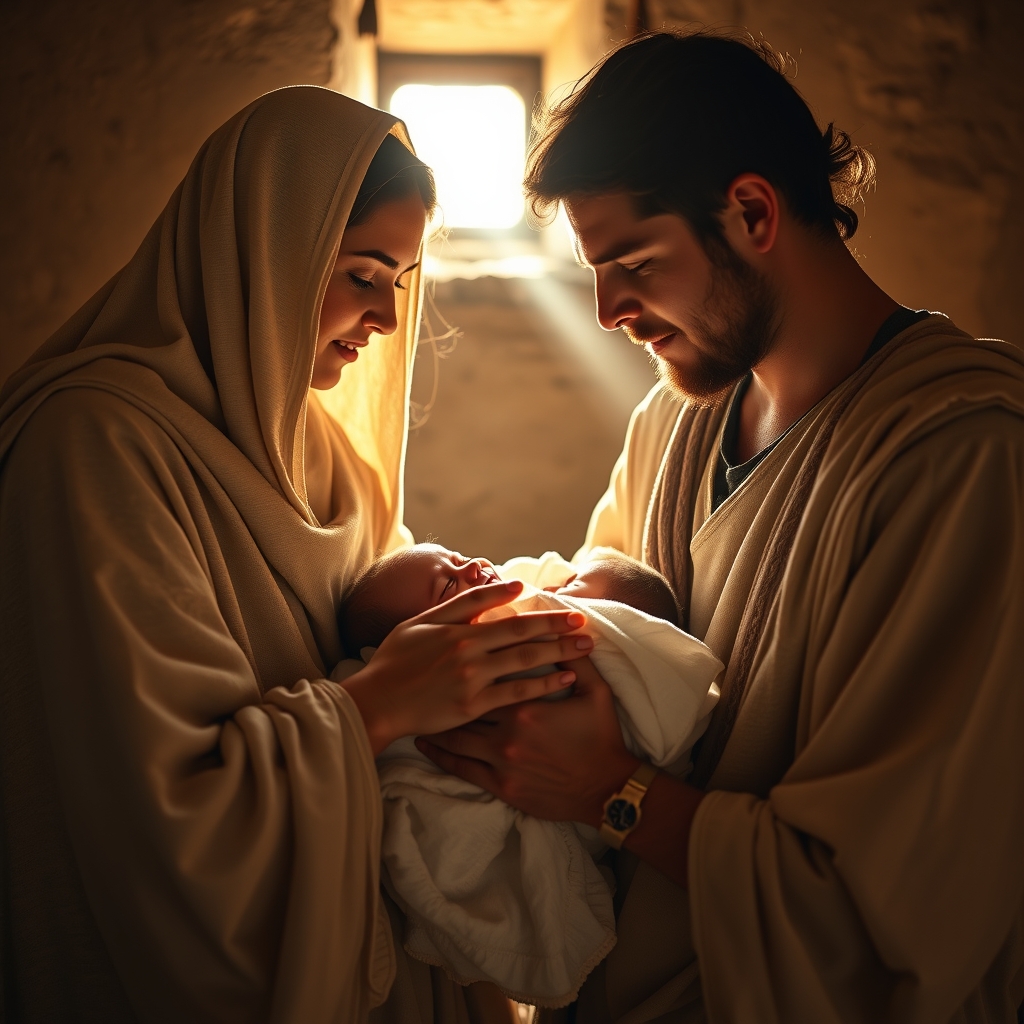
Luke 2:21 tells us that eight days after His birth, Jesus was circumcised and officially given the name “Jesus”—the name the angel Gabriel had spoken to Joseph before He was conceived. This act fulfilled Mosaic Law and God’s covenant with Abraham, while powerfully declaring that the Lord Himself had come to save His people from their sins, just as the angel announced in Matthew 1:21.
Eight days after His birth, something remarkable happened in the quiet life of a young Jewish family in Bethlehem. In a small, seemingly ordinary act of obedience, Mary and Joseph carried out a command that had been given centuries before—and one that had been confirmed by an angel from heaven. Luke 2:21 records this sacred moment: the circumcision and naming of Jesus, the Son of God, who entered the world not as a distant deity, but as a real, flesh-and-blood baby boy. This single verse carries profound theological weight, connecting the promises made to Abraham with their ultimate fulfillment in Christ.
In this article, we will explore the deep meaning behind Luke 2:21—why Jesus was circumcised, why His name was given before His birth, and what the eighth day signifies in God’s redemptive plan. Whether you are a new believer seeking to understand the foundations of your faith or a mature Christian desiring a richer understanding of Scripture, this passage reveals a beautiful truth: Jesus did not come to abolish God’s covenant but to fulfill it completely. Let us open God’s Word together and discover what this verse teaches us about the identity, mission, and glory of our Lord and Savior, Jesus Christ.
What Does Luke 2:21 Say?

Luke 2:21 is a powerful verse that captures a pivotal moment in the life of Jesus Christ. It records two significant events: the circumcision of Jesus and the moment He was officially given His name. This verse may seem brief, but it carries deep theological meaning for every believer.
Luke 2:21 in Different Bible Translations
Reading Luke 2:21 across multiple Bible translations helps us appreciate the richness and clarity of this verse. Each translation brings out slightly different nuances while preserving the same essential truth.
| Translation | Text of Luke 2:21 |
|---|---|
| King James Version (KJV) | “And when eight days were accomplished for the circumcising of the child, his name was called JESUS, which was so named of the angel before he was conceived in the womb.” |
| New International Version (NIV) | “On the eighth day, when it was time to circumcise the child, he was named Jesus, the name the angel had given him before he was conceived.” |
| English Standard Version (ESV) | “And at the end of eight days, when he was circumcised, he was called Jesus, the name given by the angel before he was conceived in the womb.” |
| New Living Translation (NLT) | “Eight days later, when the baby was circumcised, he was named Jesus, the name given by the angel even before he was conceived.” |
| New King James Version (NKJV) | “And when eight days were completed for the circumcision of the Child, His name was called JESUS, which was given by the angel before He was conceived in the womb.” |
As you can see, every translation affirms the same core truths. Jesus was circumcised on the eighth day. His name was Jesus. This name was not chosen by Mary and Joseph on their own. It was given by the angel of the Lord before Jesus was even conceived. This detail is profoundly important because it shows that God Himself ordained the name and mission of His Son from before the foundation of the world.
Furthermore, the consistency across translations reinforces the reliability of Scripture. The Bible is not a collection of uncertain stories. It is the inspired, authoritative Word of God, preserved faithfully for every generation (2 Timothy 3:16).
The Context of Luke 2:21 within the Christmas Narrative
To fully understand Luke 2:21, we must see it within the broader story of Christ’s birth. Luke chapter 2 is one of the most beloved passages in all of Scripture. It tells us about the humble arrival of our Savior into the world.
Before verse 21, we read about several key events:
- The decree of Caesar Augustus — God used a Roman emperor’s decree to fulfill prophecy, bringing Mary and Joseph to Bethlehem (Luke 2:1–3; Micah 5:2).
- The birth of Jesus in a manger — The King of Kings was born in the humblest of circumstances, laid in a feeding trough because there was no room in the inn (Luke 2:7).
- The announcement to the shepherds — Angels appeared to ordinary shepherds, proclaiming the good news of a Savior born in the city of David (Luke 2:8–14).
- The shepherds’ visit — The shepherds came swiftly to see the newborn Christ child and then spread the word about what they had witnessed (Luke 2:15–20).
Luke 2:21 comes right after these remarkable events. It shifts our attention from the public announcement of Jesus’ birth to the private, obedient actions of Mary and Joseph. They followed the Law of Moses faithfully. They circumcised Jesus on the eighth day. They named Him exactly as the angel had commanded.
This context is essential because it shows us that the Christmas story is not just about a baby in a manger. It is about the Son of God entering the world in real human flesh, under the Law, to accomplish the Father’s redemptive plan. As Paul writes, “But when the fullness of the time had come, God sent forth His Son, born of a woman, born under the law” (Galatians 4:4).
In addition, the Christmas narrative in Luke 2 demonstrates God’s faithfulness to His promises. Every detail — from the timing of the decree to the place of birth to the naming of Jesus — was orchestrated by God. Nothing was left to chance. Luke 2:21 is a beautiful reminder that Jesus came at exactly the right time, in exactly the right way, bearing exactly the right name to fulfill exactly the right mission: the salvation of all who believe in Him (John 3:16).
What Is the Meaning of Luke 2:21?
Luke 2:21 is a powerful verse that captures two significant events in the early life of Jesus Christ. It tells us that Jesus was circumcised on the eighth day and officially given the name the angel had declared before His birth. These acts were not random. They carried deep spiritual meaning and revealed God’s perfect plan of salvation.
Let’s explore what this verse means and why it matters for every believer today.
Jesus Was Circumcised on the Eighth Day
Luke 2:21 records that Jesus was circumcised exactly eight days after His birth. This was not a coincidence. It followed the command God gave to Abraham in Genesis 17:12. Every male child in Israel was to be circumcised on the eighth day as a sign of God’s covenant with His people.
By being circumcised, Jesus did several important things:
- He identified fully with humanity. Jesus was born as a real, flesh-and-blood baby. Circumcision proved He truly shared in our human experience.
- He submitted to God’s law. Even though Jesus was sinless, He fulfilled every requirement of the Law on our behalf.
- He honored the Abrahamic covenant. God promised Abraham that through his seed, all nations would be blessed. Jesus is that promised seed.
This act shows us that Jesus did not come to abolish the Law but to fulfill it. As He later said in Matthew 5:17, “Do not think that I have come to abolish the Law or the Prophets; I have not come to abolish them but to fulfill them.” His circumcision was the beginning of a life lived in perfect obedience to the Father.
His Name Was Called Jesus, As Spoken by the Angel
Luke 2:21 also tells us that the child was named Jesus. This name was not chosen by Mary and Joseph. It was given by God Himself through the angel Gabriel. In Luke 1:31, the angel told Mary, “You will conceive and give birth to a son, and you are to call him Jesus.”
the name Jesus comes from the Hebrew name Yeshua, which means “the Lord saves” or “Yahweh is salvation.” This name reveals His mission. He came to save His people from their sins, as Matthew 1:21 declares.
Consider the significance of this name:
- It was divinely appointed. God chose this name before Jesus was even conceived.
- It declared His purpose. Jesus came for one reason — to bring salvation to a lost world.
- It fulfilled Old Testament prophecy. The prophets foretold a Savior would come, and His name would reveal who He is.
There is no other name by which we can be saved. Acts 4:12 makes this clear: “Salvation is found in no one else, for there is no other name under heaven given to mankind by which we must be saved.” The naming of Jesus in Luke 2:21 is a declaration that God’s plan of redemption was unfolding exactly as He promised.
Together, the circumcision and the naming of Jesus in Luke 2:21 show us a Savior who is both fully human and fully divine. He entered this world as a real baby, lived under the Law, and carried the name that would one day be above every name. This is the Jesus we worship — the Lord who saves.
Why Was Jesus Circumcised According to Luke 2:21?

Fulfillment of the Abrahamic Covenant
When we read Luke 2:21, we see that Jesus was circumcised on the eighth day. This was not a random act. It was a direct fulfillment of God’s covenant with Abraham, given many centuries earlier.
In Genesis 17:12, God commanded Abraham: “He who is eight days old among you shall be circumcised.” This command applied to every male in Abraham’s household. It was a sign of the covenant between God and His people.
Jesus, being born under the Law (Galatians 4:4), fulfilled this requirement perfectly. His parents, Joseph and Mary, were faithful to God’s command. They obeyed without hesitation.
Consider the following truths about the Abrahamic Covenant:
- It was an everlasting covenant — God’s promises to Abraham extend to all who believe (Genesis 17:7).
- Circumcision was its outward sign — It marked God’s people as set apart (Genesis 17:11).
- Jesus fulfilled it completely — He kept every requirement of the Law on our behalf (Matthew 5:17).
- Through faith, we are included — Believers in Christ are Abraham’s spiritual descendants (Galatians 3:7-9).
Furthermore, this act of circumcision showed that Jesus truly came as a real human being. He did not merely appear as a man. He was born into the covenant community. He submitted to the same rituals that every Jewish boy experienced.
As a result, Jesus’ circumcision connects Him directly to the promises God made to Abraham. Through Jesus, those promises are now available to all who place their faith in Him — both Jew and Gentile alike (Galatians 3:14).
Jesus Identified with Humanity to Fulfill All Righteousness
Beyond fulfilling the Abrahamic covenant, Jesus’ circumcision reveals something even deeper. It shows that He fully identified with humanity. Though He was sinless, He still submitted to the Law.
In Matthew 3:15, Jesus told John the Baptist: “Let it be so now, for thus it is fitting for us to fulfill all righteousness.” This principle carried through His entire life — from His circumcision as an infant to His death on the cross.
Jesus did not need circumcision for His own sake. He was without sin. Yet He chose to walk the path of obedience so that He could stand in our place.
Here is what His identification with humanity means for us:
- He bore the marks of human experience — From birth, Jesus lived under the same covenant obligations as every Israelite.
- He fulfilled the Law perfectly — Every act of obedience, including circumcision, was part of His righteous life (2 Corinthians 5:21).
- His obedience becomes our righteousness — When we trust in Christ, His perfect obedience is credited to us (Romans 4:24).
- He is the mediator of a new covenant — Through His blood, a better covenant was established (Hebrews 8:6).
The circumcision of Jesus, therefore, was not merely a cultural tradition. It was a profound act of divine obedience. Jesus, the Son of God, chose to enter fully into the human condition so that He could redeem it.
In the end, Luke 2:21 points us to a Savior who is both fully God and fully man. His circumcision affirms His real humanity. His name — Jesus, meaning “The Lord Saves” — affirms His divine mission. Together, these truths remind us that our salvation rests on a Savior who truly came, truly lived, and truly died — and truly rose again.
On What Day Was Jesus Named and Circumcised?
Luke 2:21 tells us a precise and beautiful truth: Jesus was circumcised and named on the eighth day. This detail is not accidental. It carries deep meaning rooted in God’s Word and His eternal plan of salvation.
The Significance of the Eighth Day in Scripture
The eighth day holds special importance throughout the Bible. In the Old Testament, God commanded that every male child be circumcised on the eighth day after birth (Leviticus 12:3). This command was part of the covenant God made with Abraham (Genesis 17:12).
Why the eighth day? Scripture reveals that the number eight often symbolizes new beginnings and new creation in God’s design. Consider these truths:
- Seven days represent the completion of God’s creation week (Genesis 2:2–3).
- The eighth day points to something beyond the old creation — a new beginning in God’s redemptive plan.
- Jesus rose from the dead on the first day of the week, which is also the eighth day, marking the dawn of new life for all who believe (John 20:1).
- Circumcision on the eighth day signified that a child was formally brought into God’s covenant people.
When Jesus was circumcised on the eighth day, He was not merely following a religious custom. He was fulfilling the Law perfectly on our behalf. He identified fully with the people He came to save. As Paul later wrote, “When the set time had fully come, God sent his Son, born of a woman, born under the law, to redeem those under the law” (Galatians 4:4–5, NIV).
Furthermore, the eighth day reminds us that Jesus is the fulfillment of every promise God ever made. He is the new beginning for all humanity. Through Him, we are made new creations in Christ (2 Corinthians 5:17).
The Uniqueness of Jesus’ Human and Divine Nature
The circumcision of Jesus reveals a profound mystery: Jesus is both fully God and fully man. This truth is central to the Christian faith and is clearly taught in Scripture.
Consider what His circumcision tells us:
- He was truly human. Jesus was born of a woman. He had a real, physical body. He experienced hunger, thirst, weariness, and pain. His circumcision confirms that He entered fully into human life.
- He was without sin. Though Jesus took on human flesh, He was born without the stain of original sin. He lived a perfect, sinless life (Hebrews 4:15).
- He fulfilled the Law. By submitting to circumcision, Jesus honored the Law of Moses. He did this not because He needed to, but because He was fulfilling all righteousness on our behalf (Matthew 3:15).
- He shed His first blood. At circumcision, Jesus’ blood was shed for the first time. This foreshadowed the ultimate shedding of His blood on the cross for the forgiveness of our sins (Ephesians 1:7).
At the same time, the name given to Him — Jesus — reveals His divine mission. The angel declared before His birth, “You are to give him the name Jesus, because he will save his people from their sins” (Matthew 1:21, NIV). The name Jesus means “The Lord saves.” Only God can save. Only God can forgive sins. In naming Him Jesus, heaven itself declared His divine purpose and identity.
This is why Jesus cannot be reduced to a mere teacher, prophet, or myth. He is the eternal Son of God who took on human flesh to accomplish what no human could ever do — reconcile a holy God with sinful humanity. As the apostle John wrote, “The Word became flesh and made his dwelling among us” (John 1:14, NIV).
On that eighth day in Bethlehem, wrapped in swaddling clothes and lying in a manger, the Creator of the universe submitted to the covenant sign of His own Law. What humility. What love. What grace.
Jesus was named and circumcised on the eighth day to show us that He is the fulfillment of God’s promises, the Savior of the world, and the Lord who saves all who call upon His name (Romans 10:13).
What Is the Importance of Jesus’ Name in Luke 2:21?
Jesus Means ‘The Lord Saves’
The name given to our Savior in Luke 2:21 is not a random choice. It is a divine declaration of His mission. Before Jesus was even born, the angel of the Lord spoke to Joseph in a dream and said:
“She will bear a Son, and you shall call His name Jesus, for He will save His people from their sins.” — Matthew 1:21 (NKJV)
The name Jesus comes from the Greek form of the Hebrew name Yeshua (Joshua), which means “The Lord saves” or “Yahweh is salvation.” This name was not chosen by Mary and Joseph. It was given by God Himself through the angel Gabriel. That fact alone reveals the extraordinary significance of this moment in Luke 2:21.
Consider what this name tells us about who Jesus is and why He came:
- Jesus is our Savior. His very name announces His purpose. He did not come to be merely a teacher, a prophet, or a moral example. He came to save us.
- Jesus saves from sin. The angel specifically said He would save His people “from their sins.” Our greatest problem is not poverty, sickness, or political oppression. Our greatest problem is sin, which separates us from a holy God (Romans 3:23).
- Jesus is the only one who can save. Acts 4:12 declares, “Nor is there salvation in any other, for there is no other name under heaven given among men by which we must be saved.” The name of Jesus is not one option among many. It is the only name that brings salvation.
Furthermore, the name Jesus connects Him to the entire story of the Old Testament. God had been promising a Savior since the fall of Adam and Eve in Genesis 3:15. Every sacrifice, every prophet, and every covenant pointed forward to this moment — the day when a baby would be named Jesus, because He would save His people.
On the eighth day, when Joseph and Mary brought their Son to be circumcised, they were obeying the Law. But they were also fulfilling prophecy. The name spoken by the angel was now officially given. The Savior of the world had a name, and that name means “The Lord saves.”
The Name Above Every Name
The importance of Jesus’ name in Luke 2:21 extends far beyond His birth. The New Testament reveals that the name of Jesus holds supreme authority over all creation. The Apostle Paul wrote these powerful words:
“Therefore God also has highly exalted Him and given Him the name which is above every name, that at the name of Jesus every knee should bow, of those in heaven, and of those on earth, and of those under the earth.” — Philippians 2:9–10 (NKJV)
This is an astonishing claim. The baby who was circumcised and named on the eighth day in Luke 2:21 is the same Jesus who now holds the highest name in all of existence. Every being — angel, human, and demon — will one day bow before Him.
Here is what the Bible teaches about the supreme authority of Jesus’ name:
- His name has power over demons. In Mark 16:17, Jesus said believers would cast out demons in His name. Demons recognize and fear the authority of Jesus’ name.
- His name brings healing. In Acts 3:6, Peter said to a lame man, “In the name of Jesus Christ of Nazareth, rise up and walk.” The man was instantly healed.
- His name is the basis of our prayers. Jesus Himself promised in John 14:13–14, “Whatever you ask in My name, that I will do.” We pray in Jesus’ name because He is our mediator before the Father.
- His name grants eternal life. Romans 10:13 says, “For whoever calls on the name of the Lord shall be saved.” There is no other path to God.
Some may ask, “Is Jesus real, or is He just a myth?” The answer is clear. A myth does not have the power to transform lives. A myth does not rise from the dead. A myth does not hold authority over every created thing. The Jesus of Luke 2:21 is the same Jesus who was crucified, buried, and raised to life on the third day (1 Corinthians 15:3–4). He is the risen Lord, and His name is above every name.
The circumcision and naming of Jesus in Luke 2:21 was not a minor ritual. It was the moment when God’s eternal plan of salvation became personal. A real baby, born of a real woman, in a real place, was given a real name that carries eternal power. That name is Jesus — the Lord who saves, the name above every name, and the only name by which we can be reconciled to God.
As believers, we do not treat the name of Jesus casually. We honor it. We proclaim it. We trust in it. For in that name is everything we need — forgiveness, healing, hope, and everlasting life. Luke 2:21 reminds us that the Savior has come, His name has been declared, and His mission is salvation.
How Does Luke 2:21 Connect with Luke 2:21–40 and the Broader Passage?
Luke 2:21 is far more than a single verse about a ritual. It is the opening moment of a powerful sequence of events that reveals who Jesus is and why He came. When we read Luke 2:21 together with the surrounding passage, we see a beautiful picture of God’s faithfulness unfolding in real time. Let us walk through each section and discover how they connect.
Luke 2:21–22 – Presentation at the Temple
Immediately after the naming and circumcision, Luke 2:22 tells us that Mary and Joseph brought Jesus to the temple in Jerusalem. This was the time of their purification according to the Law of Moses. Furthermore, they came to present Jesus to the Lord, as it is written in the Law: “Every firstborn male is to be consecrated to the Lord” (Luke 2:23, referencing Exodus 13:2).
Several important truths emerge from this passage:
- Jesus’ family obeyed God’s Word. Mary and Joseph did not skip the requirements of the Law. They honored God fully, showing us that Jesus grew up in a home of faith and obedience.
- Jesus was presented to the Father. This act of presenting the firstborn was a recognition that the child belonged to God. In Jesus’ case, this was literally true — He is God the Son, presented to God the Father for His earthly mission.
- Jesus fulfilled the Law perfectly. From His very first days, Jesus lived under the Law so that He would one day fulfill it completely on our behalf (Matthew 5:17).
As a result, Luke 2:21 and 22 together show us that Jesus was not only named as the Savior but also set apart for His divine purpose from the beginning.
Luke 2:21–35 – Simeon’s Prophecy Over Jesus
One of the most moving moments in all of Scripture follows the naming of Jesus. A righteous and devout man named Simeon had been promised by the Holy Spirit that he would not die before seeing the Messiah (Luke 2:26). When Mary and Joseph brought Jesus into the temple, Simeon took the child in his arms and praised God.
Simeon declared:
“Sovereign Lord, as you have promised, you may now dismiss your servant in peace. For my eyes have seen your salvation, which you have prepared in the presence of all nations: a light for revelation to the Gentiles, and the glory of your people Israel” (Luke 2:29–32, NIV).
This prophecy connects directly to Luke 2:21 in powerful ways:
- The name Jesus is confirmed by Simeon’s words. God had said through the angel, “You are to give him the name Jesus, because he will save his people from their sins” (Matthew 1:21). Simeon now sees that salvation with his own eyes. The name and the mission are one.
- Jesus is revealed as salvation for everyone. Simeon proclaims that Jesus is not only for Israel but for all nations. This is the Gospel breaking forth from the very beginning.
- Simeon also spoke a word of warning to Mary. He said, “This child is destined to cause the falling and rising of many in Israel, and to be a sign that will be spoken against… so that the thoughts of many hearts will be revealed” (Luke 2:34–35). Even at His naming, the cross was foreshadowed.
Through Simeon’s prophecy, we see that the baby named Jesus in Luke 2:21 is the long-awaited Savior of the world. His birth was not a myth or a legend. It was a real, historical event witnessed by real people who recognized Him by the power of the Holy Spirit.
Luke 2:21–40 – Simeon, Anna, and the Holy Family’s Return
The passage continues with yet another witness. A prophetess named Anna, an elderly woman who worshiped in the temple night and day, also saw the child Jesus. Luke 2:38 tells us she “gave thanks to God and spoke about the child to all who were looking forward to the redemption of Jerusalem.”
Consider the significance of these two witnesses:
- Simeon and Anna represent faithful Israel. They had waited their whole lives for the Messiah. Their recognition of Jesus confirms that He is the fulfillment of centuries of prophecy.
- Anna proclaimed Jesus publicly. She did not keep the news to herself. She spoke about Him to everyone who was waiting. This is the first recorded act of evangelism in Jesus’ life — and it happened on the day He was named.
- The Holy Family returned to Nazareth. After everything was completed according to the Law, Luke 2:39 tells us, “When they had everything in accordance with the Law of the Lord, they returned to Galilee to their own town of Nazareth.” Jesus grew in wisdom and stature, and in favor with God and man (Luke 2:40, 52).
Luke 2:21–40, taken together, forms a complete picture. Jesus was circumcised and named. He was presented at the temple. He was recognized by the faithful. He was proclaimed to those who were waiting. And then He went home to live an ordinary life — all while being the extraordinary Son of God.
This is the beauty of Luke’s Gospel. Every detail points to the same truth: Jesus Christ is Lord. He is fully God and fully human. He came in real flesh, at a real time, in a real place, to accomplish a real salvation for all who believe in Him (John 3:16).
How Does Luke 2:21 Affirm Jesus as the Son of God?
Jesus Cannot Be a Myth — Scripture Records His Real Birth
Some people claim that Jesus is a myth or a legend. However, Luke 2:21 gives us a very different picture. This verse records a real event in history. It tells us that a real baby was born. He was circumcised on the eighth day. He was given a real name — Jesus.
Luke was a careful historian. He wrote his Gospel based on eyewitness accounts (Luke 1:1–4). He recorded specific details. He mentioned real places like Bethlehem. He named real people like Mary and Joseph. He even referenced the Roman census under Caesar Augustus. These are not the details of a fairy tale. These are the marks of a true historical record.
Furthermore, the naming and circumcision of Jesus show that He entered human history at a specific time and place. He was not a distant, abstract idea. He was a real child born to a real mother. The apostle John confirmed this truth. He wrote, “The Word became flesh and made His dwelling among us” (John 1:14). Jesus truly came to earth as a real person.
As a result, we can have full confidence that Jesus is not a myth. He is the living Son of God who entered our world to save us.
His Circumcision Proves He Was Fully Human, Fully God
Luke 2:21 also reveals a profound truth about who Jesus is. His circumcision shows that He was truly human. At the same time, His divine identity as the Son of God was confirmed by the angel’s message. Let us look at both truths.
Jesus Was Fully Human
Circumcision was a physical act performed on a real, flesh-and-blood baby. This means Jesus had a real human body. He experienced what every other infant experienced. He grew and developed just as we do. The writer of Hebrews tells us, “He had to be made like them, fully human in every way” (Hebrews 2:17).
Why did Jesus need to be fully human? There are several important reasons:
- He needed to live a perfect, sinless life on our behalf.
- He needed to fulfill the Law of Moses completely.
- He needed to become the perfect sacrifice for our sins.
- He needed to identify with us in our weakness and suffering.
His circumcision was the first step in His lifelong obedience to God’s Law. It showed that He truly belonged to the people of Israel. He was one of us.
Jesus Was Fully God
At the same time, Jesus was not an ordinary child. The angel Gabriel had already declared His divine identity. The angel told Mary, “The Holy One to be called will be the Son of God” (Luke 1:35). The name “Jesus” itself means “the Lord saves.” Only God can save sinners from their sins. Therefore, the very name given to this child pointed to His divine mission.
Consider the following truths about Jesus’ dual nature:
| Jesus’ Humanity | Jesus’ Divinity |
|---|---|
| Born of a woman (Galatians 4:4) | Declared to be the Son of God (Luke 1:35) |
| Circumcised on the eighth day (Luke 2:21) | His name means “the Lord saves” |
| Grew in wisdom and stature (Luke 2:52) | Worshipped as God (Matthew 14:33) |
| Experienced hunger, thirst, and fatigue | Forgave sins — something only God can do (Mark 2:5–7) |
This mystery — that Jesus is both fully God and fully human — is at the heart of the Gospel. He had to be human to die for us. He had to be God for His death to have infinite value. As the apostle Paul wrote, “Great indeed, we confess, is the mystery of godliness: He was manifested in the flesh” (1 Timothy 3:16).
In conclusion, Luke 2:21 powerfully affirms that Jesus is the Son of God. He is not a myth or a legend. He is the real, historical Son of God who became fully human so that He could save us from our sins. His circumcision on the eighth day was the beginning of His perfect obedience. That obedience would ultimately lead Him to the cross — where He would lay down His life for all who believe in Him.
Frequently Asked Questions
What is the meaning of Luke 2:21?
Luke 2:21 records two momentous events in the life of Jesus. First, it tells us that Jesus was circumcised on the eighth day after His birth. Second, it confirms that His name was officially given as “Jesus.” This name was commanded by the angel Gabriel before He was even conceived in Mary’s womb (Luke 1:31).
Circumcision was the sign of the covenant between God and Abraham (Genesis 17:12). By submitting to circumcision, Jesus showed His perfect obedience to God’s Law. In addition, it proved His full identification with humanity and with the people He came to save.
Who is the woman in red in the Bible?
Throughout history, some artistic traditions have depicted certain biblical women in red garments. However, no major woman in Scripture is consistently identified simply as “the woman in red.” For example, in Luke 2:21–38, the prophetess Anna encountered Jesus at the temple. She was a faithful servant of God who spent her days worshiping and fasting.
Furthermore, some artistic depictions of Mary, the mother of Jesus, show her wearing red or blue robes. In reality, the most important detail about Mary is not her clothing. Rather, she was chosen by God to bear His Son into the world (Luke 1:30-33). Ultimately, every biblical woman points us to Christ, who is the true focus of God’s redemptive plan.
On what day was Jesus named and circumcised?
According to Luke 2:21, Jesus was named and circumcised on the eighth day after His birth. This timing was not incidental. God had commanded Abraham that every male child be circumcised on the eighth day (Genesis 17:12). Jesus fulfilled this command perfectly.
In addition to the Abrahamic law, the eighth day held symbolic meaning in Scripture. It represented a new beginning and dedication to God. As a result, the naming and circumcision of Jesus fulfilled both the letter and the spirit of God’s commandments. He was set apart for His mission from the very first days of His earthly life.
Is Luke 2:11 a Christmas verse?
Yes, Luke 2:11 is one of the most beloved Christmas verses in the entire Bible. It reads: “For unto you is born this day in the city of David a Saviour, which is Christ the Lord.” This verse was spoken by the angel to the shepherds on the night Jesus was born.
Furthermore, it reveals the heart of Christmas. It is not merely about a baby in a manger. It is about the arrival of our Savior. At JustJesusTime.com, we believe that every detail of Jesus’ birth, including His naming in Luke 2:21, fulfills God’s eternal plan. He came to save sinners, and that is the true gift of Christmas.
Conclusion: Jesus Was Named, Circumcised, and Glorified

Luke 2:21 offers us a profound glimpse into the early moments of Jesus’ earthly life. However, this single verse carries truths that echo throughout all of Scripture. In addition, it reveals the heart of God’s plan for the redemption of humanity. Therefore, let us reflect on the key truths found in this powerful passage.
Jesus Was Circumcised on the Eighth Day
First, Jesus was circumcised exactly eight days after His birth, in perfect obedience to God’s covenant with Abraham. This act was not meaningless. Furthermore, it identified Jesus with the people He came to save. Scripture tells us:
- He was born under the Law (Galatians 4:4)
- He was made in the likeness of men (Philippians 2:7)
- He came not to abolish the Law but to fulfill it (Matthew 5:17)
His Name Was Called Jesus
Second, the angel’s command was fulfilled. His name was called Jesus, which means “The Lord saves.” In addition, this name was not chosen by Joseph or Mary. Most importantly, it was given by God Himself. As a result, we see the salvation of the Lord wrapped up in one precious name. Scripture confirms:
“She will bear a Son, and you shall call His name Jesus, for He will save His people from their sins.” — Matthew 1:21 (ESV)
Jesus Was Fully Human and Fully God
In addition, the circumcision of Jesus proves a vital doctrine — that He was fully human. Yet, at the same time, the angel’s divine announcement proves He is fully God. This mystery is central to our faith. Therefore, we worship a Savior who walked in human flesh, yet remained the eternal Son of God. Consider these truths:
- The Word became flesh and dwelt among us (John 1:14)
- In Him the whole fullness of deity dwells bodily (Colossians 2:9)
- He is the exact imprint of God’s nature (Hebrews 1:3)
From the Manger to the Cross
Luke 2:21 quietly points forward to the cross. Jesus came not only to be born but to die. In addition, His baptism of blood at circumcision foreshadowed the greater shedding of blood on Calvary. Furthermore, every step of His life moved toward one purpose — the salvation of sinners. Scripture declares:
“For the Son of Man came to seek and to save the lost.” — Luke 19:10 (ESV) [1]
The Name Above Every Name
Finally, this name — Jesus — is the name above every name. Scripture is clear. One day, every knee will bow and every tongue will confess that Jesus Christ is Lord (Philippians 2:9-11). In addition, there is no other name under heaven by which we must be saved (Acts 4:12). Therefore, we hold fast to this name with unwavering faith.
In conclusion, Luke 2:21 is far more than a simple verse about a newborn child. It reveals the humility, obedience, and divine mission of our Savior. Jesus was identified with us through circumcision. Furthermore, He was named by God to display His saving power. As a result, His birth, His name, and His mission all point to the cross and the empty tomb. We can trust in Jesus fully — the Son of God who became flesh to bring us life. As Scripture says:
“For God so loved the world, that He gave His only Son, that whoever believes in Him should not perish but have eternal life.” — John 3:16 (ESV)