
King Herod the Great was the Roman-appointed king of Judea at the time of Jesus Christ’s birth. When he learned from the Magi about the birth of the ‘King of the Jews,’ he felt his throne was threatened and sought to kill the infant. This led to his order for the Massacre of the Innocents in Bethlehem, an atrocity from which the holy family escaped by fleeing to Egypt (Matthew 2).
The arrival of a newborn king typically heralds celebration and hope. For one powerful ruler in ancient Judea, however, it ignited a consuming fear that led to unspeakable cruelty. The biblical account of King Herod and Jesus presents a dramatic clash between earthly ambition and divine sovereignty. It was a pivotal moment where the fragile power of man stood trembling before the humble arrival of the King of Heaven. Herod the Great, a shrewd and ruthless monarch, built his empire through cunning and violence, only to find his world threatened by a prophecy of a new King—one born not of human decree but of divine promise. This confrontation illuminates God’s unwavering plan and the futility of all human opposition.
This article delves into the compelling narrative found primarily in the Gospel of Matthew to explore the profound significance of this encounter. We will examine who King Herod was, the source of his intense paranoia, and the desperate measures he took to thwart God’s redemptive purpose. We will also witness God’s perfect protection over His Son, Jesus Christ, and uncover the powerful lessons this account holds for believers. This study affirms the truth that no earthly ruler, however powerful, can ever stand against the Lord of all creation (Psalm 2:2-4).
To grasp the significance of this confrontation between an earthly king and the divine infant, we must first understand the man who opposed God’s plan from the start. Let us begin by examining the profile of King Herod at the time of Jesus’ birth.
Who was King Herod when Jesus was born?

Herod the Great: A Profile of Power and Paranoia
King Herod, known as Herod the Great, was a powerful and influential figure who ruled Judea at the time of Jesus’ birth. Appointed by the Roman Senate, he governed a vast territory from 37 BC to 4 BC [1].
Herod was renowned as an extraordinary builder. His ambitious projects, which gained him considerable fame, included the massive expansion of the Second Temple in Jerusalem and the construction of impressive fortresses like Masada and Herodium [2].
However, Herod’s legacy is also stained by extreme cruelty. Ruling with an iron fist, he showed little mercy to anyone he perceived as a threat. His intense paranoia led him to commit terrible acts, such as executing his own wife, Mariamne, and several of his sons. These actions stemmed from his constant fear of plots against his throne.
Therefore, when news of a new “King of the Jews” reached him, Herod reacted with immediate alarm. Since his earthly power was his ultimate concern, he saw any potential rival as a direct challenge. This deep-seated fear would soon clash with God’s divine plan.
The Prophecy That Troubled a King (Micah 5:2)
The glorious birth of Jesus Christ was not a random event but was meticulously foretold by God’s prophets. Written centuries earlier, these prophecies provided clear signs that affirmed Jesus’ true identity.
One such prophecy from the prophet Micah proved particularly troubling for King Herod. Scripture declares, “But you, Bethlehem Ephrathah, though you are small among the clans of Judah, out of you will come for me one who will be ruler over Israel, whose origins are from of old, from ancient times” (Micah 5:2).
This powerful verse identified Bethlehem as the Messiah’s birthplace. Understanding this, the wise men from the East followed a star in search of the newborn King. Upon arriving in Jerusalem, they inquired about the “King of the Jews” (Matthew 2:1-2).
When Herod heard their questions, he was greatly disturbed. He gathered his chief priests and teachers of the law and asked them where the Messiah was to be born. They readily confirmed the prophecy by citing Micah 5:2, which pointed to Bethlehem of Judea (Matthew 2:4-6).
The prospect of a divinely appointed ruler directly threatened Herod’s earthly sovereignty and was therefore intolerable to him. Yet, God’s Word stands eternal, and no human king, however ruthless, can obstruct the Lord’s perfect will. Jesus Christ, our Lord and Savior, was indeed the long-awaited King, whose kingdom is everlasting, not of this world (John 18:36).
Why was King Herod unhappy with the birth of Jesus?

Why was King Herod unhappy with the birth of Jesus?
King Herod the Great ruled Judea with an iron fist. His reign was marked by magnificent building projects but also by ruthless paranoia. The news of Jesus’ birth deeply disturbed him, not because of the infant himself, but because of the perceived threat to his earthly power.
The Arrival of the Magi from the East
The story begins when wise men from the East, known as the Magi, arrived in Judea seeking a new king. These learned astrologers had followed a unique star, which they understood heralded the birth of the “King of the Jews.”
Upon arriving in Jerusalem, they inquired, “Where is He who has been born King of the Jews? For we saw His star in the East and have come to worship Him” (Matthew 2:2). News of this bold question quickly reached King Herod, troubling both him and all of Jerusalem. A declaration of a new king was an immediate cause for concern.
A Perceived Threat to an Earthly Throne
Herod’s position as king was precarious. Appointed by the Roman Empire and not of Jewish descent, the Idumean ruler’s claim to the throne was often met with skepticism by his subjects [3]. As a result, he was acutely aware of potential rivals and took extreme measures throughout his reign to secure his power.
Therefore, the Magi’s announcement of a newborn “King of the Jews” ignited Herod’s profound insecurity. He considered this title his own, making the infant a direct challenge to his authority and a threat to his dynasty. Herod’s fear was not about the spiritual implications of a Messiah; it centered entirely on losing his temporal power.
In response, Herod summoned the chief priests and scribes, demanding to know where the Christ was to be born (Matthew 2:4). They cited the prophecy from Micah 5:2, which identified Bethlehem. This information solidified Herod’s fear, as he now knew the location of his perceived rival. Ultimately, Herod’s unhappiness stemmed from a heart consumed by worldly ambition and a desperate need to cling to his throne, leaving him completely oblivious to the true, divine kingship of Jesus Christ.
What did King Herod do to Jesus?
Fueled by paranoia and a desperate desire to cling to power, King Herod sought to eliminate any perceived threat to his throne. His fear was ignited by the Wise Men, who brought news of a newborn King, Jesus Christ. In response, Herod’s actions against Jesus were cunning and brutal, but ultimately futile against the sovereign will of God.
The Deception of the Wise Men
When the Wise Men arrived in Jerusalem seeking the “King of the Jews,” the news deeply disturbed Herod the Great (Matthew 2:3). He called together the chief priests and scribes to ask where the Christ was to be born (Matthew 2:4). They informed him of the prophecy that pointed to Bethlehem of Judea (Matthew 2:5-6).
Herod then secretly summoned the Wise Men, carefully inquiring about the time the star had appeared (Matthew 2:7). He sent them to Bethlehem with deceptive instructions: “Go and search diligently for the child, and when you have found him, bring me word, that I too may come and worship him” (Matthew 2:8).
However, Herod’s true intent was not worship but murder. He planned to use the Wise Men to locate Jesus so he could have the child killed. This deception was a clear act of malice meant to thwart God’s divine plan, yet God’s wisdom far surpassed Herod’s cunning.
The Massacre of the Innocents (Matthew 2:16-18)
After finding and worshipping Jesus, the Wise Men were warned in a dream not to return to Herod (Matthew 2:12). Consequently, they departed for their own country by another route. When Herod realized he had been outwitted, he became furious (Matthew 2:16).
In his rage, Herod issued a horrific decree: the killing of all male children in Bethlehem and its vicinity who were two years old and under. He determined this age based on the information he had gathered from the Wise Men (Matthew 2:16).
This dreadful act, known as the Massacre of the Innocents, testifies to Herod’s unparalleled cruelty and insecurity. He believed that by eliminating all potential contenders, he could secure his reign. This tragic event also fulfilled the prophecy spoken through Jeremiah: “A voice is heard in Ramah, weeping and great mourning, Rachel weeping for her children and refusing to be comforted, because they are no more” (Jeremiah 31:15; Matthew 2:17-18). Herod’s paranoia led to immense suffering and underscored his opposition to the true King. Indeed, Herod the Great was known for his ruthlessness and suspicion throughout his reign [4].
God’s Divine Protection: The Flight to Egypt
Before Herod could execute his murderous plan, God intervened. An angel of the Lord appeared to Joseph in a dream with a command: “Get up, take the child and his mother and escape to Egypt. Stay there until I tell you, for Herod is going to search for the child to kill him” (Matthew 2:13).
Joseph obeyed immediately, rising to take Mary and the infant Jesus and flee to Egypt under the cover of night (Matthew 2:14). They remained there in safety until Herod’s death. This swift departure not only ensured Jesus’ safety but also demonstrated God’s absolute sovereignty.
The family’s flight to Egypt also fulfilled another Old Testament prophecy: “Out of Egypt I called my son” (Hosea 11:1; Matthew 2:15). Through such meticulously orchestrated details, God’s divine protection ensured that Jesus, the promised Savior, would be preserved to fulfill His mission. This demonstrates that even powerful earthly rulers cannot ultimately thwart God’s perfect plan.
Did Herod ever meet Jesus?
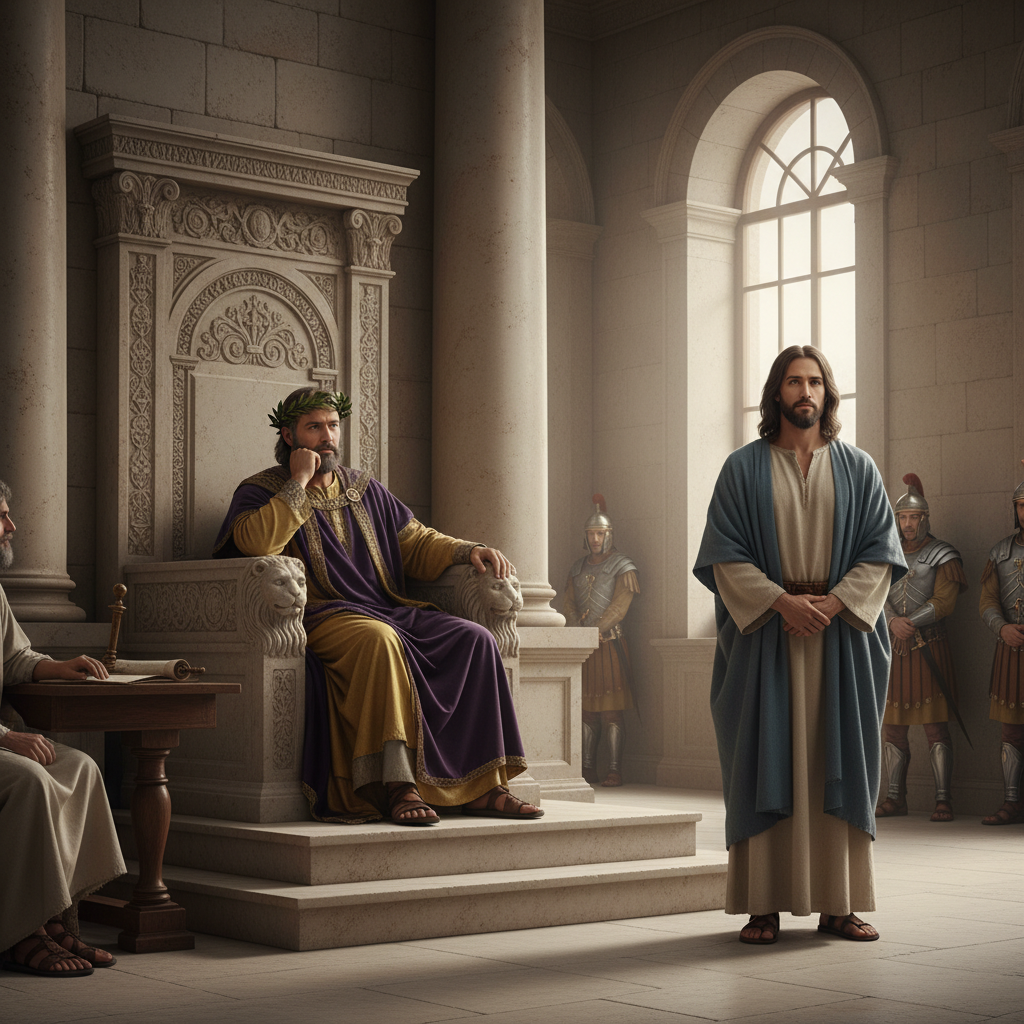
Herod the Great and the Infant Christ
Many people wonder if Herod the Great ever met Jesus, but the two never came face-to-face. While King Herod is a central figure in the Christmas story, his interactions with the infant Christ were indirect and hostile.
As the Roman client king of Judea, Herod was known for both his impressive building projects and his extreme paranoia. So, when the wise men arrived in Jerusalem seeking the newborn “King of the Jews,” Herod was deeply troubled. Viewing this prophesied king as a direct threat to his power, Herod plotted to destroy the child rather than meet him.
- The Magi’s Quest: Wise men from the East followed a star to find the one born King of the Jews. Their search first led them to Jerusalem, where they asked Herod for directions (Matthew 2:1-2).
- Herod’s Deception: Herod feigned interest in worshipping the child, secretly planning to kill him instead. He instructed the wise men to find Jesus and then report the location back to him (Matthew 2:7-8).
- Divine Intervention: However, God intervened. An angel warned the wise men in a dream not to return to Herod (Matthew 2:12). Joseph also received a divine warning, telling him to flee to Egypt with Mary and the young Jesus (Matthew 2:13-14). This divine protection kept Jesus safe from Herod’s evil plot.
Enraged by the wise men’s disobedience, Herod ordered a horrific act: the killing of all male children two years old and under in and around Bethlehem (Matthew 2:16-18). This event, known as the Massacre of the Innocents, highlights Herod’s ruthless nature and confirms that he never met Jesus. God’s plan for His Son could not be thwarted by any earthly king.
Herod Antipas and the Ministry of Jesus Christ
While Herod the Great never met Jesus, his son Herod Antipas did. As the tetrarch of Galilee and Perea, Antipas ruled the region where Jesus spent most of his adult ministry. It is important to recognize that Herod Antipas is a distinct figure from his father. [5]
Herod Antipas often heard reports about Jesus’ ministry, which left him intrigued and fearful. Having previously executed John the Baptist, Antipas worried that Jesus was actually John raised from the dead (Mark 6:14-16).
- Jesus’ Opinion of Antipas: Jesus Himself referred to Antipas as “that fox” (Luke 13:32), a description that speaks to Antipas’s cunning and deceptive character.
- Antipas’s Desire to See Jesus: Scripture tells us that Antipas had “long desired to see Jesus,” hoping to witness a miracle or sign (Luke 23:8). This desire was driven by curiosity, not by genuine faith.
- The Trial Encounter: Their only face-to-face meeting occurred during Jesus’ trial. When the Roman governor Pontius Pilate learned Jesus was from Galilee, he sent him to Antipas, who had jurisdiction over that region (Luke 23:6-7).
During their meeting, Antipas questioned Jesus at length, but Jesus gave him no answer. This powerful silence affirmed His divine authority and sovereign control over the situation. In response, Antipas and his soldiers mocked Jesus, dressing Him in an elegant robe before sending Him back to Pilate (Luke 23:11). Ultimately, Jesus’ dignified silence demonstrated the futility of worldly power against the King of Heaven. Therefore, while Jesus did meet Herod Antipas, it was on His own divine terms.
What Can We Learn from the Encounter Between Herod and Jesus?
The Sovereignty of God Over Worldly Rulers
The encounter between King Herod and the infant Jesus provides a profound lesson in God’s ultimate sovereignty. Appointed by Rome, Herod was a powerful ruler who wielded immense authority. However, his earthly power was insignificant compared to God’s divine will. God orchestrated every detail, from the star that guided the Magi to the dream that warned Joseph. Herod’s reign, though extensive, was finite.
God’s plan for His Son’s arrival unfolded perfectly, and no earthly king could derail it. As Proverbs 21:1 reminds us, “The king’s heart is a stream of water in the hand of the LORD; he turns it wherever he will.” This verse illustrates God’s control over even the most powerful leaders. Furthermore, Romans 13:1 teaches that all authority comes from God, which means Herod’s power was ultimately granted and overseen by the Almighty.
Therefore, we learn that God’s purposes stand firm and are unchangeable. His hand is present in all events, guiding them toward His divine purpose. We can find comfort in knowing that God is in control, even amidst chaos.
The Futility of Opposing God’s Plan
Herod’s desperate actions reveal the utter futility of opposing God’s plan. Feeling threatened by the prophecy of a new king, he first deceived the Magi and subsequently ordered the horrific Massacre of the Innocents (Matthew 2:16-18). Although Herod believed he could eliminate this perceived threat, his efforts were in vain because God had already intervened.
Warned in a dream, Joseph took Jesus and Mary to safety in Egypt, where they remained until Herod’s death. This turn of events reflects the truth of Psalm 33:10-11: “The LORD brings the counsel of the nations to nothing; he frustrates the plans of the peoples. The counsel of the LORD stands forever, the plans of his heart to all generations.” This scripture powerfully affirms God’s unyielding will.
Herod’s attempt to stop the King of Heaven was ultimately pointless, demonstrating that no human scheme, however ruthless, can thwart God’s sovereign will. His plans are perfect and cannot be overcome.
Jesus Christ: The True and Everlasting King
The stark contrast between King Herod and Jesus Christ reveals a profound truth about true kingship. Herod’s temporal kingdom was marked by paranoia and violence, and it ultimately crumbled when he died a miserable death. In contrast, Jesus’ kingdom is eternal and not of this world (John 18:36).
While Herod sought to maintain power through force, Jesus established His dominion through love, sacrifice, and resurrection. The birth of Jesus, though met with Herod’s hostility, signaled the arrival of the promised Messiah and the dawn of a new era. As the Son of God, not merely an earthly monarch, His kingship extends over all creation.
This contrast highlights the nature of Jesus’ true kingship:
- His Divine Authority: Jesus proclaimed, “All authority in heaven and on earth has been given to me” (Matthew 28:18).
- His Eternal Reign: Luke 1:33 states, “He will reign over Jacob’s descendants forever; his kingdom will never end.”
- His Universal Lordship: Philippians 2:9-11 declares that God exalted Jesus, “so that at the name of Jesus every knee should bow, in heaven and on earth and under the earth, and every tongue confess that Jesus Christ is Lord, to the glory of God the Father.”
Ultimately, the encounter with Herod solidifies Jesus’ identity as the “King of kings and Lord of lords” (Revelation 19:16). He came not to build an earthly empire but to establish a spiritual kingdom built on grace and truth. This kingdom offers salvation and eternal life to all who believe, fulfilling His mission to redeem humanity through His death and resurrection. He is the Son of God, our Lord and Savior, whose reign truly has no end.
Frequently Asked Questions About King Herod and Jesus
What happened to King Herod in the Bible?
King Herod the Great, infamous for trying to kill the infant Jesus, met a gruesome end. His death is recorded by the ancient historian Josephus and referenced in the Bible. After the Magi deceived him and Joseph fled with Jesus to Egypt, Herod’s paranoia and cruelty escalated.
According to historical accounts, Herod suffered from a horrific illness that caused agonizing pain, gangrene, worms, and a foul stench. This physical torment was accompanied by severe mental distress. His final days were filled with brutal acts of violence, even against his own family [4].
Herod died shortly after ordering the slaughter of all male children in and around Bethlehem who were two years old and under (Matthew 2:16). In God’s perfect timing, Herod’s death cleared the way for Jesus and His family to return from Egypt to Israel, fulfilling prophecy. As Matthew 2:19-20 states: “But when Herod was dead, behold, an angel of the Lord appeared in a dream to Joseph in Egypt, saying, ‘Rise, take the young Child and His mother, and go to the land of Israel; for those who sought the young Child’s life are dead.'”
Therefore, Herod’s demise serves as a powerful demonstration of God’s sovereignty. It shows that no earthly ruler, regardless of their power, can thwart the divine plan for His Son, Jesus Christ, our Lord and Savior.
How old was Jesus when King Herod died?
Jesus was a very young child, likely a toddler, when King Herod the Great died. Because most scholars date Jesus’s birth between 6 and 4 BC and Herod’s death in 4 BC, Jesus would have been two years old or younger [4].
This timing aligns with Herod’s horrific decree to kill all male children in Bethlehem “two years old and under” (Matthew 2:16). Herod chose this specific age range based on the information the Magi gave him about the star’s first appearance.
During this dangerous time, God divinely protected Jesus. An angel warned Joseph to flee with Mary and Jesus to Egypt, where they remained until Herod’s death (Matthew 2:13-15). After an angel confirmed the threat was gone, the family returned to Israel (Matthew 2:19-21). This sequence of events clearly highlights God’s unwavering protection of His Son, Jesus Christ.
What are the key Bible verses about King Herod and Jesus?
The primary biblical account of King Herod the Great’s plot against Jesus is found in the Gospel of Matthew. These key verses highlight God’s sovereign control over the events surrounding Jesus’s birth:
- Matthew 2:1-3: “Now after Jesus was born in Bethlehem of Judea in the days of Herod the king, behold, wise men from the East came to Jerusalem, saying, ‘Where is He who has been born King of the Jews? For we have seen His star in the East and have come to worship Him.’ When Herod the king heard this, he was troubled, and all Jerusalem with him.”
- Matthew 2:7-8: “Then Herod, when he had secretly called the wise men, determined from them what time the star appeared. And he sent them to Bethlehem and said, ‘Go and search carefully for the young Child; and when you have found Him, bring back word to me, that I may come and worship Him also.'”
- Matthew 2:12: “Then, being divinely warned in a dream that they should not return to Herod, they departed for their own country another way.”
- Matthew 2:13-15: “Now when they had departed, behold, an angel of the Lord appeared to Joseph in a dream, saying, ‘Arise, take the young Child and His mother, flee to Egypt, and stay there until I bring you word; for Herod will seek the young Child to destroy Him.’ When he arose, he took the young Child and His mother by night and departed for Egypt, and was there until the death of Herod, that it might be fulfilled which was spoken by the Lord through the prophet, saying, ‘Out of Egypt I called My Son.'”
- Matthew 2:16-18: “Then Herod, when he saw that he was deceived by the wise men, was exceedingly angry; and he sent forth and put to death all the male children who were in Bethlehem and in all its districts, from two years old and under, according to the time which he had determined from the wise men. Then was fulfilled what was spoken by Jeremiah the prophet, saying: ‘A voice was heard in Ramah, Lamentation and weeping and great mourning, Rachel weeping for her children, Refusing to be comforted, Because they are no more.'”
- Matthew 2:19-21: “But when Herod was dead, behold, an angel of the Lord appeared in a dream to Joseph in Egypt, saying, ‘Arise, take the young Child and His mother, and go to the land of Israel; for those who sought the young Child’s life are dead.’ Then he arose, took the young Child and His mother, and came into the land of Israel.”
Which Herod put John the Baptist to death?
The ruler who executed John the Baptist was not Herod the Great, but his son, Herod Antipas. This distinction is important, as the New Testament mentions several rulers from the Herodian dynasty.
Herod Antipas, the tetrarch of Galilee and Perea, had John the Baptist killed. The Gospels detail the events that led to John’s execution:
- John’s Condemnation: John the Baptist publicly condemned Herod Antipas for marrying Herodias, the wife of his brother Philip, an act forbidden by Jewish law (Leviticus 18:16).
- Imprisonment: For rebuking him, Herod Antipas had John arrested and put in prison (Matthew 14:3-4, Mark 6:17-18, Luke 3:19-20).
- The Deadly Oath: During Herod’s birthday celebration, Herodias’s daughter danced for the king and his guests. Pleased by her performance, Herod rashly promised to give her anything she asked, up to half his kingdom (Matthew 14:6-7, Mark 6:21-23).
- Herodias’s Vengeance: Coached by her vengeful mother, the girl asked for the head of John the Baptist on a platter (Matthew 14:8, Mark 6:24).
- Execution: Although Herod was distressed by the request, he felt bound by his oath made before his guests. He therefore ordered John to be beheaded in the prison (Matthew 14:9-11, Mark 6:26-28).
Therefore, it was Herod Antipas—not Herod the Great—who ordered the death of John the Baptist. This account demonstrates the courage required to speak God’s truth to power, and it affirms that Jesus Christ is the ultimate King whose authority surpasses all earthly rulers.