John 19 in the King James Version (KJV) provides a detailed account of the trial, crucifixion, death, and burial of Jesus Christ. The chapter chronicles Jesus’ suffering before Pilate, His journey to Golgotha, His final words from the cross, and the fulfillment of Old Testament prophecies concerning His death, solidifying His identity as the Lamb of God who takes away the sin of the world.
No event in human history holds more weight or eternal significance than the crucifixion of Jesus Christ. It was at the cross that divine love met human sin, prophecy found its fulfillment, and the pathway to redemption was forged for all mankind. This sacred story, recounted in the Gospel of John, is the cornerstone of our Christian faith. To deepen your understanding of this pivotal moment, this study of John 19 KJV offers a journey into the heart of God’s redemptive plan.
As we turn to this chapter, we do more than observe a historical event. We are invited to stand in awe of the Son of God, who willingly gave His life out of immeasurable love (John 3:16). This guide will walk you through each verse of John 19 in the King James Version. We will explore the trial before Pilate, the journey to Golgotha, the reality of the cross, and the tender moments of Christ’s burial. Every detail, recorded by the Apostle John, affirms the truth of Jesus’ divine nature, His suffering, and His victorious sacrifice for our salvation.
Our purpose is to provide clear answers that strengthen your faith and offer encouragement as we contemplate God’s ultimate demonstration of love. John 19 is not merely a historical account; it is a living testament to the power of the Gospel, revealing the depths of grace and the unwavering commitment of our Savior. Let us now delve into the profound truths of this vital chapter, preparing our hearts to receive its transformative message.
What is the Overall Meaning of John 19 KJV?
The nineteenth chapter of John in the King James Version (KJV) is a pivotal section of Scripture, meticulously recording the climax of Jesus Christ’s earthly ministry. It details His trial, His crucifixion, and His burial. For any believer, understanding the meaning of John 19 KJV is essential, as it reveals foundational truths about God’s love and redemption.
John 19 focuses on Jesus’ suffering and ultimate victory, underscoring both His divine nature and His purpose. The chapter refutes any idea that Jesus was merely a historical figure or a myth, powerfully affirming Him as the Son of God. His death was not a defeat but the fulfillment of God’s perfect plan for humanity’s salvation. This narrative lies at the very heart of the Christian faith.
Core Meanings of John 19 KJV
John 19 reveals several profound spiritual truths that form the bedrock of a believer’s understanding of Christ’s sacrifice. Key meanings from the chapter include:
- God’s Sovereign Plan Unfolding: Despite the injustice and cruelty Jesus faced, God remained in control. Every event, from Pilate’s hesitation to the soldiers’ actions, served God’s redemptive purpose. Jesus Himself stated, “No man taketh it from me, but I lay it down of myself” (John 10:18 KJV). This chapter reveals God’s divine plan at work, not a series of human errors.
- The Ultimate Sacrifice for Sin: John 19 graphically portrays Jesus’ suffering. His scourging and crucifixion were agonizing, but this was not random violence. It was a purposeful act of atonement. Jesus, the sinless Son of God, bore the sins of the world (2 Corinthians 5:21), and His death paid the penalty we could not pay.
- Fulfillment of Old Testament Prophecy: The events in John 19 perfectly align with ancient prophecies. For instance, the soldiers casting lots for His garment (John 19:24) fulfills Psalm 22:18. His thirst (John 19:28) fulfills Psalm 69:21, and the piercing of His side (John 19:34) fulfills Zechariah 12:10. This undeniable precision confirms Jesus’ identity as the promised Messiah.
- The King on the Cross: Though mocked and crucified, Jesus remained King. Pilate’s inscription, “JESUS OF NAZARETH THE KING OF THE JEWS,” (John 19:19 KJV) served as an unwitting declaration of this truth. Even in His lowest moment, Jesus’ authority remained undeniable. His kingdom is “not of this world” (John 18:36), yet He reigns supreme.
- Triumph and Redemption: Jesus’ final words, “It is finished” (John 19:30 KJV), declare ultimate victory. This was not a cry of defeat but a triumphant announcement that the work of salvation was complete. Sin’s power was broken, and death lost its sting. This profound declaration opened the way for eternal life for all who believe (John 3:16).
Ultimately, the meaning of John 19 KJV is unmistakable. It provides the definitive account of our Savior’s crucifixion and unequivocally demonstrates His divine identity as the Lamb of God who takes away the sin of the world. Through His voluntary suffering and death, He secured our eternal redemption. This chapter stands as a timeless testament to God’s immense love and power, calling us to worship the crucified and risen Lord.
What Happened During Jesus’ Trial Before Pilate? (John 19:1-16)
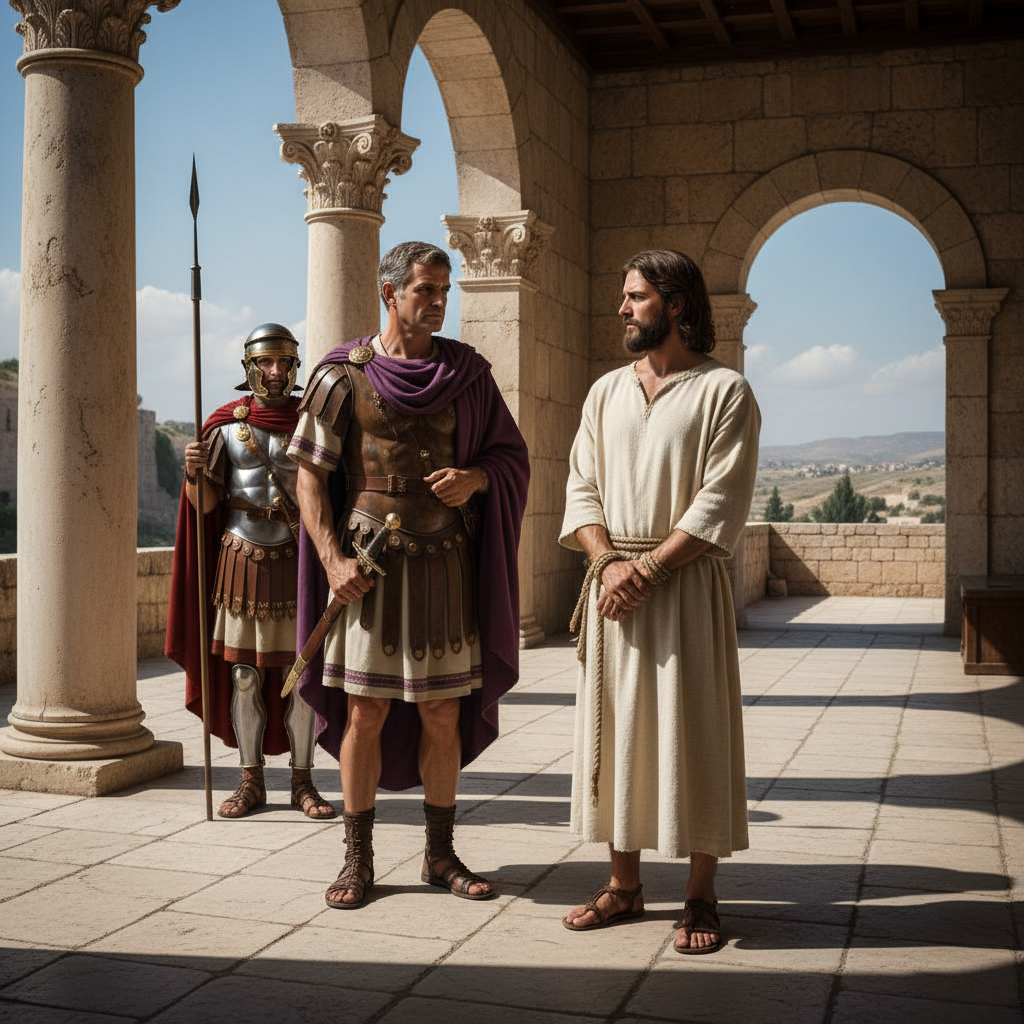
The Scourging and Mocking of the King
The trial of Jesus before Pontius Pilate was a pivotal moment in human history. After His arrest, Jesus was brought before the Roman governor. Though Pilate found no fault in Jesus (John 18:38), he sought to appease the angry crowd demanding condemnation.
Therefore, Pilate ordered Jesus to be scourged—a brutal Roman punishment where a whip embedded with bone or metal tore at the flesh, often leaving victims near death (John 19:1). Jesus endured this horrific ordeal for our sins.
The soldiers then continued their mockery. They twisted thorns into a crown for His head and clothed Him in a purple robe, a symbol of royalty (John 19:2). Offering sarcastic homage, they said, “Hail, King of the Jews!” while striking Him repeatedly (John 19:3). Amid this profound humiliation and immense agony, Jesus remained silent, His suffering highlighting His true divine kingship (Isaiah 53:7).
Pilate Presents the King: ‘Behold the Man!’
Hoping to satisfy the crowd’s thirst for blood, Pilate presented the scourged Jesus, still wearing the crown of thorns and purple robe (John 19:4). Pilate declared, “Behold the Man!” (John 19:5). This phrase, “Ecce Homo,” was meant to highlight Jesus’ broken state and evoke pity. Even then, Pilate proclaimed Jesus’ innocence.
However, the sight did not move the chief priests and officers to pity. Instead, they intensified their demands, crying out, “Crucify him, crucify him!” (John 19:6). A frustrated Pilate urged them to do it themselves, reasserting his finding: “I find no fault in him” (John 19:6).
The Jewish leaders then introduced a new accusation: Jesus claimed to be the Son of God (John 19:7). Under their law, this was blasphemy, a capital offense. This revelation deeply troubled the already uneasy Pilate (John 19:8).
The Final Judgment and Sentence of Death
Pilate took Jesus back into the judgment hall and asked, “Whence art thou?” (John 19:9). When Jesus gave no answer, Pilate’s fear and perplexity deepened. He reminded Jesus of his authority to either release or crucify Him (John 19:10).
Jesus calmly replied that Pilate’s authority was only granted from God above (John 19:11). He then noted that the one who delivered Him to Pilate, referring to Caiaphas, bore the greater sin. This divine perspective revealed Jesus’ control, even in His apparent helplessness.
Although Pilate still sought to release Jesus, the Jewish leaders issued a political threat (John 19:12). They warned Pilate, “If thou let this man go, thou art not Caesar’s friend,” arguing that anyone claiming kingship defied Caesar. Facing this direct threat to his career, Pilate caved to their pressure.
Pilate brought Jesus out one last time and sat on the judgment seat at a place called The Pavement (Gabbatha in Hebrew) (John 19:13). It was the day of Preparation for the Passover, about the sixth hour (John 19:14). Presenting Jesus, he said, “Behold your King!” The crowd cried, “Away with him, away with him, crucify him!” When Pilate asked, “Shall I crucify your King?” the chief priests defiantly replied, “We have no king but Caesar” (John 19:15).
Ultimately, Pilate delivered Jesus to be crucified (John 19:16). Though he symbolically washed his hands to claim innocence (Matthew 27:24), his actions condemned a guiltless man. The trial was a travesty of justice, revealing both humanity’s fallen nature and God’s perfect plan for salvation through His Son, Jesus Christ.
How Does John 19 Describe the Crucifixion of Jesus? (John 19:17-27)
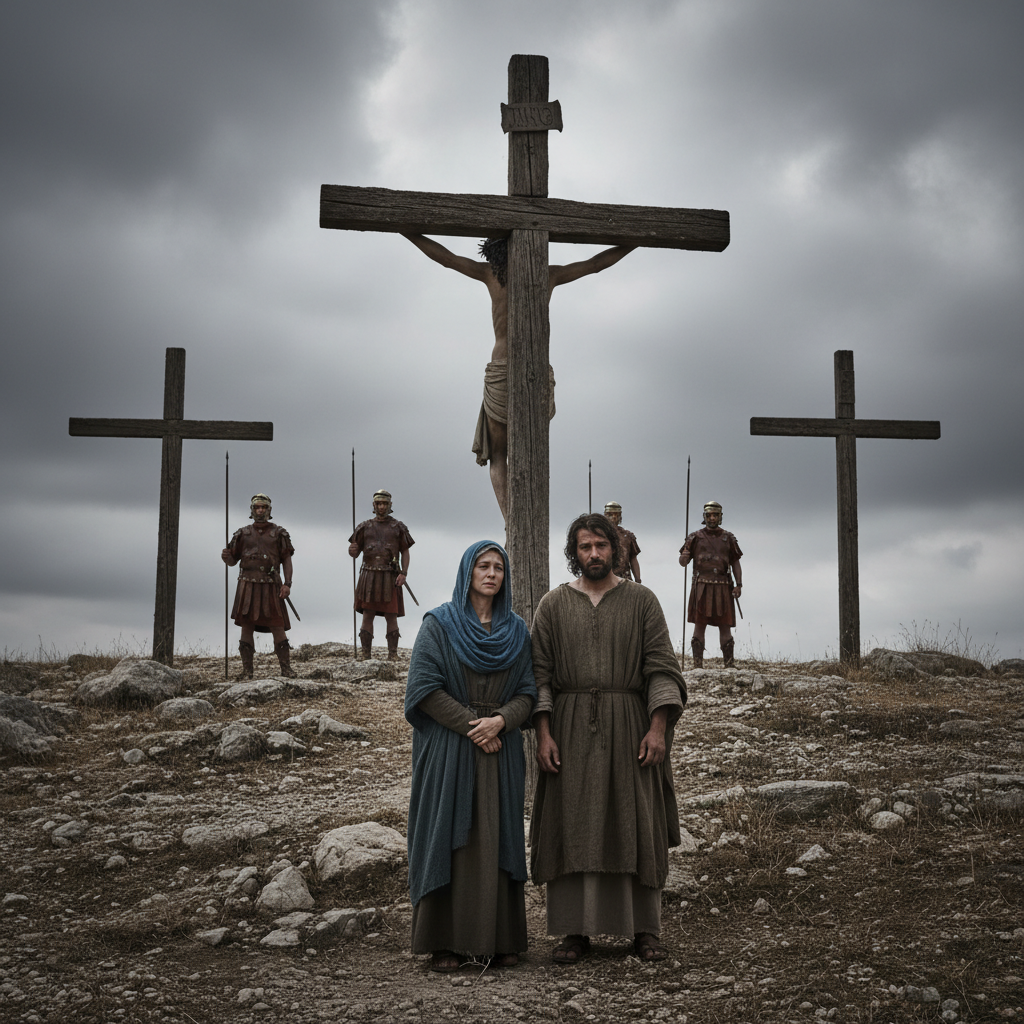
The Gospel of John provides a profound and deeply personal account of Jesus’ crucifixion. This passage, John 19:17-27, details the journey to Golgotha, the powerful inscription on the cross, and a tender moment revealing Jesus’ enduring care for His mother. The account is a testament to both His humanity and His divine mission.
The Walk to Golgotha, the Place of a Skull
Following Pilate’s judgment, Jesus was led away to be crucified. John 19:17 recounts, “And he bearing his cross went forth into a place called the place of a skull, which is called in the Hebrew Golgotha.” This verse highlights a significant detail: Jesus carried His own cross. This was an immense burden, especially after the brutal scourging and mocking He had already endured.
Golgotha, which means “place of a skull,” was likely a small hill outside Jerusalem’s city walls and a common site for public executions. The journey there was agonizing, with each step filled with pain and humiliation. Yet, Jesus walked purposefully toward His ultimate sacrifice. This path, known as the Via Dolorosa, demonstrates His unwavering commitment to fulfilling God’s will [1].
The act of carrying the crossbeam (the patibulum) was standard Roman practice for condemned criminals. For Jesus, however, it represented the weight of the world’s sin. He bore it for us, and His divine strength allowed Him to endure what no mere mortal could. This was a necessary step towards our redemption.
The Inscription on the Cross: ‘Jesus of Nazareth the King of the Jews’
Once Jesus arrived at Golgotha, He was crucified. At this point, Pilate made a notable decision. John 19:19 records, “And Pilate wrote a title, and put it on the cross. And the writing was, JESUS OF NAZARETH THE KING OF THE JEWS.” This inscription, known as a titulus, served as a public declaration of the condemned’s crime.
The chief priests were deeply displeased. They protested to Pilate, saying, “Write not, The King of the Jews; but that he said, I am King of the Jews” (John 19:21). Pilate, however, famously responded, “What I have written I have written” (John 19:22). His firm refusal is seen as an act of divine providence, as Pilate unwittingly proclaimed Jesus’ true identity, even if it was intended as mockery.
The inscription held significant meaning for several reasons:
- Universal Proclamation: It was written in Hebrew, Greek, and Latin (John 19:20). These three major languages ensured that virtually everyone passing by could understand the declaration.
- Divine Irony: What was intended as an insult by the Roman authorities became a powerful statement of truth. Jesus truly is the King of the Jews, and indeed, the King of all humanity.
- Fulfillment of Prophecy: This declaration inadvertently pointed to Jesus’ messianic claim. It affirmed His royalty, even as He suffered the death of a criminal.
Pilate’s stubbornness ultimately served God’s greater purpose, affirming Jesus’ kingly status for all to see and solidifying His identity as the promised Messiah.
Jesus Entrusts His Mother to John
Even amidst His excruciating suffering, Jesus demonstrated profound love and compassion. John 19:26-27 recounts, “When Jesus therefore saw his mother, and the disciple standing by, whom he loved, he saith unto his mother, Woman, behold thy son! Then saith he to the disciple, Behold thy mother! And from that hour that disciple took her unto his own home.”
This poignant exchange reveals Jesus’ enduring care for His earthly family. Even in His final moments, He thought of His mother, Mary. By entrusting her to John, “the disciple whom he loved,” Jesus ensured she would be cared for. This single act highlights several beautiful truths:
- Filial Piety: Jesus honored His mother, demonstrating the importance of caring for one’s parents.
- Selflessness: Despite His own immense agony, Jesus prioritized the well-being of others.
- Community of Faith: He established a new familial bond within the nascent Christian community. John, a beloved disciple, became a son to Mary, showing how believers are called to care for one another.
This moment underscores Jesus’ complete humanity. He felt pain and love. He was fully man, yet at the same time, fully God. His actions on the cross were not just about atonement; they also demonstrated divine love and set an example for us all. He is our Lord and Savior, who cared for us even to His last breath.
What are the Details of Jesus Christ’s Death on the Cross? (John 19:28-37)
The Fulfillment of Scripture: ‘I thirst.’
As Jesus hung on the cross, His suffering was immense, having endured hours of torment while bearing the weight of all humanity’s sin. In His final moments, He spoke again. John 19:28 records, “After this, Jesus knowing that all things were now accomplished, that the scripture might be fulfilled, saith, I thirst.”
This declaration was not merely a cry of physical discomfort but served a much deeper, divine purpose. Jesus intentionally spoke these words to fulfill a specific Old Testament prophecy found in Psalm 69:21: “They gave me also gall for my meat; and in my thirst they gave me vinegar to drink.”
In response, the soldiers offered Him a sponge full of vinegar, putting it on a hyssop branch and lifting it to His mouth (John 19:29). Even in His agony, Jesus ensured every prophetic detail was accomplished. His perfect obedience secured our salvation.
The Final Words of Victory: ‘It is finished.’
After receiving the vinegar, Jesus uttered His powerful final words. John 19:30 states, “When Jesus therefore had received the vinegar, he said, It is finished: and he bowed his head, and gave up the ghost.” This phrase, “It is finished” (Greek: Tetelestai), holds profound meaning as a declaration of triumph, not defeat.
Consider the depth of this statement:
- The Work of Redemption: Jesus completed the Father’s plan by fully paying the price for sin. All required sacrifices were now fulfilled.
- Prophecy Fulfilled: Every Old Testament prophecy concerning the Messiah’s suffering and death was perfectly accomplished.
- Satan’s Defeat: The power of sin and death was broken, and Satan’s hold over humanity was destroyed.
- New Covenant Established: The way to God was now open, made accessible through Jesus’ blood. No further atonement is needed.
The phrase “gave up the ghost” highlights His sovereign control over His own life. He was not a victim; instead, He willingly laid down His life (John 10:18), making His death a victorious completion of God’s saving work for us.
The Piercing of Jesus’ Side
As the day of the crucifixion neared its end, the Jewish leaders asked Pilate to hasten the deaths of the crucified men. Because it was the preparation day for the Passover Sabbath, they wanted the bodies removed before sundown to avoid defiling the holy day (John 19:31).
Following custom, Roman soldiers began breaking the legs of the crucified—an action that hastened death by preventing them from pushing up to breathe. They broke the legs of the two thieves, but when they came to Jesus, they found He was already dead (John 19:32-33), a crucial detail.
To confirm His death, one soldier pierced Jesus’ side with a spear, and immediately, “there came out blood and water” (John 19:34). This event carries deep significance.
- Proof of Death: The outflow of blood and water medically confirms death, suggesting fluid separation in the pericardial sac or pleural cavity [source: https://www.ncbi.nlm.nih.gov/pmc/articles/PMC1120019/].
- Prophetic Fulfillment: This act fulfilled multiple scriptures. In a direct parallel to the Passover lamb, not one of Jesus’ bones was broken (Exodus 12:46; Psalm 34:20). Furthermore, Zechariah 12:10 prophesied, “they shall look upon me whom they have pierced.”
- Spiritual Symbolism: The blood represents atonement and forgiveness (Hebrews 9:22), while the water symbolizes cleansing and new life through the Holy Spirit (John 7:38-39).
John, an eyewitness to these events, testifies to their truthfulness (John 19:35). The piercing of Jesus’ side therefore serves as undeniable confirmation of His sacrificial death, a validation of the prophetic word, and a solidifying of His identity as the true Messiah and our Savior.
Who Buried Jesus According to John 19? (John 19:38-42)
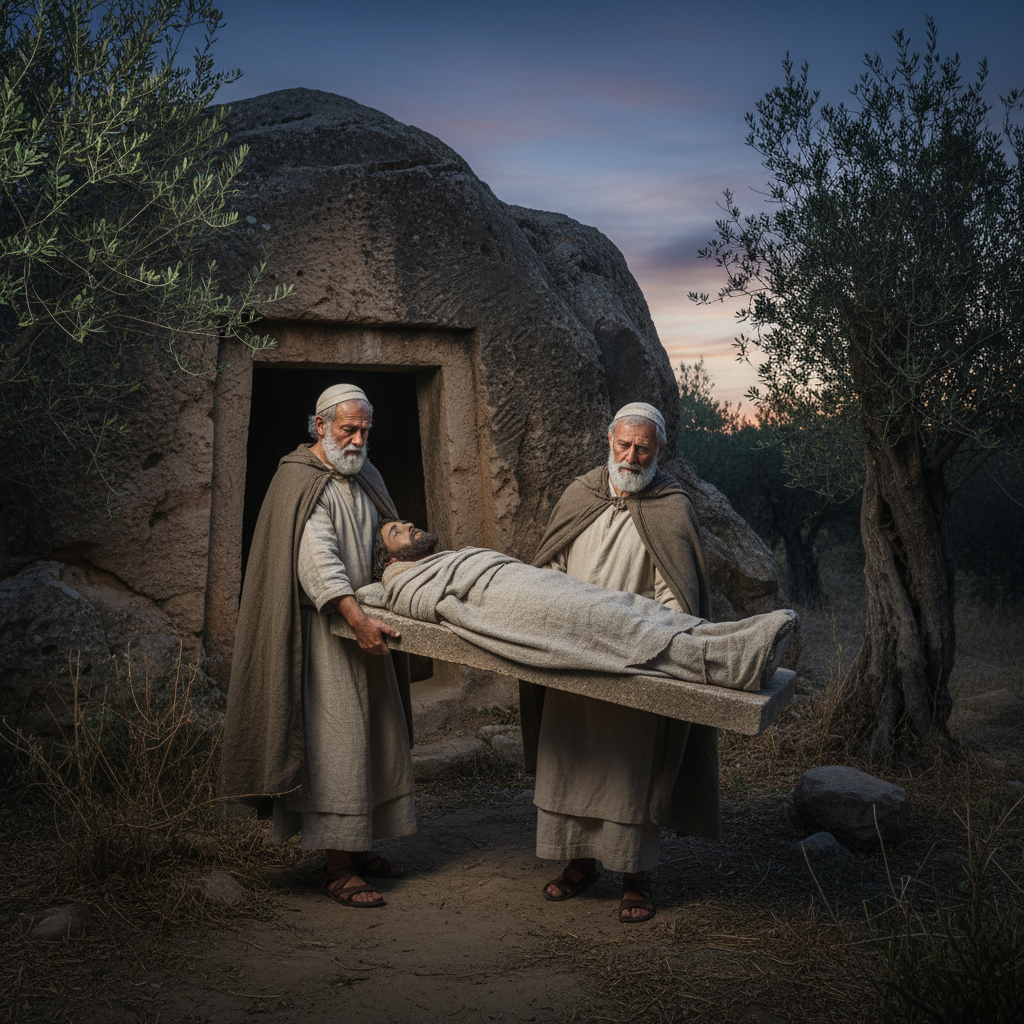
After Jesus died on the cross, the sacred task of His burial began. This pivotal event, detailed in John 19:38-42, not only confirms the historical reality of the crucifixion but also sets the stage for the glorious resurrection. Let’s look at the individuals who bravely stepped forward to honor our Lord in His death.
Joseph of Arimathaea’s Boldness
After Jesus’ death, a man named Joseph of Arimathaea showed remarkable courage. According to John 19:38, he was a disciple of Jesus but kept it secret “for fear of the Jews.” As a prominent member of the Sanhedrin—the same Jewish council that had condemned Jesus—publicly associating with Christ was incredibly dangerous.
Despite this risk, Joseph went to Pilate and boldly asked for permission to take away Jesus’ body. This was an act of profound faith and daring. By doing so, he risked his reputation, social standing, and even his life to ensure the Lord received a proper burial.
Pilate granted the request. Joseph’s actions also fulfilled ancient prophecy, specifically Isaiah 53:9, which foretold that the Messiah would be “with the rich in his death.” This detail shows God’s sovereign plan unfolding even in a moment of great sorrow.
Nicodemus’ Offering of Myrrh and Aloes
Joseph of Arimathaea was not alone in this solemn task; he was joined by Nicodemus. Readers of the Gospel of John will remember Nicodemus as the man who came to Jesus by night to learn about being “born again” (John 3:1-21). Now, this once-secret inquirer openly declared his allegiance to Christ.
John 19:39 details Nicodemus’ generous contribution. He “brought a mixture of myrrh and aloes, about an hundred pound weight”—an incredibly costly and substantial amount. Myrrh and aloes were aromatic resins used in Jewish burial customs to anoint the body and counteract the smell of decomposition [2].
This lavish offering demonstrated the deep reverence both men held for Jesus. It was a final act of worship, preparing His body for the tomb with the dignity and honor He deserved.
The Burial in the Garden Tomb
With the body of Jesus and the precious spices in hand, Joseph and Nicodemus proceeded with the burial. John 19:40-42 provides the following details:
- They took the body of Jesus and wrapped it in linen cloths with the spices, following Jewish burial customs.
- The burial took place in a garden near Golgotha, the site of the crucifixion.
- They laid Jesus in a new tomb that belonged to Joseph of Arimathaea.
- Because the tomb had never been used, it was a pure resting place for the Lord’s body.
- The burial was completed quickly because the Sabbath was about to begin at sunset, when all work had to stop.
This swift and honorable burial in a new tomb is a cornerstone of Christian faith. It provides definitive proof of Jesus’ physical death and establishes a clear, undeniable location from which He would rise again. The empty tomb, therefore, is not merely a historical detail; it is the bedrock of Christian hope and the ultimate validation of Jesus Christ’s victory over death.
Why is John 19 Central to the Christian Faith?
John 19 in the KJV stands as a profound cornerstone of Christian belief, meticulously detailing the suffering, crucifixion, and death of Jesus Christ. More than a historical narrative, this chapter reveals central truths about God’s character and His plan for humanity. Understanding its contents deepens our faith by illuminating the very heart of the Gospel message.
The Ultimate Revelation of God’s Love
First, John 19 powerfully displays God’s boundless love for mankind. For our salvation, Jesus, the Son of God, willingly endured immense suffering, humiliation, and a cruel death on the cross. The cross, therefore, stands as the ultimate demonstration of divine love, fulfilling the promise of John 3:16: “For God so loved the world, that he gave his only begotten Son.” This chapter shows that sacrificial love in action as Jesus lays down His life for His friends.
Atonement for Sins
Moreover, John 19 is central because it details the atonement for sin. Separated from God by sin, humanity could not bridge the gap on its own. Jesus’ death on the cross paid the penalty for our transgressions, as He became the perfect, spotless sacrifice. As Romans 5:8 says, “But God commendeth his love toward us, in that, while we were yet sinners, Christ died for us.” Through His shed blood, we are cleansed and find reconciliation with God.
Fulfillment of Prophecy
Furthermore, this chapter vividly illustrates the fulfillment of Old Testament prophecies concerning the Messiah’s suffering and death. John 19 shows Jesus fulfilling these ancient scriptures down to the smallest detail. For instance, the piercing of His side confirms Zechariah 12:10, and the offering of vinegar fulfills Psalm 69:21. These specific fulfillments not only affirm the Bible’s authority but also declare Jesus’ identity as the promised Savior, proving that God’s divine plan was in motion all along.
Victory Over Sin and Death
Although the crucifixion may seem like a defeat, John 19 actually sets the stage for the ultimate victory. Jesus’ death was a triumph over the power of sin and death; by dying, He conquered, and by entering the grave, He prepared for the resurrection. His cry, “It is finished” (John 19:30), signifies that the work of salvation was accomplished, providing hope for all believers. This victory is echoed in 1 Corinthians 15:55: “O death, where is thy sting? O grave, where is thy victory?”
The Foundation of the Gospel Message
Finally, John 19 is indispensable to the Gospel itself. The good news is not simply that Jesus lived, but that He died for our sins and rose again. Without the crucifixion, there is no resurrection, and without the cross, there is no hope of eternal life. The events in this chapter are the bedrock of our faith and the very message we proclaim, as we preach “Christ crucified…Christ the power of God, and the wisdom of God” (1 Corinthians 1:23-24). Therefore, John 19 is more than just a chapter; it is the essence of the Christian faith, revealing Jesus Christ as Lord, Savior, and King.
Frequently Asked Questions About John 19 KJV
What is the significance of John 19:1 KJV?
John 19:1 KJV marks a pivotal moment in Christ’s path to the cross: “Then Pilate therefore took Jesus, and scourged him.” In this verse, the Roman governor Pontius Pilate orders Jesus to be scourged—an act with profound and multi-faceted significance.
- Intense Suffering: Scourging was an incredibly brutal Roman punishment. The whip, often tipped with bone or metal, was designed to tear flesh from the victim’s back. This agonizing torment fulfilled prophecies about the Messiah’s suffering (Isaiah 53:5) and preceded His crucifixion. Indeed, the Bible states, “by His stripes we are healed.”
- Pilate’s Ambivalence: Pilate was convinced of Jesus’ innocence (John 19:4, 6). He hoped that scourging Jesus would appease the crowd, allowing him to release Jesus. However, this attempt at compromise failed. Pilate’s actions highlight the human struggle between justice and the pressure of popular opinion.
- Divine Purpose: Despite the human cruelty and political maneuvering, the scourging was part of God’s sovereign plan for redemption. Jesus willingly endured this horrific pain as a necessary step in atoning for sin. His suffering demonstrates an immense love for humanity by taking our punishment upon Himself.
Therefore, John 19:1 signifies the beginning of Jesus’ most intense physical suffering, revealing both human depravity and God’s perfect plan for salvation through Christ’s sacrifice.
Where can I find a good commentary on John 19 KJV?
To deepen your understanding of John 19 KJV, many excellent commentaries are available. These resources illuminate the historical context, theological details, and practical applications of this crucial chapter. Below are some recommended categories and examples:
- Devotional Commentaries: These focus on spiritual encouragement and personal application.
- Matthew Henry’s Commentary on the Whole Bible: This timeless classic is known for its pious and practical insights, offering verse-by-verse explanations.
- John Gill’s Exposition of the Entire Bible: This commentary offers a deeply theological and comprehensive perspective from a rich, Reformed tradition.
- Expository/Academic Commentaries: These delve into textual analysis, historical background, and theological themes.
- The Expositor’s Bible Commentary: Provides scholarly yet accessible analysis from a conservative evangelical perspective.
- The New American Commentary: Offers robust academic scholarship while remaining committed to the inerrancy of Scripture.
- NIV Application Commentary: Bridges the gap between the ancient text and modern life, explaining both the passage’s original meaning and its contemporary relevance.
- Study Bibles: Many modern study Bibles include verse-by-verse notes that function as a concise commentary.
- ESV Study Bible: Features extensive notes, articles, and maps that provide substantial insights into the text.
- MacArthur Study Bible: Known for its detailed, conservative theological commentary from John MacArthur.
When choosing a commentary, look for one that aligns with sound biblical doctrine and helps you draw closer to Christ. Reputable online platforms also host many of these commentaries for free access [3]. Ultimately, allow the Holy Spirit to guide your study, as He is the ultimate teacher of God’s Word.
How do the NKJV or NIV translations of John 19 compare to the KJV?
Comparing the King James Version (KJV) of John 19 with translations like the New King James Version (NKJV) and the New International Version (NIV) reveals different approaches to God’s Word. Although all three faithfully present the core narrative of Jesus’ crucifixion, they differ in their underlying translation philosophies and source texts.
Key Differences and Similarities:
This comparison illustrates their distinct characteristics:
| Feature | King James Version (KJV) | New King James Version (NKJV) | New International Version (NIV) |
|---|---|---|---|
| Translation Philosophy | Formal Equivalence (word-for-word) | Formal Equivalence (word-for-word) | Dynamic Equivalence (thought-for-thought) |
| Source Text | Textus Receptus (Majority Text) | Textus Receptus (Majority Text) | Critical Text (e.g., Nestle-Aland, UBS) |
| Language Style | Traditional 17th-century English (“thee,” “thou”) | Modernized 20th-century English, retaining KJV cadence | Contemporary 20th/21st-century English, very readable |
| Example (John 19:30) | “When Jesus therefore had received the vinegar, he said, It is finished: and he bowed his head, and gave up the ghost.” | “So when Jesus had received the sour wine, He said, ‘It is finished!’ And bowing His head, He gave up His spirit.” | “When he had received the drink, Jesus said, ‘It is finished.’ With that, he bowed his head and gave up his spirit.” |
| Emphasis | Emphasizes historical wording and the theological precision of the original text’s structure. | Updates vocabulary for modern readers while retaining the KJV’s textual basis and reverent tone. | Prioritizes clear communication for modern readers, aiming for a natural, easy-to-read flow. |
Understanding the Impact:
- KJV’s Enduring Legacy: The KJV remains beloved for its historical impact, poetic language, and theological depth. Its faithful rendition of the Textus Receptus has shaped English-speaking Christianity for centuries.
- NKJV’s Accessibility: The NKJV offers an excellent bridge for those who appreciate the KJV’s heritage but prefer updated English, providing the same textual basis in more accessible language.
- NIV’s Readability: The NIV aims for high readability and is widely used for personal devotion and evangelism. Its dynamic equivalence approach conveys the original meaning in clear, contemporary language. For example, in John 19:1, the KJV says “scourged him,” while the NIV says “had Jesus flogged,” both conveying the same brutal punishment.
Each translation offers a unique window into the glorious events of John 19 while presenting the same divine truth. They all confirm that Jesus Christ is the Son of God, who willingly suffered and died for our salvation. We encourage believers to prayerfully engage with God’s Word in the translation that best aids their understanding and spiritual growth [4].
What happens in John 20 KJV after the crucifixion?
John 20 KJV reveals the most foundational event of Christian faith: the resurrection of Jesus Christ. After the somber crucifixion in John 19, this chapter bursts forth with the hope, triumph, and undeniable proof of Jesus’ victory over sin and death.
Key events in John 20 include:
- The Empty Tomb (John 20:1-10): Early on the first day of the week, Mary Magdalene finds the tomb empty. She runs to tell Peter and John, who race to the tomb and find only the grave clothes, confirming that Jesus’ body is gone. This discovery immediately points to a miraculous event.
- Jesus Appears to Mary Magdalene (John 20:11-18): Grieving at the tomb, Mary encounters two angels and then Jesus Himself. At first, she mistakes Him for the gardener but recognizes Him when He speaks her name, becoming the first eyewitness to the resurrected Christ.
- Jesus Appears to His Disciples (John 20:19-23): That evening, Jesus appears to His disciples in a locked room. He greets them with peace, shows them His hands and side, and breathes on them, bestowing the Holy Spirit and commissioning them for ministry. This appearance transforms their fear into joy.
- Thomas’s Doubt and Belief (John 20:24-29): Thomas, who was absent, refuses to believe without seeing and touching Jesus’ wounds. A week later, Jesus appears again for Thomas’s benefit. Thomas responds with the profound confession, “My Lord and my God!” (John 20:28).
- The Purpose of John’s Gospel (John 20:30-31): John concludes the chapter by stating his primary reason for writing: “But these are written, that ye might believe that Jesus is the Christ, the Son of God; and that believing ye might have life through his name” (John 20:31).
John 20 emphatically establishes the truth of Jesus’ resurrection, which is the cornerstone of Christian belief. It proves Jesus’ divine identity, validates His sacrifice on the cross, and offers eternal life to all who believe in His name. It is a chapter that moves from sorrow to joy and from doubt to unwavering faith, all centered on the living Lord Jesus Christ.