
John 6:66 states, ‘From this time many of his disciples turned back and no longer followed him.’ This verse describes the moment when many people who had been following Jesus chose to abandon Him because they could not accept His difficult teaching that He is the ‘Bread of Life’ and that one must ‘eat His flesh and drink His blood’ to have eternal life (John 6:53-58). It marks a pivotal point, separating casual followers from committed disciples who accept Jesus’ divine claims.
The Bible contains powerful moments that reveal the true cost of discipleship, and John 6:66 is one of the most challenging. This verse marks a pivotal turning point in Jesus’ ministry. It records the moment when many of his followers made a decisive choice to turn away and “walked with Him no more.” This is more than a historical account; it is a stark revelation about genuine commitment, the demands of faith, and the unwavering truth of Jesus’ teachings.
This verse, often called “the hard saying,” immediately follows Jesus’ declaration that He is the “Bread of Life.” He explained that true life comes from eating His flesh and drinking His blood (John 6:35, 6:53-56). While spiritually foundational, these words were met with shock and disbelief. This teaching was designed to separate superficial followers from those whose faith was truly rooted in Him as the Son of God (John 6:41-42, 6:51). The message is clear: following Jesus Christ requires more than casual interest. It demands complete surrender and belief in His divine authority and saving mission.
In this article, we will explore the context that led to this departure, understand the meaning behind the disciples’ decision, and see how the remaining twelve apostles responded. Our journey through this powerful scripture will illuminate the historical event and provide timeless lessons. We will learn about the cost of true discipleship, the necessity of unwavering faith, and the enduring assurance found only in Jesus, “the Holy One of God” (John 6:69).
What Was the Context Before John 6:66?
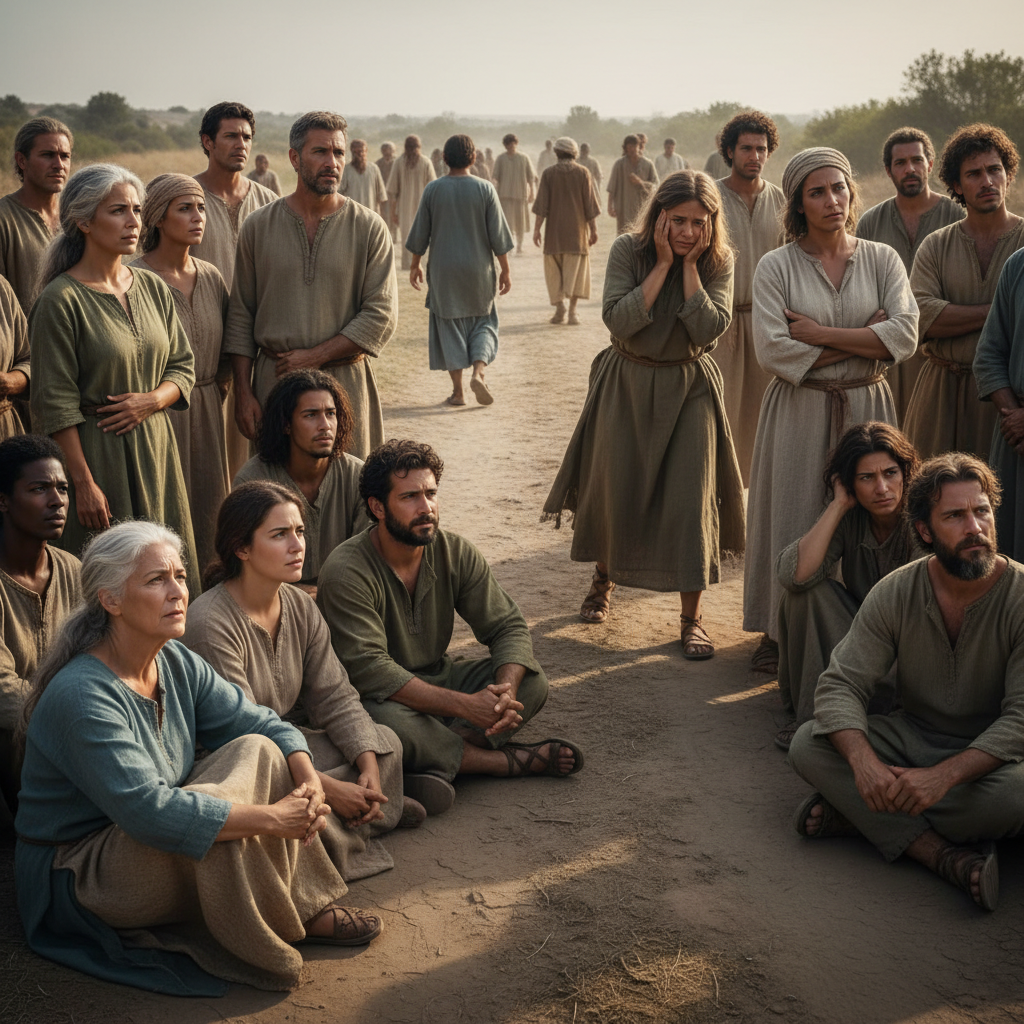
Jesus’ ‘Bread of Life’ Discourse (John 6:22-59)
To understand this pivotal moment, it’s crucial to know what happened right before. Jesus had just miraculously fed over five thousand people with only five barley loaves and two fish (John 6:1-14). Captivated by this incredible sign, the crowd sought Him out again, hoping for more physical food. However, Jesus wanted to offer them something of far greater value.
He began to teach about a different kind of bread—not earthly food that perishes, but spiritual nourishment that provides eternal life. Jesus declared, “I am the bread of life; whoever comes to me shall not hunger, and whoever believes in me shall never thirst” (John 6:35). With these words, He revealed His divine nature and heavenly origin, stating that He had come down from heaven (John 6:33, 6:38).
The discourse then became more profound and challenging. Jesus explained that to receive eternal life, one must “eat the flesh of the Son of Man and drink His blood” (John 6:53). This was not a literal command but a powerful spiritual metaphor. It signified a complete reliance on His sacrifice for salvation and an intimate union with Him through faith in His atoning work. This teaching demanded a deep and trusting faith in Jesus Christ as the only source of eternal life (John 6:40).
The Shock and Disbelief of the Crowd
Jesus’ powerful words caused confusion and offense. Many in the crowd, including some of His own followers, struggled with the message because they interpreted it literally. “How can this man give us his flesh to eat?” they murmured (John 6:52). This idea was deeply shocking to Jewish listeners, as Mosaic Law strictly forbade the consumption of blood (Leviticus 17:10-14). Consequently, Jesus’ teaching seemed not only confusing but abhorrent.
The crowd’s focus remained on the physical; they wanted more miraculous bread, not challenging spiritual truths. They failed to grasp that Jesus was speaking metaphorically, not of literal cannibalism. He was calling them to spiritually receive His life and fully trust in His redemptive work through faith. Many found this teaching “hard” (John 6:60) because it challenged their expectations of the Messiah. This difficult message exposed the true reason they were following Him: was it for earthly benefits or for eternal truth? The discourse thus set the stage for a critical decision, leading directly to the turning point in John 6:66.
What is the meaning of John 6:66?
John 6:66 marks a pivotal and sobering moment in Jesus’ ministry, revealing the profound challenge of true discipleship. When many who had previously followed Jesus turned away, the verse highlighted an essential truth: following Jesus requires unwavering faith and complete surrender to His divine authority and teachings.
‘Many of His disciples turned back’
The phrase “many of His disciples turned back” describes a significant turning point. Until this moment, large crowds had often followed Jesus, many of them drawn by His miracles and the hope of healing or even physical food. The shift occurred after Jesus delivered His profound “Bread of Life” discourse (John 6:22-59), in which He declared Himself the living bread from heaven. He specifically stated, “Unless you eat the flesh of the Son of Man and drink His blood, you have no life in you” (John 6:53).
This teaching was difficult for many to accept, seeming both shocking and offensive. Struggling with a literal interpretation, the listeners failed to grasp the spiritual truth Jesus presented because they could not see beyond the physical. Their hearts were not ready for such a deep revelation, and consequently, many who had identified as “disciples” walked away. John 6:60 confirms their reaction: “Therefore many of His disciples, when they heard this, said, ‘This is a hard saying; who can understand it?'”
Jesus, knowing their thoughts, challenged their unbelief by asking if this truth offended them (John 6:61). This critical moment separated those with genuine faith from those with only a superficial interest. It demonstrated that belief in Jesus demands more than witnessing miracles; it requires spiritual understanding and humble acceptance of His divine claims.
‘And walked with Him no more’
The departure of these individuals was final, as the text states they “walked with Him no more.” This phrase signifies a complete rejection of both Jesus’ teaching and His person. No longer part of His immediate circle, they proved unwilling to accept the spiritual depth of His words. Ultimately, their decision underscores the cost of true discipleship.
Walking with Jesus is not a casual endeavor but one that requires wholehearted commitment. These individuals chose comfort over truth, preferring their own understanding to divine revelation. Their departure serves as a stark warning that external association with Christ is not enough. True faith must reside in the heart and be willing to embrace even the “hard sayings.” As Jesus Himself said, “If anyone desires to come after Me, let him deny himself, and take up his cross daily, and follow Me” (Luke 9:23). These so-called disciples were unwilling to carry that cross.
Their turning away was not merely a physical separation but a spiritual withdrawal. In turning their backs on the very source of eternal life, their refusal to believe demonstrated a profound lack of spiritual understanding. Ultimately, they prioritized their earthly perspectives over the divine wisdom of the Son of God.
The Difference Between a Follower and a True Disciple
John 6:66 highlights the crucial distinction between a casual follower and a true disciple. Not everyone who follows Jesus demonstrates committed faith. Let’s explore this difference:
- A Follower:
- Is often drawn by external factors, such as miracles or personal benefit.
- May listen to Jesus’ teachings but does not fully internalize or obey them.
- Shows superficial enthusiasm, but their commitment is shallow.
- Turns away when the teachings become challenging or require sacrifice.
- Prioritizes their own understanding or comfort over Christ’s commands.
- A True Disciple:
- Is committed to Jesus Christ as Lord and Savior above all else.
- Abides in His word and seeks to understand and obey His teachings (John 8:31-32).
- Demonstrates their love for Christ by loving others (John 13:34-35).
- Perseveres through difficult times and “hard sayings” with unwavering faith.
- Bears spiritual fruit, reflecting Christ’s character in their life (John 15:8).
Jesus Himself defined a true disciple, saying, “If you abide in My word, you are My disciples indeed. And you shall know the truth, and the truth shall make you free” (John 8:31-32). True discipleship is a lifelong journey that requires daily surrender to the Son of God, acknowledging His absolute authority and wisdom. It is a relationship founded on faith in His death, resurrection, and ongoing lordship. Therefore, as believers, we are called not just to follow, but to be true disciples who make disciples of all nations (Matthew 28:19-20).
How Did the Twelve Apostles Respond?

Jesus’ Question to the Twelve (John 6:67)
After many followers walked away, Jesus turned to His inner circle, the Twelve. He posed a direct and deeply searching question: “Do you also want to go away?” (John 6:67). This moment reveals a crucial truth about faith: Jesus never forces anyone to follow Him but instead respects their free will.
Jesus’ question was not born from doubt but served as a profound test. It presented a stark choice to those closest to Him: Would they also abandon Him? Would they stumble over His “hard saying” about His flesh and blood? This critical moment separated casual followers from committed disciples, highlighting the cost of unwavering faith. Furthermore, it underscored that even the Twelve were not immune to such spiritual testing.
Peter’s Declaration of Faith (John 6:68-69)
The silence that followed must have been heavy. Then, Simon Peter, ever the outspoken one, broke it with a powerful declaration of faith. His words resonate through the centuries, offering profound insight into true discipleship. Peter’s answer was not merely impulsive but was divinely inspired.
Peter declared:
- “Lord, to whom shall we go? You have the words of eternal life” (John 6:68).
- “Also we have come to believe and know that You are the Christ, the Son of the living God” (John 6:69). (Note: Some versions like the KJV and NIV have “the Holy One of God” [source: BibleGateway – John 6:69: https://www.biblegateway.com/verse/en/John%206:69])
This response stands in powerful contrast to the desertion of the crowd. Peter recognized that despite the difficulty of Jesus’ teaching, there was no other source of truth or path to eternal life. He understood that Jesus alone possessed “the words of eternal life.” This was a spiritual understanding that saw beyond the literal and into the divine essence of Jesus’ message.
Peter’s confession affirmed Jesus’ true identity, declaring Him to be “the Holy One of God” or “the Christ, the Son of the living God.” This was not a mere intellectual agreement but a heartfelt, Spirit-led acknowledgment of His divinity. This declaration solidified the apostles’ commitment, and they chose to stay with Jesus. Their faith transcended their immediate understanding, allowing them to trust in Jesus’ person even when His words were challenging. Peter’s profound statement serves as a timeless model for all believers, calling us to cling to Christ as the singular source of salvation and truth.
What Does John 6:66 Teach Christians Today?

The Cost of Discipleship
John 6:66 serves as a powerful reminder of the true cost of discipleship. Many who initially followed Jesus did so for superficial reasons, drawn by His miracles and the bread He multiplied (John 6:26). However, Jesus’ teachings went much deeper, challenging their worldly understanding with spiritual truths that were difficult for many to accept.
Following Jesus requires a genuine commitment that goes beyond casual admiration; it demands a complete surrender of self. As Jesus Himself made clear:
- “If anyone would come after me, let him deny himself and take up his cross daily and follow me.” (Luke 9:23)
- “Whoever does not bear his own cross and come after me cannot be my disciple.” (Luke 14:27)
Ultimately, true discipleship involves the sacrifice of choosing God’s will over our own desires. Although this path is not always easy and often leads to challenges, the eternal reward far outweighs any earthly cost. We must be prepared for this journey.
The Necessity of Unwavering Faith in Christ
The departure of many followers in John 6:66 highlights the absolute necessity of unwavering faith. During His “Bread of Life” discourse, Jesus spoke of spiritual nourishment, declaring, “I am the bread of life; whoever comes to me shall not hunger, and whoever believes in me shall never thirst” (John 6:35). While this was a profound spiritual truth, many focused only on the physical.
Faith is more than intellectual agreement; it is a deep trust in Jesus Christ that sustains us through difficult times and allows us to accept truths our minds may struggle with. Peter’s response perfectly illustrates this vital faith:
When Jesus asked the twelve if they also wanted to leave, Peter answered, “Lord, to whom shall we go? You have the words of eternal life” (John 6:68). In this moment, Peter recognized that Jesus was the sole source of eternal salvation and that there was no other path.
Therefore, our faith must remain steadfast, anchored in Christ alone. He is “the way, and the truth, and the life” (John 14:6), and there is salvation in no one else (Acts 4:12).
Finding Assurance in Jesus, the Holy One of God
Ultimately, John 6:66 teaches us that true assurance is not found in the number of followers or in popular opinion. Instead, our assurance rests entirely in the person of Jesus Christ. Peter’s profound declaration confirms this truth when he confesses, “We have believed, and have come to know, that you are the Holy One of God” (John 6:69).
This title, “the Holy One of God,” affirms Jesus’ divine nature by speaking to His unique relationship with the Father, His perfect righteousness, and His authority to offer eternal life. Our confidence, therefore, comes not from our own strength but from His saving power, as we are saved by grace through faith (Ephesians 2:8-9).
Because of this, Christians today can find great comfort and assurance in knowing who Jesus truly is. He is not merely a prophet or a good teacher, but the Son of God—our Lord and Savior. He died for our sins, rose again, and now offers eternal life to all who believe. This divine identity forms the bedrock of our faith, providing an unshakeable foundation for every believer.
Frequently Asked Questions about John 6:66
What is the meaning of John 6:66-67?
John 6:66-67 marks a pivotal moment in Jesus’ ministry, revealing the profound cost of true discipleship. Leading up to this, Jesus delivered His “Bread of Life” discourse. He declared that He was the living bread from heaven (John 6:51) and that those who eat His flesh and drink His blood would have eternal life (John 6:54).
This teaching was incredibly challenging for many followers. Jesus presented a spiritual truth in shocking, literal-sounding terms. As a result, many who had been following Him wavered in their commitment.
- John 6:66: “From this time many of his disciples turned back and no longer walked with him.” This verse illustrates a mass exodus. Here, the term “disciples” likely refers to a broader group of followers, not just the inner twelve. These followers were attracted to His miracles and teachings but were not ready for the deeper, more demanding spiritual truths He presented. Their turning away highlights that their initial commitment was superficial. They found His words “hard” (John 6:60) and refused to accept the spiritual reality He offered.
- John 6:67: “So Jesus said to the Twelve, ‘Do you want to go away as well?'” Following this departure, Jesus turns directly to His closest apostles. His question is a poignant test of their faith and loyalty, forcing them to confront the same challenging teaching. Because Jesus knew the hearts of all men (John 2:24-25), His question was not born of uncertainty. Rather, it was an invitation for them to reaffirm their commitment. It underscores that following Christ is a personal, deliberate choice.
Together, these verses teach about the demanding nature of authentic faith. True discipleship requires unwavering belief in Jesus, even when His words seem difficult or contradict worldly wisdom.
What does John 6:66 say in different Bible versions (KJV, NIV, etc.)?
While the core message of John 6:66 remains consistent across various Bible translations, there are subtle differences in wording. These variations reflect different approaches to translating the original Greek text into modern language. However, the powerful truth—that many turned away from Jesus—is universally affirmed.
Here is a comparison of John 6:66 in several popular English Bible versions:
| Version | John 6:66 Text |
|---|---|
| King James Version (KJV) | “From that time many of his disciples went back, and walked no more with him.” |
| New International Version (NIV) | “From this time many of his disciples turned back and no longer followed him.” |
| English Standard Version (ESV) | “After this many of his disciples turned back and no longer walked with him.” |
| New Living Translation (NLT) | “At this point many of his disciples turned away and deserted him.” |
| Christian Standard Bible (CSB) | “From that moment many of his disciples turned back and did not accompany him any longer.” |
As the table shows, phrases like “went back,” “turned back,” and “deserted him” all point to the same action: a withdrawal of allegiance. Likewise, expressions such as “walked no more with him” and “no longer followed him” clearly describe the end of their discipleship. This consistency across translations affirms the reliability of Scripture, preserving the core message about Jesus’ teachings and the reactions to them.
What is the Catholic interpretation of John 6:66?
The passage of John 6:66 holds profound significance in Catholic theology, especially for its connection to the doctrine of the Eucharist. Catholics understand that Jesus’ “Bread of Life” discourse—which culminates in many disciples turning away—is a literal teaching on the Real Presence of Christ in the Eucharist.
The Catholic Church teaches that when Jesus says, “Unless you eat the flesh of the Son of Man and drink his blood, you have no life in you” (John 6:53), He means it literally. This belief is called Transubstantiation—the doctrine that during the Mass, the consecrated bread and wine truly become the body, blood, soul, and divinity of Jesus Christ, while retaining their outward appearance [1].
The Catholic interpretation, therefore, is that the disciples in John 6:66 turned away because they could not accept this literal truth. They found the idea of eating His flesh and drinking His blood too difficult to believe. From the Catholic perspective, this event underscores the challenging nature of the doctrine from the very beginning.
From a broader Christian perspective, the passage emphasizes the absolute necessity of receiving Jesus as the “Bread of Life.” All Christians agree that His words in John 6 demanded a profound level of faith and commitment, and many struggled to grasp the spiritual depth of His claims.
While denominations may interpret the manner of consuming Jesus’ flesh and blood differently (literally or spiritually), all true believers must acknowledge the critical message: Jesus is the sole source of eternal life. Turning away from Him, as those in John 6:66 did, means rejecting the very sustenance for our souls. Our faith must rest in Jesus Christ, the Son of the living God, who offers Himself completely for our salvation.