Biblical figures and contemporaries are the individuals who lived during the times described in the Bible, particularly those who interacted with Jesus Christ during His earthly ministry. These include His family like Mary and Joseph, His twelve disciples, followers like Mary Magdalene, and authorities like Pontius Pilate, all of whom played a role in the unfolding of God’s redemptive plan.
The Gospel narratives place Jesus Christ at the heart of a diverse tapestry of human experience. From the quiet villages of Galilee to the bustling streets of Jerusalem, His life intersected with countless individuals who each played a unique role in God’s redemptive plan. Understanding these key biblical figures is more than an academic exercise; it is an opportunity to deepen our faith, witness God’s grace, and grasp the reality of Jesus as the Son of God, truly incarnate among us (John 1:14). These are not myths but historical accounts, preserved by divine inspiration in the Holy Scriptures. They affirm the undeniable truth of Christ’s existence, death, and glorious resurrection.
In this guide, we will journey through the lives of those who walked alongside, followed, or even opposed Jesus Christ. We will explore His intimate relationships with His earthly family, including His mother Mary and His devoted father Joseph. We will also meet His twelve chosen disciples, other faithful followers, and those who became His antagonists. Each story is rooted in scripture and offers profound insights into the character of God, the nature of humanity, and the unchanging truth of the Gospel. As we examine these lives, we are reminded that Jesus came for all—the devout, the skeptical, the lost, and the searching—offering salvation and eternal life to those who believe (John 3:16).
Join us as we uncover the stories of these remarkable individuals. Their experiences illuminate the boundless love and sovereign purpose of our Lord and Savior. Through their journeys, we will witness the undeniable impact of Jesus Christ, the Living Word, whose identity as Messiah and King echoes through eternity.
Who Were the People in Jesus’ Life?
While the life of Jesus Christ is the central story of our faith, He did not live in isolation. He was surrounded by a diverse group of people who played vital roles in His earthly journey. Understanding their stories deepens our appreciation for God’s divine plan and highlights the transformative power of Jesus’ presence. From His devoted family and chosen disciples to His opponents, each person contributes to the rich tapestry of the Gospel narrative.
The Bible faithfully records these interactions, showing us how Jesus impacted every life He touched. While some became His closest companions and powerful witnesses, others tragically sought to harm Him. Nevertheless, God used every encounter to fulfill His eternal purpose, revealing His hand at work in each relationship.
The Varied People in Jesus’ Life
Jesus’ interactions with people from all walks of life reveal much about His character and mission. His boundless compassion and resonant teachings are evident in these relationships. Therefore, examining them offers profound insights, helping us understand the Son of God more fully. His life was a testament to love, truth, and grace, demonstrated in how He loved and taught those around Him.
The individuals around Jesus can be grouped into several key categories:
- The Holy Family: This group includes His earthly mother, Mary, and His earthly father, Joseph—the people closest to Him. Mary holds a unique place, having been chosen by God for an extraordinary calling (Luke 1:26-38). Her faith and obedience serve as an enduring example for all believers. Joseph, a righteous man, faithfully protected and provided for them.
- The Inner Circle: Jesus selected twelve disciples, often called the 12 apostles of Jesus, to be His closest companions. These men walked with Him daily, witnessing His miracles and hearing His most intimate teachings (Matthew 10:1-4). They later became foundational leaders in the early Church.
- Devoted Followers: Beyond the twelve, many men and women were transformed by Christ, believing in Him wholeheartedly and following Him faithfully. Mary Magdalene is a prime example, becoming a devoted disciple and the first witness to His resurrection (John 20:11-18). The Bethany family—Lazarus, Mary, and Martha—also shared a special bond with Jesus (John 11).
- The Antagonists: Not everyone welcomed Jesus’ message, as some religious and political leaders fiercely opposed Him. Among them, Judas Iscariot is a tragic figure; though one of the 12 disciples, he betrayed Jesus (Matthew 26:14-16). Others, like Pontius Pilate and Caiaphas/”>Caiaphas/”>Caiaphas, played key roles in His crucifixion, an opposition that ultimately fulfilled prophetic scripture.
- Other Notable Biblical Contemporaries: Many other figures had significant encounters with Jesus. The Three Wise Men sought the newborn King (Matthew 2), Nicodemus came to Him by night (John 3), and Simon of Cyrene carried His cross (Mark 15:21). Each interaction reveals another facet of Jesus’ universal appeal and impact.
As you explore these vital relationships, you will discover the rich human context of Jesus’ divine mission. Each story serves as a reminder of God’s perfect plan and assures us of Jesus Christ’s identity as our Lord and Savior. He is truly the Son of God, who died for our sins and rose again, just as the Scriptures declare (1 Corinthians 15:3-4).
The Holy Family: Those Closest to Jesus

What is the story of Mary the Mother of Jesus?
Mary, the mother of Jesus, holds a unique and revered place in the history of salvation. Her story is one of profound faith, humble obedience, and extraordinary grace. She was a young virgin from Nazareth in Galilee, betrothed to a carpenter named Joseph.
The pivotal moment in Mary’s life was the Annunciation. During this event, the Angel Gabriel appeared to her, announcing that she would conceive a son by the Holy Spirit. This child would be the Son of God, Jesus, the Messiah (Luke 1:26-33). Although perplexed, Mary responded with unwavering faith: “Behold, I am the servant of the Lord; let it be to me according to your word” (Luke 1:38).
By accepting God’s will, Mary set in motion the miraculous incarnation of the Lord. Soon after, she visited her cousin Elizabeth, who was also miraculously pregnant in her old age. Upon Mary’s arrival, Elizabeth’s unborn child, John the Baptist, leaped in her womb, recognizing the presence of his Lord (Luke 1:41-44). Mary then responded with the “Magnificat,” her beautiful song of praise to God for His mercy and power (Luke 1:46-55).
Mary and Joseph soon traveled to Bethlehem for a census. It was there, in humble surroundings, that Mary gave birth to Jesus, the King of Kings (Luke 2:1-7). She laid Him in a manger, cradling the Savior of the world. Her life continued to be intertwined with Jesus’ mission:
- She presented Jesus at the Temple, where Simeon prophesied sorrow for her (Luke 2:22-35).
- She fled to Egypt with Joseph and Jesus to escape King Herod’s wrath (Matthew 2:13-15).
- She pondered all these things in her heart, reflecting on God’s incredible plan (Luke 2:19, 51).
- She witnessed Jesus’ first miracle at the wedding in Cana, trusting His divine power (John 2:1-11).
- Mary stood faithfully at the foot of the cross, experiencing deep anguish as her Son died (John 19:25-27).
- She was present with the apostles in the upper room after Jesus’ ascension, awaiting the Holy Spirit (Acts 1:14).
Mary’s life exemplifies true devotion to God. She is a model of faith for all believers, showing us how to say “yes” to God’s incredible, sometimes challenging, plans. Her willing heart brought forth the Messiah, Jesus Christ, through whom we receive salvation and eternal life.
Joseph: The Earthly Father of Jesus
Joseph, the earthly father of Jesus, is a figure of quiet strength, righteous character, and profound obedience. He was a carpenter, a just and honorable man from the lineage of King David (Matthew 1:1-17, Luke 3:23-38). Joseph was betrothed to Mary when he learned of her miraculous pregnancy.
When faced with this challenging situation, Joseph’s righteous character guided his actions. He initially planned to divorce Mary quietly to spare her public disgrace (Matthew 1:19). However, God intervened. An angel appeared to Joseph in a dream and revealed the truth: “Joseph, son of David, do not fear to take Mary as your wife, for that which is conceived in her is from the Holy Spirit. She will bear a son, and you shall call his name Jesus, for he will save his people from their sins” (Matthew 1:20-21).
Joseph’s response was immediate and complete obedience. He awoke and did as the angel commanded, taking Mary as his wife. His faith protected Mary’s honor and provided a loving, secure home for Jesus. Joseph embraced his vital role as Jesus’ earthly father and protector:
- He led his family to Bethlehem for the census (Luke 2:4-5).
- He ensured Jesus’ safe birth and initial care (Luke 2:6-7).
- He obeyed God’s command to flee to Egypt, safeguarding the young Messiah from Herod’s murderous decree (Matthew 2:13-15).
- He returned to Nazareth, settling his family there as directed by God (Matthew 2:19-23).
- He provided for Jesus and taught Him the trade of carpentry (Matthew 13:55).
- He consistently demonstrated spiritual leadership, bringing Jesus to Jerusalem for Passover each year (Luke 2:41-42).
Joseph’s unwavering commitment to God’s will is a powerful testament to his character. He faithfully raised Jesus, the Son of God, guiding Him through His early life. Though the Bible does not record Joseph’s presence during Jesus’ public ministry, his foundational role as a righteous, protective, and obedient earthly father was indispensable to God’s redemptive plan. Through Joseph, we see the beauty of living a life dedicated to serving the Lord, even when the path is unexpected or difficult.
The Inner Circle: Who Were the 12 Disciples of Jesus?
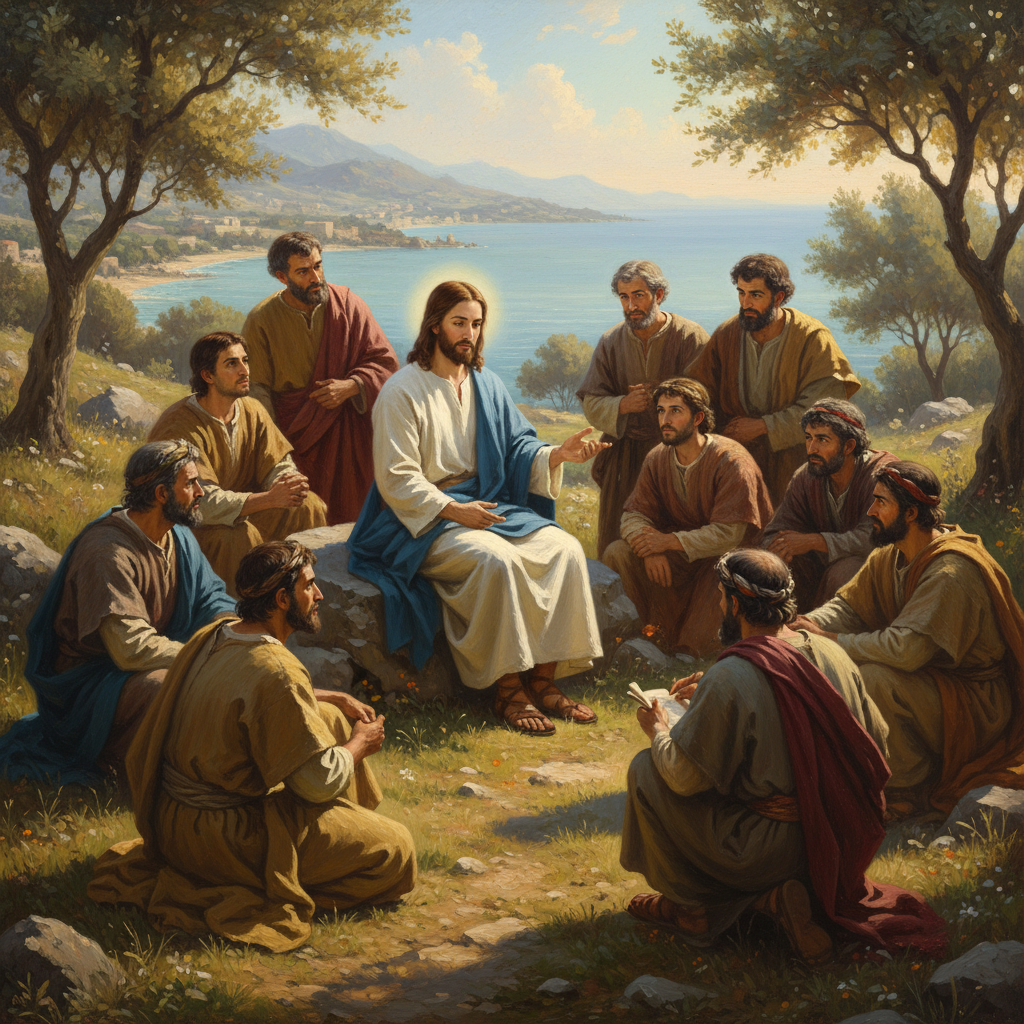
The Calling of the Twelve Apostles (Matthew 10:1-4)
During His divine mission on earth, our Lord Jesus Christ did not walk alone. He chose a special group of men to be His closest companions and to carry His message to the world.
Before selecting His inner circle, Jesus spent an entire night in prayer (Luke 6:12). Afterward, He called twelve men and appointed them as His apostles (Mark 3:13-19). The word “apostle” means “one who is sent,” and these men were sent with the authority to preach the Gospel, cast out demons, and heal the sick (Matthew 10:1).
This profound calling marked the beginning of a new era, as these twelve individuals would become the foundation of the early Church. They witnessed Jesus’ miracles, listened to His teachings, and were present for His death, resurrection, and ascension. Through His love and power, their lives were forever transformed.
Simon Peter: The Rock
Among the twelve, the Galilean fisherman Simon Peter stands out. Jesus gave him the prophetic name “Peter,” which means “rock,” because he would become a cornerstone of the Church (Matthew 16:18).
Though often impulsive and quick to speak, Peter’s heart was fully devoted. It was he who boldly declared Jesus to be “the Christ, the Son of the living God” (Matthew 16:16).
Yet, Peter also showed human frailty when he denied Jesus three times on the night of His betrayal (Mark 14:66-72). Despite this failure, Jesus lovingly restored him and commissioned him to “feed My sheep,” demonstrating God’s boundless grace (John 21:15-19). Peter went on to become a powerful and fearless preacher, truly living up to his calling as a foundational leader.
John: The Disciple Whom Jesus Loved
John, the son of Zebedee, shared a unique intimacy with Jesus. He is often referred to as “the disciple whom Jesus loved,” a title that speaks volumes about their profound bond (John 13:23). As a member of Jesus’ inner circle, John was present at many pivotal moments.
For example, he reclined next to Jesus at the Last Supper and stood faithfully at the foot of the cross, where Jesus entrusted His mother, Mary, to John’s care (John 19:26-27). After the resurrection, John was among the first to believe and later became known as a pillar of the early Church (Galatians 2:9).
John’s Gospel emphasizes Jesus’ divinity, eternal life, and love. He also authored three epistles and the prophetic book of Revelation. After faithfully serving the Lord for many decades, his writings continue to inspire believers and call them to a deeper relationship with Christ.
A Complete List of the Apostles’ Names
The twelve apostles were a diverse group from various backgrounds, but they were united by a common calling from Jesus. Chosen to spread the Good News, their mission would change the world. Here is a complete list of the twelve disciples Jesus selected:
- Simon Peter (also known as Cephas or Simon Bar-Jonah)
- Andrew (Peter’s brother)
- James (son of Zebedee, often called James the Greater)
- John (James’ brother, “the disciple whom Jesus loved”)
- Philip
- Bartholomew (often identified with Nathanael)
- Thomas (also known as Didymus, “the doubter”)
- Matthew (also Levi, the tax collector)
- James (son of Alphaeus, often called James the Less)
- Thaddaeus (also known as Judas, son of James, or Lebbaeus)
- Simon the Zealot
- Judas Iscariot (the one who betrayed Jesus)
- Learn more about these foundational figures: Who Was Simon Peter in the Bible? – Discover the full story of Simon Peter, from his calling as a fisherman to his role as a foundational leader of the Church. Learn about his profound faith, human weaknesses, and ultimate restoration by Christ.
These were the men Jesus chose to walk with and learn directly from Him. Despite their flaws, God used them mightily to launch a movement that changed the world. Their lives remain a powerful testimony to the transformative power of Jesus Christ, our Lord and Savior.
Devoted Followers: The Men and Women Transformed by Christ

Mary Magdalene: First Witness to the Resurrection (John 20:11-18)
Mary Magdalene stands as a powerful testament to Christ’s transformative love. It is important to note she was not Mary, the mother of Jesus, nor the sister of Martha and Lazarus. Scripture introduces her as a woman from whom Jesus cast out seven demons (Luke 8:2). After this profound deliverance, her life was changed completely. She became a devoted follower, providing for Jesus and His disciples from her own means (Luke 8:3).
Her unwavering loyalty is evident throughout the Gospels. For instance, she was present at the foot of the cross during the crucifixion (John 19:25) and was among the women who went to anoint Jesus’s body after His death (Mark 16:1-2). Though her sorrow was deep, her faith was about to be profoundly rewarded.
On that glorious first Easter morning, Mary Magdalene was granted the extraordinary privilege of being the first person to encounter the resurrected Christ (John 20:11-18). Jesus specifically chose her to carry the most significant news in human history: “I am ascending to My Father and your Father, and to My God and your God” (John 20:17). She then proclaimed this joyous truth to the disciples (John 20:18). Mary Magdalene’s story powerfully affirms Jesus’s victory over death and His divine authority.
Lazarus, Mary, and Martha: The Siblings of Bethany (John 11)
The siblings Lazarus, Mary, and Martha of Bethany were dear friends of Jesus, and their home was a place of rest and fellowship for Him. This unique relationship not only highlights Jesus’s humanity and His deep capacity for love but also serves as a backdrop for demonstrating His divine power.
Consider their profound experiences:
- Martha’s Service and Faith: Martha was known for her hospitality and diligent service, often worrying about practical matters (Luke 10:38-42). Yet, even in her deepest grief over Lazarus’s death, she declared an unwavering faith, telling Jesus, “Lord, if you had been here, my brother would not have died” (John 11:21). She then affirmed Him as “the Christ, the Son of God” (John 11:27).
- Mary’s Devotion: Mary, in contrast, was known for her profound devotion. She famously sat at Jesus’s feet to listen to His words (Luke 10:39) and later anointed His feet with expensive perfume—a beautiful act of worship that foreshadowed His burial (John 12:1-8).
- Lazarus’s Resurrection: The most astounding event involving these siblings was the death and resurrection of Lazarus (John 11). To demonstrate God’s glory, Jesus allowed Lazarus to die and then, after four days, called him forth from the tomb with the command, “Lazarus, come out!” (John 11:43). This undeniable miracle proved Jesus’s power over death and confirmed His claim to be “the resurrection and the life” (John 11:25).
Ultimately, the story of Lazarus, Mary, and Martha powerfully underscores Jesus’s identity as both fully human—capable of friendship and sorrow—and fully divine, wielding ultimate power over life and death. Their account strengthens our faith in both His miraculous capabilities and His loving heart.
John the Baptist: The Forerunner of the Messiah (Matthew 3)
John the Baptist was a pivotal figure in God’s plan of salvation. He was not a disciple in the traditional sense but rather a divinely appointed forerunner whose mission was to prepare the way for the Lord (Matthew 3:3)—a role foretold centuries earlier by the prophet Isaiah (Isaiah 40:3).
Dedicated to this singular purpose, John lived an austere life in the wilderness, preaching a message of repentance (Matthew 3:1-2). He called people to be baptized as a sign of turning from sin, and his powerful message stirred the hearts of many, causing crowds to flock to hear him.
Most importantly, John bore witness to Jesus’s true identity, famously declaring, “Behold, the Lamb of God, who takes away the sin of the world!” (John 1:29). Recognizing Jesus’s superior authority, John initially hesitated to baptize Him. However, Jesus insisted, stating it was necessary “to fulfill all righteousness” (Matthew 3:15). During the baptism, the Holy Spirit descended, and a voice from heaven affirmed, “This is My beloved Son, with whom I am well pleased” (Matthew 3:17). By faithfully fulfilling his prophetic role, John pointed everyone to Christ, truly becoming the voice crying in the wilderness to make straight the path for our Lord.
Zacchaeus: The Repentant Tax Collector (Luke 19)
The story of Zacchaeus is a beautiful illustration of Jesus’s mission to seek and save the lost. As a chief tax collector in Jericho, Zacchaeus was a despised figure (Luke 19:2). Because tax collectors worked for the Roman occupiers and were often corrupt, they were seen as traitors and shunned by their Jewish neighbors.
Despite his wealth, Zacchaeus deeply desired to see Jesus. Being a short man, he climbed a sycamore-fig tree to get a better view (Luke 19:3-4). Jesus, knowing his heart, stopped directly beneath the tree and called out, “Zacchaeus, hurry and come down, for I must stay at your house today” (Luke 19:5). This personal invitation shocked the crowd, who grumbled that Jesus would associate with such a sinner.
However, this encounter with Jesus’s love transformed Zacchaeus. He immediately responded with repentance and generosity:
- He promised, “Behold, Lord, the half of my goods I give to the poor” (Luke 19:8).
- He also committed, “If I have defrauded anyone of anything, I restore it fourfold” (Luke 19:8).
In response, Jesus declared, “Today salvation has come to this house… For the Son of Man came to seek and to save the lost” (Luke 19:9-10). Zacchaeus’s story powerfully demonstrates that no one is beyond the reach of Jesus’s grace. His transformative power offers forgiveness and a new life to all who turn to Him.
The Antagonists: Those Who Opposed Jesus
Judas Iscariot: The Disciple Who Betrayed Jesus
Judas Iscariot, one of Jesus’ twelve chosen disciples, holds a tragic place in biblical history [source: https://www.biblica.com/resources/bible-qa/who-were-the-12-disciples/]. Despite his close relationship with Jesus and his role as the group’s treasurer, Judas ultimately betrayed Him. John 12:6 reveals that his heart was hardened by avarice, as he was known to steal from the money bag.
The Gospels detail Judas’s pivotal role in Jesus’s arrest. He approached the chief priests and offered to hand Jesus over for thirty pieces of silver (Matthew 26:14-16), a price that fulfilled an Old Testament prophecy (Zechariah 11:12-13). Later, in the Garden of Gethsemane, Judas identified Jesus to the authorities with a kiss, which directly led to His arrest (Matthew 26:47-50).
Judas’s betrayal was not an accident; it was part of God’s divine plan. Yet, this did not excuse Judas’s sin. Jesus acknowledged the betrayal, saying, “The Son of Man goes as it is written of him, but woe to that man by whom the Son of Man is betrayed! It would have been better for that man if he had not been born” (Matthew 26:24). This statement holds in tension the reality of both God’s sovereignty and human responsibility.
The Biblical Accounts of Judas’ Death (Matthew 27:3-5, Acts 1:18-19)
The Bible provides two accounts of Judas Iscariot’s death, one in Matthew and the other in Acts. Both narratives describe the tragic end of a life consumed by sin and highlight the severe consequences of betraying the Son of God.
Matthew’s Gospel describes Judas’s remorse following Jesus’ condemnation. Overcome with regret, Judas returned the thirty pieces of silver, declaring, “I have sinned by betraying innocent blood” (Matthew 27:4). However, his repentance led not to salvation but to despair, and he ultimately went and hanged himself (Matthew 27:5).
The Book of Acts offers another perspective through the words of Peter. He recounts that Judas “acquired a field with the reward of his wickedness” and then “fell headlong, his body burst open and all his intestines spilled out” (Acts 1:18). This gruesome end became so well-known that the field was named Akeldama, which means “Field of Blood.”
Rather than being contradictory, these accounts are often seen as complementary. The traditional understanding is that Judas hanged himself in the field he had acquired, and the rope or branch subsequently broke, causing his body to fall and burst open as described in Acts. Together, both passages underscore God’s judgment and reveal the dark reality of rejecting Christ, serving as a sober warning.
Pontius Pilate: The Roman Governor Who Condemned Christ
Pontius Pilate, the fifth Roman governor of Judea (AD 26-36), played a crucial role in Jesus’ crucifixion. As the ultimate authority in the region, he held the power of life and death [source: https://www.britannica.com/biography/Pontius-Pilate].
When Jesus was brought before him, the Jewish leaders accused Him of sedition, claiming He was making Himself a king. After questioning Jesus personally, however, Pilate found no basis for the charges (John 18:38) and declared, “I find no guilt in this man” (Luke 23:4).
Knowing the Jewish leaders had acted out of envy, Pilate tried to release Jesus. He invoked a Passover custom of releasing one prisoner, offering the crowd a choice between Jesus and a notorious criminal named Barabbas. Incited by the chief priests, the crowd chose Barabbas (Matthew 27:15-21). Pressured by their shouts and fearing a riot, Pilate’s resolve weakened (Matthew 27:24).
In a symbolic gesture, Pilate washed his hands and declared himself innocent of Jesus’ blood (Matthew 27:24). Despite this, he ultimately handed Jesus over to be crucified. His decision was not based on justice but on political expediency, prioritizing his own position and power. In doing so, this figure of Roman authority condemned the Son of God.
Caiaphas: The High Priest Who Plotted Against Jesus
Caiaphas served as the Jewish high priest from approximately AD 18 to 36, a period covering Jesus’ entire public ministry and crucifixion. As a central figure in the opposition to Jesus, his power was solidified by his marriage to the daughter of Annas, a former high priest (John 18:13).
Presiding over the Sanhedrin, the supreme Jewish court, Caiaphas led the charge against Jesus. After Jesus raised Lazarus from the dead, Caiaphas and the council plotted to kill Him (John 11:47-53). It was then that Caiaphas famously declared, “It is better for you that one man should die for the people, not that the whole nation should perish” (John 11:50).
Though sinister in its intent, this statement was unknowingly prophetic, foretelling Jesus’ sacrificial death for the nation and for all of God’s scattered children (John 11:51-52). Later, during Jesus’ trial, Caiaphas demanded to know if He was the Christ, the Son of God. When Jesus affirmed it, Caiaphas tore his robes, accused Him of blasphemy (Matthew 26:63-65), and sealed the Jewish leaders’ condemnation. In this way, Caiaphas used his religious authority to reject the Messiah.
King Herod: The Ruler Who Mocked the King of Kings
The King Herod mentioned in the passion narrative was Herod Antipas, a son of Herod the Great. As tetrarch, he ruled Galilee and Perea as a client king under Roman authority. This was the same Herod who had imprisoned and beheaded John the Baptist (Mark 6:14-29).
During His trial, Jesus appeared before Herod Antipas. When Pilate learned that Jesus was from Galilee, Herod’s jurisdiction, he sent Jesus to him. Herod, who was in Jerusalem for the Passover, had long wanted to see Jesus, hoping to witness one of His miracles (Luke 23:6-8). Although Herod questioned Jesus extensively, Jesus refused to answer him (Luke 23:9).
In response to His silence, Herod and his soldiers mocked Jesus, dressing Him in an elegant robe to ridicule His claim to kingship (Luke 23:11). Finding no grounds to execute Him, Herod sent Jesus back to Pilate. The Bible notes that Pilate and Herod, who had previously been enemies, became friends that day (Luke 23:12). Their joint action against Jesus unintentionally fulfilled prophecy, demonstrating the world’s opposition to God’s Anointed One.
- Explore this key antagonist further: Who Was Caiaphas? The High Priest Who Condemned Jesus Christ – Delve into the story of the high priest who played a crucial role in Jesus’s trial and condemnation, fulfilling a dark yet necessary part of God’s redemptive plan.
Despite the opposition from these powerful figures, Jesus Christ remained unwavering as His divine mission continued toward its glorious fulfillment. Ultimately, their efforts to stop Him only served to advance God’s sovereign plan. The Son of God willingly laid down His life and then rose again, conquering sin and death. He is truly Lord and Savior, and His authority reigns supreme over all earthly powers (Philippians 2:9-11).
Other Notable Biblical Contemporaries
The Three Wise Men (Magi): Seekers of the Newborn King (Matthew 2)
The arrival of the Magi is a beautiful testament to Jesus’ universal kingship. Traveling from the East, these men were likely astrologers or scholars rather than kings, as tradition sometimes suggests. Guided by a miraculous star, they journeyed to worship the newborn “King of the Jews” (Matthew 2:2).
Upon finding Jesus in Bethlehem, they knelt in profound reverence and offered Him precious gifts, each deeply symbolic of His identity and mission.
- Gold: This gift acknowledged Jesus’ royal status as King.
- Frankincense: An aromatic resin used in worship, this gift signified Jesus’ divinity and role as High Priest.
- Myrrh: A bitter herb used for anointing the dead, this gift foreshadowed Jesus’ suffering, death, and embalmment.
The Magi’s worship demonstrated that Jesus came not just for Israel, but for all nations. Afterward, God warned them in a dream not to return to King Herod, so they went home by a different route, thus avoiding Herod’s evil intent (Matthew 2:12).
The Penitent Thief on the Cross (Luke 23:43)
Amidst the agony of the crucifixion, Jesus offered ultimate grace. As He was crucified between two criminals, one mocked Him and demanded a rescue. The other thief, however, showed remarkable faith. He rebuked his companion and humbly asked Jesus, “Lord, remember me when You come into Your kingdom” (Luke 23:42).
Jesus’ response was immediate and profound: “Truly, I say to you, today you will be with Me in Paradise” (Luke 23:43). This powerful exchange reveals God’s boundless mercy, confirming that salvation is available even in the final moments of life through genuine repentance and faith in Christ Jesus.
Nicodemus: The Pharisee Who Came to Jesus by Night (John 3)
Nicodemus was a prominent Pharisee and a respected ruler among the Jews (John 3:1). Intrigued by Jesus’ miracles and teachings, he sought Jesus out under the cover of night—a decision suggesting both caution and genuine curiosity.
During their conversation, Jesus taught Nicodemus about being “born again,” a spiritual rebirth essential for entering the Kingdom of God (John 3:3-7). Although Nicodemus initially struggled to understand this concept, Jesus explained its spiritual nature, emphasizing that salvation comes through belief in the Son of God (John 3:16-17).
Nicodemus later showed his developing faith by subtly defending Jesus before the Sanhedrin (John 7:50-52). His courage grew further after the crucifixion when he bravely assisted Joseph of Arimathea in burying Jesus, bringing a significant amount of myrrh and aloes for the anointing (John 19:39). His journey reveals a gradual transformation from cautious inquirer to courageous follower.
Joseph of Arimathea: The Secret Follower (John 19:38-42)
Joseph of Arimathea was a wealthy and honorable council member who secretly followed Jesus out of fear of the Jewish leaders (Mark 15:43, John 19:38). After Jesus’ death, however, Joseph’s quiet faith gave way to incredible courage.
He boldly approached Pontius Pilate to request Jesus’ body for burial—a dangerous act that could have linked him to a condemned criminal. Pilate granted his request (Mark 15:44-45).
Joseph then took Jesus’ body, wrapped it in clean linen cloth, and laid it in his own new tomb, which had been carved out of rock (Matthew 27:59-60). In doing so, Joseph’s actions not only fulfilled prophecy (Isaiah 53:9) but also demonstrated a deep love and reverence for his Lord, marking his transition from secret belief to open devotion.
Simon of Cyrene: The Man Who Carried the Cross (Mark 15:21)
As Jesus struggled and faltered under the immense weight of the cross, Roman soldiers, eager to expedite the crucifixion, compelled a bystander to help. This man was Simon of Cyrene, a visitor from North Africa who was likely in Jerusalem for the Passover festival (Mark 15:21).
Simply passing by, Simon was forced into this unexpected and somber service, bearing Jesus’ cross for a portion of the journey to Golgotha. Though involuntary, this act connected him directly to Christ’s suffering. It is believed that Simon and his family later became followers; Mark’s mention of his sons, Alexander and Rufus, suggests they were well-known figures in the early Christian community (Mark 15:21). Simon’s story highlights how God can use ordinary people in extraordinary ways to fulfill His divine plan.
- Learn more about God’s amazing grace: The Thief on the Cross: The Ultimate Guide to Grace at Calvary – Discover the remarkable story of the penitent thief who received salvation from Jesus in his final moments, a powerful testament to God’s boundless mercy.
- Discover other key figures: Who Was Simon in the Bible? The Key Figures Explained – Explore the different men named Simon in the Bible, from the Apostle Peter to Simon of Cyrene, and understand their unique roles in the biblical narrative.
Frequently Asked Questions about Biblical Figures
Is Mary, mother of Jesus, and Mary Magdalene the same person?
No, Mary, the mother of Jesus, and Mary Magdalene were two distinct women in the Gospels. While both were vital to Christ’s ministry, their lives and roles were entirely separate.
- Mary, the Mother of Jesus: God chose her to miraculously conceive and give birth to Jesus Christ, the Son of God (Luke 1:26-38). Her life is marked by humility, obedience, and devotion as the mother of our Lord. She was present at His birth, during His childhood, and sorrowfully witnessed His crucifixion (John 19:25-27).
- Mary Magdalene: She was a devoted follower of Jesus, who had cast seven demons out of her (Luke 8:2). She traveled with Jesus and His disciples, supporting His ministry. Mary Magdalene has the unique honor of being the first person to see the risen Jesus, and He commissioned her to share the glorious news with the disciples (John 20:11-18).
These two women fulfilled unique and essential purposes in God’s redemptive plan, each demonstrating deep faith and love for our Savior, Jesus Christ.
What does contemporaries mean in the Bible?
In the context of the Bible, “contemporaries” are people who lived during the same time as a particular figure. For instance, the contemporaries of Jesus Christ were the people who lived during His time, including those who interacted with Him or were affected by His life, ministry, death, and resurrection.
These figures include:
- His family, like Mary and Joseph.
- His disciples, such as Peter, John, and Judas.
- Religious leaders like Caiaphas and Nicodemus.
- Roman officials like Pontius Pilate.
- Other individuals touched by His miracles or teachings, like Mary Magdalene, Lazarus, or Zacchaeus.
Understanding Jesus’ contemporaries helps us grasp the social, political, and religious environment in which the Gospel message took root and spread.
Which biblical figures actually existed?
The Bible presents a historical account of real people, places, and events. From a Christian faith perspective, all figures mentioned in Scripture are considered real. Above all, Jesus Christ is not a myth but a historical person whose life, death, and resurrection are central to human history.
The historical existence of many biblical figures, especially Jesus, is supported by various sources:
- Internal Biblical Consistency: The Gospels and Epistles offer detailed accounts, genealogies, and eyewitness testimonies regarding Jesus and His contemporaries (Luke 1:1-4).
- Extra-Biblical Historical Accounts: Several non-Christian historians from the 1st and 2nd centuries affirm Jesus’s existence. For instance, Roman historian Tacitus, writing around 115 A.D., refers to “Christus,” from whom Christians derived their name, and notes his execution under Pontius Pilate [source: https://www.britannica.com/topic/Jesus#ref377953]. Similarly, the 1st-century Jewish historian Josephus writes about Jesus, John the Baptist, and James, the brother of Jesus [source: https://www.britannica.com/topic/Jesus#ref377954].
- Archaeological Evidence: Discoveries continue to corroborate biblical accounts, confirming the existence of various cities, rulers, and cultural practices mentioned in Scripture.
Jesus Christ is not a fictional character. He is a real historical figure who walked the earth, died for our sins, and rose again, just as the Scriptures declare (1 Corinthians 15:3-4). His historical reality is the foundation of the Christian faith, anchoring our hope in a true, living Savior.
What did Jesus say about mother Mary?
Jesus honored His mother, Mary, while always prioritizing His divine mission and His heavenly Father’s will. Their relationship, as depicted in the Gospels, demonstrates both human affection and divine purpose.
Here are key instances:
- At the Wedding in Cana: When Mary informed Jesus that the wedding party had run out of wine, Jesus initially responded, “Woman, what does this have to do with me? My hour has not yet come” (John 2:4). However, He then honored her request by performing His first public miracle, turning water into wine. This interaction shows His respect for her while also asserting His divine timing.
- Regarding His Spiritual Family: When His mother and brothers came to see Him, Jesus used the opportunity to teach, saying, “Who is My mother, or My brothers?… For whoever does the will of God, he is My brother and sister and mother” (Mark 3:33-35). With this teaching, Jesus emphasized that our spiritual relationship with God is the most important bond, even more so than earthly family ties.
- At the Cross: In His final moments on the cross, Jesus showed profound care for His mother. He entrusted her to the care of His beloved disciple, John, saying, “Woman, behold your son!” and to John, “Behold your mother!” (John 19:26-27). This was a loving act to ensure she would be cared for.
Through these interactions, Jesus affirmed the importance of His earthly mother while consistently pointing to His ultimate purpose: fulfilling the will of God the Father and bringing salvation to humanity.