
John 11:25-26 contains Jesus’ profound declaration to Martha, stating, ‘I am the resurrection and the life. The one who believes in me will live, even though they die; and whoever lives by believing in me will never die.’ This scripture is a cornerstone of Christian faith, affirming that eternal life is not merely a concept but is embodied in the person of Jesus Christ, who holds ultimate authority over death itself.
Our world is often overshadowed by grief, loss, and the finality of death. In response, humanity instinctively searches for something more: a hope beyond the grave and an assurance of eternal life. It is into this deep human longing that Jesus Christ, our Lord and Savior, steps with a declaration that echoes through eternity. He offers not just comfort but absolute victory, proclaiming a profound truth that changes everything for those who believe.
This article delves into the transformative message of John 11:25-26, where Jesus states, “I am the resurrection and the life. Whoever believes in me, though he die, yet shall he live, and everyone who lives and believes in me shall never die. Do you believe this?” (John 11:25-26, ESV). This is more than a philosophical statement; it is a divine revelation. It is a promise cemented by His own death and glorious resurrection, guaranteeing eternal hope and freedom from death for all who trust in Him. We will unpack the meaning of this passage, understand its context, and explore what Jesus’ words mean for us today.
Join us as we explore this cornerstone of faith. Together, we can strengthen our belief and embrace the boundless hope offered by the One who conquered death, beginning with the question: What is the meaning of John 11:25-26?
What is the meaning of John 11 25-26?
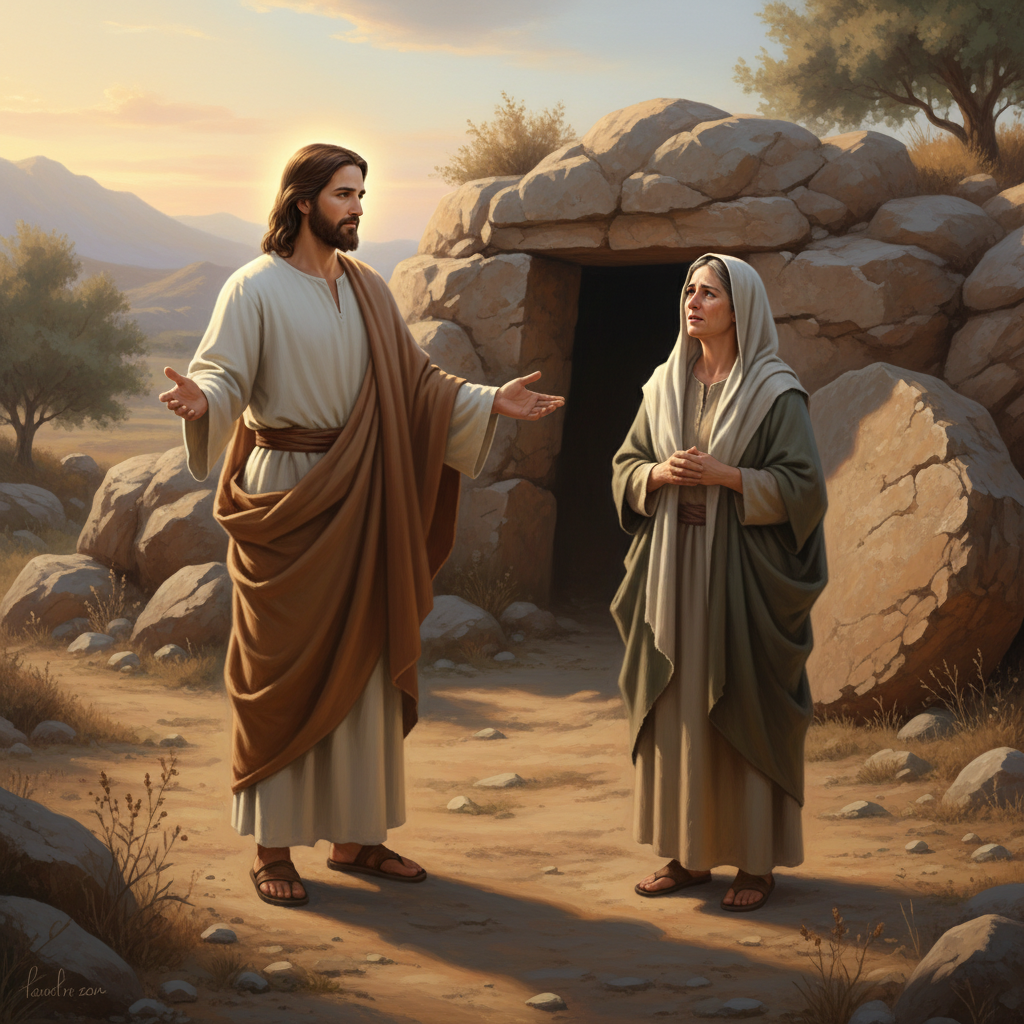
The Context: Jesus, Martha, and the Shadow of Death
The profound words of John 11:25-26 arise from a moment of intense human grief. The setting is Bethany, a village near Jerusalem, where Jesus’ dear friends—Mary, Martha, and their brother Lazarus—lived. Tragedy struck their home when Lazarus fell gravely ill. His sisters sent an urgent message to Jesus: “Lord, behold, he whom you love is ill” (John 11:3).
However, Jesus did not rush to their side. He intentionally delayed His arrival for two days, a delay that allowed Lazarus to die. By the time Jesus reached Bethany, Lazarus had been in the tomb for four days—a sign of irreversible death to those present.
Martha, a woman of deep faith, was the first to meet Jesus. With a heart heavy with sorrow, she expressed a sentiment many can relate to in loss: “Lord, if you had been here, my brother would not have died” (John 11:21). Her words reveal both her immense pain and her unwavering belief in Jesus’ power.
This delay was not out of indifference. Instead, Jesus allowed this tragedy to unfold for a divine purpose: to reveal His glory in an unmistakable way (John 11:4). This moment of profound grief became the perfect stage for Him to declare one of the most powerful truths about His identity.
Breaking Down the Words of Jesus: ‘I Am the Resurrection and the Life’
In response to Martha’s grief, Jesus speaks words that offer timeless, eternal hope. He declares, “I am the resurrection and the life. Whoever believes in me, though he die, yet shall he live, and everyone who lives and believes in me shall never die. Do you believe this?” (John 11:25-26).
This is one of Jesus’ profound “I Am” declarations from the Gospel of John. By using this phrase, He directly connects Himself to the divine name God revealed to Moses—”I AM WHO I AM” (Exodus 3:14). In doing so, Jesus is claiming absolute divinity and eternal existence.
Let’s unpack these two critical titles:
- “I Am the Resurrection”: Jesus doesn’t just promise a future resurrection; He is its source and power. He holds authority over death itself, possessing the power to raise the dead both physically and spiritually. As Scripture confirms, “For as in Adam all die, so also in Christ shall all be made alive” (1 Corinthians 15:22).
- “I Am the Life”: Jesus is the very essence of life, not merely its giver. This is not about an extended lifespan but about eternal life—a spiritual existence with God that begins the moment one believes. Jesus Himself said, “I came that they may have life and have it abundantly” (John 10:10), for He is “the way, and the truth, and the life” (John 14:6).
With these words, Jesus asserts His complete sovereignty over death and life. He is not simply a prophet or teacher, but the divine Son of God who conquers the grave and gives eternal life to all who believe in Him.
Belief as the Key to Eternal Life
After this glorious declaration, Jesus states the condition for this promise: belief. “Whoever believes in me, though he die, yet shall he live, and everyone who lives and believes in me shall never die” (John 11:25-26). Belief is the vital response He seeks. So, what does this belief truly mean?
In the Bible, belief is not just intellectual agreement. It is a full surrender and trust in Jesus Christ as Lord and Savior—a confident reliance on His atoning work on the cross and His triumphant resurrection. This active faith is composed of several key elements:
- Accepting Jesus’ Identity: Acknowledging that He is indeed the Son of God, divine and all-powerful (John 20:31).
- Trusting His Sacrifice: Believing that His death paid the penalty for our sins (Romans 5:8).
- Embracing His Resurrection: Affirming that He rose again, conquering sin and death (Romans 10:9).
- Committing to His Lordship: Surrendering our lives to His guidance and authority (Luke 9:23).
The promise attached to this belief is astonishing, addressing two kinds of death and two kinds of life:
- Victory Over Physical Death: “Though he die, yet shall he live.” For the believer, physical death is not the end but a transition into eternal life with Christ (2 Corinthians 5:8). Jesus demonstrated this power by raising Lazarus from the grave, a powerful foreshadowing of His own resurrection and ours.
- Freedom From Spiritual Death: “Everyone who lives and believes in me shall never die.” This promise refers to spiritual death—eternal separation from God. Through faith in Christ, a believer has already passed from spiritual death to spiritual life (John 5:24). This new, eternal life begins now and will never end.
Therefore, belief in Jesus is not simply about avoiding punishment. It is about receiving an active, vibrant, and eternal relationship with God—a gift offered freely through Christ’s sacrifice. “For God so loved the world, that he gave his only Son, that whoever believes in him should not perish but have eternal life” (John 3:16).
What does God promise about eternal life in John 11 25-26?

A Present Possession, Not Just a Future Hope
Many people think of eternal life as something that begins only after death. However, Jesus reveals a deeper truth in John 11:25-26, declaring, “I am the resurrection and the life. Whoever believes in me, though he die, yet shall he live, and everyone who lives and believes in me shall never die.” This powerful promise shows that eternal life isn’t just a future hope—it is a present reality for all who believe.
When we place our faith in Jesus, we immediately receive this eternal life. This spiritual transformation begins the moment we confess Him as Lord, with several profound implications:
- Immediate Access: We don’t have to wait for eternity. It starts the moment we believe (John 3:16).
- New Identity: Our spiritual status changes from being “dead in trespasses” to “alive with Christ” (Ephesians 2:1, 5).
- Present Relationship: Eternal life is fundamentally about knowing God and Jesus Christ personally (John 17:3), and this relationship begins now.
Therefore, eternal life is not merely an extended lifespan but a new quality of existence in union with God. It is a gift received today that profoundly affects how we live right now.
Victory Over Physical Death
While eternal life begins now, Jesus’ words also offer a firm promise about physical death. The first part of his statement, “Whoever believes in me, though he die, yet shall he live,” is a powerful declaration of victory over the grave. For the believer, physical death is not the end but a transition to a new life.
Jesus demonstrated this victory firsthand through His own resurrection. His triumph over death is the guarantee of our future resurrection. We have an assurance that even though our physical bodies perish, they will be raised in glory. Specifically, the Bible teaches:
- Resurrection is Certain: Just as Christ was raised, so will all believers be raised (1 Corinthians 15:20-22).
- New, Imperishable Bodies: We will receive glorified bodies, free from decay and weakness (1 Corinthians 15:42-44).
- Death’s Sting is Removed: For those in Christ, death loses its ultimate power and fear (1 Corinthians 15:55-57).
Because of this, the promise in John 11 offers immense comfort and unwavering hope. It redefines death from a dreaded finality into a doorway to a glorious resurrection.
Freedom From Spiritual Death
The second part of Jesus’ promise—”everyone who lives and believes in me shall never die”—addresses an even deeper reality: freedom from spiritual death. Spiritual death means separation from God, the source of all life. Because of sin, all people are born spiritually dead (Romans 6:23).
However, Jesus guarantees that believers will never experience this ultimate separation. By believing in Him, we are spiritually reborn, passing from death to life (John 5:24). This creates an unbreakable, eternal connection with God, which means:
- No Condemnation: There is no spiritual judgment for those who are in Christ (Romans 8:1).
- Eternal Security: Our bond with God is secured forever through Jesus (Romans 8:38-39).
- Abundant Life: We receive life in its fullest sense, empowered by the Holy Spirit (John 10:10).
This freedom from spiritual death is the heart of the gospel. It is an assurance that our souls will flourish in God’s presence forever—a gift made possible by Christ’s atoning sacrifice and triumphant resurrection. We live forever, because He lives forever.
How Does This Passage Strengthen Our Faith Today?

Finding Comfort in Times of Grieving
Losing a loved one brings profound pain, and grief can feel overwhelming. In these moments, the words of Jesus in John 11:25-26 offer powerful comfort: “I am the resurrection and the life.” This singular truth changes everything.
Because Jesus made this promise, death is not the final word. Our Lord has conquered the grave (1 Corinthians 15:54-57), so we do not grieve as those without hope. Instead, we can cling to His promise of eternal life.
Consider these points of comfort:
- Jesus Shares Our Sorrow: He wept at Lazarus’ tomb (John 11:35). He understands our pain.
- A Future Reunion Awaits: Believers who have died will rise again. We will be reunited with them in Christ (1 Thessalonians 4:13-14).
- Life Beyond the Grave: Our loved ones who believed in Jesus are truly “alive” with Him. Physical death is merely a transition into His glorious presence (Philippians 1:21).
This promise strengthens our resolve. We find peace in Jesus’ ultimate power over death and gain strength to face loss with faith.
Living with the Assurance of Heaven
The promise in John 11:25-26 also transforms our daily lives. Believing that Jesus is the resurrection and the life gives us the blessed assurance of heaven—a gift that is a present possession for every believer.
This means we are not living for an uncertain future, because our eternal destination is secure in Christ. This certainty provides a firm foundation of hope, changing how we approach life’s challenges.
This assurance enables us to:
- Walk in Confidence: We know our future is in God’s hands. No earthly trial can snatch us from Him (Romans 8:38-39).
- Live with Purpose: Our lives here have eternal significance. We are called to serve Him faithfully, knowing our labor is not in vain (1 Corinthians 15:58).
- Overcome Fear: The fear of death loses its sting. Jesus has taken away its power (Hebrews 2:14-15). We live freely in His grace.
Therefore, we can live each day with an eternal perspective, knowing our citizenship is in heaven (Philippians 3:20). This promise makes our faith vibrant and active.
Answering Jesus’ Question: ‘Do You Believe This?’
After declaring, “I am the resurrection and the life,” Jesus asks Martha a direct question: “Do you believe this?” (John 11:26). This is not just a historical query; it is a vital question for each of us today.
Our answer to this question defines our relationship with Him. Martha’s reply was clear and profound: “Yes, Lord, I believe that you are the Christ, the Son of God, who is coming into the world” (John 11:27).
What does it mean for us to answer “Yes, Lord” today?
- Personal Trust: It means placing our complete trust in Jesus alone for salvation and confessing Him as Lord.
- Active Faith: Our belief is not passive. It leads to following His commands as we strive to live as His disciples.
- Unwavering Conviction: We affirm His divine identity. Jesus is indeed the Son of God, who died for our sins and rose again.
Believing in John 11:25-26 is a direct affirmation of who Jesus is. He is not a myth; He is the very source of life. His words are truth, and His resurrection is a historical fact witnessed by many (1 Corinthians 15:3-8). Answering “yes” to His question means committing to the reality of His power and His promise. Our faith is therefore built on the solid rock of the true, living Jesus Christ—His identity and His mission.
Comparing John 11:25-26 Across Bible Translations
Understanding Jesus’ profound words in John 11:25-26 is vital, and examining the passage in different Bible translations can offer deeper insight. While each version strives to convey the original Greek meaning, their slightly different English phrasing can highlight various nuances of Jesus’ powerful declaration. Ultimately, the core message remains unchanged: Christ is the Resurrection and the Life.
John 11:25-26 in the KJV
The King James Version (KJV) holds a revered place in Christian history, with beautiful, traditional language that has shaped generations of believers. As a formal equivalence translation, it aims for a word-for-word rendering of the original Greek. Here is how it presents John 11:25-26:
- John 11:25-26 (KJV): “Jesus said unto her, I am the resurrection, and the life: he that believeth in me, though he were dead, yet shall he live: And whosoever liveth and believeth in me shall never die. Believest thou this?”
The KJV’s phrasing, “though he were dead, yet shall he live,” carries a majestic tone that highlights the miracle of resurrection over physical death. Similarly, the promise that “whosoever liveth and believeth in me shall never die” strongly affirms the eternal security of faith, resonating deeply with traditional Christian devotion.
John 11:25-26 in the NIV
Widely popular today, the New International Version (NIV) seeks a balance between word-for-word accuracy and readability. It is known for its clarity and contemporary English, making the biblical text accessible to a broad modern audience. Here is the passage in the NIV:
- John 11:25-26 (NIV): “Jesus said to her, ‘I am the resurrection and the life. The one who believes in me will live, even though they die; and whoever lives by believing in me will never die. Do you believe this?'”
The NIV’s phrasing, “The one who believes in me will live, even though they die,” clearly conveys the promise of spiritual life beyond physical death. The direct assurance that believers “will never die” emphasizes the absolute certainty of eternal life in Christ. This straightforward language makes the profound truth immediately accessible, especially for new believers.
John 11:25-26 in the ESV
Highly regarded for its precision and literary excellence, the English Standard Version (ESV) is a literal translation that prioritizes faithfulness to the original Greek. Similar to the KJV but using updated English, the ESV is an excellent choice for in-depth study. Consider its rendering of John 11:25-26:
- John 11:25-26 (ESV): “Jesus said to her, ‘I am the resurrection and the life. Whoever believes in me, though he die, yet he shall live, and everyone who lives and believes in me shall never perish. Do you believe this?'”
The ESV’s phrase “though he die, yet he shall live” closely mirrors the KJV’s venerable wording, powerfully articulating the triumph of Christ over death. Furthermore, its use of “shall never perish” is significant, as it implies a complete and permanent deliverance from destruction. This specific term beautifully conveys the comprehensive nature of eternal life in Jesus.
John 11:25-26 in the NLT
The New Living Translation (NLT) is a thought-for-thought translation, meaning it focuses on conveying the original meaning in natural, easy-to-understand English. Celebrated for its readability and engaging style, the NLT aims to make the Bible’s message exceptionally clear to modern readers. See John 11:25-26 in the NLT:
- John 11:25-26 (NLT): “Jesus told her, ‘I am the resurrection and the life. Anyone who believes in me will live, even after dying. Everyone who lives in me and believes in me will never ever die. Do you believe this?'”
The NLT renders the passage with remarkable clarity: “Anyone who believes in me will live, even after dying.” This phrasing presents the truth of spiritual life in simple, direct terms. The emphatic addition of “never ever die” powerfully underscores the absolute assurance of eternal security, offering tremendous comfort and leaving no room for doubt.
Across these revered translations, the divine truth of John 11:25-26 shines brightly. Jesus Christ unequivocally declares Himself the source of both resurrection and eternal life. His promise remains steadfast: believing in Him means victory over death and the assurance of a future with Him forever. This unchanging message is a powerful source of fortitude for our faith.
Frequently Asked Questions about John 11:25-26
What does Mark 11:25-26 mean?
You may be thinking of the more well-known passage, John 11:25-26. While the Gospel of Mark does have verses 25-26 in chapter 11, they discuss a different topic than the passage in John.
Mark 11:25-26 focuses on the importance of forgiveness in prayer. It says, “And whenever you stand praying, forgive, if you have anything against anyone, so that your Father also who is in heaven may forgive you your trespasses” (Mark 11:25 ESV). This verse teaches that a forgiving heart is essential for our relationship with God. It calls believers to release bitterness and pursue reconciliation, which reflects God’s own gracious character.
In contrast, the passage you are likely seeking is John 11:25-26, which contains a foundational truth about Jesus’ identity. In it, Jesus declares, “I am the resurrection and the life. The one who believes in me will live, even though they die; and whoever lives by believing in me will never die” (John 11:25-26 NIV). This is a cornerstone of Christian faith, identifying Jesus as the source of eternal life and the victor over death.
What is the NIV version of John 11:25-26?
The New International Version (NIV) provides a clear and impactful translation of Jesus’ powerful words in John 11:25-26. It reads:
- John 11:25 (NIV): Jesus said to her, “I am the resurrection and the life. The one who believes in me will live, even though they die;
- John 11:26 (NIV): and whoever lives by believing in me will never die. Do you believe this?”
This translation effectively communicates the dual promise Jesus makes: future resurrection for those who die believing in Him, and present eternal life for all who believe. It also underscores that belief is the key to receiving these divine gifts.
How can John 11:25-26 be used in a sermon?
John 11:25-26 is a rich passage for any sermon, as it offers comfort, conviction, and a clear call to faith. Pastors and speakers can use it to:
- Offer Comfort in Grief: This passage is a primary source of solace during funerals or memorial services. It assures believers that death is not the end for those who trust in Jesus and provides hope for resurrection (1 Thessalonians 4:13-14).
- Emphasize Jesus’ Divinity and Power: The declaration “I am the resurrection and the life” is a profound “I Am” statement, identifying Jesus with God (Exodus 3:14; John 8:58). A sermon can highlight His unique power over death and His role as the giver of life.
- Explain the Nature of Eternal Life: This passage clarifies that eternal life is not just a future hope but also a present reality for the believer. It begins the moment a person places their faith in Jesus (John 5:24).
- Issue a Call to Faith: Jesus’ direct question to Martha, “Do you believe this?”, serves as a powerful invitation to the congregation. It prompts listeners to personally examine their own faith in Christ.
- Highlight the Assurance of Salvation: For those who believe, the promise that they will “never die” spiritually provides incredible assurance of their salvation and eternal future with God (Romans 8:38-39).
Furthermore, preachers can connect these verses to the story of Lazarus’s resurrection (John 11:1-44), showing how Jesus immediately demonstrates His power over death.
What is the difference in meaning between John 11:25 and John 11:26?
While interconnected, John 11:25 and John 11:26 reveal distinct yet complementary aspects of Jesus’ promise:
John 11:25: The Promise of Future Resurrection
- Focus: Jesus’ divine identity and authority. By declaring, “I am the resurrection and the life,” He reveals His absolute power over both physical death and spiritual life.
- Promise: “The one who believes in me will live, even though they die.” This promise primarily addresses physical death. It assures believers of a future bodily resurrection. Even after a believer dies physically, their life continues with God until their body is raised (1 Corinthians 15:52-54).
- Key Concept: Jesus is the source. Life and resurrection are not just things He gives; they are part of His very nature.
John 11:26: The Reality of Present Eternal Life
- Focus: The believer’s current experience of eternal life through faith. The verse states, “and whoever lives by believing in me will never die.”
- Promise: This promise addresses spiritual death. It means that anyone who has spiritual life through faith in Jesus will never be separated from God. This eternal life is a present reality that cannot be ended (John 10:28).
- Key Concept: Belief is the condition. A living faith in Jesus is the key to receiving this continuous, unending spiritual life that transcends physical death.
In short, John 11:25 identifies Jesus as the authority over death and promises a future resurrection. John 11:26 then clarifies that believers also possess a present spiritual life that death can never touch. Together, the verses provide a complete picture of Jesus’ victory over every form of death.