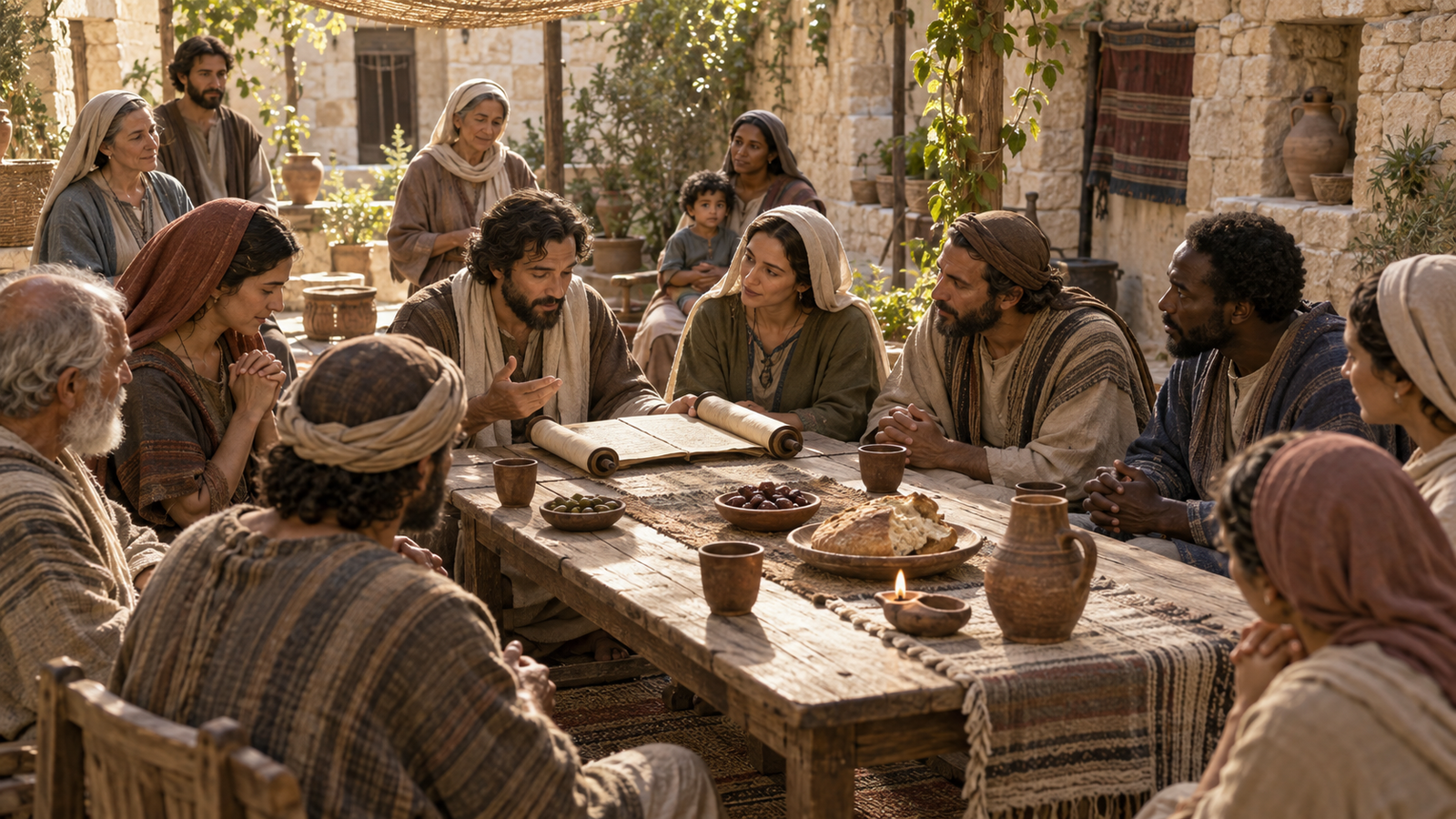
What Does Christ Covenant Church Mean?
Many people search for Christ Covenant Church because they want to understand a local congregation, a church name, or the meaning of covenant Christianity. The name sounds specific, but it can describe more than one church in more than one place. A careful answer must begin with the local church’s own location, statement of faith, and public teaching.
The word Christ tells us where the church must look. Jesus Christ is not a decoration added to a church brand. He is the eternal Son of God, the Savior who died for sinners, the Lord who rose again, and the Head of His people. The word covenant points to God’s promises and to the relationship He establishes with His people through grace.
This guide gives a Biblical way to understand the name and to evaluate a local congregation. It does not treat every church with a similar name as identical. For a wider introduction, read the guide to Christian churches and denominations. Then test every claim by the Bible.
Why Covenant Matters in the Bible
A covenant is a solemn promise or relationship established by God. In the Bible, God makes covenant promises to His people and calls them to trust Him, worship Him, and walk in faithful obedience. These promises do not come from human strength. They reveal God’s holy character and His gracious purpose to save.
The new covenant reaches its fulfilment in Jesus. At the Last Supper, Jesus spoke of His blood as the blood of the covenant. His death was not a tragic end to a good teacher. He gave Himself to deal with sin. His resurrection showed that His sacrifice was accepted and that death could not keep Him in the grave.
A church called covenant should therefore point beyond human loyalty. It should point to God’s promise in Christ. Christians do not become right with God by signing a membership form or joining the right group. We are saved by grace through faith in Jesus, and then we grow as members of His body.
What the Bible Says About the Church
The church is not first a building, a programme, or a weekly event. The church is the people whom God has called to Himself through Jesus Christ. Scripture describes believers as Christ’s body, God’s household, a holy temple, and a people who belong to Him. These pictures show both closeness to God and responsibility toward one another.
Acts 2 describes the early believers devoting themselves to the apostles’ teaching, fellowship, the breaking of bread, and prayers. Their faith was public and shared. They listened to God’s Word, cared for one another, worshiped together, and welcomed new believers. A healthy local church should still make these priorities visible.
The church also has a sure foundation. Jesus Christ is the cornerstone, and His people are built together in Him. This protects a congregation from becoming centred on one powerful leader or a popular style. The church belongs to Jesus, so its life must be shaped by His Word and His mission.
Is Christ Covenant Church a Denomination?
The name Christ Covenant Church does not identify one universal denomination. One prominent church with this name, in Matthews, North Carolina, identifies as a member of the Presbyterian Church in America. Its public materials describe a Reformed congregation committed to worshiping God, making disciples, loving one another, and serving the body of Christ.
Other congregations may use Christ Covenant Church as an independent local name or may belong to another church family. That is why a search result, logo, or shared name is not enough to establish what a particular church believes. Read the exact local statement of faith and ask how its beliefs shape worship, leadership, membership, and mission.
This distinction is not meant to create suspicion. It is a call to truth. Christians should be glad when a church explains its beliefs clearly. A congregation that belongs to a denomination should identify that relationship honestly, and an independent church should explain its own accountability and doctrinal standards.
What Should Christ Covenant Church Believe?
A Christ-centred church must confess the truth about Jesus. He is fully God and truly man. He lived without sin, died for the sins of His people, rose bodily from the dead, ascended to the Father, and will return in glory. These are not minor details. They are the heart of the Gospel and the foundation of Christian hope.
The church should also teach that there is one true God, eternally existing as Father, Son, and Holy Spirit. The Bible is God’s authoritative Word. People are sinners who cannot rescue themselves, but God saves by His grace through faith in Jesus Christ. Good works follow salvation. They do not purchase it.
A local church may differ from another church in its governance, worship customs, or traditions. Yet it must not replace the Gospel with self-help, politics, personality, or vague spirituality. The central question is always this: does the church help people see, trust, worship, and obey the real Jesus revealed in Scripture?
Jesus Christ Is the Head of the Church
Jesus is not only the reason the church exists. He is its living Head. He purchased His people with His blood and rules them with truth and mercy. Church leaders are servants, not owners. Members are not an audience gathered to admire a platform. Every Christian belongs to Jesus and is called to honour Him.
This changes the way a church handles authority. Pastors and elders must teach what Christ has given in Scripture. They must not ask people to obey private revelations, personal preferences, or rules that contradict the Bible. Members should respect faithful leaders while remembering that every leader answers to the Chief Shepherd.
The life of Jesus shows the kind of Lord He is. He welcomed the needy, confronted sin, taught the truth, prayed to the Father, served His disciples, and gave His life for sinners. Read more about the life and ministry of Jesus to see why a church must reflect His holiness, compassion, and courage.
The Bible Must Govern Church Life
A church cannot be faithful if the Bible is treated as a prop. Scripture must govern what the church teaches about God, salvation, worship, marriage, suffering, money, justice, and daily conduct. The church does not stand above the Bible. It receives the Bible as the Word of the God it worships.
This does not mean every question is answered by a quick verse taken out of context. Faithful teachers explain Scripture carefully, respect the whole story of the Bible, and show how every part points to God’s saving work in Christ. The goal is not to win arguments. The goal is to form people who love truth and live it.
A visitor can ask simple questions. What passage will be preached? How does the church handle disagreement? Are difficult texts explained honestly? Is Jesus central in sermons and prayers? You can also read about what Jesus preached and use His teaching as a clear test for Christian ministry.
Worship Should Honour God
Christian worship is more than music. It includes hearing the Word, prayer, confession, thanksgiving, singing, giving, baptism, the Lord’s Supper, and the gathered life of the church. These practices are not empty rituals when they are received in faith. They direct the church away from self-display and toward the glory of God.
Jesus is worthy of worship because He is the divine Son and the risen Lord. The church should not make worship depend on a celebrity leader, emotional pressure, or impressive production. A congregation can worship with great joy in a simple room when its heart is fixed on Christ and its words are true.
Good worship also teaches. Songs should say what is faithful. Prayers should agree with Scripture. Sermons should explain the Bible. The Lord’s Supper should proclaim the death of Jesus until He comes. When worship is shaped by truth, it helps new believers grow and gives mature believers deeper reasons to praise.
A Church Grows Through Word and Prayer
Growth in a church is not measured only by attendance, buildings, or online reach. The New Testament connects growth with the faithful work of God through His Word and Spirit. Believers learn the truth, repent of sin, trust Christ, encourage one another, and become more like Jesus. This kind of growth may be quiet, but it is real.
Prayer shows that a church depends on God. A praying church does not pretend that skill, money, or planning can save people. It asks the Father to honour the Son, strengthen the weak, send workers, protect the church from error, and open doors for the Gospel. Prayer also teaches members to bring their fears and needs to God.
New believers should be welcomed into this pattern. They need more than a one-time decision. They need patient teaching, Christian friendship, correction, and a place to serve. Mature believers also need the same means of grace. No Christian outgrows the Word, prayer, or dependence on Jesus.
Membership Means Belonging and Serving
Church membership is not a club badge. It is a public way of saying that you belong to Jesus and want to walk with His people under the care of a local church. Membership includes joy, but it also includes responsibility. Christians receive care, accept correction, keep promises, and help others follow Christ.
The New Testament assumes that believers know one another and carry one another’s burdens. This is difficult when church life is only anonymous attendance. Shared meals, prayer, small groups, pastoral care, and practical service help people move from watching to belonging. A church should make room for people who are new, weak, grieving, or searching.
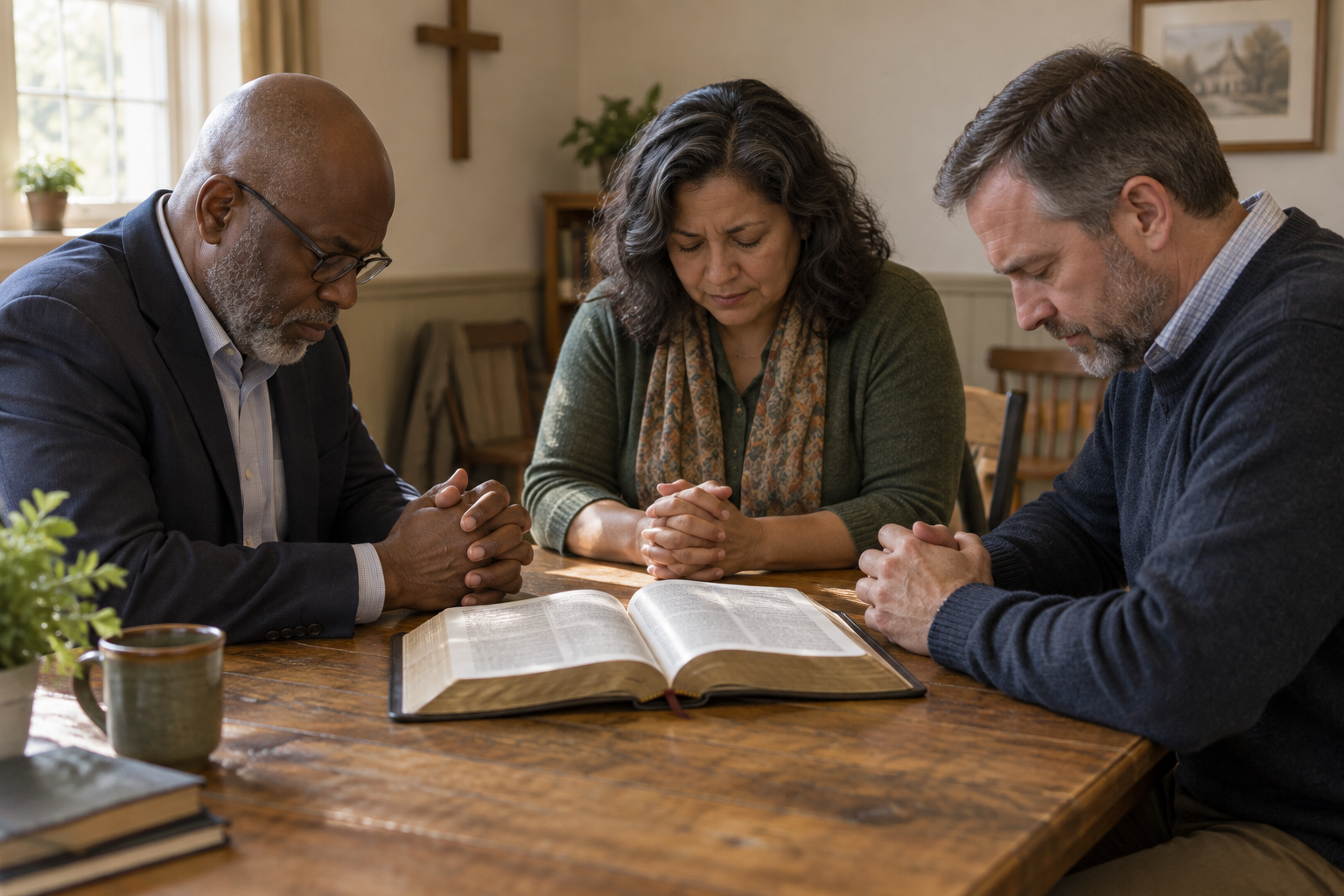
The home fellowship pictured here is not a replacement for gathered worship. It is a reminder that the church follows Jesus in ordinary life. Members can read Scripture at a table, pray for a neighbour, welcome a lonely person, and use their gifts to strengthen the body. Explore Christian wisdom for daily life as you consider these choices.

Elders, Pastors, and Deacons
The New Testament gives churches recognised leaders who teach, shepherd, protect, and serve. Different traditions use different structures, but leaders should be qualified by character as well as ability. A gifted speaker who lacks honesty, self-control, humility, or care for people is not a safe shepherd.
Pastors and elders must guard the teaching of the church and care for the flock. They should be willing to explain their decisions, receive correction, and handle power with fear of God. Deacons and other servants help meet practical needs so that the church can show mercy and maintain good order.
Members should pray for leaders and honour faithful service. Leaders should never use their position to control people, hide wrongdoing, or place themselves beyond accountability. Jesus is the model for Christian authority. He leads by truth, sacrifice, holiness, and love.
Love, Unity, and Care in the Body
Jesus said that His disciples would be known by their love for one another. Christian love is not vague kindness. It tells the truth, forgives, bears burdens, welcomes outsiders, and refuses to use people. It is patient with growth but serious about sin. It does not confuse peace with silence when someone is being harmed.
A local church will include people with different ages, backgrounds, abilities, and experiences. Unity does not require every person to have the same personality or preference. It requires a shared submission to Jesus and His Word. The cross gives believers a deeper identity than class, nationality, politics, or personal taste.
Care becomes visible when a church visits the sick, supports the grieving, protects children, helps the poor, welcomes the lonely, and receives correction. These actions do not earn salvation. They show the life that grows from the Gospel. A church should make the mercy of Jesus easier to see, not harder.
Mission Means Making Disciples
Jesus gave His church a mission to make disciples of all nations. This means proclaiming the Gospel, calling people to repent and believe, baptizing believers, and teaching them to obey all that Jesus commanded. Mission is not only a church event. It is the steady work of bringing the truth of Christ to neighbours, families, workplaces, campuses, and nations.
A disciple is more than a person who agrees with Christian ideas. A disciple follows Jesus. The church should help people read the Bible, pray, resist sin, love the saints, serve the needy, and speak about Christ with courage and gentleness. Teaching must lead to a changed life because Jesus is Lord.
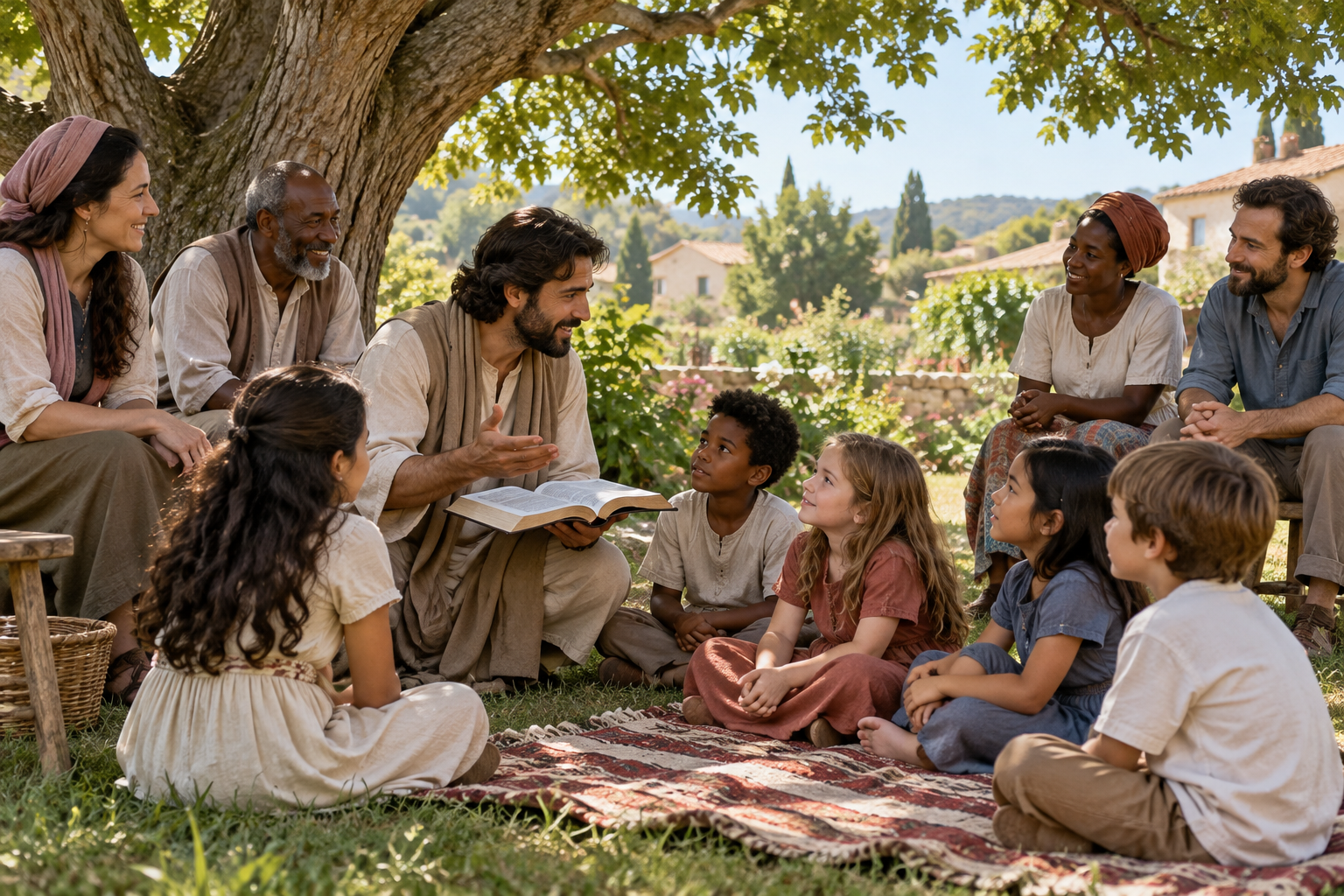
Children and young people should be taught with care, not treated as an afterthought. New believers need patient foundations. Mature Christians should be equipped to disciple others. The group under the tree shows a simple truth: the mission of Jesus includes passing on His words so that the next generation can know Him.
How a Local Church Shows the Gospel
A church shows the Gospel first by speaking it clearly. People need to hear that God is holy, that sin is real, that Jesus died and rose again, and that forgiveness is offered to those who turn to Him in faith. Service without the Gospel can become social work without eternal hope. Words without love can make true doctrine sound empty.
The church also shows the Gospel through practical mercy. Food, visits, hospitality, counselling, generosity, and care for the vulnerable do not replace preaching. They give visible shape to the compassion of Christ. The church serves because Jesus served and because every person is made in God’s image.
The volunteers pictured here should remind us that Christian service is not a way to build a reputation. It is an offering to the Lord. A church can ask whether its service protects dignity, tells the truth, welcomes people into Christian community, and directs attention to Jesus rather than to the church’s image.

How to Evaluate a Local Church
When you visit a church called Christ Covenant Church, begin with its statement of faith. Does it confess the Trinity, the authority of the Bible, the divinity of Jesus, His sinless life, His death for sinners, His bodily resurrection, and His return? Does it explain salvation as God’s grace received through faith in Christ?
Then observe the church’s life. Is Scripture read and explained? Are prayers shaped by dependence on God? Are leaders accountable? Are members encouraged to serve and forgive? Are children and vulnerable people protected? Are money and power handled openly? Does the church welcome questions while remaining clear about the Gospel?
Finally, ask what the church produces. Jesus said a tree is known by its fruit. No local church is perfect, and every Christian community needs repentance. Yet a faithful church should make the holiness, mercy, truth, and love of Jesus more visible over time. The name matters less than the church’s submission to Christ.
Questions to Ask Before Joining
Ask what the church believes about Jesus and how those beliefs are taught. Ask how new members are received, how leaders are chosen, and how concerns are handled. Ask what the church expects from members and what care members can expect from pastors and other believers.
Ask how the church practices baptism and the Lord’s Supper. Ask how it teaches children, supports marriages and families, welcomes single adults, helps the poor, and responds to people who are suffering. These questions are not signs of disrespect. They help you understand whether the church is prepared to shepherd real people in real life.
Take time to listen and pray. Do not choose a church only because the music is moving, the building is beautiful, or the pastor is impressive. Look for a community that will help you know Jesus, obey Scripture, love other Christians, and remain faithful when following Christ is costly.
Frequently Asked Questions
What is Christ Covenant Church?
Christ Covenant Church is a name used by more than one local Christian church. A church with this name should be understood by its own beliefs and location. Biblically, a faithful church is a gathered people who follow Jesus Christ, receive the authority of Scripture, worship God, love one another, and make disciples.
What denomination is Christ Covenant Church?
The name does not identify one universal denomination. For example, the official Christ Covenant Church in Matthews, North Carolina, identifies as a member of the Presbyterian Church in America. Other local churches with similar names may be independent or belong to another church family, so check the local church’s own statement of faith.
What does covenant mean in Christianity?
A covenant is a solemn relationship established by God’s promise and commitment. The Bible tells the story of God’s covenant purposes fulfilled in Jesus Christ. Christians do not earn salvation by joining a church. They receive salvation by grace through faith in Jesus, then join His people to worship and serve Him.
What should I look for in a Christ-centred church?
Look for clear teaching from the Bible, a right understanding of Jesus as Lord and Savior, prayer, faithful worship, loving fellowship, accountable leaders, care for the needy, and a serious call to repentance and holy living. A church should point you to Christ rather than to a personality, brand, or building.
Is Christ Covenant Church right for every Christian?
No single local church is the right fit for every Christian, and the name alone cannot answer that question. Visit the church, read its statement of faith, listen to its teaching, ask how it practices membership and discipline, and compare its life with Scripture. Keep Jesus and the Bible at the centre of the decision.
Scripture and Sources for Further Study
Read these passages in context. They show what the church is, how it should live, and why everything must remain centred on Jesus Christ.
- Acts 2:42-47, which describes the early church’s devotion to teaching, fellowship, shared meals, and prayer.
- Ephesians 2:19-22, which describes believers as members of God’s household and a temple built together in Christ.
- Matthew 28:18-20, where Jesus commands His church to make disciples and teach His people.
- John 13:34-35, where Jesus gives His disciples a new commandment to love one another.
- Christ Covenant Church, whose official site identifies the Matthews congregation and its mission.
- Christ Covenant Church’s Statement of Faith, which explains that local church’s doctrinal commitments.
- Visiting Christ Covenant Church, which describes its local church community and invitation to visitors.
Christ Covenant Church should never be reduced to a name, a building, or a tradition. The church belongs to Jesus. He is the Savior who died and rose again, the Lord who rules His people, and the cornerstone on whom the whole household of God is built. Seek a church that helps you trust Him, obey His Word, and love His people.