
In Mark 12:41-44, Jesus observes a poor widow who gives two small coins—all she had to live on—into the temple treasury. He teaches that her sacrificial gift is worth more than the large donations of the rich because she gave everything she had, showing total dependence on God and perfect devotion.
Have you ever wondered how God sees your giving—not just what you put in the offering plate, but the heart behind it? In Mark 12:41-44, we find one of the most moving and convicting moments in all of Scripture, where Jesus Himself watches people as they give and draws a profound lesson about worship, sacrifice, and the kind of devotion He truly treasures. The world often measures generosity by size, but our precious Savior measures it by surrender—and His perspective changes everything.
This passage invites us to step into the temple courts alongside Christ and witness a scene that still speaks directly to believers today. Through the humble offering of a poor widow, Jesus reveals a timeless truth that reaches far beyond money and into the very core of our relationship with Him. If you desire a faith that goes deeper than surface-level religion and grows into wholehearted reliance on the Lord, the story of the widow’s mite has exactly the encouragement and conviction you need. Let us explore together what Jesus intended for us to learn from this beautiful act of radical worship.
What Happens in Mark 12:41-44?
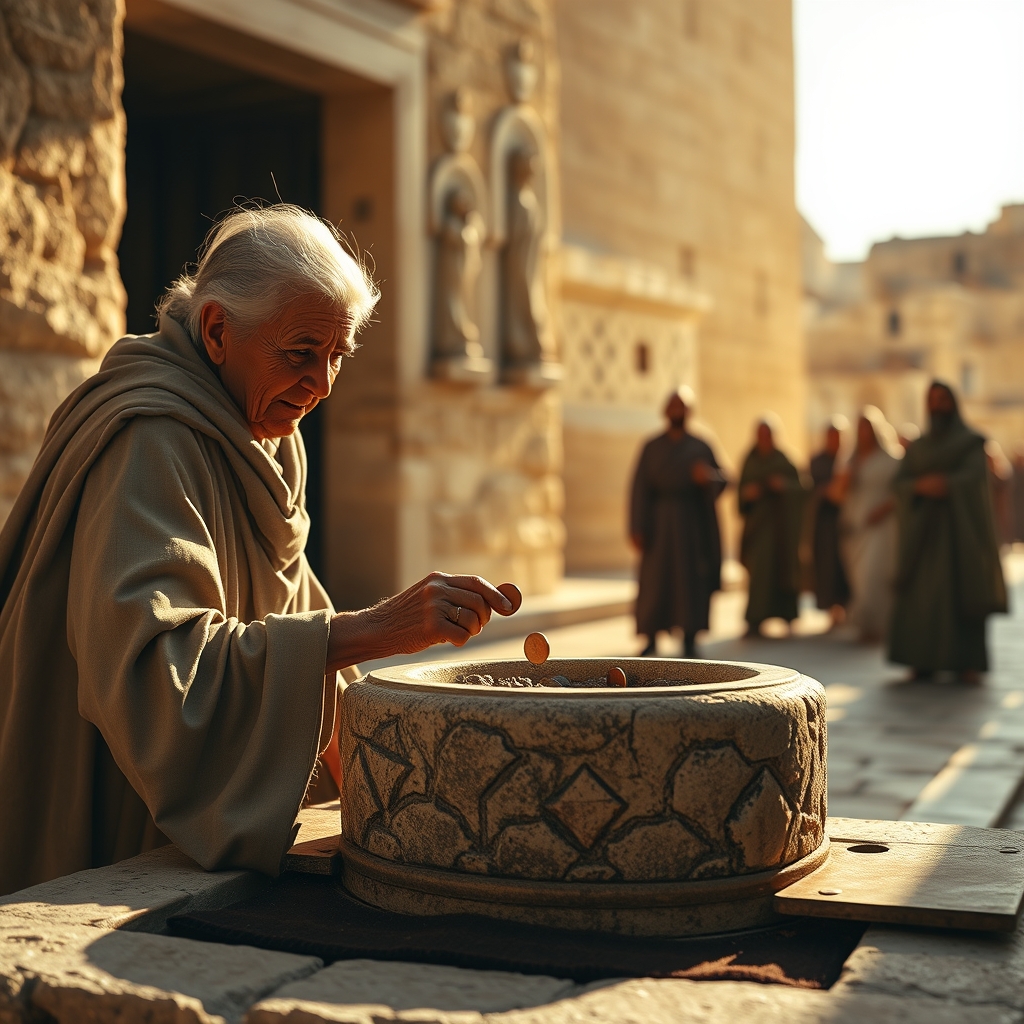
Jesus Observes the Temple Treasury
In Mark 12:41–44, Jesus positions Himself near the temple treasury. He watches as people drop in their offerings. Many wealthy individuals give large sums. The scene reflects both generosity and spiritual danger.
First, Jesus observes quietly. He sees the external act of giving. Yet He looks beyond the surface. His divine insight weighs every motive of the heart. Nothing escapes His holy gaze.
In addition, the rich give from their surplus. Their gifts appear impressive. However, these offerings cost them little. There is no sacrifice involved. Their comfort remains unchanged.
As a result, Jesus sees more than money. He discerns pride, reputation-driven giving, and empty religiosity. Furthermore, He identifies hearts that rely on outward show rather than inward devotion.
This moment reveals the temptation of superficial piety. People may give generously yet remain spiritually empty. The Pharisees often embodied this danger. Their religion focused on appearance more than obedience to God. [1]
The Poor Widow’s Gift
After the wealthy give, a poor widow approaches. She puts in two small copper coins, worth only a fraction of a penny. Her gift seems insignificant compared to the others.
However, Jesus calls His disciples to Him. He declares that she has given more than anyone else. In other words, God measures giving differently than people do.
“Truly I tell you,” Jesus says, “this poor widow has put in more than all the others.” Her small offering represented her entire life. She gave all she had to live on.
This moment highlights profound truths:
- The widow gave everything; the wealthy gave only a portion.
- Her gift reflected radical trust in God’s provision.
- Jesus affirmed her faith publicly, even though others likely overlooked her.
- Her worship cost her dearly, yet this is what Jesus honors.
Furthermore, Jesus contrasts her sacrifice with external religiosity. Many honored the rich givers. Yet God honors the humble, surrendered heart. The widow’s act reflects total dependence on God.
In the Jewish context, widows were often vulnerable and overlooked (Mark 12:40; James 1:27). As a result, her story carries even more weight. God singles out a marginalized woman as a model of faith. [2]
What is the lesson of Mark 12 41 44?
The account of the widow’s mite in Mark 12:41-44 reveals timeless truths about what truly matters to our Heavenly Father. This passage challenges every believer to examine their own heart when it comes to generosity and worship.
God Values the Heart Over the Amount
Jesus positioned Himself near the temple treasury to observe how people gave. Many wealthy individuals contributed large sums. However, Jesus did not commend them. Instead, He drew attention to a poor widow who gave two small coins.
Jesus declared:
“Truly I tell you, this poor widow has put in more than all the others. All these people gave their gifts out of their wealth; but she out of her poverty put in all she had to live on.”
— Mark 12:43-44 (NIV)
This statement reveals a fundamental truth. God does not measure giving by dollar amounts. He measures it by sacrifice. The wealthy gave what they could easily spare. The widow gave everything she had.
| What the World Sees | What God Sees |
|---|---|
| Large donations from the rich | Sacrifice without reservation |
| Public recognition | Private devotion to God |
| Surplus giving | Total trust in God’s provision |
The widow’s act demonstrates that God looks beyond external appearances. He sees the heart behind every offering. As we read in 1 Samuel 16:7, “The Lord does not look at the things people look at. People look at the outward appearance, but the Lord looks at the heart.”
The Danger of Superficial Piety
Earlier in Mark 12, Jesus warned the crowd about religious leaders who used their positions for personal gain. He said:
“Watch out for the teachers of the law. They like to walk around in flowing robes and be greeted with respect in the marketplaces. They have the most important seats in the synagogues and the places of honor at banquets. They devour widows’ houses and for a show make lengthy prayers. These men will be punished most severely.”
— Mark 12:38-40 (NIV)
These religious leaders displayed outward signs of devotion. Yet their hearts were far from God. They performed acts of religion for public approval, not from genuine love for God or others.
Jesus contrasted their hypocrisy with the widow’s authentic faith. This comparison teaches us several vital lessons:
- Performative faith is empty faith. God sees through religious actions done for show.
- genuine worship costs something. True devotion requires sacrifice and surrender.
- God honors humble hearts. A small gift given with pure motives pleases God more than a large gift given for recognition.
- Outward appearances deceive. We must guard against judging spiritual maturity by external measures.
The widow did not seek attention. She did not announce her gift. She simply gave everything she had to God. Her quiet act of worship revealed a heart completely surrendered to the Lord.
As believers reflecting on Mark 12:41-44, we must ask ourselves honest questions. Are we giving to be seen by others? Or are we giving from hearts that truly love and trust Jesus Christ?
Living faith is not measured by status or wealth. It is measured by the willingness to surrender all we have to our Lord and Savior. The widow’s mite reminds us that the smallest act of genuine faith is precious in the eyes of God.
What is the moral lesson of the widow’s mite?

Total Dependence on God
The story of the widow’s mite in Mark 12:41-44 reveals one of the most powerful truths in all of Scripture. This poor widow gave just two small coins. It was everything she had. In the world’s eyes, her gift seemed insignificant. However, Jesus saw something no one else could see. He saw a heart that trusted God completely.
The widow’s act teaches us about total dependence on God. She did not hold anything back. Furthermore, she did not wait until she had more to give. Instead, she gave boldly, trusting that God would provide for her needs. This is radical faith in action.
The wealthy people in the temple gave from their surplus. Their gifts did not cost them anything. In contrast, the widow’s gift cost her everything. As a result, Jesus honored her offering above all others. He said she put in more than anyone else. Why? Because she gave out of her poverty, not her wealth.
This lesson challenges us to examine our own hearts. Do we give God what is left over? Or do we give Him our very best? The widow models what complete trust looks like. She did not rely on her own resources. She relied on her Heavenly Father.
Total dependence on God means believing His promises. It means knowing that He is our provider. Scripture tells us, “And my God will meet all your needs according to the riches of his glory in Christ Jesus” (Philippians 4:19). The widow lived this truth before it was ever written down.
Consider what total dependence looks like in our daily lives:
- Giving without fear. The widow did not fear running out. She trusted God’s provision completely.
- Putting God first. Her offering came before her own comfort. She honored God with her finances.
- Living by faith, not by sight. She could not see where her next meal would come from. Yet she gave anyway.
- Finding security in God alone. Her two coins were not her safety net. The Lord was.
Jesus calls us to this same kind of faith. He said, “Do not worry about your life, what you will eat or drink; or about your body, what you will wear” (Matthew 6:25). The widow understood this teaching deeply. Her life was a living testimony of trust.
We often want to feel secure before we give. We want to know we have enough saved. However, the widow shows us a different path. True security is found in surrendering everything to God. When we depend on Him fully, we discover that He is more than enough.
A Testimony of Faith for All Generations
The widow’s story has been told for over two thousand years. It has inspired countless believers to trust God with their lives. Her small act of faith echoes through the centuries. It still speaks to us today.
Jesus made sure her story would not be forgotten. He called His disciples to witness her offering. He pointed her out as an example. In doing so, He elevated her faith for all generations to see. Her testimony was not written in stone. It was written in the Word of God.
This reminds us that God sees every act of faith. Nothing done for Him goes unnoticed. The widow never knew her story would be in the Bible. She simply gave out of love for God. Yet her faithfulness became an eternal lesson.
Our acts of faith also matter more than we realize. When we give sacrificially, others notice. When we trust God in hard times, it encourages fellow believers. Our faith becomes a testimony to those around us.
Consider the impact of a faithful life:
- It inspires others to trust God. The widow’s example has motivated millions to give generously.
- It glorifies God. When we live by faith, we point others to His goodness.
- It leaves a lasting legacy. Faithful acts ripple through generations.
- It honors Christ. Every sacrifice made in His name is precious to Him.
The widow’s mite teaches us that God measures faithfulness differently than the world does. The world values size and spectacle. God values the heart. He values trust. He values surrender.
Jesus Christ is the ultimate example of sacrificial giving. He left the glory of heaven. He gave His very life on the cross for us. “For God so loved the world that he gave his one and only Son, that whoever believes in him shall not perish but have eternal life” (John 3:16). His sacrifice is the foundation of our faith.
As we reflect on the widow’s story, let us ask ourselves: Are we living with total dependence on God? Are we giving Him our all? The answer to these questions shapes not only our lives but also the legacy we leave behind.
The widow’s two small coins changed the world. They remind us that God uses the small and the humble to accomplish His greatest purposes. May we follow her example. May we trust God completely. And may our lives be a testimony of faith for all generations to come.
What is the lesson of the widow’s offering?
The widow’s offering in Mark 12:41-44 rewrites how we define generosity. Jesus highlights that true giving is about the heart, not the amount. Our Savior measures sacrifice by love and trust.
Redefining True Generosity
Worldly standards focus on numbers. However, God sees our hearts clearly. The widow’s two small coins moved the Lord more than all the larger gifts. Why? She gave everything she had to God.
Consider these contrasts:
- Rich givers: Gave from their surplus 1 Timothy 6:17 reminds us not to put hope in wealth.
- The widow: Gave her whole livelihood Luke 21:3 shows she gave “all she had to live on.”
- God’s measure: Sees faith, not funds Colossians 3:23-24 urges us to work heartily for the Lord.
Paul echoes this in 2 Corinthians 8:1-5. The Macedonian churches gave beyond their means, first giving themselves to the Lord. True generosity starts with surrender of self.
Jesus as Our Ultimate Example of Sacrifice
Looking further, Jesus Himself is the greatest example of sacrificial giving. Philippians 2:6-8 reveals that though He existed in the form of God, He emptied Himself, taking the form of a servant, and humbled Himself to death on a cross.
As a result, no one has ever given more than Jesus gave. Consider His sacrifice:
- He left heavenly glory for a manger John 3:16 promises eternal life through belief in Him.
- He bore our sins on the cross 1 Peter 2:24 declares He bore our sins in His own body.
- He gave His life so we could live Romans 5:8 proves God’s love: Christ died for us while we were sinners.
- He rose again, securing our salvation 1 Corinthians 15:3-4 states He rose on the third day according to the Scriptures.
The widow pointed ahead to Jesus Christ, who would give everything for us just days later in Jerusalem. His crucifixion and resurrection seal the ultimate act of love. Therefore, when we give, we simply reflect what He first gave to us.
In conclusion, Mark 12:41-44 calls us to give with whole hearts, trusting our Lord completely. Moreover, it points us to the cross where Jesus gave His all for our redemption.
What is the story of the woman who gave her last coin?
The story of the woman who gave her last coin is one of the most powerful and moving moments in all of Scripture. Found in Mark 12:41-44, this brief account captures an encounter between Jesus and a poor widow at the temple in Jerusalem. Though her offering was only two small coins, Jesus saw something in her heart that He wanted every believer to understand. Let us explore the historical context of her gift and the radical nature of her worship.
Historical Context of the Temple Offering
To fully appreciate this woman’s sacrifice, we need to understand the setting. Jesus was sitting near the temple treasury, watching people place their offerings. The treasury consisted of thirteen trumpet-shaped collection boxes. Each box was designated for a specific type of offering. Wealthy donors would cast their coins loudly into the horns, and the clinking drew attention from everyone nearby.
In that era, the offering system had become deeply problematic. The religious leaders had turned giving into a public performance. They praised the rich while neglecting the poor. Furthermore, historians note that these same leaders often exploited widows, even devouring their homes while making a show of long prayers (Mark 12:40). Against this backdrop of greed and hypocrisy, one unnamed widow stepped forward.
This woman was not only poor. She was destitute. In the ancient world, widows had no social safety net. They depended entirely on the generosity of others. To give her last two coins meant she was giving everything she had to live on. Yet she stepped forward anyway.
Her Act of Radical Worship
Jesus watched her closely. He recognized that the wealthy gave from their surplus, but she gave from her poverty. Her two small coins, called lepta, were the smallest denominations in circulation. Their combined value was less than a penny. By every human measure, her gift was insignificant. However, by God’s measure, it was the greatest gift that day.
Jesus called His disciples to her side and declared, “Truly I tell you, this poor widow has put in more than all the others. All these people gave their gifts out of their wealth; but she out of her poverty put in everything — all she had to live on” (Mark 12:43-44, NIV).
Her act of radical worship teaches us several truths:
- God measures the heart, not the amount. The quantity of her gift was nothing compared to the wealthy donors. Yet Jesus said she gave more because her sacrifice reflected total trust in God’s provision.
- Radical worship requires relinquishing control. She held nothing back. She did not calculate whether she could afford to give. She simply trusted that God would sustain her.
- Her faith was not performative. She did not seek applause. In fact, no one else in the crowd noticed her. Only Jesus saw.
- Her story is told for all generations. Though we do not even know her name, Jesus ensured her legacy endures in Scripture.
This unnamed woman’s gift challenges every believer today. Are we giving from our abundance, or are we surrendering everything to the One who gave His life for us? Her act of worship was not just about coins. It was about complete, unreserved trust in the goodness of God.
Frequently Asked Questions

What is the lesson of Mark 12:41-44?
The central lesson of Mark 12:41-44 is that God measures gifts by the giver’s heart, not the gift’s size. Jesus watched wealthy people donate large sums from their surplus. Then a poor widow gave two small copper coins, representing all she had to live on. He valued her gift as greater than all others because she sacrificed everything to God.
God sees our internal condition rather than external appearances. The wealthy gave from abundance, while she gave trusting completely to God. Furthermore, this story challenges us to examine our own giving—do we give from surplus, or do we sacrifice in faith? Ultimately, this passage reminds us that no gift is small when given with pure devotion.
What is the moral lesson of the widow’s mite?
The moral lesson of the widow’s mite centers on total dependence on God. This widow’s act demonstrated radical faith and complete trust. She gave all she had, believing God would provide for her.
Her story teaches us:
- Total dependence on God: She trusted God completely with her survival.
- A Testimony of Faith for All Generations: Her act of radical worship challenged onlookers then and inspires us now.
- True sacrifice matters more than surplus: Small offerings given wholeheartedly please God more than large offerings given casually.
- Worship is sacrificial: She gave everything, not just excess.
Moreover, Jesus Himself is our ultimate example of sacrificial giving. As Philippians 2:7-8 states, He “made himself nothing” and “humbled himself” for us.[3]
What is the lesson of the widow’s offering?
The widow’s offering redefines true generosity. Many assume generosity means giving large amounts. However, God’s economy operates differently—He measures sacrifice, not size.
Consider the contrast Jesus highlighted:
| The Wealthy Givers | The Poor Widow |
|---|---|
| Gave from their surplus | Gave from her poverty |
| Gave large amounts | Gave two small coins |
| Expect nothing back | Expected God’s provision |
| Noticed by people | Noticed by Jesus |
Jesus saw what others missed. The crowd saw a small gift; He saw a devoted heart. In addition, this challenges us to examine our priorities. Do we cling to security, or do we trust God with everything? Her offering teaches that generosity is a heart condition, not a financial calculation.
What is the story of the woman who gave her last coin?
The story of the woman who gave her last coin takes place at the temple treasury. Jesus positioned Himself there, carefully observing every donation. He saw many wealthy people contributing substantial amounts. Then, a poor widow approached and placed two small coins—worth only a fraction of a penny—into the offering.[4]
Scripture tells us three crucial details:
- Historical Context of the Temple Offering: Temple giving was customary, yet this system often exploited widows. Despite this injustice, she still gave.
- Her Act of Radical Worship: She could have kept even one coin for survival. Instead, she offered everything as an act of faith.
- The Disciples as Witnesses: Jesus called His disciples to highlight this moment. He wanted them—and us—to understand true devotion.
As a result, this account has echoed through generations. Her story reshapes how we view generosity and worship. She did not know Jesus would praise her gift. Similarly, we give without knowing outcomes, trusting God anyway. This woman’s sacrifice foreshadowed Jesus’ own giving on the cross. In the same way, she embodies Proverbs 3:9: “Honor the LORD with your wealth.” Ultimately, her two small coins teach us that true worship costs everything—and is worth every sacrifice.