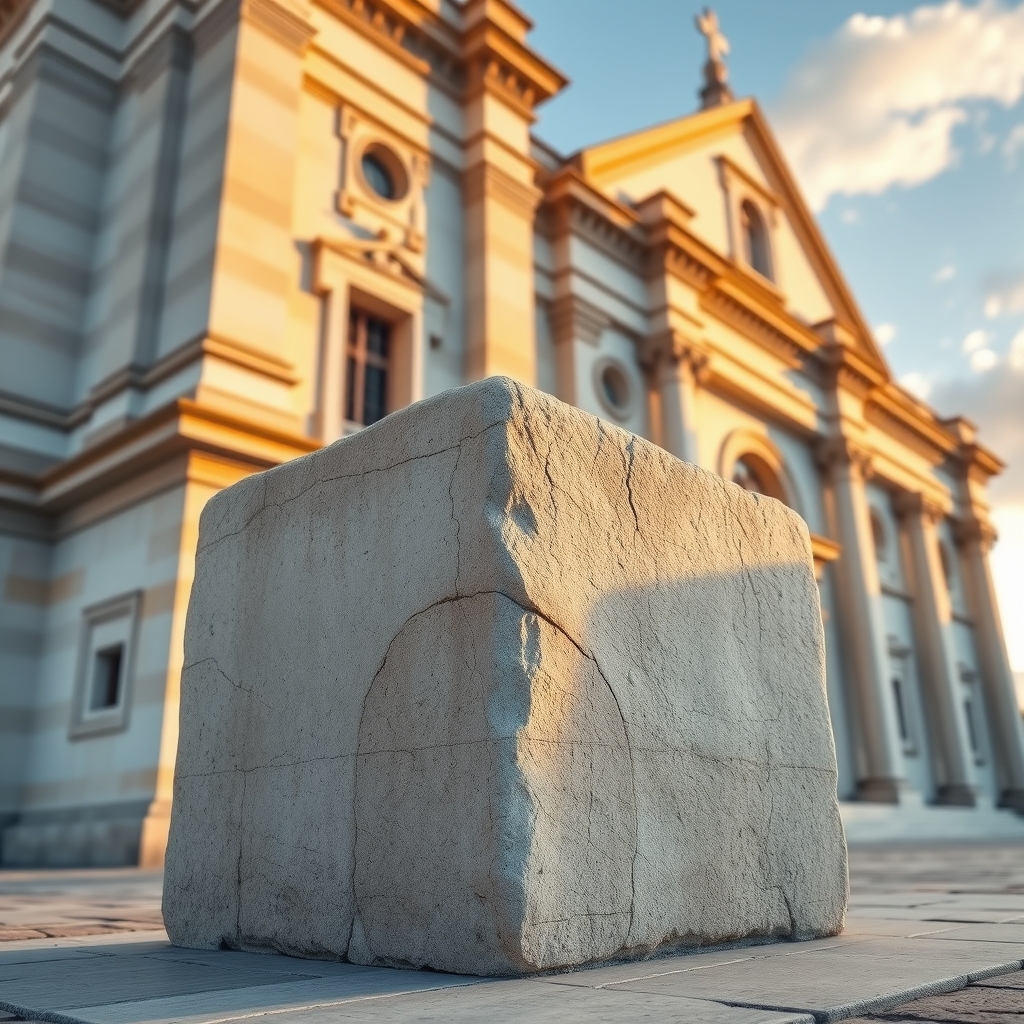
Christ the Rock is a biblical title for Jesus Christ, drawn from passages such as Matthew 16:18 and 1 Corinthians 10:4, declaring that Jesus is the unshakable spiritual foundation upon which God builds His Church. Just as a rock is solid, immovable, and dependable, Jesus is the eternal cornerstone and source of salvation for all who place their trust in Him. Building your life on Christ the Rock means anchoring your faith, hope, and purpose in His finished work on the cross and His resurrection power.
What does it mean that Jesus is called “Christ the Rock”? Far more than a poetic phrase or a simple metaphor, this profound truth is woven throughout the entire Scripture — from the ancient pages of the Old Testament to the powerful declarations of the New Testament. In a world where countless voices compete for our attention and foundations shift beneath our feet, the Bible invites every believer to discover the one unshakable cornerstone upon which an enduring faith can be built.
In this article, we will explore what the Bible means by “Christ the Rock,” tracing His identity from the Song of Moses to His own words spoken centuries later. Whether you are a new believer seeking a firm foundation or a mature Christian longing to go deeper, this journey through Scripture will reveal why Jesus alone stands as our refuge, our fortress, and the cornerstone of our salvation. No matter what storms life brings, His truth does not waver — and neither must we.
What Does the Bible Mean by “Christ the Rock”?
The phrase “Christ the Rock” is not just a poetic title. It is a profound declaration of who Jesus is and what He means to every believer. Throughout Scripture, God is described as a Rock — immovable, eternal, and faithful. That same description is fulfilled perfectly in Jesus Christ.
In the Old Testament, God revealed Himself as the Rock of Israel. These passages paint vivid pictures of His strength and protection. However, they were only shadows of something greater to come. In the New Testament, the fullness of this title is unveiled. Jesus steps forward and claims it for Himself.
Understanding why Jesus is called the Rock transforms how we see Him. It moves our faith from abstract ideas to a firm foundation. Let’s explore what the Bible teaches about this powerful title.
Old Testament Shadows of Christ as the Rock
Long before Jesus walked the earth, God used the image of a rock to reveal His nature. The Old Testament writers understood that a rock represents stability, protection, and permanence. Each of these passages pointed forward to a coming Savior who would embody all of these qualities perfectly.
Consider these Old Testament revelations:
- Deuteronomy 32:4 — Moses sings, “He is the Rock, His works are perfect, and all His ways are just. A faithful God who does no wrong, upright and just is He.” Here, God Himself is declared the Rock of Israel. This is not a mere metaphor. It is a revelation of His unchanging character.
- 2 Samuel 22:2–3 — David proclaims, “The Lord is my rock, my fortress and my deliverer; my God is my rock, in whom I take refuge.” David knew God as his secure foundation amid every battle and trial.
- Psalm 62:6–7 — The Psalmist writes, “He alone is my rock and my salvation; he is my fortress, I will not be shaken. My salvation and my honor depend on God; He is my mighty rock, my refuge.”
- Isaiah 28:16 — The prophet declares, “So this is what the Sovereign Lord says: ‘See, I lay a stone in Zion, a tested stone, a precious cornerstone for a sure foundation; the one who relies on it will never be stricken with panic.'” This prophesy points directly to Jesus Christ as the cornerstone God would establish. [1]
These passages are not merely historical references. They are divine foreshadowing. God was painting a portrait of the Messiah through the imagery of a rock. Every description of God as Rock in the Old Testament finds its ultimate fulfillment in Jesus Christ.
The Israelites experienced God as their Rock in tangible ways. He provided water from the rock at Meribah (Exodus 17:6). He was their refuge in the wilderness. Yet these physical signs were meant to point their hearts toward a greater spiritual reality — the coming Christ, the Living Rock who would quench every thirst and shelter every soul.
Jesus Declares Himself the Rock in the New Testament
When Jesus appeared, He did not simply align Himself with the Old Testament images of God. He claimed them personally and directly. The New Testament makes an unmistakable connection between Christ and the Rock.
The most striking declaration comes in Matthew 16:18. When Peter confesses that Jesus is “the Christ, the Son of the living God,” Jesus responds, “On this rock I will build my church, and the gates of Hades will not overcome it.” Jesus connects His identity as the Christ to the very foundation upon which His church would stand. [2]
The Apostle Paul makes this connection explicitly. In 1 Corinthians 10:4, he writes about the Israelites in the wilderness and declares, “and drank from the spiritual Rock that accompanied them, and the Rock was Christ.” Paul removes all ambiguity. The Rock was not merely a symbol or a tool — the Rock was Christ Himself, present and active throughout Israel’s journey. [3]
Furthermore, the Apostle Peter, in his first letter, quotes Isaiah 28:16 and applies it directly to Jesus:
- 1 Peter 2:6 — “See, I lay in Zion a stone, a chosen and precious cornerstone, and whoever believes in Him will not be put to shame.” Peter identifies Jesus as the precious cornerstone prophesied by Isaiah. [4]
There is no room for confusion. The Rock of the Old Testament and the Christ of the New Testament are one and the same. Jesus does not merely point us to God as Rock — He is the Rock. He is the fulfillment of every promise, every shadow, and every prophetic declaration.
When the Bible calls Jesus “the Rock,” it is affirming His divinity. It is declaring that in Christ, the fullness of God’s unchanging, eternal, and saving nature dwells in human flesh. This is why the title “Christ the Rock” is not simply a comforting illustration. It is a theological truth that anchors the entire Gospel.
To call Jesus the Rock is to say that He is:
- Eternal — He has no beginning and no end (John 1:1–3).
- Unchanging — “Jesus Christ is the same yesterday and today and forever” (Hebrews 13:8).
- Faithful — He will never abandon or forsake His people (Hebrews 13:5).
- Sufficient — He is all we need for salvation, strength, and eternal life (Colossians 2:10).
As we continue through this article, we will explore the specific ways Jesus fulfills the role of the Rock in our lives today. From being our foundation and fortress to being our very source of living water, Christ the Rock offers everything our souls need. He is not one option among many. He is the only foundation that will stand when everything else falls away (Matthew 7:24–27).
Christ the Rock in the Old Testament

Deuteronomy 32: The Song of Moses and God as Rock
The title “Christ the Rock” finds its deepest roots in one of the most powerful passages in the entire Old Testament. In Deuteronomy 32, Moses delivers his final song to Israel. This prophetic hymn reveals God as the eternal, unshakakble Rock. Furthermore, this ancient passage points directly to Jesus Christ, who is the fulfillment of every promise God made.
Moses declares:
“I will proclaim the name of the LORD. Oh, praise the greatness of our God! He is the Rock, his works are perfect, and all his ways are just. A faithful God who does no wrong, upright and just is he.” — Deuteronomy 32:3–4 (NIV)
In this passage, Moses uses the Hebrew word tsur, meaning “rock” or “cliff.” However, this is not a simple geological term. It is a profound metaphor for God’s faithfulness, strength, and immutability. The Rock does not shift. The Rock does not crack. The Rock does not fail.
Nevertheless, Moses also warns Israel about turning away from the Rock:
“They abandoned the God who made them, the Rock their Savior who did not value the Rock of their salvation.” — Deuteronomy 32:15, 18 (paraphrased)
This warning echoes across the centuries. Those who reject the Rock will stumble. But those who trust in the Rock will stand forever. As the apostle Paul later confirmed, “They drank from the spiritual rock that accompanied them, and that rock was Christ.” — 1 Corinthians 10:4 (NIV)
Therefore, when Moses sang of the Rock, he was singing about Jesus Christ. The same God who delivered Israel from slavery would one day deliver all humanity from sin through the cross.
Psalm 18:2 — My Rock and My Fortress
David, the shepherd king who knew God’s faithfulness through trials and battles, gave us one of the most personal declarations of trust found in all of Scripture. He opened Psalm 18 with these powerful words:
“The LORD is my rock, my fortress and my deliverer; my God is my rock, in whom I take refuge, my shield and the horn of my salvation, my stronghold.” — Psalm 18:2 (NIV)
Notice how many images David uses to describe the Rock. He does not just call God one thing. Instead, he layers metaphor upon metaphor to show the fullness of what the Rock provides:
- Rock: a place of stability and immovable strength
- Fortress: A place of protection from all enemies
- Deliverer: One who rescues from every danger
- Shield: A defense in the midst of spiritual warfare
- Horn of salvation: The power of God’s saving might
- Stronghold: The ultimate, unbreakable refuge
David wrote these words after God delivered him from Saul and his enemies. He had learned through suffering that human strength fails. However, the Rock never wavers. As a result, every believer who faces trials can declare with confidence: “The LORD is my rock.”
Furthermore, David’s words in Psalm 18 are not merely personal. They are prophetic. The Rock that sustained David is the same Rock that would sustain the entire world through Christ’s sacrifice on Calvary. Jesus fulfills every image David described. He is our fortress when the enemy attacks. He is our deliverer when we are trapped in sin. He is our stronghold when the storms of life rage.
The question for every reader is simple: Have you made Jesus your Rock? David did not trust in his own skill with a sling. He trusted in the Lord alone. In the same way, we must place our full confidence in Christ, the eternal Rock.
Isaiah 28:16 — The Precious Cornerstone
Centuries after Moses and David, the prophet Isaiah delivered a message that would become one of the most quoted prophecies about Jesus Christ in the entire New Testament. God spoke through Isaiah with breathtaking precision:
“So this is what the Sovereign LORD says: ‘See, I lay a stone in Zion, a tested stone, a precious cornerstone for a sure foundation; the one who relies on it will never be stricken with panic.'” — Isaiah 28:16 (NIV)
This prophecy is extraordinary for several reasons:
- In Zion: The cornerstone is laid in God’s holy city, in the place of His presence
- Tested stone: It has been proven through trial and found reliable — pointing to Christ’s sinless life and resurrection
- Precious cornerstone: It is not an ordinary stone but one of infinite value
- Sure foundation: Anyone who builds upon it will never be shaken
The apostle Peter later referenced this verse directly, writing: “See, I lay a stone in Zion, a chosen and precious cornerstone, and the one who believes in him will never be put to shame.” — 1 Peter 2:6 (NIV) [5]
Moreover, the context of Isaiah 28 is critically important. God was speaking to Israel’s leaders, who had made a “covenant with death.” They trusted in their own schemes, alliances, and self-righteousness. As a result, they were building on sand. Nevertheless, God declared that He alone would provide the true foundation — a cornerstone so solid that anyone who stakes their life upon it will never be put to shame.
This is the essence of what it means for Jesus to be the Rock. He is not merely one option among many. He is the only sure foundation. Every other path crumbles. Every other refuge fails. But Christ the Rock stands forever, tested by suffering, proven by the resurrection, and precious beyond all measure.
The Old Testament is rich with these revelations of Christ as the Rock. From Moses’ song to David’s psalm to Isaiah’s prophecy, the message is consistent and unmistakable: God alone is the unshakable foundation. And in the fullness of time, that Rock took on human flesh, walked among us, died for our sins, and rose again in glorious victory.
Jesus Himself said: “Everyone who hears these words of mine and puts them into practice is like a wise man who built his house on the rock.” — Matthew 7:24 (NIV)
Jesus Christ Is the Rock: New Testament Revelation
Matthew 16:18 — Upon This Rock I Will Build My Church
One of the most powerful declarations Jesus ever made is found in Matthew 16:18. He said, “On this rock I will build my church, and the gates of Hades will not overcome it.” This statement came after Peter confessed, “You are the Messiah, the Son of the living God” (Matthew 16:16). Jesus honored that declaration by naming Peter “Rock” (Petros in Greek). Yet the deeper truth goes even further.
Christ Himself is the ultimate foundation. Peter’s confession revealed what every believer must declare: Jesus Christ is the Rock. The church is not built on a man. It is built on the unshakable truth of who Jesus is and what He accomplished through His death and resurrection.
- Jesus used a metaphor the disciples immediately understood. A rock provides stability, permanence, and safety.
- The “gates of Hades” represent death and the powers of darkness. Even they cannot overcome the church built on Christ!
- This promise gives believers absolute confidence. No force in this world or the next can tear down what God has established in His Son.
When you trust in Christ, you become part of something eternal. The storms of life will come. However, your foundation will hold because the Rock never moves.
1 Corinthians 10:4 — That Rock Was Christ
The apostle Paul wrote one of the clearest New Testament connections between the Old Testament and the identity of Jesus. In 1 Corinthians 10:4, he said the Israelites “drank from the spiritual rock that accompanied them, and that rock was Christ.” This is a stunning claim!
In Exodus 17, God commanded Moses to strike a rock at Horeb. When he did, water flowed to save thousands from thirst. Paul tells us that the physical rock was a shadow pointing to something far greater. Jesus Christ is the true Rock from whom living water flows.
Consider what this means for believers today:
- Just as the rock miraculously provided water in the desert, Jesus satisfies the deepest thirst of the human soul (John 4:14).
- That rock was struck once, and God’s grace flowed freely. In the same way, Christ was crucified once for all (Hebrews 10:10).
- Paul warns the Corinthians not to make the same mistakes as ancient Israel. Even those who witnessed miracles fell into sin and unbelief.
- The rock “followed” the Israelites through the wilderness. Similarly, Jesus never leaves His people (Hebrews 13:5).
This passage does more than teach history. It reveals God’s eternal plan. Throughout the Old Testament, Christ was already present as the source of sustenance and salvation. He was not waiting to appear in Bethlehem. He was the living Rock who had always been leading His people toward the ultimate fulfillment of His promises.
1 Peter 2:6–8 — Christ the Cornerstone
The apostle Peter, who once declared Jesus to be the Christ, later wrote one of the most beautiful passages in all of Scripture about Jesus as the cornerstone. Quoting Isaiah 28:16, Peter wrote: “See, I lay in Zion a chosen and precious cornerstone, and the one who believes in Him will never be put to shame” (1 Peter 2:6).
A cornerstone was the most important stone in ancient construction. It was cut with precision and placed at the foundation. Every other stone in the building was aligned to it. If the cornerstone was true, the entire structure was sound.
Peter also described two responses to this precious cornerstone:
- To those who believe, Christ is chosen and precious. He is the foundation of a life that will never be put to shame.
- To those who reject Him, He becomes “a stone that causes people to stumble and a rock that makes them fall” (1 Peter 2:8).
There is no neutral ground when it comes to Jesus. He is either your foundation or your stumbling block. He is either the cornerstone of your salvation or the reason for your downfall. Christ the Rock demands a response.
For those who place their faith in Him, the promise is extraordinary. You will never be put to shame. Not in this life, not at the judgment, and not for all eternity. Your hope is anchored in the most solid foundation imaginable.
Jesus Christ is not merely a teacher, a prophet, or a good example. He is the Rock of ages, the cornerstone chosen by God Himself. The entire structure of our faith rests upon Him, and nothing will ever cause it to fall.
Why Is Jesus Called the Rock?
He Is Our Unshakable Foundation
In a world filled with uncertainty, Jesus Christ stands as our unshakable foundation. Buildings need strong foundations to endure storms, earthquakes, and the test of time. In the same way, our lives need a firm foundation to withstand trials and hardships. Christ the Rock provides that stability. He is immovable, eternal, and trustworthy.
Isaiah 28:16 declares, “So this is what the Sovereign LORD says: ‘See, I lay a stone in Zion, a tested stone, a precious cornerstone for a sure foundation; the one who relies on it will never be stricken with panic.'”[6] This prophecy directly points to Jesus as the foundation God Himself laid. We never have to worry about our foundation shifting or crumbling.
- He is the same yesterday, today, and forever (Hebrews 13:8).[7]
- No storm can destroy a life built on Him.
- His promises never fail, giving us confidence in every season.
When we build our lives on anything other than Christ, we build on sand. It may look sturdy for a moment, but it cannot hold. Christ the Rock is the only foundation that lasts for eternity.
He Is Our Source of Living Water
Throughout Scripture, the image of water flowing from a rock represents God’s life-sustaining provision. When Moses struck the rock at Horeb in the wilderness, water gushed out to quench the thirst of two million Israelites (Exodus 17:6).[8] This was more than a physical miracle. It was a powerful foreshadowing of Jesus Christ.
The Apostle Paul made this connection unmistakably clear when he wrote, “They drank from the spiritual rock that accompanied them, and that rock was Christ” (1 Corinthians 10:4).[9] Paul understood something profound: the physical rock in the desert was a shadow. The true source of life-giving water is Jesus Himself.
Jesus declared this truth openly during the Feast of Tabernacles when He stood and cried out, “Anyone who believes in me may come and drink! As the Scriptures have said, ‘Rivers of living water will flow from within them'” (John 7:37–38).[10] Later, in John 4:14, He told the Samaritan woman, “Whoever drinks the water I give them will never thirst. Indeed, the water I give them will become in them a spring of water welling up to eternal life.”[11]
This means Jesus is not merely a teacher or a moral example. He is our source of spiritual life and refreshment.
- He satisfies the deepest thirst of our souls.
- He provides spiritual nourishment that the world cannot offer.
- He transforms us from within, filling us with purpose and peace.
Just as water is essential for physical survival, Christ the Rock is essential for spiritual survival. Without Him, we wander through life dry and empty. In Him, we find more than enough.
He Is Our Refuge and Fortress
The title “Rock” also speaks to God’s role as our protector. David understood this intimately. He declared, “The LORD is my rock, my fortress and my deliverer; my God is my rock, in whom I take refuge, my shield and the horn of my salvation, my stronghold” (Psalm 18:2).[12] For David, God was not a distant concept. He was a present refuge in times of real danger.
This is exactly what Christ offers to every believer today. When enemies surround us, He is our fortress. When fear overwhelms us, He is our shield. When life feels chaotic, He is our stronghold. The rock provides a place of safety that no enemy can breach.
Consider what makes a fortress effective. It must be impenetrable, unbreakable, and reliable. Jesus meets every one of these criteria.
- He is impenetrable — No weapon formed against you shall prosper when He is your covering (Isaiah 54:17).[6]
- He is unbreakable — No power in heaven or earth can separate us from His love (Romans 8:38–39).[13]
- He is reliable — He has never failed those who trusted in Him, and He never will (Joshua 1:9).[14]
Some may wonder if Jesus truly understands our need for protection. The answer is absolutely yes. He faced temptation, betrayal, and even death on our behalf. He knows what it means to be under attack. Therefore, He is more than qualified to be our refuge.
However, taking refuge in Christ requires a step of faith. It means acknowledging that our own strength is not enough. Instead, we must place our trust entirely in Him. Christ the Rock is always ready to shelter those who call upon His name.
He Is the Cornerstone of Our Salvation
The most important reason Jesus is called the Rock is that He is the cornerstone of our salvation. In ancient construction, the cornerstone was the most critical stone in a building. It determined the alignment of the entire structure. If the cornerstone was set correctly, everything else would be straight and true.
Jesus Christ is that cornerstone. His death and resurrection are the foundation upon which our entire salvation rests. Peter wrote, “See, I lay a stone in Zion, a chosen and precious cornerstone, and the one who believes in him will never be put to shame” (1 Peter 2:6).[15] Without Jesus, there is no salvation. There is no hope beyond the grave. There is no reconciliation with God.
This is what makes the gospel so urgent and so beautiful. Everything depends on Christ.
- He paid the penalty for our sins on the cross (Romans 5:8).[16]
- He conquered death through His resurrection (1 Corinthians 15:55–57).[17]
- He now intercedes for us at the right hand of the Father (Romans 8:34).[18]
- He offers eternal life to all who believe in Him (John 3:16).[19]
Some have tried to dismiss Jesus as a myth or simply a good teacher. However, Scripture is clear: He is the divine Son of God, fully God and fully man. He did not merely teach about God. He is God in human flesh. His resurrection proves this fact beyond any reasonable doubt.[20] History itself bears witness that the tomb is empty. Christ the Rock is alive forevermore, and because He lives, we too shall live.
Building your faith on anyone or anything other than Jesus is building on an uncertain foundation. But building your life on Him means your salvation is secure, your hope is certain, and your future is eternal. He is not just a cornerstone among many. He is the only cornerstone. He is the Rock on which everything else must stand.
What Does It Mean to Build Your Life on Christ the Rock?

The Bible’s most practical illustration of building on Christ the Rock comes from Jesus’ own words in the Sermon on the Mount. He told a simple yet profound story about two builders. One built on solid rock, and the other built on the sand. The difference between them determined everything. This parable, paired with clear steps for daily obedience, shows us exactly what it means to truly build your life on Jesus.
H3: The Two Builders: Wise and Foolish (Matthew 7:24–27)
Jesus concluded His Sermon on the Mount with a powerful parable about two builders:
“Therefore everyone who hears these words of mine and puts them into practice is like a wise man who built his house on the rock. The rain came down, the streams rose, and the winds blew and beat against that house; yet it did not fall, because it had its foundation on the rock. But everyone who hears these words of mine and does not put them into practice is like a foolish man who built his house on sand. The rain came down, the streams rose, and the winds blew and beat against that house, and it fell with a great crash.”
— Matthew 7:24–27 (NIV)
Both builders faced the same storm. However, the outcomes were completely different. The difference was not the storm. The difference was the foundation. Let’s examine what each builder represents.
The Wise Builder: Hearing and Obeying
The wise builder is not merely someone who hears the Word. Many people hear sermons. Many people read the Bible. Many people attend church. The wise builder goes further. He puts the Word into practice. His obedience is what sets him apart. As James 1:22 also reminds us:
- “Do not merely listen to the word, and so deceive yourselves. Do what it says.”
When trials and storms come, this person’s life stands firm. Not because they are stronger. Not because they are better. But because their foundation is Christ the Rock. Their faith is rooted in the unshakable truth of Jesus and His Word.
The Foolish Builder: Hearing Without Obeying
The foolish builder heard the same words. He knew the truth. But he did not act on it. His life looked similar on the outside. Yet there was no depth. No obedience. No genuine surrender to Christ. When the storm came, his house collapsed.
Jesus said it fell “with a great crash.” The destruction was total. A life built on anything other than Christ is ultimately fragile. Careers fade. Health fails. Relationships crumble. Only what is built on Jesus endures forever. As Colossians 1:17 declares, “He is before all things, and in him all things hold together.”
Key Parallels Between the Two Builders
| The Wise Builder | The Foolish Builder |
|---|---|
| Hears Jesus’ words and obeys them | Hears Jesus’ words but does not obey |
| Builds on a foundation of rock (Christ) | Builds on a foundation of sand (human effort) |
| Stands firm in every storm | Collapses under pressure |
| Produces fruit that endures | Results in total loss |
The lesson is clear. Knowing about Jesus is not enough. Building your life on Christ the Rock means hearing His Word and living it out daily. Every decision, every relationship, every ambition must rest on the solid ground of Christ and His truth.
How to Build Your Life on Christ Today
Building on Christ the Rock is not a one-time event. It is a daily commitment. Here are practical, biblical ways to ensure your foundation is secure:
1. Read and Meditate on Scripture Daily
The Bible is how Jesus speaks to us today. Joshua 1:8 calls us to meditate on God’s Word day and night. When we immerse ourselves in Scripture, we anchor our hearts and minds to the truth of Christ. Start with the Gospels — Matthew, Mark, Luke, and John — to truly know who Jesus is and what He has done. Psalm 1:2-3 describes this kind of person as “a tree planted by streams of water, which yields its fruit in season and whose leaf does not wither.”
2. Pray Without Ceasing
Prayer is the living conversation between you and your Savior. 1 Thessalonians 5:17 urges us to “pray continually.” This does not mean being on your knees all day. It means maintaining a heart posture of dependence and communion with Christ. Bring every worry, every decision, and every praise to Him. He is your refuge and your strength.
3. Obey What God Reveals to You
James 1:22 is direct and clear: “Do whatever it says.” Obedience is the proof that your foundation is real. When God’s Word convicts you, respond. When Jesus calls you to forgive, forgive. When the Spirit leads you to serve, serve. Obedience is how faith becomes action. And action on the Rock of Christ produces a life that stands.
4. Stay in Community with Other Believers
Hebrews 10:24-25 encourages us not to give up meeting together. You were not meant to build your faith alone. Surround yourself with other Christians who love Jesus. They will sharpen you. They will correct you. They will stand with you when storms come. The Church is the living body of Christ, and we build on Him better together.
5. Put Jesus at the Center of Every Decision
Before making choices about relationships, work, finances, or the future, ask: “How does this align with following Jesus?” Proverbs 3:5-6 says, “Trust in the LORD with all your heart and lean not on your own understanding; in all your ways submit to him, and he will make your paths straight.” When Christ the Rock is your starting point, every path leads somewhere secure.
6. Trust Him in Every Storm
Storms are guaranteed. Sickness, loss, uncertainty, and trials will come. But Jesus promised in John 16:33, “In this world you will have trouble. But take heart! I have overcome the world.” He does not promise a storm-free life. He promises a storm-proof foundation. When you stand on the Rock, no storm can ultimately destroy you. Your hope, your salvation, and your eternity are secure in Him alone.
A Final Encouragement
Building your life on Christ the Rock is the most important decision you will ever make. It is not about perfection. It is not about having all the answers. It is about placing your full trust, your daily obedience, and your eternal hope in Jesus Christ — the Son of God, the Savior of the world, the unshakable Foundation of all things.
Jesus Himself said it best in John 14:6: “I am the way and the truth and the life. No one comes to the Father except through me.” He is the Rock. He is the Cornerstone. He is the only foundation that will never crumble.
Will you build on the Rock today?
Frequently Asked Questions
Do we sleep after death or go to heaven?
Believers in Jesus Christ do not simply “sleep” at death. Scripture teaches that to be absent from the body is to be present with the Lord (2 Corinthians 5:8). When a person places their faith in Christ the Rock as Savior, their eternal destiny is secure. At the moment of physical death, the believer is immediately in the presence of God.
Paul wrote, “For to me, to live is Christ and to die is gain… I desire to depart and be with Christ, which is better by far” (Philippians 1:21, 23). This clearly shows that when Paul died, he expected to be directly with Christ, not in an unconscious state. Jesus also told the thief on the cross, “Today you will be with me in paradise” (Luke 23:43), affirming that the moment of death brought immediate fellowship with Him.
The Bible describes the intermediate state of believers as conscious, joyful communion with God. Revelation 6:9-11 shows souls in heaven aware of their surroundings and speaking to God. Building your life on Christ the Rock means you can face death with absolute confidence and hope.
What color will we wear in heaven?
The Bible does not specify a single color of clothing in heaven. Instead, it emphasizes the glory and purity that surround God’s throne. Scripture describes heavenly garments as white, symbolizing purity and righteousness. Revelation 7:9 depicts a great multitude wearing white robes. These white robes are washed in the blood of the Lamb (Revelation 7:14), representing the forgiven and cleansed believer clothed in Christ’s righteousness.
However, the color of heaven’s clothing is not the focus of Scripture. What matters is who Christ the Rock is and what He has done. Our identity in heaven is defined not by what we wear but whose we are. Isaiah 61:10 declares, “He has clothed me with garments of salvation and arrayed me in a robe of righteousness.”
Heaven is ultimately about being with Jesus Christ forever. The glory of God fills the eternal city (Revelation 21:23). Our joy, our peace, and our purpose all center on Him. When you build your life on Christ the Rock today, you are preparing for an eternity defined not by earthly details but by the overwhelming beauty of God’s presence.
Sources
- https://www.biblegateway.com/passage/?search=Isaiah+28:16&version=NIV
- https://www.biblegateway.com/passage/?search=Matthew+16:18&version=NIV
- https://www.biblegateway.com/passage/?search=1+Corinthians+10:4&version=NIV
- https://www.biblegateway.com/passage/?search=1+Peter+2:6&version=NIV
- https://www.biblegateway.com/
- https://www.biblegateway.com/passage/?search=Isaiah%2028%3A16&version=NIV
- https://www.biblegateway.com/passage/?search=Hebrews%2013%3A8&version=NIV
- https://www.biblegateway.com/passage/?search=Exodus%2017%3A6&version=NIV
- https://www.biblegateway.com/passage/?search=1%20Corinthians%2010%3A4&version=NIV
- https://www.biblegateway.com/passage/?search=John%207%3A37-38&version=NIV
- https://www.biblegateway.com/passage/?search=John%204%3A14&version=NIV
- https://www.biblegateway.com/passage/?search=Psalm%2018%3A2&version=NIV
- https://www.biblegateway.com/passage/?search=Romans%208%3A38-39&version=NIV
- https://www.biblegateway.com/passage/?search=Joshua%201%3A9&version=NIV
- https://www.biblegateway.com/passage/?search=1%20Peter%202%3A6&version=NIV
- https://www.biblegateway.com/passage/?search=Romans%205%3A8&version=NIV
- https://www.biblegateway.com/passage/?search=1%20Corinthians%2015%3A55-57&version=NIV
- https://www.biblegateway.com/passage/?search=Romans%208%3A34&version=NIV
- https://www.biblegateway.com/passage/?search=John%203%3A16&version=NIV
- https://www.biblegateway.com/passage/?search=Matthew%2028%3A5-6&version=NIV