
Simon of Cyrene was a man compelled by Roman soldiers to carry the cross of Jesus Christ to Golgotha, as recorded in Matthew 27:32, Mark 15:21, and Luke 23:26. His encounter with Jesus on the way to Calvary powerfully illustrates the call of discipleship—a willingness to take up one’s cross and follow the Lord.
The journey to Calvary is one of the most solemn and pivotal moments in all of Scripture—a path our Lord Jesus Christ walked willingly, carrying the weight of the world’s sin upon His shoulders. Yet in the midst of that sorrowful walk, a man from a distant land unexpectedly stepped into one of the most profound moments in history. His name was Simon of Cyrene, an ordinary passerby who was compelled to bear the physical weight of the cross that led to our salvation. His brief but powerful encounter with Jesus reminds us that God often works through the most unexpected vessels.
At Just Jesus Time, we want to explore the identity, significance, and lasting legacy of Simon of Cyrene as revealed in God’s Word. Who was this man, and where did he come from? What does Scripture tell us about his encounter with Jesus, and what can we learn about true discipleship from his story? Whether you are a new believer just beginning to walk with Christ or a seasoned follower seeking deeper understanding, Simon’s account carries a timeless truth for every Christian: the call to take up your cross and follow Jesus is not reserved for the famous or the powerful—it is an invitation extended to all. Let us journey together into this rich testimony and discover what it means to carry the cross alongside our Savior.
Who Was Simon of Cyrene in the Bible?
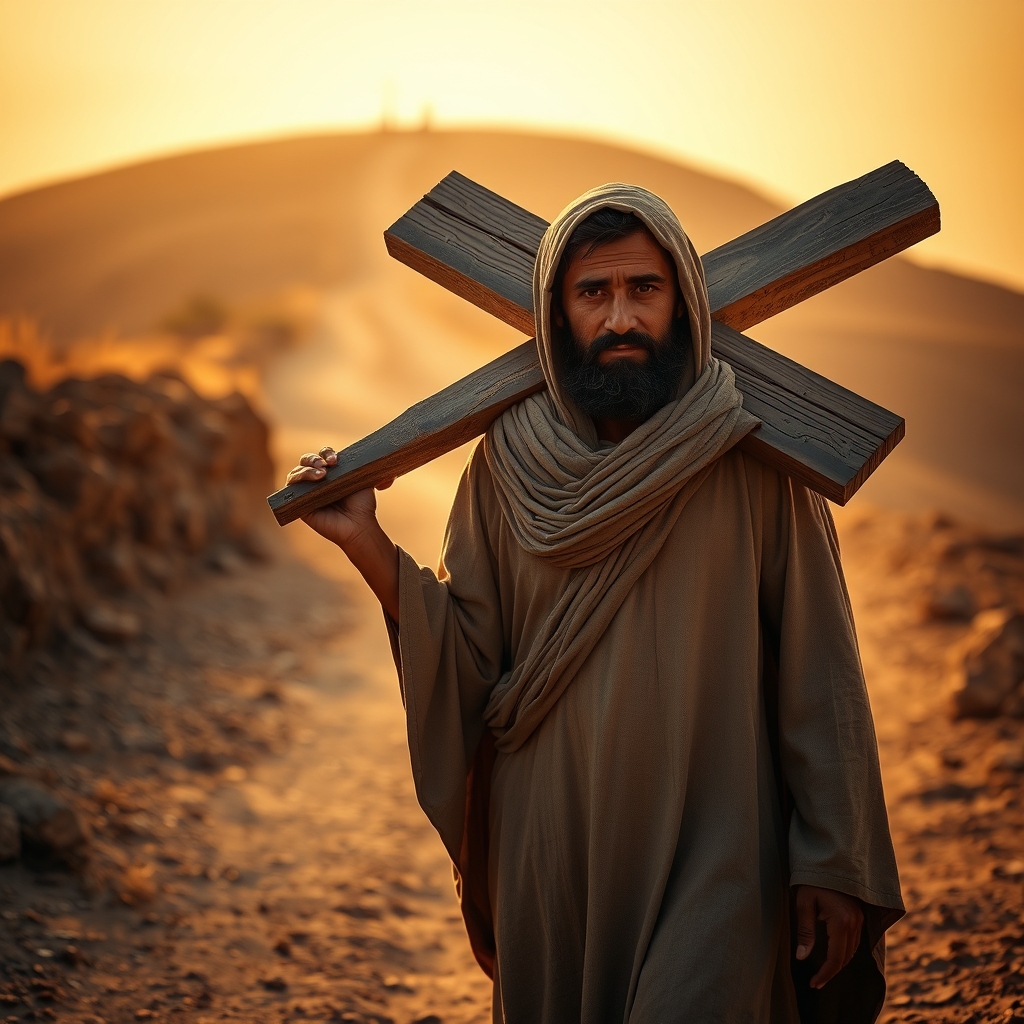
Simon’s Identity and Where He Came From
Simon of Cyrene is one of the most compelling and yet often overlooked figures in the Gospel accounts of Jesus’ crucifixion. He appears for just a moment in Scripture, but his story carries profound meaning for every believer. So, who was this man?
First, his name tells us something important. Simon was a very common Jewish name in the first century. However, his identifier—”of Cyrene”—tells us where he came from. Cyrene was a significant city located in North Africa, in what is today modern-day Libya. [1] It was home to a large Jewish population at the time of Christ. [2]
Many scholars believe Simon had traveled to Jerusalem to celebrate the Passover festival. As a Jewish man from Cyrene, he likely made the long journey to worship at the Temple. He was simply a visitor in the city. He was not one of Jesus’ disciples. In fact, he probably never expected that this particular Passover would change his life forever.
Consider what we know about him from Scripture:
- He was a visitor to Jerusalem — He came from Cyrene, a distant city in North Africa.
- He worshipped the God of Israel — His presence at Passover confirms his Jewish faith.
- He was an ordinary man — He held no special religious title or standing.
- he had no prior connection to Jesus — He was not a follower or a disciple.
In addition, the Gospel of Mark gives us a personal detail that reveals even more. Mark 15:21 tells us that Simon was “the father of Alexander and Rufus.” This small detail suggests that his sons were known to the early church. It implies they became believers and were recognized members of the Christian community. More on that later—but for now, it is enough to see that this ordinary man left an extraordinary legacy.
The Encounter on the Way to Calvary
Now, let us turn to the moment that made Simon of Cyrene unforgettable. After Jesus was condemned by Pontius Pilate, He was forced to carry His own cross to the place of execution. This site was known as Golgotha, which means “the place of the skull” in Aramaic.
However, the journey was brutal. Jesus had already endured a night of unjust trials, beatings, and the cruel scourging at the hands of Roman soldiers. The weight of the crossbeam, combined with His physical exhaustion, became too much. He fell under the crushing burden.
At this critical moment, the Roman soldiers needed someone to carry the cross. They could not let the procession stop. So, they looked into the crowd and seized the first available person. They grabbed Simon of Cyrene.
Matthew 27:32 records it simply: “As they were going out, they met a man from Cyrene, named Simon, and they forced him to carry the cross.” Mark 15:21 and Luke 23:26 echo the same account. The word “forced” here carries real weight. Simon did not volunteer. He was compelled by Roman authority—likely at the point of a spear or the threat of punishment.
Imagine Simon’s perspective in that moment. He was a pilgrim. He had come to Jerusalem to worship. Suddenly, he was caught in the middle of a brutal Roman execution. He was a bystander who became a participant in the most important event in human history.
But something remarkable happened as Simon carried that cross. What began as an act of forced duty transformed into an act of profound spiritual significance. For a brief, sacred stretch of road, Simon carried the cross behind Jesus. He walked in the footsteps of the Son of God.
Think about the symbolism here:
- Simon carried what Jesus could no longer carry — He literally bore the weight of the instrument of our salvation.
- He entered into Jesus’ suffering — Though briefly, he shared in the agony of the cross.
- He became a living illustration of discipleship — Jesus Himself said, “Whoever does not take up their cross and follow me is not worthy of me” (Matthew 10:38).
Furthermore, Simon’s encounter with Jesus on the road to Calvary was not the end of his story—it was the beginning. When a person comes face to face with the cross of Christ, true transformation follows. Scripture and early church tradition suggest that Simon’s life was forever changed that day. He went back to Cyrene, but he did not return the same man. Eventually, he became a witness—carrying the message of the cross just as he had carried the physical cross of our Lord.
What does the Bible say about Simon of Cyrene?
Simon of Cyrene in the Gospel of Matthew
The first mention of Simon of Cyrene appears in the Gospel of Matthew. He writes:
“As they were going out, they met a man from Cyrene, named Simon, and they forced him to carry the cross.” — Matthew 27:32 (NIV)
Matthew’s account is brief but powerful. He simply notes that Simon was “from Cyrene.” Furthermore, he records that Roman soldiers compelled Simon to carry the cross of Jesus. At this point in the journey, Jesus was physically weakened from the scourging and beatings He had endured. As a result, the soldiers enlisted Simon to bear the weight of the crossbeam toward Golgotha.
What stands out in Matthew’s telling is the word “forced.” The Greek word used here (angareuo) specifically denotes a conscription of labor by authority. In other words, Simon had no choice in the matter. This was not a voluntary act of devotion — at least not at first. God, however, is sovereign over even the involuntary acts of men.
Matthew’s Gospel reminds us that God is not limited by our willingness. He can use any person, in any moment, for His divine purposes. Sometimes our first encounter with Jesus begins not with a willing step, but with a forced one.
Simon of Cyrene in the Gospel of Mark
Mark provides the most detailed account of Simon among the Gospel writers. He writes:
p>
“A certain man from Cyrene, Simon, the father of Alexander and Rufus, was passing by on his way in from the country, and they forced him to carry the cross.” — Mark 15:21 (NIV)
Here, Mark adds a remarkable personal detail. He identifies Simon not only by his hometown but by his family. He names his sons, Alexander and Rufus. This is significant. Why? In a culture where family lineage was deeply important, Mark may be signaling that these were known believers in the early Christian community.
Consider this: Mark wrote his Gospel for a Roman audience. It is very likely that his readers personally knew Alexander and Rufus. This detail transforms Simon from a random bystander into a real person with a real family — a family that would go on to walk with Jesus.
Furthermore, other early Christian writings reference a Rufus mentioned in Romans 16:13. In that passage, Paul writes:
“Choose Rufus, who is chosen in the Lord, and his mother, who has been a mother to me, too.” — Romans 16:13 (NIV)
While we cannot say with absolute certainty this is the same Rufus, the connection is compelling. It suggests that Simon’s encounter with Jesus at Calvary profoundly changed his entire household. What began as an act of forced labor ended as an act of grace — not just for Simon, but for his sons as well.
Mark’s Gospel teaches us that our encounter with Jesus has a ripple effect. When we carry His cross, our families and communities feel the impact of that encounter for generations to come.
Simon of Cyrene in the Gospel of Luke
Luke’s account adds one unique and deeply spiritual detail not found in the other Gospels. He writes:
p>
“A great number of people followed him, and among them were women who were mourning and wailing. Jesus turned and said to them, ‘Daughters of Jerusalem, do not weep for me; weep for yourselves and for your children.'” — Luke 23:27–28 (NIV)
Then Luke immediately continues with the mention of Simon:
“As the soldiers led him away, they seized Simon from Cyrene, who was on his way in from the country, and put the cross on him and made him carry it behind Jesus.” — Luke 23:26 (NIV)
Notice Luke’s careful detail here. He says Simon carried the cross “behind Jesus.” This phrase is profoundly meaningful. It evokes the very words Jesus Himself spoke about discipleship:
“Whoever does not take up their cross and follow me is not worthy of me.” — Matthew 10:38 (NIV)
Luke portrays Simon walking behind Jesus, carrying the cross of the Savior. This is a picture — a living illustration — of what it means to follow Christ. Discipleship often begins in ways we do not expect. Simon did not choose to follow Jesus that day. Yet Jesus placed the cross in His hands and invited him into the most sacred journey ever walked.
Luke’s Gospel draws a beautiful parallel between forced obedience and faithful discipleship. For Simon, the two became one. He may have been compelled to carry the cross, but his encounter with the suffering Savior changed his heart forever. The cross he carried was not just wood — it was the weight of the world’s sin, borne by our Lord Jesus Christ, the Son of God, who willingly laid down His life so that we might live (John 10:18).
All three Gospel accounts together paint a powerful portrait of Simon of Cyrene. He was an ordinary man, from a distant land, who found himself stepping into the most significant moment in human history. His story is an enduring reminder that Jesus calls every person — regardless of background or circumstance — to take up their cross and follow Him in faith.
Why is Simon of Cyrene significant?
`html
A Picture of Taking Up Your Cross
Simon of Cyrene’s brief appearance in Scripture carries a profound spiritual truth. Jesus had just told His disciples, “If anyone would come after me, let him deny himself and take up his cross and follow me” (Mark 8:34). Moments later, Simon of Cyrene was literally forced to carry the cross of Jesus. In that moment, Simon became a living illustration of what it means to follow Christ.
Jesus was too weak to carry His own cross. The Roman soldiers needed someone to help. Simon was chosen. He was an ordinary man, likely a visitor in Jerusalem for the Passover. Yet God placed him in that exact place at that exact time. This was no accident. It was divine appointment.
Consider what this means for us today. Jesus calls every believer to take up their cross. He does not ask us to carry His cross—He already bore that burden alone. Instead, He invites us to follow Him in surrender, obedience, and sacrifice. Simon’s story reminds us that following Jesus is not always comfortable. It may mean stepping into someone else’s suffering. It may mean being associated with a crucified Messiah in a world that rejects Him.
Yet there is also great honor in it. Simon was given a role in the most important event in human history. He physically carried the cross of the Son of God. What an extraordinary privilege. In the same way, when we surrender our lives to Christ, we are invited into something far greater than ourselves.
Scripture tells us:
- Luke 9:23 — “If anyone would come after me, let him deny himself and take up his cross daily and follow me.”
- Galatians 2:20 — “I have been crucified with Christ. It is no longer I who live, but Christ who lives in me.”
- Romans 12:1 — “Present your bodies as a living sacrifice, holy and acceptable to God, which is your spiritual worship.”
Simon’s act was compelled. Ours should be voluntary. He was forced by Roman authority. We are invited by divine love. The cross we carry is not wood—it is the daily dying to self, the surrender of our will, and the choice to follow Jesus no matter the cost.
God Uses Unexpected People
One of the most beautiful truths in Simon of Cyrene’s story is that God often chooses the most unlikely people for His purposes. Simon was not a disciple. He was not part of Jesus’ inner circle. He was simply a man passing by. Yet God used him in a way that would be remembered for all of history.
This is a consistent theme throughout Scripture. God delights in using ordinary, unexpected people to accomplish His extraordinary plans. Consider:
- David — A young shepherd boy chosen to be king of Israel (1 Samuel 16:7).
- Ruth — A Moabite widow who became an ancestor of Jesus Christ (Ruth 1:16-17).
- Peter — A fisherman with a flawed past who became a pillar of the early church (Matthew 4:18-19).
- Paul — A persecutor of Christians who became the greatest missionary of the faith (Acts 9:1-19).
Simon of Cyrene fits perfectly into this pattern. He was not seeking Jesus. He was not looking for a divine encounter. Yet God placed him exactly where he needed to be. Sometimes God’s call comes when we least expect it. Sometimes obedience begins not with a choice, but with a moment of surrender to His sovereign plan.
Furthermore, Simon’s story shows us that no one is too far from God’s reach. He came from Cyrene, a city in North Africa, far from Jerusalem. He may have been a Jew living abroad, or perhaps a visitor drawn to the Passover feast. Either way, his origin reminds us that the Gospel is for all people, from every nation and every background.
Jesus did not come for the righteous. He came for sinners (Mark 2:17). He came for the lost, the broken, the overlooked, and the unexpected. Simon of Cyrene is proof that God sees every person. He knows every name. And He is always working, even in the moments we do not understand.
As believers, we can take great comfort in this truth. If God could use a passerby from Cyrene to carry the cross of His Son, He can use any one of us. Our past does not disqualify us. Our background does not limit Him. Our weaknesses are opportunities for His strength. As Paul wrote in 1 Corinthians 1:27, “God chose what is foolish in the world to shame the wise; God chose what is weak in the world to shame the strong.”
Simon of Cyrene’s significance is not just about one man carrying a cross. It is a picture of the Gospel itself—Jesus bearing our sin, calling us to follow, and using the most unlikely hearts to display His glory.
`
Was Simon of Cyrene black?
Cyrene and Its Historical Context
Simon of Cyrene came from the ancient city of Cyrene, located in modern-day Libya in North Africa. Cyrene was a prominent city in the ancient world, known for its Greek and Roman influences, as well as its significant Jewish population. Cyrene was home to a thriving Jewish community that had been established there for centuries.[3]
Given Cyrene’s location in North Africa, it is historically accurate to note that the population of Cyrene would have been diverse, including people of African, Greek, and Roman heritage. However, the Bible does not specifically describe Simon’s physical appearance or racial identity. Scripture focuses instead on his encounter with Jesus and what that moment reveals about God’s redemptive plan.
What we can say is this: Simon of Cyrene was a man from a distant land, likely of mixed ethnic and cultural background, who found himself at the most pivotal moment in all of human history. His story reminds us that the Gospel is not limited by geography, ethnicity, or race.
What Simon’s Origin Tells Us About the Gospel
Simon’s story powerfully illustrates the universal reach of Jesus Christ’s mission. Jesus did not come for one people group alone. He came for the whole world. Isaiah 49:6 prophetically speaks of this truth, declaring that the Servant of the Lord would be "a light for the Gentiles" so that God’s salvation might "reach to the ends of the earth."
Consider what Simon’s presence at Calvary reveals to us:
- The crosses we carry often find us when we least expect it. Simon did not plan to become part of the crucifixion narrative. Yet Jesus allowed him to share in His suffering.
- God uses people from every nation and background. A man from North Africa was chosen to carry the cross of the Jewish Messiah. This foreshadows the inclusion of all peoples in salvation.
- The Gospel transcends all human boundaries. Race, nationality, and social standing matter nothing compared to one’s encounter with Jesus.
Ultimately, Simon of Cyrene demonstrates that Christianity is not defined by skin color or ethnicity. It is defined by a personal encounter with the risen Lord. As Galatians 3:28 declares, "There is neither Jew nor Gentile, neither slave nor free, nor is there male and female, for you are all one in Christ Jesus." Whether Simon was Black, of mixed heritage, or any other background, the true significance lies in the fact that God chose him for that moment. That is what makes his story eternally relevant for every believer.
What did Jesus say to Simon of Cyrene?
The Silence of Scripture
One of the most common questions people ask about Simon of Cyrene is whether Jesus spoke to him directly. The honest answer is that the Bible does not record any words Jesus said to Simon. None of the three Gospel accounts—Matthew, Mark, or Luke—include a conversation between Jesus and Simon during the walk to Calvary.
This silence is worth pausing over. It does not mean the moment was unimportant. In fact, the absence of recorded words makes the moment even more powerful. Sometimes the most profound encounters with Jesus happen without a single spoken word.
What the Gospels Do Tell Us
Let us look at what each Gospel writer shares about this encounter:
- Matthew 27:32 states, “As they were going out, they met a man from Cyrene, named Simon, and they forced him to carry the cross.” [4]
- Mark 15:21 adds that Simon was “the father of Alexander and Rufus,” giving us a personal detail that suggests his family was known in the early church. [5]
- Luke 23:26 says, “As they led him away, they seized Simon from Cyrene, who was on his way in from the country, and put the cross on him and made him carry it behind Jesus.” [6]
Notice the details Luke provides. Simon was coming in from the countryside. He was likely a visitor in Jerusalem, perhaps there for the Passover. He had no idea that this day would change his life forever. Furthermore, Luke tells us Simon carried the cross “behind Jesus.” This small detail is deeply significant. It places Simon in the position of a follower.
Jesus Spoke Without Words
Even though Scripture does not record Jesus speaking to Simon, the entire scene speaks volumes. Consider what was happening. Jesus had been beaten, scourged, and was physically collapsing under the weight of the cross. He was on His way to die for the sins of the world—including Simon’s sins.
In a very real sense, everything Jesus was doing at that moment was for Simon. The cross Simon carried was the instrument of his own salvation. Jesus did not need to say a word. His suffering was the message. His love was on full display.
There is also something beautiful in the fact that Simon was compelled to help. He did not volunteer. The Roman soldiers forced him. Yet this moment of involuntary obedience became the doorway to something far greater. As we will see in later sections, Simon’s family became known in the early church. It is very likely that this encounter with Jesus transformed Simon’s heart.
What Jesus Says to Us Through Simon’s Story
While Jesus may not have spoken directly to Simon of Cyrene, He speaks to all of us through this account. His message is clear:
- Following Jesus means carrying a cross. In Luke 9:23, Jesus said, “Whoever wants to be my disciple must deny themselves and take up their cross daily and follow me.” Simon’s story is the living illustration of this truth. [7]
- Jesus meets us in unexpected moments. Simon was not looking for Jesus. He was simply going about his day. Yet God had a divine appointment planned for him. In the same way, Jesus often enters our lives when we least expect it.
- No act of service to Jesus goes unnoticed. Even carrying His cross for a short distance was recorded in Scripture for all eternity. Every act of obedience matters to our Lord.
Simon of Cyrene’s encounter with Jesus reminds us that we do not always need to hear His voice to experience His presence. Sometimes, simply being near the cross is enough to change everything. The question for each of us is the same: when Jesus calls us to carry our cross, will we follow Him?
What happened to Simon of Cyrene after the crucifixion?
The Bible does not explicitly record what happened to Simon of Cyrene after he carried the cross of Jesus to Calvary. However, Scripture offers meaningful clues, and early Church history provides fascinating suggestions that shed light on Simon’s life after that pivotal day. His story did not end on the road to Golgotha. In fact, there is strong reason to believe that Simon encountered the living Christ and became a follower of Jesus.
Clopas and Alexander—Simon’s Family
In the Gospel of Mark, we find a subtle but significant detail. Mark 15:21 describes Simon of Cyrene as “the father of Alexander and Rufus.” This is the only Gospel that includes this specific reference. Why would Mark mention Simon’s sons by name? The answer likely lies in the original audience of Mark’s Gospel.
- Alexander and Rufus were apparently known members of the early Christian community.
- By naming them, Mark was essentially saying, “You may know the sons of the man who carried Jesus’ cross—even if you don’t know Simon himself.”
Furthermore, in Romans 16:13, Paul writes: “Greet Rufus, chosen in the Lord, and his mother, who has been a mother to me, too.” Many scholars believe this Rufus is the same son of Simon of Cyrene. [8] If so, Simon’s entire family became devoted believers in Jesus Christ.
Mark’s Meaningful Reference to His Sons
Mark’s decision to name Alexander and Rufus is not accidental. Consider what this tells us:
- The early church would have recognized these names immediately.
- Rufus being called “chosen in the Lord” indicates he was a respected believer in the Roman church.
- The mention of his mother being like a mother to Paul suggests a close, familial bond with the apostle.
- This shows that Simon’s family was deeply woven into the fabric of the early Christian movement.
As a result, the man who was compelled to carry Jesus’ cross likely went home transformed. His encounter with Christ on the way to Golgotha was not merely physical—it was deeply spiritual. Furthermore, his sons rising to prominence in the early church points to a lasting impact.
What Scripture and Early Church History Suggest
While the Bible does not give us a detailed biography of Simon of Cyrene after the crucifixion, the pieces we have point in a clear direction. Scripture tells us that witnessing Christ’s sacrifice had a profound effect on the people present. Mark 15:39 records the Roman centurion’s declaration: “Surely this man was the Son of God!” If a hardened Roman soldier was moved, how much more would Simon, who walked side by side with Jesus in His darkest hour, have been transformed?
Early Church tradition also supports the idea that Simon became a believer and a leader:
- Irenaeus of Lyon, writing in the late second century, identified Simon of Cyrene with a certain Simon mentioned in early Christian teaching. [9]
- The consistent tradition across the early church is that Simon and his family embraced the Gospel of Jesus Christ.
In addition, early interpretations often linked Simon’s story with the words of Jesus in Matthew 16:24: “Whoever wants to be my disciple must deny themselves and take up their cross and follow me.” Simon took up the physical cross. There is every reason to believe he also took up the spiritual call.
As we reflect on Simon’s story, we see the beautiful truth of God’s grace reaching unexpected places and people. A foreigner from North Africa, passing through Jerusalem, was thrust into the most important event in all of history. From that day forward, Simon of Cyrene and his family were never the same. Scripture may be silent on the details, but the legacy of his sons in the early church speaks volumes. Simon’s encounter with Jesus began with a forced burden—carrying a cross—but it ended with an eternal reward.
How did Simon of Cyrene die?
The Silence of Scripture on Simon’s Death
When it comes to the question of how Simon of Cyrene died, the honest answer is that we simply do not know. The Bible is entirely silent on the matter. Scripture records nothing about Simon’s death, nor does it provide details about the later years of his life beyond a brief but meaningful reference in the Gospel of Mark.
This silence can feel unsatisfying to us. We naturally want to know the full story. However, the Bible is not a comprehensive biography of every person who encountered Jesus. Instead, it is the inspired Word of God, carefully focused on revealing the person and work of Jesus Christ. Every detail included in Scripture serves that greater purpose.
Simon’s role in the biblical narrative is profoundly important, even if it is brief. He was the man compelled to carry the cross of Jesus on the way to Calvary. That single act placed him in the pages of eternal Scripture. His story reminds us that God uses ordinary people in extraordinary moments for His divine purposes.
What Church Tradition Suggests
Beyond the Bible, early church tradition offers a few possibilities regarding Simon’s later life. However, it is important to note that these traditions are not Scripture. They are historical reflections that may or may not be accurate.
Some early Christian writings suggest that Simon became a follower of Jesus after the crucifixion and resurrection. This is a reasonable assumption. After all, Simon witnessed the most significant event in human history. He stood near the cross of the Son of God. It would be remarkable if such an encounter did not transform his heart.
There are also traditions that link Simon to the early church in North Africa or to missionary work spreading the Gospel. Some accounts even suggest he may have died as a martyr for his faith in Christ. While these traditions are meaningful, they remain unverified. We must hold them loosely and anchor ourselves only to what Scripture clearly teaches.
What We Can Know with Confidence
Even though we do not know how Simon of Cyrene died, we can know with certainty what his life meant. His encounter with Jesus on the road to Golgotha was not an accident. God, in His sovereign plan, placed Simon in that exact place at that exact moment.
Consider what we do know from Scripture:
- Simon was from Cyrene, a city in North Africa, which tells us the Gospel was already reaching beyond the borders of Israel even before the crucifixion.
- He was compelled to carry the cross (Matthew 27:32), showing that God sometimes calls us through circumstances we did not choose.
- Mark identifies his sons, Alexander and Rufus (Mark 15:21), suggesting that Simon’s family was known and recognized in the early Christian community.
- Paul mentions a Rufus in Romans 16:13, whom he calls “chosen in the Lord.” Many scholars believe this is the same Rufus, Simon’s son, which would mean Simon’s household became devoted followers of Jesus Christ.
These details paint a beautiful picture. Simon may have come to Jerusalem as a visitor, perhaps for the Passover. He had no idea that God would use him in such a pivotal way. Yet his brief moment of obedience became an eternal testimony to the power of the cross.
The Greater Truth of Simon’s Story
Ultimately, the question of how Simon died matters far less than the question of how he lived after meeting Jesus. The Bible’s silence on his death is not a gap in the story. It is an invitation for us to focus on what truly matters.
Simon’s story teaches us that every encounter with Jesus has the power to change a life forever. Whether Simon lived many more years or died soon after, his legacy is secure. He carried the cross of the Savior of the world. And through the testimony of his sons, his family became part of the early church that turned the world upside down for the glory of God.
As followers of Christ, we do not need to know every detail of Simon’s life to learn from his example. We simply need to respond to Jesus the way Simon did. When God calls us to carry a cross, whether literal or spiritual, we must obey. As Jesus Himself said, “If anyone would come after me, let him deny himself and take up his cross and follow me” (Matthew 16:24).
Simon of Cyrene reminds us that no act of obedience to Jesus is ever wasted. Even the smallest moment of faithfulness is recorded in heaven and woven into God’s eternal plan. And that is a truth worth holding onto, no matter what we do not know.
Is Simon of Cyrene a saint?
The Biblical View of Sainthood for All Believers
Many people wonder whether Simon of Cyrene is considered a saint. This is a wonderful question. However, the Bible offers a perspective that may surprise you. Scripture does not reserve the title of “saint” for only a select few. Instead, the New Testament teaches that every true follower of Jesus Christ is a saint.
The word “saint” comes from the Greek word hagios, which means “holy one” or “set apart one.” In his letters, the Apostle Paul addressed entire churches as saints. He wrote to the believers in Corinth, “To the church of God which is at Corinth, to those who are sanctified in Christ Jesus, called to be saints” (1 Corinthians 1:2, NKJV). Furthermore, Paul used the same language for believers in Ephesus, Rome, and Philippi. This means that sainthood is not earned through extraordinary deeds. It is a gift given to all who place their faith in Jesus Christ.
Consider what this means for Simon of Cyrene. Scripture does not tell us that Simon performed miracles. It does not record any sermons he preached. Yet his encounter with Jesus on the road to Calvary was real and transformative. Simon physically carried the cross of the Son of God. As a result, his life was forever changed by that single, sacred moment.
The Bible makes it clear that sainthood is rooted in relationship with Christ, not in human achievement. Paul wrote, “For by grace you have been saved through faith, and that not of yourselves; it is the gift of God” (Ephesians 2:8, NKJV). Therefore, anyone who has received God’s grace through faith in Jesus is a saint in the biblical sense.
So is Simon of Cyrene a saint? If Simon came to faith in Jesus, either during or after that walk to Golgotha, then the answer is yes. He stands among the great cloud of witnesses described in Hebrews 12. More importantly, his story reminds us that sainthood is available to every single person who turns to Christ.
Simon’s story is ultimately not about earning a title. It is about encountering Jesus. When we meet Christ, everything changes. We are set apart. We become His. And that is the true meaning of sainthood.
Simon of Cyrene and a Life of Following Jesus

From Compelled Obedience to Voluntary Discipleship
The story of Simon of Cyrene begins with an unexpected interruption. He was likely traveling to Jerusalem for the feast of Passover. Then, suddenly, Roman soldiers seized him and placed a heavy burden on his shoulders. Scripture tells us plainly that Simon was “compelled” to carry the cross of Jesus (Matthew 27:32). At that moment, he had no choice in the matter.
However, what began as forced obedience may have transformed into something far more meaningful. There is a beautiful journey hidden in this brief encounter. It is the journey from duty to devotion, from obligation to surrender. Furthermore, it mirrors the very heart of what it means to follow Jesus Christ.
Today, every believer understands this similar journey. We may first come to Christ out of a sense of need or even desperation. Perhaps we recognize our sin and our inability to save ourselves. As we continue walking with Him, however, everything changes. Our hearts begin to burn with love for the Savior who gave everything for us.
Consider the transformation that may have taken place in Simon’s heart as he walked that dusty road:
- First, he saw the suffering of Jesus up close. Simon walked behind our Lord and witnessed the wounds, the blood, and the weight of the cross. This was not a distant theological idea. This was the Son of God pouring out His life for the sins of the world.
- Second, he shared in Christ’s humiliation. Carrying a criminal’s cross meant shame and scorn. Yet Jesus Himself said, “Whoever does not take up their cross and follow me is not worthy of me” (Matthew 10:38). Simon did not choose this assignment, but God used it to draw him closer to His Son.
- Third, his heart was opened to the gospel. We do not know exactly what Simon believed in that moment. Nevertheless, the fact that Mark names his sons, Alexander and Rufus, suggests his family became known in the early church. Something profound likely happened in Simon’s heart on that road to Calvary.
This is the beauty of God’s grace. He meets us right where we are, even in moments we did not plan. Simon did not set out that morning to meet Jesus. Yet God had a divine appointment waiting for him. In the same way, God is working in your life right now, even when you least expect it.
Furthermore, Simon’s journey reminds us that true discipleship is never forced. It grows out of a heart that has encountered the love of Christ. When we truly see what Jesus did for us, our obedience flows from gratitude, not guilt. As the Apostle Paul wrote, “For Christ’s love compels us, because we are convinced that one died for all” (2 Corinthians 5:14).
What Simon’s Story Means for Us Today
The account of Simon of Cyrene is far more than a historical footnote. It is a living picture of what it means to be a follower of Jesus Christ. Every believer can find deep encouragement and challenge in this powerful story.
God uses unexpected moments to draw us to Himself. Simon did not volunteer. He was compelled. Yet that single moment changed the course of his life and his family’s legacy forever. Therefore, never underestimate what God can do with your life when you are willing to follow His Son.
Carrying the cross is not optional for the follower of Christ. Jesus was unmistakable when He said, “Whoever wants to be my disciple must deny themselves and take up their cross and follow me” (Matthew 16:24). This does not mean we seek suffering for its own sake. Rather, it means we surrender our own ambitions, comfort, and plans to the lordship of Jesus.
Every act of obedience, no matter how small, matters to God. Carrying that cross for a few steps may have felt insignificant to Simon. Yet scripture preserves his name and his act of service for all eternity. God sees every step of faith you take, and He never forgets it.
Your encounter with Jesus can transform your entire family. Mark’s reference to Simon’s sons suggests that Simon’s experience led his household to faith. God’s grace reaches beyond the individual. It ripples out to touch loved ones, future generations, and the world around us.
So today, consider what it means to follow Jesus wholeheartedly. Perhaps you are in a season of compelled circumstances, carrying a burden you did not choose. Take heart, because God is at work in your life. He can take even the heaviest moments and turn them into testimonies of His faithfulness.
Furthermore, maybe you have been a believer for many years. Simon’s story challenges you to move beyond routine obedience into passionate, joyful surrender. Following Jesus is never about simply going through the motions. It is about daily choosing to walk in step with the Savior who first loved you.
Finally, never forget the heart of this story. Jesus carried that cross for you. He endured the shame, the pain, and the ultimate sacrifice so that you could be forgiven, redeemed, and made new. As scripture declares, “But God demonstrates his own love for us in this: While we were still sinners, Christ died for us” (Romans 5:8).
Today, take up your cross and follow Him. The journey may be costly, but it is filled with His presence, His purpose, and His unfailing love every single step of the way.
Frequently Asked Questions
What happened to Simon from Cyrene?
Simon of Cyrene was a man who was passing by on the road to Jerusalem. As Jesus carried His cross toward Calvary, the Roman soldiers compelled Simon to carry it behind Jesus (Mark 15:21). This was not a random act. God used this moment to show that following Jesus means taking up our cross and walking in His footsteps. After this encounter, Scripture tells us that Simon had two sons, Alexander and Rufus, who became known in the early church (Mark 15:21). This suggests that Simon’s life was forever changed by meeting Jesus, even if only for a brief moment on the road to the cross.
What happened to Simon of Cyrene after the crucifixion?
The Bible does not give us a detailed account of Simon’s life after the crucifixion. However, there are strong clues that he became a follower of Jesus. Mark specifically mentions his sons, Alexander and Rufus, by name. This is significant because Mark’s original readers apparently knew who they were. In Romans 16:13, Paul mentions a Rufus who was “chosen in the Lord.” Many Bible scholars believe this could be Simon’s son. If so, it means Simon’s entire family came to faith in Christ. What began as forced obedience likely became a life of voluntary discipleship.
Early church tradition also supports this view. Some historical accounts suggest Simon became a believer and possibly a leader in the early church. While we cannot confirm every detail, the evidence points to a man whose encounter with Jesus on the road to Calvary transformed his life and his family forever.
Simon of Cyrene Bible Verse
Simon of Cyrene is mentioned in all three Synoptic Gospels. Here are the key passages:
- Matthew 27:32 — “As they were going out, they met a man from Cyrene, named Simon, and they forced him to carry the cross.”
- Mark 15:21 — “A certain man from Cyrene, Simon, the father of Alexander and Rufus, was passing by on his way in from the country, and they forced him to carry the cross.”
- Luke 23:26 — “As they led Him away, they seized Simon from Cyrene, who was on his way in from the country, and put the cross on him and made him carry it behind Jesus.”
Each account highlights a different detail. Mark gives us the most personal information by naming Simon’s sons. Luke emphasizes that Simon carried the cross behind Jesus, which paints a beautiful picture of discipleship. Matthew focuses on the historical fact of the event. Together, these verses give us a rich and complete picture of Simon’s role in the crucifixion narrative.
Simon of Cyrene was crucified
This is a common misunderstanding. Simon of Cyrene was not crucified. He was the man who was compelled to carry the cross of Jesus. Jesus Christ was the one who was crucified at Calvary. The Roman soldiers forced Simon to carry the crossbeam because Jesus, weakened from scourging and suffering, had fallen under its weight (Luke 23:26).
It is important to understand this distinction clearly. Jesus died on the cross for our sins. He is the only Savior, the only one whose death brings eternal life. As Scripture declares, “For God so loved the world that He gave His one and only Son, that whoever believes in Him shall not perish but have eternal life” (John 3:16). Simon’s role was to carry the cross. Jesus’ role was to die on it and rise again, conquering sin and death for all who believe.
Sources
- https://www.britannica.com/place/Cyrene
- https://www.jewishvirtuallibrary.org/cyrene
- https://www.britannica.com/place/Cyrenaica
- https://www.biblegateway.com/passage/?search=Matthew+27:32&version=NIV
- https://www.biblegateway.com/passage/?search=Mark+15:21&version=NIV
- https://www.biblegateway.com/passage/?search=Luke+23:26&version=NIV
- https://www.biblegateway.com/passage/?search=Luke+9:23&version=NIV
- https://www.biblegateway.com
- https://www.newadvent.org