
Lazarus in the Bible was a beloved friend of Jesus and the brother of Mary and Martha of Bethany, best known for being raised from the dead by Jesus after four days in the tomb, as recorded in John 11. This powerful miracle demonstrated Jesus’ divine authority over death and served as a foreshadowing of His own resurrection, affirming that He is the Son of God and the source of eternal life for all who believe.
Few moments in Scripture move the heart like the account of Lazarus in the Bible. Here is a man Jesus personally called a dear friend—a brother deeply loved alongside his sisters Mary and Martha. When the news reached Jesus that Lazarus was seriously ill, the Savior did something astonishing: He waited. By the time He arrived in Bethany, Lazarus had been dead for four days, wrapped in grave clothes, sealed in a tomb. And then, standing before that stone slab covering the body of His beloved friend, the Son of God wept. It is the shortest and one of the most powerful verses in the entire Bible—”Jesus wept” (John 11:35)—and it reveals something stunning about the character of our Lord: even as He knew He was about to call Lazarus back to life, He still grieved with those who grieved. In that moment, Jesus showed the world that God is not distant or untouched by human sorrow. He enters into our pain, feels our loss, and then brings glory out of the ashes of our deepest grief.
In this article, we will walk through the full story of Lazarus as recorded in the Gospel of John—from his illness and the four days he spent in the tomb, to the miraculous moment Jesus called him back into the light of day. We will explore the meaning behind Jesus’ tears, why He delayed His visit, what this miracle reveals about who Christ truly is, and the hope this story offers to anyone carrying sorrow today. Whether you are a new believer seeking to understand the deeper truths of Scripture or a mature Christian longing for renewed encouragement, the account of Lazarus has something profoundly personal to say to you. This story is not just ancient history; it is living truth. It is a preview of the resurrection power available to all who place their faith in Jesus Christ—the same power that conquered the grave and offers eternal life to everyone who believes.
Who Was Lazarus in the Bible?
When we encounter the name Lazarus in the Bible, we meet one of the most remarkable figures in all of Scripture. His story stands as a powerful testament to the authority of Jesus Christ over death itself. Furthermore, the account of Lazarus reveals the deep, personal love that Jesus has for those who trust in Him.
Lazarus of Bethany: Brother of Mary and Martha
The most well-known Lazarus in Scripture is Lazarus of Bethany. He was the beloved brother of Mary and Martha. This family lived in the small village of Bethany, just outside Jerusalem. The Gospel of John tells us that Jesus loved this family deeply (John 11:5).
Lazarus was not a disciple who traveled with Jesus during His ministry. He was not a Pharisee or a religious leader. Instead, he was an ordinary man. Yet God chose him for an extraordinary purpose. Through Lazarus’s illness, death, and resurrection, the glory of God was revealed to the world.
Here are the key facts about Lazarus of Bethany:
- His home: Bethany, a village near Jerusalem (John 11:1)
- His family: Brother of Mary and Martha (John 11:1–2)
- His significance: The man Jesus raised from the dead after four days (John 11:43–44)
- His legacy: A living witness to the power of Jesus Christ over death
The story of Lazarus is recorded in John chapter 11. It is one of the most moving and faith-building accounts in the entire Bible. In this passage, we see Jesus display both His humanity and His divinity. He weeps with those who mourn. Then He calls a dead man back to life with a single command.
Mary, Martha, and Lazarus shared a close friendship with Jesus. In Luke 10:38–42, we read about a visit to their home. Martha was busy serving while Mary sat at Jesus’ feet. This family opened their home to the Savior. They knew Him not just as a teacher, but as a dear friend.
When Lazarus fell gravely ill, his sisters sent word to Jesus. Their message was simple yet full of faith: “Lord, the one you love is sick” (John 11:3). They did not demand that Jesus come. They simply trusted that He would respond. This is a beautiful picture of how we should bring our needs before the Lord.
The Two Different Lazarus Figures in Scripture
Many readers are surprised to learn that there are two different Lazarus figures in the Bible. It is important to understand the difference between them. Confusing the two can lead to misunderstandings about Scripture.
The first Lazarus is Lazarus of Bethany, the brother of Mary and Martha. His story is a historical event recorded in the Gospel of John. Jesus physically raised this man from the dead. Many witnesses saw Lazarus alive after his resurrection. As a result, many people believed in Jesus (John 11:45).
The second Lazarus appears in Luke 16:19–31. In this passage, Jesus tells a parable about a rich man and a poor beggar named Lazarus. This Lazarus is not the same person as Lazarus of Bethany. He is a character in a story that Jesus used to teach an important spiritual lesson.
Here is a clear comparison of the two Lazarus figures:
| Lazarus of Bethary (John 11) | Lazarus in the Parable (Luke 16) | |
|---|---|---|
| Type of Account | Historical event | Parable (a teaching story) |
| Family | Brother of Mary and Martha | No family mentioned |
| Role in the Story | Raised from the dead by Jesus | A poor beggar who died and was carried to Abraham’s side |
| Purpose | To reveal Jesus’ power over death | To teach about the eternal consequences of how we live |
Understanding this distinction is essential for correctly interpreting Scripture. The Lazarus death account in John 11 is a real event that points to Jesus’ divine authority. The parable in Luke 16 is a spiritual teaching about the afterlife and the importance of heeding God’s Word.
Some have wondered whether the parable in Luke 16 refers to the actual Lazarus of Bethany. However, the context makes it clear that Jesus was telling a story to make a point. The rich man begged Abraham to send Lazarus to warn his brothers. Abraham replied, “They have Moses and the Prophets; let them listen to them” (Luke 16:29). This teaching emphasizes that God’s Word is sufficient. We do not need miraculous signs to believe.
Both accounts, though different in nature, point us to the same truth. Jesus Christ is Lord over life and death. He is the source of all hope. Whether we read the historical account of Lazarus being raised or the parable of the rich man and Lazarus, we are reminded that our eternal destiny rests in the hands of Jesus alone.
The Lazarus Bible verse that captures the heart of this entire story is found in John 11:25–26. Jesus declared: “I am the resurrection and the life. The one who believes in me will live, even though they die; and whoever lives by believing in me will never die.” This promise is for every person who places their faith in Christ. It is the foundation of our hope, both now and for eternity.
What Is the Story of Lazarus in the Bible?
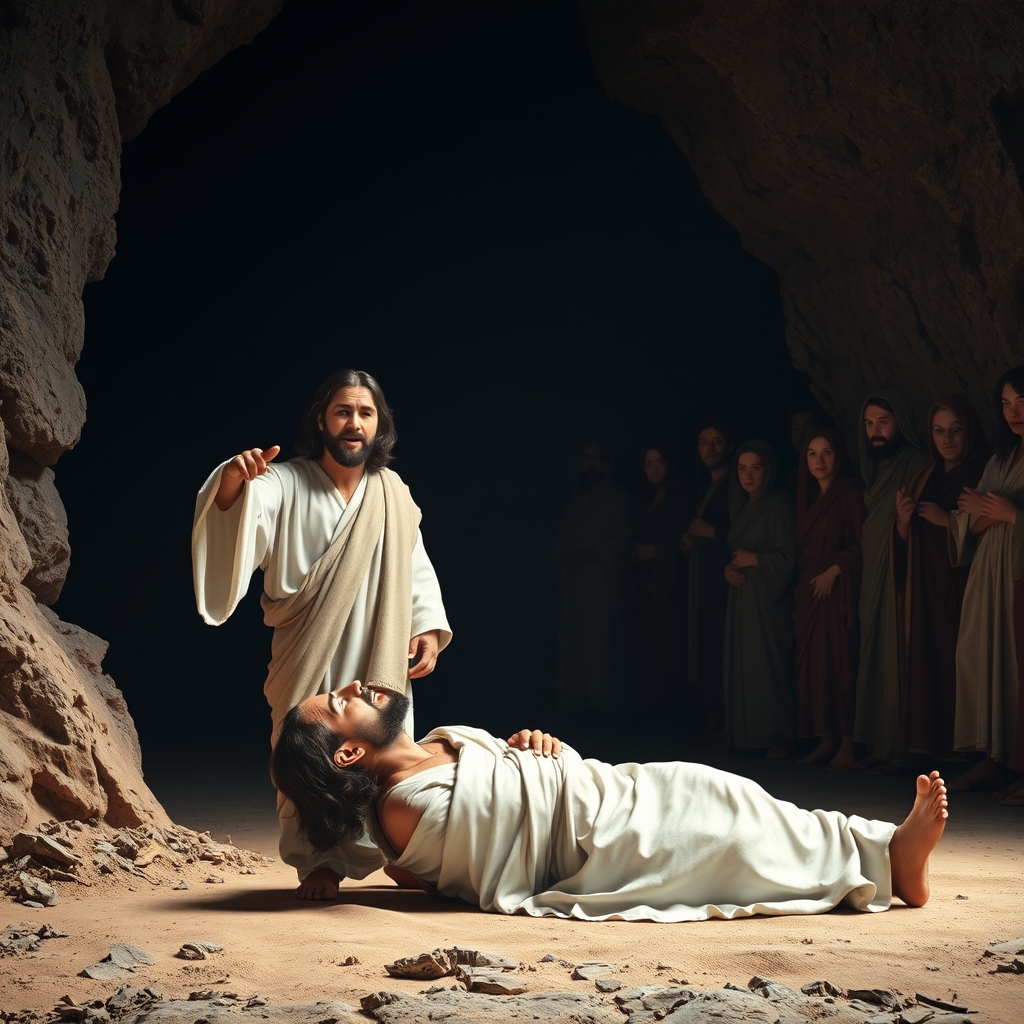
Lazarus Falls Ill and Dies (John 11:1–16)
The story of Lazarus in the Bible begins with devastating news. Lazarus, a resident of Bethany, became very sick. This was no ordinary illness. Mary and Martha, his two sisters, knew they needed to act quickly. They sent a message to Jesus with desperate urgency. The message was simple: "Lord, the one you love is sick" (John 11:3, NIV).
This detail matters deeply. The sisters didn’t describe Lazarus’s symptoms. They didn’t list treatments they had tried. Instead, they appealed to the heart of Jesus. They knew of His love for Lazarus. That faith in His love was the foundation of their plea.
When Jesus received the news, He made a remarkable statement. He said this sickness would not end in death. Instead, it was for the glory of God, so that the Son of God might be glorified through it (John 11:4). Even in tragedy, Jesus pointed to God’s greater purpose.
Jesus Delays His Journey (John 11:6)
Here is where the story takes an unexpected turn. After hearing that Lazarus was ill, Jesus stayed where He was for two more days (John 11:6). This delay puzzles many readers. The One who loved Lazarus chose not to come immediately.
Why would Jesus wait? The answer reveals a profound truth. Jesus operated on God’s timetable, not on human urgency. He explained to His disciples plainly: "Lazarus is dead. And for your sake I am glad I was not there, so that you may believe" (John 11:14–15, NIV). The delay wasn’t neglect. By waiting, Jesus was creating an even greater demonstration of God’s power.
When Jesus finally set out for Bethany, the disciples were afraid. Judea was dangerous. Jewish leaders had recently tried to stone Him. Yet Jesus pressed forward. He told them with tender reassurance, "Our friend Lazarus has fallen asleep; but I am going there to wake him up" (John 11:11).
The disciples misunderstood, thinking literal sleep. Jesus then spoke plainly: "Lazarus is dead." This moment teaches us that Jesus sees beyond what we can see. What looked like a terrible delay was actually divine timing at work.
Jesus Weeps at the Tomb (John 11:35)
By the time Jesus arrived at Bethany, Lazarus had already been in the tomb for four days (John 11:17). Martha heard that Jesus was coming and went out to meet Him. She poured out her grief with honest faith: "Lord, if you had been here, my brother would not have died" (John 11:21, NIV).
Jesus responded with one of the most powerful declarations in all of Scripture: "I am the resurrection and the life. The one who believes in me will live, even though they die" (John 11:25, NIV). Martha affirmed her belief in Him as the Messiah, the Son of God.
Then Jesus approached the tomb—a cave with a stone laid across it. The grief of those around Him was overwhelming. Friends and family were weeping. Mary fell at His feet, repeating the same words as her sister.
What happened next is震撼ing. Jesus wept (John 11:35). This is the shortest verse in the Bible. Yet its meaning is immeasurably deep. The Creator of the universe stood before death and wept. He who would conquer the grave in moments still felt the full weight of human suffering.
His tears revealed His true humanity and His boundless compassion. Jesus is not distant from our pain. He enters into it.
Some observers said, "See how he loved him!" (John 11:36). Others questioned if He could have prevented Lazarus’s death. The cries of doubt and love mingled together. Yet Jesus, deeply moved, moved toward the tomb with divine purpose.
The Raising of Lazarus (John 11:38–44)
What happened next stands as one of the most powerful miracles recorded anywhere in the Bible. Jesus approached Lazarus’s tomb and commanded, "Take away the stone" (John 11:39, NIV).
Martha immediately objected. Her brother had been dead for four days. The body would have already begun to decay. Her objection was understandable, yet it revealed a limited view of what God could do.
Jesus gently corrected her with a vital reminder: "Did I not tell you that if you believe, you will see the glory of God?" (John 11:40, NIV). Belief is the doorway through which God’s glory floods in.
After the stone was removed, Jesus looked heavenward. He prayed aloud so the crowd would know the miracle came from God the Father. Then He called out with a loud voice: "Lazarus, come out!" (John 11:43, NIV).
The impossible happened. A man who had been dead for four days walked out of the tomb. He was still wrapped in grave clothes. Jesus then told the onlookers, "Take off the grave clothes and let him go" (John 11:44, NIV).
This miracle revealed several extraordinary truths:
- Jesus has absolute authority over death — He is not merely a who heals the sick but the Lord over life and death itself.
- Four days of death were no obstacle — Jewish tradition believed the soul lingered near the body for three days. After that, true death was considered irreversible. Jesus waited four days to remove all doubt.
- This miracle pointed directly to the cross and resurrection — Jesus, who would soon lay down His own life and rise again, demonstrated His divine power in advance.
- Many believed because of this sign — John 11:45 records that many of the Jews who had come to visit Mary saw what Jesus did and believed in Him.
The raising of Lazarus from the dead remains one of the most powerful stories in the Bible. It is not just a tale of a miracle. It is a declaration that Jesus Christ is Lord over all things — including death itself. As we continue exploring the story of this remarkable man and the profound truths hidden within his life and death, we begin to uncover lessons that can transform our faith and offer steadfast hope in our darkest seasons.
Why Was Lazarus So Special to Jesus?
A Deep, Personal Friendship
The bond between Jesus and Lazarus was not casual. It was a deep, genuine friendship rooted in love and trust. Scripture makes this clear. When Lazarus fell ill, his sisters sent word to Jesus saying, “Lord, the one you love is sick” (John 11:3, NIV). Notice they did not say “the one you know” or “the one who follows you.” They said “the one you love.” This speaks volumes about the closeness of their relationship.
Jesus did not merely know Lazarus as one of many followers. He walked with him, shared meals with him, and called him friend. In John 11:3, the Greek word used for “love” is phileō, which conveys tender affection and deep personal care. This was a relationship built on authenticity and mutual devotion. Jesus valued Lazarus not for what he could offer, but simply for who he was.
For us, this is a beautiful reminder. Jesus desires real friendship with each of us. He does not keep His followers at a distance. Instead, He invites us into intimate relationship. As Jesus said in John 15:15, “I no longer call you servants… Instead, I have called you friends.” The story of Lazarus in the Bible shows us that God’s love is not distant or detached. It is personal, warm, and deeply relational.
- Jesus and Lazarus shared a bond of genuine friendship, not mere acquaintance.
- The sisters’ message revealed the depth of this love to those around them.
- Jesus desires the same close friendship with every person who follows Him.
Jesus’ Love for the Family of Mary, Martha, and Lazarus
The love Jesus had for Lazarus was part of a broader love for his entire family. Mary, Martha, and Lazarus were a close-knit household in Bethany. Scripture tells us that Jesus “loved Martha and her sister and Lazarus” (John 11:5, NIV). This verse is remarkable. It explicitly states Jesus’ love for all three siblings, not just Lazarus alone.
This family was one of the few places where Jesus could find rest, hospitality, and healing fellowship during His earthly ministry. Mary sat at His feet to listen to His teaching (Luke 10:39). Martha worked hard to serve and welcome Him. Lazarus opened his home and his heart. Together, they created space in the midst of Jesus’ demanding ministry for the Lord to simply be Himself among friends.
Consider the beauty of this truth. Jesus, the Son of God who holds all things together (Colossians 1:17), chose to invest deeply in an ordinary family. He did not reserve His love for religious leaders or public figures. He poured it out on a simple household in a small village. This tells us something profound about the heart of our Savior.
Furthermore, the family’s home in Bethany served as a retreat for Jesus, especially in the final weeks before His crucifixion. John 11:55–12:1 indicates that Jesus returned to the area of Bethany, just outside Jerusalem, where Lazarus lived. The comfort and acceptance Jesus found in this home were part of why this family was so special to Him.
The love Jesus showed to this family also carried eternal significance. When Lazarus died, Jesus wept (John 11:35). He entered into the grief of Martha, Mary, and all who mourned. He did not dismiss their sorrow or tell them to simply have faith. He stood with them in their pain, and then He conquered death itself to raise Lazarus from the tomb.
As a result, the story of Lazarus’ death and resurrection became one of the most powerful demonstrations of Jesus’ compassion and divine authority in all of Scripture. The raising of Lazarus was not merely a miracle of power. It was an act of love. It previewed Jesus’ own death and resurrection. It also served as undeniable proof that Jesus holds authority over life and death, foreshadowing the victory He would win for all of us at the cross and the empty tomb.
For every believer today, the lesson is clear. Jesus loves with a personal, sacrificial, and lasting love. The same Jesus who wept at the tomb of His friend stands ready to walk with you through every valley, every loss, and every trial. The story of Lazarus in the Bible ultimately points us to the very heart of God, a heart that breaks with our pain and triumphs over our deepest fears through the power of His eternal love.
Why Did Jesus Say Lazarus Died?
For the Glory of God (John 11:4)
When Jesus first heard that Lazarus was sick, He made a remarkable statement. He said, “This sickness will not end in death. No, it is for God’s glory so that God’s Son may be glorified through it” (John 11:4, NIV). This answer may have confused His disciples at the time. How could death serve God’s glory? Yet Jesus knew something they did not. The story of Lazarus would become one of the most powerful demonstrations of divine authority in all of Scripture.
Jesus did not rush to heal His friend. Instead, He stayed where He was for two more days (John 11:6). This delay was not neglect. It was intentional. God’s plan was unfolding according to His perfect timing. Sometimes we wonder why Jesus allows suffering. However, His purposes are always greater than our understanding. The glory of God was about to be revealed in a way no one expected.
Furthermore, this event was not just about one man’s illness. It was a sign pointing to something far greater. Every miracle Jesus performed revealed His identity. The raising of Lazarus would become a direct preview of His own resurrection. In addition, it would strengthen the faith of His followers for generations to come.
So That the Son of God May Be Glorified
Jesus explicitly stated that Lazarus’ death would bring glory to the Son of God. But what does this mean for us today? It means that even in our darkest moments, God is working. Even when we cannot see the outcome, He is moving behind the scenes. The story of Lazarus teaches us that God’s delays are not God’s denials.
Consider the scene at the tomb. By the time Jesus arrived, Lazarus had been dead for four days (John 11:17). Martha even said, “Lord, by this time there is a bad odor, for he has been there four days” (John 11:39, NIV). Yet Jesus was not limited by human timelines. He called Lazarus out of the tomb, alive and whole. This miracle pointed directly to His power over death itself.
The raising of Lazarus served several important purposes:
- It confirmed Jesus’ divine authority. Only God has power over life and death. By raising Lazarus, Jesus proved He was who He claimed to be.
- It prepared the disciples for Jesus’ own death and resurrection. If Jesus could raise Lazarus, He could also rise from the dead Himself.
- It deepened the faith of Mary, Martha, and all who witnessed it. Many who saw what happened believed in Him (John 11:45).
- It revealed God’s compassion. Jesus wept before raising Lazarus (John 11:35). He cares deeply about our pain.
The story of Lazarus in the Bible is not just a historical account. It is a living testimony to the power and love of Jesus Christ. When we face seasons of waiting, we can trust that God’s glory is being revealed in ways we may not yet understand. As Jesus told Martha, “Did I not tell you that if you believe, you will see the glory of God?” (John 11:40, NIV).
Today, the same Jesus who raised Lazarus from the dead lives in the hearts of all who trust in Him. His power has not diminished. His love has not faded. The story of Lazarus reminds us that no situation is beyond His reach. Whether we face physical illness, spiritual brokenness, or the grief of losing someone we love, Jesus is the resurrection and the life (John 11:25). He is the answer to every question, the hope in every trial, and the glory that shines even in our deepest darkness.
Was Lazarus Dead for 4 Days?
The Significance of Four Days in Jewish Belief
When Jesus arrived in Bethany, Martha greeted Him with a remarkable statement. She said, “Lord, if You had been here, my brother would not have died.” But then she added something striking. She said, “But even now I know that whatever You ask of God, God will give You” (John 11:21–22). However, Jesus responded with a promise that would shake her grief. He declared, “Your brother will rise again” (John 11:23).
Martha believed in the resurrection at the last day. Yet Jesus offered her something far greater. He said, “I am the resurrection and the life. He who believes in Me, though he may die, he shall live” (John 11:25). Furthermore, He asked her a life-changing question. “Do you believe this?” (John 11:26).
Before Jesus called Lazarus from the tomb, a powerful Jewish tradition stood in the way of expectations. Many Jews believed the soul lingered near the body for three days. They thought it still recognized its surroundings during this time. On the fourth day, tradition held that the soul departed completely. This belief made the timing of Jesus’ arrival deeply significant. [1]
When Mary approached Jesus, she echoed Martha’s words. “Lord, if You had been here, my brother would not have died” (John 11:32). Jesus saw her weeping. He also saw the mourners crying beside her. As a result, He was deeply moved in spirit and troubled (John 11:33). These tears were not tears of despair. Instead, they revealed His perfect compassion.
Then came the moment that stunned everyone present. Jesus asked, “Where have you laid him?” (John 11:34). They replied, “Lord, come and see.” At that point, Scripture records the shortest and most powerful verse in the entire Bible. It simply says, “Jesus wept” (John 11:35). These two words reveal the heart of our Savior. He entered fully into human sorrow without losing His divine purpose.
Some onlookers said, “Could He who opened the eyes of the blind not also have kept this man from dying?” (John 11:37). Others expressed genuine awe. They said, “See how He loved him!” (John 11:36). Meanwhile, the religious leaders saw something far different. They witnessed a threat to their authority.
Jesus approached the tomb with clear purpose. He commanded, “Take away the stone” (John 11:39). Martha protested immediately. She warned, “Lord, by this time there is a stench, for he has been dead four days” (John 11:39). Her words confirmed what everyone already believed. Lazarus was truly, completely dead. There was no possibility of mistake.
Why the Timing Matters for Our Faith
The story of Lazarus in the Bible teaches us enduring truths. First, we learn that Jesus is not bound by time. He knew Lazarus would die. He knew He would raise him. Yet He still felt the weight of human grief.
Second, we see that God’s delay is never denial. Jesus stayed two extra days before traveling (John 11:6). His timing seemed late from a human perspective. However, it was perfectly appointed for divine glory. The four-day interval removed all doubt. No one could claim Lazarus merely slept.
- Jesus arrived on day four — proving there was no natural recovery possible
- The stench of decay — confirmed complete biological death had occurred
- The stone was rolled away — demonstrating only divine power could restore life
- Lazarus emerged bound in grave clothes — showing the power of Jesus over every limitation
Third, this moment served as a preview of Easter. Just as Jesus called Lazarus from death, He Himself would conquer the grave. The resurrection of Lazarus foreshadowed our own future hope. Every believer who trusts in Christ shares this promise. As Jesus declared, “Because I live, you will live also” (John 14:19). [2]
Finally, the timing matters because it reveals Jesus’ method. He often allows situations to reach their darkest hour. Then He steps in as the only solution. Whether four days for Lazarus or three days in the tomb for Jesus Himself, the pattern holds. God glorifies Himself most powerfully when every human hope has expired.
The story of Lazarus reminds us of something essential. Our Savior does not rush to prevent suffering. But He always arrives at the perfect moment. He transforms grief into glory. He turns despair into faith. His timing may surprise us. Yet His faithfulness never fails.
For Lazarus of Bethany, four days meant complete certainty of death. For us today, it means complete certainty of hope. Whatever we face, Jesus remains the resurrection and the life. He holds our present and our future in His hands.
What Does John 11:11 Say?
One of the most misunderstood moments in the entire story of Lazarus in the Bible comes from a single, brief statement Jesus made to His disciples. John 11:11 reads: “Our friend Lazarus is asleep; but I go, that I may wake him out of sleep.” At first glance, this verse can seem confusing. However, when we examine the full context and what Jesus truly meant, a beautiful and powerful truth emerges about His authority over death itself.
The Full Context of Jesus’ Words
Before Jesus spoke these words, He received urgent news. His dear friend Lazarus was gravely ill. Mary and Martha, Lazarus’s sisters, sent word to Jesus, saying, “Lord, behold, he whom You love is sick” (John 11:3). Yet instead of rushing to Bethany, Jesus stayed where He was for two more days (John 11:6). This delay was not neglect. It was purposeful. Jesus knew that something far greater was about to unfold.
By the time Jesus told His disciples they would return to Judea, Lazarus had already died. The disciples were confused by Jesus’s words. They responded, “Lord, if he sleeps, he will get well” (John 11:12). They took Jesus literally. They thought He meant physical rest. But Jesus was speaking about something entirely different.
John 11:13–14 makes this clear: “Jesus spoke of his death, but they thought He was speaking about taking rest in sleep. Then Jesus told them plainly, ‘Lazarus is dead.'” This moment is critical for understanding the full story of Lazarus in the Bible. Jesus used a metaphor that His disciples initially misunderstood. He then clarified His meaning with direct, unmistakable language.
Here is a summary of the key details surrounding John 11:11:
| Element | Detail |
|---|---|
| Speaker | Jesus Christ |
| Audience | His twelve disciples |
| What Jesus Said | “Our friend Lazarus is asleep; but I go, that I may wake him out of sleep” |
| What the Disciples Understood | That Lazarus was resting and would recover naturally |
| What Jesus Actually Meant | Lazarus had died, and Jesus would raise him back to life |
| Clarification Given | “Then Jesus told them plainly, ‘Lazarus is dead'” (John 11:14) |
What Jesus Meant by ‘Sleep’
When Jesus called Lazarus’s death “sleep,” He was not being vague or misleading. He was revealing a profound spiritual truth. Throughout Scripture, death is sometimes described as sleep for those who belong to God. This language appears in both the Old and New Testaments. For example, Daniel 12:2 speaks of those who “sleep in the dust of the earth” awakening to everlife. The Apostle Paul also used this language in 1 Thessalonians 4:13–14, urging believers not to grieve “as others who have no hope,” because “God will bring with Him those who sleep in Jesus.”
So why did Jesus use this metaphor? There are several important reasons:
- Death is not the final word for those in Christ. Sleep implies waking. It is temporary. For the believer, physical death is not an ending. It is a transition into the eternal presence of God. Jesus wanted His disciples to understand that Lazarus’s condition was not permanent.
- Jesus was demonstrating His divine authority over death. By calling death “sleep,” Jesus showed that He viewed it as something He had power over. Just as waking someone from sleep requires no great effort, Jesus was about to show that death itself submits to His command.
- Jesus was preparing His disciples for what was coming. This moment was a teaching opportunity. The disciples needed to understand that Jesus held power over life and death. This truth would become even more essential after Jesus’s own death and resurrection.
It is also worth noting that Jesus did not use this metaphor to minimize the reality of death. He did not treat Lazarus’s death casually. In fact, when Jesus arrived at the tomb, He wept (John 11:35). He felt the weight of human suffering deeply. The metaphor of sleep was not a dismissal of grief. It was a declaration of hope.
Furthermore, Jesus’s choice of words reveals His compassion. He called Lazarus “our friend.” This was not a distant, theological statement. It was personal. Jesus loved Lazarus. He loved Mary and Martha. He entered into their pain fully, even as He prepared to do something miraculous.
The story of Lazarus in the Bible, and specifically John 11:11, reminds us of a foundational truth of the Christian faith: Jesus Christ has absolute authority over death. What seems final to us is not final to Him. What appears hopeless to human eyes is an opportunity for God to display His glory. As Jesus Himself declared in John 11:25, “I am the resurrection and the life. He who believes in Me, though he may die, he shall live.”
For anyone studying the story of Lazarus, John 11:11 is a verse that deserves careful attention. It is brief, but it carries enormous weight. It points us to the heart of the Gospel: that Jesus came to conquer death and offer eternal life to all who believe in Him. The raising of Lazarus was not just a miracle for one family in Bethany. It was a sign for all of humanity that the grave does not have the final say. Jesus does.
Why Did Jesus Weep When Lazarus Died?

Jesus Shows His Humanity and Compassion
One of the most powerful moments in the entire story of Lazarus is found in the simple, breathtaking act of Jesus weeping at the tomb. When we ask, “Why did Jesus weep when Lazarus died?” the answer reveals something profoundly beautiful about the heart of our Savior.
First, Jesus wept because He is fully God and fully man. His tears were not a sign of weakness. They were a window into the deep compassion of God Himself. Though Jesus knew He would raise Lazarus from the dead, He still entered into the raw, painful grief of those around Him.
Consider what Jesus witnessed at Bethany:
- Mary and Martha’s sorrow — Two sisters who had lost their beloved brother and had waited desperately for Jesus to arrive in time.
- The mourners’ cries —Friends and neighbors who came to grieve, expressing the universal anguish that death brings.
- The reality of death’s curse — Jesus stood face to face with the devastating consequences of sin entering the world, the very enemy He came to destroy.
Jesus did not stand at a distance and simply observe. He entered into the pain. The Bible tells us that He was “deeply moved in spirit and troubled” before He ever reached the tomb (John 11:33). His tears were an expression of genuine love — the same love that would soon be displayed fully on the cross at Calvary.
Furthermore, Jesus’ weeping demonstrates that grief is not a lack of faith. As believers, sorrow is a natural and even holy response to the brokenness of this world. Jesus honored that sorrow. He never rebuked Mary or Martha for their tears. Instead, He joined them in theirs.
This truth brings tremendous comfort to Christians today. When we face loss, disappointment, or grief, we serve a Savior who understands. As Hebrews 4:15 reminds us, “For we do not have a high priest who is unable to empathize with our weaknesses, but we have one who has been tempted in every way, just as we are — yet He did not sin.”
The Shortest Verse With the Deepest Meaning
Within the account of Lazarus in the Bible lies what is often called the shortest verse in all of Scripture: “Jesus wept” (John 11:35). Though it contains only two English words, this verse carries immeasurable theological weight and emotional depth.
Some might wonder why such a brief verse matters so much. The answer lies in what those two words reveal:
- God feels deeply. He is not distant or detached from our suffering. The Creator of the universe wept over the death of His friend.
- Love and sorrow coexist. Jesus’ tears did not contradict His divinity. They confirmed His complete identification with human pain.
- Death is an enemy. Jesus wept not only because He loved Lazarus, but because death itself is an abomination — the bitter fruit of a fallen world that He came to redeem.
The Lazarus Bible verse of John 11:35 also stands in stark contrast to the reaction of some who stood nearby. Rather than being moved by compassion, some muttered, “Could not He who opened the eyes of the blind man have kept this man from dying?” (John 11:37). This skepticism highlights a common human tendency — to question God’s timing and purposes rather than to trust His heart.
However, Jesus was not paralyzed by grief. His weeping was purposeful. Immediately after these tears, He walked to the tomb and spoke with divine authority: “Lazarus, come out!” (John 11:43). Lazarus death was not the end of the story. It was the stage upon which God’s glory would be magnified.
The word “wept” in the original Greek from which our Lazarus Bible verse is translated can also convey being moved with deep emotion or being deeply stirred. [3] This means that what Jesus felt in that moment was not a mild emotion. It was a surge of holy compassion and righteous anguish over the brokenness of death — the very brokenness He came to overcome forever.
As we reflect on why Jesus wept, we are reminded of a Savior who loves us enough to grieve with us and powerful enough to conquer the grave. Just as He called Lazareth from the tomb, He calls all who believe in Him to eternal life. John 11:25–26 records Jesus’ own words: “I am the resurrection and the life. The one who believes in me will live, even though they die; and whoever lives by believing in me will never die.”
The story of Lazarus does not end with tears. It ends with triumph — and so does our story, through faith in Jesus Christ.
What Happened to Lazarus After Jesus Died?
The Bible gives us more information about Lazarus than many realize. While the Gospel of John records his miraculous raising, it also provides a glimpse into his life afterward.
Biblical and Historical Accounts
After Jesus raised Lazarus from the dead, Scripture does not leave us without direction about what followed. In fact, the Gospel of John continues to mention him.
John 12:1–2 tells us that Jesus returned to Bethany six days before the Passover. There, Lazarus was present at a dinner held in Jesus’ honor. Martha served, and Lazarus reclined at the table with Jesus. This is a powerful detail. The man who had been dead was now alive, sharing a meal with the One who conquered the grave.
Furthermore, John 12:9–11 reveals that many Jews came to Bethany not only to see Jesus but also to see Lazarus, whom He had raised from the dead. The chief priests even plotted to kill Lazarus because so many people were believing in Jesus on account of him.
What does this tell us? Lazarus became a living testimony to the power of Jesus Christ. His very existence pointed others to faith in the Son of God. The religious leaders wanted him silenced because his resurrection was undeniable proof of Jesus’ divine authority.
Outside of Scripture, historical Christian tradition holds that Lazarus eventually traveled to Cyprus, where he served as a leader among believers. Additional accounts suggest he also spent time in regions of modern-day Turkey and France. While these traditions are not found in the Bible, they reflect the early church’s deep respect for Lazarus and his role in the story of Christ.
The Legacy of a Man Raised From the Dead
The legacy of Lazarus extends far beyond the tomb in Bethany. His life teaches us several enduring truths.
- Jesus has total power over death. Lazarus had been dead for four days. Yet Jesus spoke, and death obeyed. This points directly to the ultimate victory over death that Jesus achieved through His own resurrection.
- Those whom Jesus raises, He sends. After being brought back to life, Lazarus did not hide. He testified. He showed up at the table. He let others see what Jesus had done.
- Christ’s love pursues us even in our darkest hour. Jesus waited until Lazarus died before He came. This was not neglect. It was purpose. As Jesus said in John 11:4: “This sickness will not end in death. No, it is for God’s glory so that God’s Son may be glorified through it.”
As a result of Lazarus’ story, countless believers across centuries have found hope when facing loss, grief, or the fear of death. If Jesus could call Lazarus out of the grave, He is more than able to carry us through every trial we face. Let His power and His love be the anchor of your faith today.
What Is the Moral of the Story of Lazarus?
\n
Jesus Has Power Over Death
\n
The most powerful moral from the story of Lazarus in the Bible is this: Jesus Christ has absolute authority over death itself. When Jesus stood before the tomb of His beloved friend, He did not offer mere words of comfort. Instead, He exercised divine power. He commanded Lazarus to come forth, and a dead man walked out (John 11:43). This was not a metaphor. It was a miraculous, physical reality.
\n
This event serves as a direct declaration of Jesus’ identity. He is not merely a good teacher or a prophet. He is the Son of God, the Creator of life, and the One who holds the keys to death and the grave. As Jesus declared earlier, “I am the resurrection and the life. The one who believes in me will live, even though they die” (John 11:25). The raising of Lazarus is the ultimate proof of this promise. It shows us that no situation is beyond His reach, no darkness too deep for His light, and no death too final for His power.
\n
For believers today, this truth is the foundation of our hope. We do not grieve as those who have no hope (1 Thessalonians 4:13). We serve a Savior who has already conquered the grave. The story of Lazarus is a preview of the eternal victory we have in Christ.
\n\n
God’s Timing Is Perfect
\n
Another profound lesson from the story of Lazarus is that God’s timing is always perfect, even when it doesn’t feel like it. When Lazarus fell ill, his sisters sent word to Jesus, saying, “Lord, the one you love is sick” (John 11:3). They expected Jesus to come immediately. However, Jesus stayed where He was for two more days (John 11:6).
\n
From a human perspective, this delay seemed cruel. By the time Jesus arrived, Lazarus had been dead for four days. Mary and Martha’s faith was shaken. They both said, “Lord, if you had been here, my brother would not have died” (John 11:21, 32). They felt abandoned. Yet, Jesus’ delay was not a failure. It was a deliberate act of love. He waited so that the miracle would be undeniable and God’s glory would be revealed in a greater way.
\n
This teaches us a vital truth: God’s delays are not God’s denials. When we are in the midst of suffering, we may not understand His plan. We may feel forgotten. However, we can trust that He is working behind the scenes. His purpose is always greater than our pain. As a result, we can rest in the assurance that He is faithful, even when His timing confuses us.
\n\n
Faith in the Midst of Grief
\n
The story of Lazarus also teaches us how to hold onto faith even in our deepest grief. Martha ran to meet Jesus and expressed her sorrow. Yet, she also expressed her belief. She said, “I know that even now God will give you whatever you ask” (John 11:22). Her faith was not perfect, but it was present. She trusted Jesus even when her heart was breaking.
\n
Jesus responded to her faith with one of the most powerful promises in all of Scripture: “I am the resurrection and the life. The one who believes in me will live, even though they die; and whoever lives by believing in me will never die. Do you believe this?” (John 11:25-26). This question is not just for Martha. It is for every one of us.
\n
Faith does not mean we never grieve. Jesus Himself wept at the tomb of Lazarus (John 11:35). He felt the pain of loss. However, faith means we grieve with hope. It means we trust that God is sovereign, even in death. It means we believe that Jesus is who He says He is. The story of Lazarus calls us to bring our sorrow to Jesus and to trust Him with the outcome.
\n
In the end, the moral of the story of Lazarus is a message of hope. It reminds us that Jesus is Lord over death, that God’s timing is always perfect, and that our faith can sustain us through any trial. This is the heart of the Gospel: because He lives, we too shall live.
Lazarus in the Bible Verse: Key Scriptures to Know
`html
John 11:1–44 — The Full Account
The most important passage for understanding Lazarus in the Bible is found in the Gospel of John, chapter 11, verses 1 through 44. This is the full, inspired account of how Jesus Christ raised His beloved friend from the dead. Every verse in this passage is rich with meaning and deserving of careful study.
The passage begins with a simple yet urgent message from Mary and Martha: “Lord, behold, he whom You love is sick” (John 11:3, NKJV). Despite their close friendship with Jesus, the sisters had no idea just how dramatically God would answer their plea. Their story of Lazarus would become one of the most powerful testimonies of Jesus’ divine power in all of Scripture.
Here is an overview of the key moments in John 11:1–44:
- Verses 1–6 — Lazarus of Bethany falls gravely ill. His sisters send word to Jesus, yet He deliberately stays where He is for two more days. His delay was not a lack of love. It was an act of perfect, sovereign purpose.
- Verses 7–16 — Jesus tells His disciples they are returning to Judea. When they express concern, He tells them plainly, “Our friend Lazarus sleeps, but I go that I may wake him up” (John 11:11). The disciples misunderstand, so Jesus then tells them clearly that Lazarus has died.
- Verses 17–27 — By the time Jesus arrives, Lazarus has been in the tomb for four days. Martha meets Jesus first and expresses both grief and faith: “Lord, if You had been here, my brother would not have died” (John 11:21). Jesus responds with one of the most profound declarations in all the Bible: “I am the resurrection and the life. He who believes in Me, though he may die, he shall live” (John 11:25).
- Verses 28–37 — Martha goes to call Mary. Mary comes to Jesus weeping, and those around her weep as well. At the tomb, we read the shortest yet most piercing verse in Scripture: “Jesus wept” (John 11:35). His tears reveal His genuine humanity, His deep compassion, and His sorrow over the devastation that sin and death have brought into the world.
- Verses 38–44 — Jesus commands the stone to be removed from the tomb. Martha protests because of the smell. Jesus gently reminds her: “Did I not say to you that if you would believe you would see the glory of God?” (John 11:40). Then, with a loud voice, He cries out: “Lazarus, come forth!” (John 11:43). And Lazarus — still bound in burial cloths — walks out of the tomb, alive.
The full account in John 11 is not simply a miracle story. It is a carefully recorded testimony that Jesus Christ is the Son of God, sovereign over death itself. As Jesus declared: “This sickness is not unto death, but for the glory of God, that the Son of God may be glorified through it” (John 11:4, NKJV). Every detail serves this purpose — to glorify the name of our Lord.
For anyone seeking the definitive Lazarus Bible verse, John 11:38–44 stands above all others. It is the climax of the story and the undeniable proof of Jesus’ divine authority.
John 12:1–11 — Mary Anoints Jesus
Following the story of Lazarus, John chapter 12 gives us a remarkable scene that connects directly to the raising of Lazarus. Six days before the Passover, Jesus returns to Bethany, the hometown of Lazarus, Mary, and Martha. A dinner is held in His honor.
During this meal, Mary — the same Mary who sat at Jesus’ feet and listened to His teaching (Luke 10:39) — takes a pound of costly perfume made of pure spikenard and anoints the feet of Jesus. She then wipes His feet with her hair. The fragrance fills the entire house (John 12:3).
However, Judas Iscariot, who would later betray Jesus, protests the act and asks why the perfume was not sold and the money given to the poor. Jesus responds with a striking rebuke: “Let her alone; she has kept this for the day of My burial. For the poor you have with you always, but Me you do not have always” (John 12:7–8, NKJV).
This moment is deeply meaningful for several reasons:
- Gratitude for resurrection life. Mary’s extravagant act was likely an overflow of gratitude for what Jesus had done for her brother Lazarus. She had witnessed firsthand His power over death. Her response was one of total devotion.
- A prophetic act. Jesus recognized that Mary was unknowingly preparing His body for burial. She poured out her offering in anticipation of His sacrificial death on the cross.
- A contrast of hearts. Judas cared nothing for the poor, for he was a thief (John 12:6). But Mary cared only for Jesus. This scene challenges every believer to examine the posture of their own heart.
- The crowd’s reaction. Many Jews came not only to see Jesus but also to see Lazarus, the man raised from the dead (John 12:9, 17–18). The chief priests even plotted to kill Lazarus because so many were believing in Jesus because of him (John 12:10–11).
John 12:1–11 powerfully illustrates how the story of Lazarus did not end at the tomb. It continued to impact lives, draw crowds, and fuel both faith and opposition. Through it all, the glory of Jesus Christ was on display.
Luke 16:19–31 — The Rich Man and Lazarus (A Parable)
Many people searching for Lazarus in the Bible encounter a second figure named Lazarus in Luke chapter 16. This passage contains the parable of the Rich Man and Lazarus, told by Jesus during His earthly ministry. While this passage shares the same name, it is essential to understand that this is a parable — a spiritual story with a teaching purpose — and that this Lazarus is not the same person as Lazarus of Bethany.
In this parable, Jesus describes two men:
- The rich man — dressed in purple and fine linen, living in luxury every day.
- Lazarus — a poor beggar covered with sores, lying at the rich man’s gate, longing to eat the crumbs that fell from the rich man’s table. Even dogs came and licked his sores (Luke 16:20–21).
Both men die. The angels carry Abraham’s bosom, a place of comfort. The rich man, however, finds himself in Hades, in torment. He lifts his eyes and sees Abraham far away with Lazarus beside him. He calls out for mercy, asking that Lazarus dip his finger in water and cool his tongue. Abraham responds:
“Son, remember that in your lifetime you received your good things, and likewise Lazarus evil things; but now he is comforted and you are tormented. And besides all this, between us and you there is a great gulf fixed, so that those who want to pass from here to you cannot, nor can those from there pass to us” (Luke 16:25–26, NKJV).
The rich man then pleads that Lazarus be sent back to warn his five brothers. Abraham gives a final, sobering answer: “They have Moses and the prophets; let them hear them” (Luke 16:29). And when the rich man insists that someone rising from the dead would make them repent, Abraham replies: “If they do not hear Moses and the prophets, neither will they be persuaded though one rise from the dead” (Luke 16:31).
These are some of the key truths we learn from this parable:
- This is a parable, not a historical account. Jesus often used parables to illustrate spiritual realities. The Lazarus in Luke 16 is a character in a story Jesus told, distinct from the historical Lazarus of Bethany whom Jesus literally raised from the dead.
- It teaches about eternal consequences. The parable reveals that there is an unchangeable divide between those who trust in God and those who live for worldly pleasures alone. It is a solemn warning to all who neglect the call of God in their lives.
- It exalts the authority of Scripture. Abraham’s words make it clear: God has already revealed everything we need to know through His Word. If people will not listen to the Bible, no miracle — not even a resurrection — will change their hearts.
- It finds its ultimate fulfillment in Jesus’ own resurrection. Abraham’s final statement — “neither will they be persuaded though one rise from the dead” — is tragically prophetic. After Jesus rose from the dead, many still refused to believe (Matthew 28:11–15).
It is important not to confuse the two Lazarus figures. The Lazarus of Bethany, described in John 11, was a real person whom Jesus personally loved and raised from the dead. The Lazarus in Luke 16 is a character in a parable told by Jesus to teach about the eternal fate of the soul and the sufficiency of God’s Word.
When searching for the definitive Lazarus Bible verse, remember that the true story of resurrection power and faith is found in John 11. The parable in Luke 16, while deeply important, serves a different purpose — calling every person to repentance and trust in the Word of God before it is too late.
`
Lazarus and the Rich Man in the Bible
Understanding the Parable in Luke 16
When exploring Lazarus in the Bible, it is essential to distinguish between two very different figures. The parable found in Luke 16:19–31 is often confused with the story of Lazarus of Bethany. However, these are separate biblical accounts with distinct purposes.
Jesus told the parable of the Rich Man and Lazarus to a specific audience. He was addressing the Pharisees, people who loved money but neglected the things of God. “Now the Pharisees, who loved money, heard all this and were sneering at Jesus” (Luke 16:14, NIV). This context is critical for understanding the message.
In the parable, Lazarus was a poor beggar covered with sores. He longed to eat the crumbs that fell from the rich man’s table. The rich man ignored him entirely. When both men died, their fates were remarkably reversed. Lazarus was carried by angels to Abraham’s side. The rich man ended up in torment. Between them lay a great chasm that no one could cross.
This parable carries several profound spiritual truths:
- Earthly wealth is not a sign of God’s favor. The rich man lived in luxury, yet he lacked compassion and faith. Meanwhile, Lazarus endured suffering but trusted in God.
- Our choices in this life have eternal consequences. After death, no one can change their eternal destination.
- God’s Word is sufficient for salvation. Abraham told the rich man that his brothers already had “Moses and the Prophets” (Luke 16:29). Even a miraculous sign would not convince those who reject Scripture.
- Compassion reveals the heart of faith. The sin of the rich man was not merely wealth. It was his willful indifference to the suffering right in front of him.
This parable directly spoke to the Pharisees’ hardened hearts. They treasured riches over righteousness. They overlooked the poor while claiming devotion to God. Jesus used sharp, vivid imagery to warn them before it was too late.
The core message is clear. Love Jesus. Serve others. Treat God’s Word as your highest treasure. These are the priorities that align our hearts with the Kingdom of God.
How This Differs From Lazarus of Bethany
Many readers of the Bible wonder about the story of Lazarus and whether the beggar in Luke 16 is the same Lazarus raised from the dead in John 11. The answer is no. These are two different individuals, and understanding the difference matters.
Lazarus of Bethany was the beloved brother of Mary and Martha. Jesus had a deep, personal friendship with this family. Jesus wept at the tomb of Lazarus (John 11:35), showing His profound love and the weight of Lazarus’s death. This miracle was one of the greatest signs Jesus performed before His own crucifixion.
The two Lazarus figures can be compared as follows:
| Detail | Lazarus of Bethany (John 11) | Lazarus the Beggar (Luke 16) |
|---|---|---|
| Type of Account | Historical narrative — a real event in Jesus’ ministry | A parable — a story told to teach a spiritual lesson |
| Relationship to Jesus | Close friend and follower | No direct relationship mentioned |
| Key Event | Raised from the dead by Jesus after four days | Died and was carried to Abraham’s side |
| Purpose in Scripture | To demonstrate Jesus’ power over death and His divine authority | To warn about the dangers of greed, indifference, and unbelief |
| Post-Death Story | Lived on as a living testimony to God’s power | The story ends with the parable, no further mention |
The two accounts serve different roles in Scripture. The narrative of Lazarus of Bethany reveals the heart and power of Jesus Christ. It is a living Lazarus Bible verse of evidence that Jesus is Lord over life and death. The parable in Luke 16, on the other hand, challenges every listener to examine their priorities and embrace God’s mercy today.
Both accounts remain deeply relevant. The miracle of Lazarus of Bethany points us to the resurrection that Jesus promised to all who believe in Him (John 11:25–26). The parable in Luke 16 calls us to live with urgency, compassion, and total dependence on the truth of Scripture.
Ultimately, both stories point to the same glorious truth: Jesus Christ is the Son of God, the Lord of life, and the only hope for all eternity. Whether through a stunning miracle or a solemn parable, Jesus makes the path to salvation unmistakably clear.
Why Is the Story of Lazarus So Important?
The story of Lazarus in the Bible is one of the most powerful accounts in all of Scripture. It is far more than a miraculous event. It carries deep spiritual significance for every believer. Understanding why this story matters can strengthen your faith and deepen your trust in Jesus Christ.
A Preview of Jesus’ Own Resurrection
The raising of Lazarus served as a living preview of Jesus’ own resurrection. Before Jesus conquered the grave for all humanity, He demonstrated His power over death through His dear friend Lazarus. This miracle was not an isolated event. It was a divine sign pointing to the greatest victory in human history.
Consider the timeline. The raising of Lazarus occurred shortly before Jesus’ crucifixion. The religious leaders were already plotting against Jesus. This miracle intensified their opposition. Yet it also revealed God’s plan. Jesus was preparing both His disciples and all future believers for what was to come.
When Jesus called Lazarus out of the tomb, He showed that death does not have the final word. Lazarus walked out still wrapped in grave clothes. In the same way, Jesus would rise from the tomb, leaving His burial linens behind. The parallel is unmistakable. The story of Lazarus foreshadows the resurrection that makes our salvation possible.
Furthermore, this miracle gave the disciples a living testimony. They had witnessed Jesus raise the dead with their own eyes. When Jesus Himself was crucified and buried, they could remember what He had done for Lazarus. Their faith, though tested, had a foundation. They had seen the power of God at work.
The resurrection of Jesus is the cornerstone of the Christian faith. The Apostle Paul wrote, “If Christ has not been raised, your faith is futile” (1 Corinthians 15:17, NIV). The story of Lazarus reinforces this truth. It reminds us that the same power that raised Lazarus is the power that raised Jesus. And that same power is available to every believer today.
Proof of Jesus’ Divine Authority
The story of Lazarus also stands as undeniable proof of Jesus’ divine authority. No prophet in Scripture had ever raised someone who had been dead for four days. The Jewish people believed that the soul lingered near the body for three days. By the fourth day, decomposition had begun. There was no natural explanation for what happened at that tomb.
Jesus did not perform this miracle in private. Many witnesses were present. Mary and Martha were there. The mourners were there. The religious leaders soon heard about it. This was a public declaration of who Jesus is. He is not merely a good teacher or a prophet. He is the Son of God with authority over life and death.
Before calling Lazarus out, Jesus prayed to His Father. He said, “Father, I thank you that you have heard me. I knew that you always hear me, but I said this for the benefit of the people standing here, that they may believe that you sent me” (John 11:41–42, NIV). Jesus wanted everyone to understand that this miracle came from God. It was proof that He was sent by the Father.
This divine authority is central to the Gospel. Jesus said, “I am the resurrection and the life. The one who believes in me will live, even though they die” (John 11:25, NIV). These are not the words of an ordinary man. These are the words of God in human flesh. The story of Lazarus confirms this truth in a way that no one could deny.
In addition, the raising of Lazarus fulfilled Old Testament prophecy. Throughout the Scriptures, God promised to demonstrate His power over death. Ezekiel’s vision of the valley of dry bones (Ezekiel 37) pointed to this reality. The story of Lazarus is a fulfillment of God’s promise to conquer death once and for all through His Son.
The story of Lazarus in the Bible is essential because it reveals the heart and power of Jesus Christ. It previewed His resurrection. It proved His divine authority. And it continues to offer hope to all who believe. When you face seasons of grief or doubt, remember the tomb of Lazarus. Remember that Jesus wept, and then Jesus spoke life. That same Jesus is alive today, and He holds your life in His hands.
Frequently Asked Questions
What did Lazarus do in the Bible?
Lazarus of Bethany is best known for one extraordinary event: he was raised from the dead by Jesus Christ. Before that miracle, Lazarus lived as a devoted friend of Jesus. He was the brother of Mary and Martha. Together, the three siblings shared a close relationship with Jesus. While the Bible does not record Lazarus performing any great deed himself, his life became a powerful testament to the glory of God.
What is the Bible story of Lazarus?
The story of Lazarus is one of the most moving accounts in all of Scripture. Lazarus became gravely ill while Jesus was away. His sisters, Mary and Martha, sent word to Jesus, saying, “Lord, the one you love is sick” (John 11:3). Jesus, however, delayed His journey. By the time He arrived, Lazarus had already been dead for four days. Upon seeing the grief of Mary and Martha, Jesus wept with them (John 11:35). Then, He went to the tomb and called Lazarus back to life, demonstrating His divine authority over death itself.
What does the story of Lazarus teach us?
The story of Lazarus offers several powerful lessons for every believer today. It is not merely a record of a miracle. It is a living picture of God’s love and power.
- Jesus has power over death. By raising Lazarus after four days, Jesus proved that He holds life and death in His hands (John 11:25).
- God’s timing is perfect. Jesus delayed His journey so that God’s glory would be revealed in a greater way (John 11:4).
- Jesus grieves with us. Even knowing He would raise Lazarus, Jesus wept, showing His deep compassion for those who suffer (John 11:35).
- Faith in the midst of grief. Martha declared her belief in the resurrection even before Lazarus rose (John 11:27).
Where is the story of Lazarus in the Bible?
The primary account of Lazarus of Bethany is found in the Gospel of John, chapters 11 and 12. The raising of Lazarus is recorded in the full narrative of John 11:1–44. John 12:1–11 records Mary anointing Jesus after her brother’s resurrection. It is also important to note the parable of the Rich Man and Lazarus in Luke 16:19–31. This is a separate story that teaches about the afterlife, not a retelling of Lazarus of Bethany’s experience.
How many Lazarus are in the Bible?
The Bible mentions two different named Lazarus. It is important to distinguish between the two figures.
| Lazarus | Biblical Reference | Description |
|---|---|---|
| Lazarus of Bethany | John 11:1–44; John 12:1–11 | The brother of Mary and Martha, whom Jesus raised from the dead. |
| Lazarus (the beggar) | Luke 16:19–31 | A poor man in a parable told by Jesus about the rich man and the afterlife. |
While they share the same name, they are two distinct figures serving different purposes in Scripture. The Lazarus of Bethany is a real historical person whose story points directly to Jesus as the Messiah.
Conclusion: The Enduring Hope Found in the Story of Lazarus

The story of Lazarus in the Bible stands as one of the most powerful testimonies of Jesus’ divine authority over death itself. It is a narrative that has brought comfort to countless believers throughout the centuries. Furthermore, it offers enduring hope to every grieving heart that trusts in the Lord.
As we reflect on the full account of Lazarus’s death and resurrection, several timeless truths emerge. These truths remain as relevant today as they were two thousand years ago.
Jesus Has Absolute Power Over Death
The raising of Lazarus is not merely a miracle. It is a declaration. Jesus demonstrated that death does not have the final word. He declared plainly, “I am the resurrection and the life. The one who believes in me will live, even though they die” (John 11:25). This promise extends to every believer. Because He lives, we too shall live.
- Death is not the end for those who place their faith in Christ.
- Jesus holds authority over both physical and spiritual death.
- The story of Lazarus foreshadows the resurrection of all believers.
- No grave can hold what belongs to the Son of God.
God’s Timing Is Always Perfect
When Jesus delayed His journey to Bethany, it seemed like abandonment. Yet His delay was purposeful. He stated clearly that Lazarus’s sickness would not end in death but would serve “for the glory of God, so that the Son of God may be glorified through it” (John 11:4). In the same way, when we face seasons of waiting, we can trust that God is working. His delays are never denials.
Jesus Weeps With Those Who Grieve
Perhaps the most tender moment in the entire story is found in the shortest verse of Scripture: “Jesus wept” (John 11:35). He knew He would raise Lazarus. He knew the outcome. Yet He still wept. This reveals the compassionate heart of our Savior. He does not stand distant from our pain. He enters into it fully.
For anyone walking through grief today, this truth brings profound comfort. Jesus understands sorrow. He is not a distant deity. He is Immanuel, God with us, who weeps alongside those who mourn.
The Story Points to the Greater Resurrection
The raising of Lazarus was a preview of what was to come. Just as Jesus called Lazarus from the tomb, He Himself would soon conquer the grave forever. His own resurrection three days later confirmed what the story of Lazarus revealed. Jesus is the resurrection and the life.
Every believer can rest in this hope. The same power that called Lazarus forth from a tomb sealed after four days is the power that raised Jesus from the dead. That same power is at work in every life surrendered to Him today.
A Living Testimony That Still Speaks
The story of Lazarus in the Bible continues to transform lives. It challenges us to believe even when circumstances seem hopeless. It calls us to trust Jesus above all else. Furthermore, it reminds us that no situation is beyond His reach.
Whether you are a new believer or have walked with Christ for decades, the account of Lazarus’s death and resurrection speaks a timeless message. Jesus is Lord over death. He is present in our grief. And His promises never fail.
Let this story anchor your faith. Let it remind you that the God who raised Lazarus is the same God who holds your life today. His love endures. His power is unmatched. And His Word remains true forever.