The “Hosanna” song in Jesus Christ Superstar depicts the triumphal entry of Jesus into Jerusalem, where crowds shouted “Hosanna” as a cry of praise and a plea for salvation. Biblically, “Hosanna” means “save now” or “save, we pray,” rooted in Psalm 118:25, and it affirms Jesus as the Messiah — the Son of God who came to fulfill God’s plan of redemption.
The word “Hosanna” has echoed through centuries of worship, but for many people today, their first encounter with it comes not from a church hymnal but from the stage — specifically, from the rock operaJesus Christ Superstar. The Jesus Christ Superstar Hosanna number is one of the most electrifying and debated moments in modern musical theater. It captures a scene that is deeply rooted in Scripture, yet the way it is portrayed raises important questions for believers: What does “Hosanna” really mean? How faithfully does the musical reflect the biblical account of Jesus’ triumphal entry into Jerusalem? And how should Christians respond when art interprets the story of our Lord?
In this article, we will explore the meaning of “Hosanna” as it appears in Jesus Christ Superstar, examine the lyrics and their connection to the Bible, and provide a clear, Scripture-grounded perspective on the controversies surrounding this famous musical. Whether you are a lifelong believer or someone simply curious about the Gospel truths behind the song, our goal is to point you to the Word of God — because no matter how compelling the performance, it is the Bible that reveals the true identity of Jesus Christ, the Son of the living God (Matthew 16:16). Let us begin by uncovering the biblical origin of this powerful word.
What Does “Hosanna” Mean in Jesus Christ Superstar?
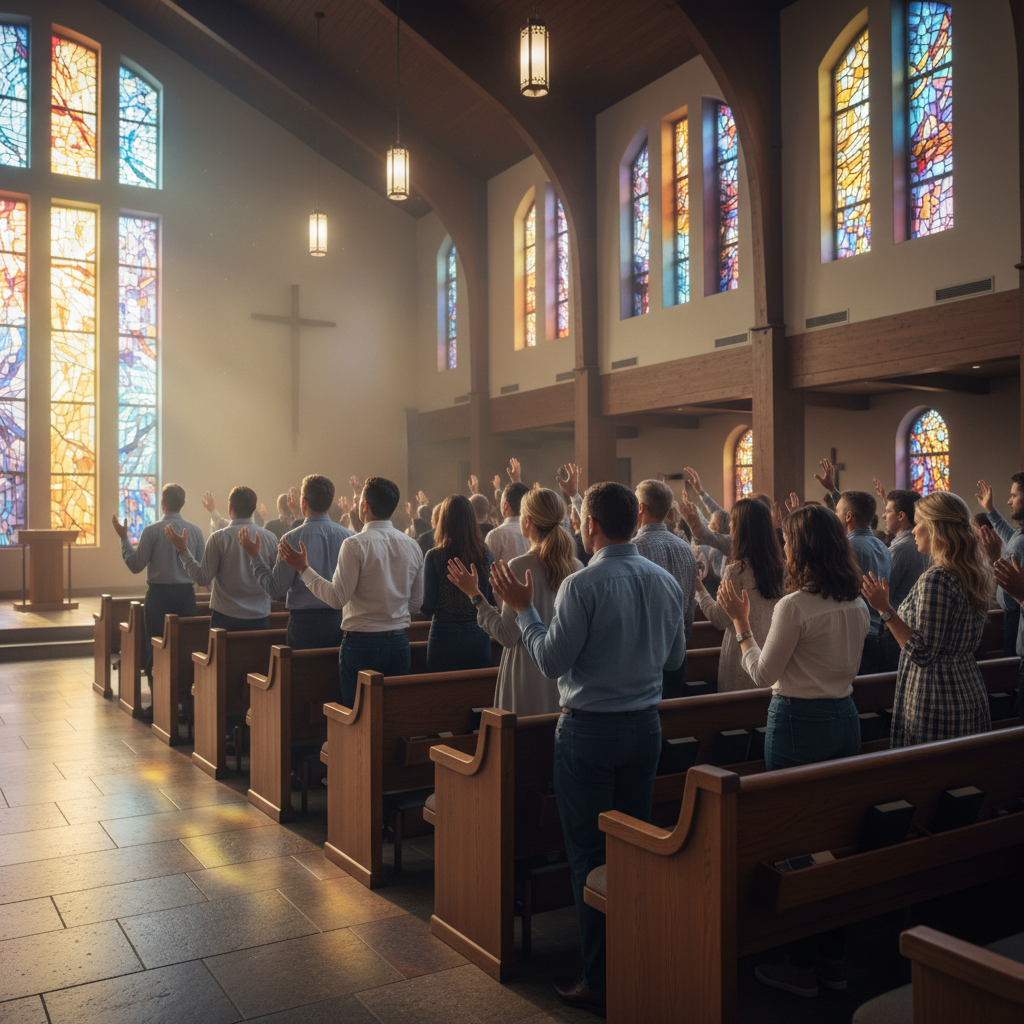
A photorealistic, high-quality stock photo of a diverse group of people in a modern church sanctuary, hands raised in worship, soft natural light streaming through stained glass windows, warm and reverent atmosphere, professional photography style, capturing a moment of genuine faith and devotion.
The word “Hosanna” carries deep biblical significance that stretches back thousands of years. In Jesus Christ Superstar
The Biblical Origin of “Hosanna”
The word “Hosanna” comes from the Hebrew phrase hoshia na, which means “save, please” or “save now.” It began as a desperate plea for God’s deliverance. Over time, it evolved into a joyful shout of praise to God.
In the New Testament, “Hosanna” appears during Jesus’ triumphal entry into Jerusalem. The crowds waved palm branches and cried out:
Matthew 21:9 — “Hosanna to the Son of David! Blessed is he who comes in the name of the Lord! Hosanna in the highest!” [1]
Mark 11:9-10 — “Hosanna! Blessed is he who comes in the name of the Lord! Blessed is the coming kingdom of our father David! Hosanna in the highest!” [2]
John 12:13 — The crowds took palm branches and went out to meet Him, crying “Hosanna! Blessed is He who comes in the name of the Lord!” [3]
Psalm 118:25 — The original Old Testament source: “Save now, I pray, O Lord” [4]
This moment fulfilled the prophecy of Zechariah 9:9, which declared that Israel’s King would come riding on a donkey. The people recognized Jesus as their long-awaited Messiah. Their cry of “Hosanna” was both a worshipful acclamation and a declaration of faith.
However, the crowd’s understanding was incomplete. They wanted a political liberator. They did not yet grasp that Jesus came to save them from sin, not from Rome. This tension between expectation and reality is central to the Gospel narrative.
How Jesus Christ Superstar Portrays the Hosanna Scene
In Jesus Christ Superstar, the “Hosanna” number captures the energy and chaos of the triumphal entry. The musical presents the scene with a mix of celebration and underlying tension. Jesus rides into Jerusalem while the crowd erupts in praise.
The song features a call-and-response structure. The crowd chants “Hosanna, hey, Hosanna!” while Jesus responds with lines that reflect His awareness of what lies ahead. He sings about superstars and glory, but also hints at His coming suffering.
Here is how the musical’s portrayal compares to the biblical account:
Element
Biblical Account
Jesus Christ Superstar
Crowd’s Motivation
Genuine messianic hope and worship
Mixed motives — excitement, political hope, and fleeting enthusiasm
Sets the stage for the conflict with religious authorities
The musical uses the “Hosanna” scene to explore a powerful theme. The crowd’s praise is genuine in the moment. Yet it is shallow. Within days, many of these same voices would cry “Crucify Him!” (Mark 15:13-14). This dramatic irony underscores a biblical truth. True faith is not built on excitement alone. It requires enduring commitment.
Furthermore, the musical raises questions about the nature of fame and glory. Jesus rejects the “superstar” label. He came not to be served but to serve, and to give His life as a ransom for many (Mark 10:45). The “Hosanna” cry, in both Scripture and the musical, reveals the human tendency to seek earthly salvation rather than embracing God’s eternal plan.
For believers, the true meaning of “Hosanna” remains unchanged. It is a cry for salvation that only Jesus Christ can fulfill. As Acts 4:12 declares, “There is salvation in no one else, for there is no other name under heaven given among men by which we must be saved.” The Jesus Christ Superstar “Hosanna” scene, while artistically compelling, ultimately points us back to the cross — where the true King accomplished the salvation the crowd unknowingly begged for.
Jesus Christ Superstar Hosanna Lyrics
A photorealistic, high-quality stock photo of an open Bible on a wooden table, with a cup of coffee nearby, soft morning light, a peaceful and contemplative setting, professional photography style, capturing the essence of studying scripture.
Full Hosanna Lyrics from the Musical
The “Hosanna” number in Jesus Christ Superstar is one of the most recognizable songs from the 1970 rock opera by Andrew Lloyd Webber and Tim Rice. The song captures the energy and excitement of Jesus’ triumphal entry into Jerusalem. Below are the key lyrics from the “Hosanna” section of the musical:
“Hosanna, hey, hosanna! Heya, sanna! Superstar!”
“Hey, J.C., won’t you smile for me? Hosanna, superstar!”
“If you’d come today, you could have reached a whole nation. Israel in four days had a Roman information.”
“Hosanna, hey, hosanna! Heya, sanna! Superstar!”
“Why’d you choose such a backward place and such a strange time? Why’d you choose to be born in a manger?”
“Hosanna, hey, hosanna! Heya, sanna! Superstar!”
“There must be over fifty thousand people here, singing without a care. But who is this man? Why is he here?”
“Hosanna, hey, hosanna! Heya, sanna! Superstar!”
“Don’t you get me wrong, I only want to know. Hosanna, superstar!”
These lyrics reflect the crowd’s enthusiasm and their mixed expectations of Jesus. Some see Him as a political liberator. Others are simply caught up in the moment. The song also includes a dialogue between Jesus and Judas, highlighting the tension between spiritual mission and worldly ambition.
The musical’s portrayal is dramatic and stylized. It uses modern language and rock music to convey the emotions of the biblical event. While the lyrics are not a direct quote from Scripture, they echo the themes found in the Gospels.
Comparing the Lyrics to Scripture
The “Hosanna” song in Jesus Christ Superstar draws heavily from the biblical account of Jesus’ entry into Jerusalem. Let’s compare the musical’s lyrics with the actual Scripture passages they reference.
Musical Lyric
Biblical Reference
Scripture Text
“Hosanna, hey, hosanna!”
Matthew 21:9
“Hosanna to the Son of David! Blessed is he who comes in the name of the Lord! Hosanna in the highest!”
“If you’d come today, you could have reached a whole nation”
“The next day the great crowd that had come for the festival heard that Jesus was on his way to Jerusalem. They took palm branches and went out to meet him, shouting, ‘Hosanna! Blessed is he who comes in the name of the Lord!'”
“Now there were some Greeks among those who went up to worship at the festival. They came to Philip… and asked him, ‘Sir, we wish to see Jesus.'”
As you can see, the musical’s lyrics are inspired by real biblical events. However, they are not a direct quotation. The songwriters took creative liberties to fit the rock opera format. The core message remains: the crowd’s excitement, their political hopes, and Jesus’ spiritual mission.
It’s important to note that the musical does not replace Scripture. It is a dramatic interpretation. For the full, authoritative account of Jesus’ triumphal entry, we must turn to the Bible. The Gospels of Matthew, Mark, Luke, and John provide the complete, inspired record of this event.
Let’s look at the key differences between the musical and Scripture:
The crowd’s motivation: The musical emphasizes political hope. Scripture shows a mix of genuine faith and political expectation.
Jesus’ response: In the musical, Jesus is more passive. In Scripture, He actively fulfills prophecy by riding a donkey (Zechariah 9:9).
The tone: The musical uses modern, sometimes irreverent language. Scripture maintains a reverent, prophetic tone.
The outcome: The musical foreshadows betrayal. Scripture reveals the full plan of salvation.
Despite these differences, the musical does capture one essential truth: Jesus was welcomed as a king. The crowd shouted “Hosanna,” which means “Save now!” or “Save, we pray!” This cry was both a prayer and a declaration of faith.
For believers, the real “Hosanna” moment is not just a historical event. It is a reminder that Jesus is the promised Messiah. He came to save His people. He came to fulfill God’s plan. And He will come again in glory.
As we study the “Hosanna” lyrics, let us always return to Scripture. Let us seek the true Jesus, not a fictional character. Let us worship Him as Lord and Savior. For He alone is worthy of our praise.
Why Do Some Christians Dislike Jesus Christ Superstar?
Concerns About the Portrayal of Jesus
Since its debut in 1970, Jesus Christ Superstar has sparked significant debate among believers. While the musical brought the story of Jesus to mainstream audiences, many Christians have expressed deep concerns about how it presents the Son of God. Understanding these concerns helps us think carefully about how we engage with popular culture.
The most common objections center on the following areas:
Jesus is shown as merely human. The musical presents Jesus as a conflicted, uncertain figure who questions His own mission. Scripture, however, reveals a Jesus who knew His purpose from the beginning. He declared, “I lay down my life — no one takes it from me, but I lay it down of my own accord” (John 10:18, NIV). The Jesus of the Bible was never confused about who He was or why He came.
the resurrection is absent or downplayed. Many versions of the musical end with the crucifixion, omitting the resurrection entirely. For Christians, the resurrection is the cornerstone of our faith. As Paul wrote, “If Christ has not been raised, your faith is futile” (1 Corinthians 15:17, NIV). Without the empty tomb, the story is incomplete.
Judas is portrayed sympathetically. The musical often frames Judas as a misunderstood figure acting out of concern. While this creates dramatic tension, it risks minimizing the gravity of his betrayal. Scripture is clear: Judas made a choice, and Jesus Himself said of him, “The Son of Man will go just as it is written about him. But woe to that man who betrays the Son of Man! It would be better for him if he had not been born” (Matthew 26:24, NIV).
Mary Magdalene’s song “I Don’t Know How to Love Him” raises theological questions. The lyrics suggest a romantic or deeply personal uncertainty about Jesus that goes beyond the biblical record. Scripture presents Mary Magdalene as a devoted follower whom Jesus delivered from seven demons (Luke 8:2). Her relationship with Christ was one of gratitude and worship, not romantic confusion.
The “Hosanna” scene can feel more like a rock concert than worship. When the crowd sings “Hosanna” in the musical, the energy often mirrors a celebrity rally rather than genuine praise. The biblical crowd that shouted “Hosanna” on Palm Sunday was acknowledging Jesus as the Messiah — the one who comes in the name of the Lord (Matthew 21:9).
These concerns are not trivial. How we portray Jesus matters because He is not a fictional character. He is the risen Lord, the Lamb of God, and the only way to the Father (John 14:6). When art reshapes His image in ways that contradict Scripture, believers have every reason to pause and reflect.
A Biblical Response to the Controversy
So how should Christians respond when a popular work like Jesus Christ Superstar takes creative liberties with the Gospel? Scripture gives us a clear framework for navigating these moments with both discernment and grace.
First, we are called to test everything against God’s Word. The Bereans were commended because they “examined the Scriptures every day to see if what Paul said was true” (Acts 17:11, NIV). In the same way, we should measure any portrayal of Jesus against the Bible. If it aligns, we can appreciate it. If it does not, we hold fast to what Scripture teaches.
Second, we should remember that no work of art can replace the authority of Scripture. The Gospels of Matthew, Mark, Luke, and John are our reliable, God-breathed record of who Jesus is and what He accomplished (2 Timothy 3:16). A musical, no matter how popular, is an interpretation — not revelation.
Third, we can use these moments as opportunities for conversation. When someone mentions Jesus Christ Superstar, it opens the door to share the real story of Jesus. You might say, “That’s an interesting take. Let me tell you what the Bible actually says about that moment.” This approach is both loving and bold.
Here are some key truths to keep at the center of any discussion about Jesus:
Jesus is fully God and fully man — not a confused human, but the divine Son who willingly came to save us (John 1:14, Philippians 2:6–8).
His death was not a tragedy but a triumph. He died for our sins, was buried, and rose again on the third day, just as Scripture foretold (1 Corinthians 15:3–4).
The “Hosanna” of Palm Sunday was a declaration of His kingship. He is not a celebrity to be cheered and then abandoned. He is the King of Kings who reigns forever (Revelation 19:16).
Our worship of Jesus must be rooted in truth, not in how culture portrays Him. “True worshipers will worship the Father in the Spirit and in truth” (John 4:23, NIV).
Ultimately, the controversy surrounding Jesus Christ Superstar reminds us of something important: Jesus is worth getting right. He deserves our careful attention, our reverent hearts, and our commitment to proclaim Him as He truly is — not as any artist imagines Him to be.
As believers, we do not need to fear cultural depictions of Jesus. We simply need to know the real Jesus of Scripture and be ready to share Him with a world that is still searching. The next time you hear “Hosanna” — whether in a church, a musical, or a conversation — let it point you back to the One who truly saves.
What Was the Famous Line from Jesus Christ Superstar?
“Hosanna, Hey, Hosanna!” and Other Iconic Lines
One of the most recognizable lines from Jesus Christ Superstar is the triumphant cry, “Hosanna, hey, Hosanna!” This phrase is repeated throughout the musical’s “Hosanna” number, sung by the crowd as they welcome Jesus into Jerusalem. The line is catchy, energetic, and has become synonymous with the rock opera itself.
However, the musical features several other memorable lines that have resonated with audiences for decades. These lines capture the emotional weight of the Passion narrative, even if the musical’s interpretation differs from Scripture.
Here are some of the most famous lines from the Jesus Christ Superstar “Hosanna” scene:
“Hosanna, hey, Hosanna!” — The crowd’s repeated praise of Jesus as He enters Jerusalem.
“Hey JC, JC, you’re alright by me!” — A casual, modernized expression of admiration for Jesus.
“If you’d come today you’d have reached a whole nation!” — A line reflecting the crowd’s political expectations of Jesus.
“Israel in four days has been set free!” — The crowd’s hope that Jesus would overthrow Roman rule.
“Tell me Christ, how you’re feeling today?” — A personal, almost conversational question directed at Jesus.
These lines are written in a contemporary, rock-musical style. They were crafted to make the story of Jesus accessible to modern audiences. As a result, they use informal language that departs from the reverent tone of Scripture.
It is important to note that these lines are fictional lyrics written by Andrew Lloyd Webber and Tim Rice. They are not direct quotes from the Bible. While they reference events in the Gospels, they do so through the lens of a dramatic, artistic interpretation.
How the Famous Lines Reflect the Gospel Narrative
Despite their modern style, the famous lines from Jesus Christ Superstar do reflect elements of the true Gospel narrative. The “Hosanna” scene in the musical is based on the biblical account of Jesus’ triumphal entry into Jerusalem, recorded in all four Gospels.
According to Scripture, as Jesus rode into Jerusalem on a donkey, the crowds shouted:
“Hosanna to the Son of David! Blessed is he who comes in the name of the Lord! Hosanna in the highest heaven!” — Matthew 21:9 (NIV)
The word “Hosanna” is a Hebrew expression meaning “Save now!” or “Save, we pray!” In the biblical account, the people were crying out to Jesus as their Messiah and King. Their praise was rooted in genuine faith and recognition of who Jesus truly was.
The musical’s use of “Hosanna” captures this moment of public praise. However, the lyrics also introduce a tension that is not present in Scripture. In Jesus Christ Superstar, the crowd’s enthusiasm is portrayed as fickle and politically motivated. The famous line “If you’d come today you’d have reached a whole nation” suggests the people wanted a political liberator, not a suffering Savior.
This portrayal raises an important question: What did the people truly understand about Jesus?
Scripture tells us that many in the crowd did not fully understand Jesus’ mission. Some saw Him as a political figure. Others were drawn by His miracles. Yet Jesus Himself made His purpose clear:
“For the Son of Man came to seek and to save the lost.” — Luke 19:10 (NIV)
Furthermore, Jesus knew that the same crowd shouting “Hosanna” would soon cry out for His crucifixion. The Gospels record this tragic shift. Within days, the praise turned to condemnation.
The famous lines from Jesus Christ Superstar can serve as a starting point for deeper reflection. They remind us that outward praise is not the same as true faith. The crowd in Jerusalem sang Jesus’ praises, but many did not believe in Him as Lord and Savior.
As believers, we are called to more than surface-level worship. Scripture teaches us:
“These people honor me with their lips, but their hearts are far from me.” — Matthew 15:8 (NIV), quoting Isaiah 29:13
The Jesus Christ Superstar “Hosanna” scene, while artistically powerful, ultimately points us back to the true Gospel. Jesus is not a political figure or a cultural icon. He is the Son of God, the Lamb who was slain for the sins of the world.
His entry into Jerusalem was not a moment of earthly triumph. It was the beginning of His journey to the cross. And it is through His death and resurrection that we receive the salvation the crowd was crying out for — even if they did not fully understand it.
As we consider the famous lines from this musical, let us remember the true meaning of “Hosanna.” It is a cry for salvation. And that salvation is found in Jesus Christ alone.
What Is the Hardest Song to Sing in Jesus Christ Superstar?
Vocal Challenges in the Hosanna Number
The Jesus Christ Superstar “Hosanna” number is one of the most electrifying moments in the entire musical. However, it is also one of the most vocally demanding. The song requires a performer who can navigate rapid shifts between powerful belting and delicate, almost conversational phrasing. Furthermore, the chorus must deliver the repeated “Hosanna, hey, Hosanna!” lines with both precision and raw energy.
As a result, the lead vocalist singing the role of Jesus must sustain high notes while conveying deep emotional weight. The song sits in a challenging vocal range that pushes even experienced singers to their limits. In addition, the ensemble must maintain tight harmonies throughout the number, creating a wall of sound that mirrors the biblical crowd’s fervent praise.
Here are the key vocal challenges in the “Hosanna” number:
Wide vocal range: The melody spans a broad range, requiring both powerful low notes and soaring high notes.
Dynamic control: Singers must shift quickly from soft, reverent tones to full-throated, triumphant declarations.
Ensemble coordination: The chorus must stay perfectly synchronized while maintaining the energy of a spontaneous crowd.
Emotional authenticity: The performer must convey genuine worship and urgency, even within the theatrical context.
Endurance: The song appears in a long sequence of demanding numbers, requiring vocal stamina.
From a biblical perspective, the original “Hosanna” cry was a genuine expression of praise to Jesus as He entered Jerusalem (Matthew 21:9). The musical captures that same spirit of adoration, even though it does so through a modern lens. As believers, we know that every song of praise ultimately points to the true King, our Lord Jesus Christ.
Other Difficult Songs in the Musical
While “Hosanna” stands out, Jesus Christ Superstar contains several other songs that are notoriously difficult to perform. These songs demand exceptional vocal skill, emotional depth, and dramatic presence. Below is a comparison of some of the most challenging numbers:
Song Title
Primary Challenge
Vocal Range Required
Gethsemane (I Only Want to Say)
Emotional intensity and sustained high notes
Baritone to high tenor
Superstar
Powerful belting and rhythmic precision
Tenor with strong projection
Hosanna
Dynamic shifts and ensemble coordination
Wide range, both low and high
King Herod’s Song
Theatrical flair and comedic timing
Baritone with character voice
I Don’t Know How to Love Him
Delicate, intimate phrasing
Mezzo-soprano with emotional nuance
Each of these songs presents unique challenges that test a performer’s versatility. However, the most demanding role overall is arguably Jesus himself. The actor must carry the emotional weight of the entire story while maintaining vocal excellence throughout the show.
It is worth noting that the musical’s score was originally written for rock voices, which adds another layer of difficulty. Rock singing requires a different technique than traditional musical theater. As a result, performers must blend rock power with theatrical storytelling.
Despite these challenges, the music of Jesus Christ Superstar has inspired generations of singers and audiences alike. The songs continue to resonate because they touch on timeless themes of faith, doubt, and devotion. For Christians, the musical can serve as a reminder of the real story behind the songs — the true story of Jesus Christ, who is Lord and Savior.
Does the Catholic Church Approve of Jesus Christ Superstar?
The Catholic Church’s Official Stance
The Catholic Church has never issued a formal, official statement specifically approving or condemning Jesus Christ Superstar. However, the Church has addressed the musical through various bishops’ conferences and Catholic publications over the decades. The general Catholic response has been one of cautious engagement rather than outright endorsement.
In the early 1970s, when the musical first gained widespread attention, several Catholic leaders expressed concern about its portrayal of Jesus. The depiction of Christ as a conflicted, uncertain figure troubled many Catholic theologians. The Church teaches that Jesus is fully God and fully man, without sin or internal doubt about His divine mission (Hebrews 4:15). Any portrayal that suggests otherwise raises legitimate theological questions.
That said, some Catholic educators and clergy have used Jesus Christ Superstar as a conversation starter. They find value in discussing what the musical gets right and what it misses about Jesus. The “Hosanna” scene, for instance, captures the genuine excitement of the crowds on Palm Sunday. This can lead to meaningful discussions about who Jesus truly is.
The United States Conference of Catholic Bishops has not banned the musical. Instead, they encourage Catholics to engage with all media through the lens of Scripture and Church teaching. Catholics are urged to compare any artistic portrayal of Jesus with the Gospels themselves (Matthew 4:4).
How Christians Across Denominations View the Musical
Christian responses to Jesus Christ Superstar vary widely across denominations. There is no single “Christian” position on the musical. Believers hold a range of views, from strong opposition to cautious appreciation.
Here is a summary of how different Christian traditions have responded:
Denomination/Group
General View
Key Concern
Roman Catholic
Cautious, no formal ban
Portrayal of Jesus’ humanity over His divinity
Mainline Protestant
Mixed, some appreciation
Historical accuracy and theological depth
Evangelical Christians
Often skeptical or opposed
Jesus is shown without clear resurrection emphasis
Eastern Orthodox
Generally disapproving
The musical format is seen as irreverent to sacred history
Many evangelical Christians point to a critical weakness in the musical. Jesus Christ Superstar ends with the crucifixion. It does not clearly present the resurrection. For believers, the resurrection is the cornerstone of the faith (1 Corinthians 15:14). Without it, the story of Jesus is incomplete.
On the other hand, some Christians appreciate the musical’s ability to reach people who might never open a Bible. The “Hosanna” song, with its energy and emotion, can spark curiosity about the real Jesus. When that happens, it opens a door for sharing the Gospel.
Ultimately, Christians across all traditions agree on one essential truth. Jesus Christ is Lord. He is the Son of God. He died for our sins and rose again on the third day (Romans 10:9). No musical, film, or artistic work can replace the authority of Scripture. The Bible remains the final word on who Jesus is and what He accomplished.
As believers, we are called to test everything against God’s Word (1 Thessalonians 5:21). Whether or not you choose to listen to Jesus Christ Superstar, let the “Hosanna” of your heart be directed to the real Jesus. He is the one who saves. He is the one who reigns forever.
Listen to Jesus Christ Superstar Hosanna
A photorealistic, high-quality stock photo of a person listening to music with headphones, in a cozy living room setting, warm ambient lighting, professional photography style, capturing a moment of personal reflection and enjoyment.
The 1973 Original Recording
The 1973 film soundtrack of Jesus Christ Superstar remains one of the most iconic recordings of the “Hosanna” number. Featuring Ted Neeley as Jesus and Carl Anderson as Judas, this version captures the raw energy and tension of the original stage production. The recording reached wide audiences and helped popularize the musical globally. For many listeners, this is the definitive rendition of the “Hosanna” scene. The powerful vocals and dramatic orchestration bring the biblical narrative to life in a way that resonates deeply with audiences. You can find this recording on major music platforms and streaming services today.
Notable Performances Over the Years
Since its debut, Jesus Christ Superstar has seen numerous memorable performances of the “Hosanna” number. Each production brings a fresh interpretation while honoring the original spirit of the song.
The 1971 Original Broadway Cast: This production introduced the world to the rock opera format. Ben Vereen’s portrayal of Judas and Jeff Fenholt’s Jesus set the standard for all future performances.
The 2000 Broadway Revival: Starring Glenn Carter as Jesus and Tony Vincent as Judas, this revival brought renewed energy to the classic material. The “Hosanna” scene was particularly praised for its emotional intensity.
The 2012 Arena Tour: This production featured a star-studded cast including Melanie C as Mary Magdalene. The arena setting amplified the crowd scenes, making the “Hosanna” moment feel even more like the biblical triumphal entry.
The 2016 Regent’s Park Open Air Theatre Production: This critically acclaimed London production won multiple awards. The outdoor setting created a unique atmosphere for the “Hosanna” scene, with natural light and open space adding to the drama.
The 2018 Live Television Broadcast: NBC’s live production brought Jesus Christ Superstar to millions of viewers. John Legend’s portrayal of Jesus and Sara Bareilles’ Mary Magdalene received widespread praise. The “Hosanna” scene was broadcast live, capturing the spontaneity of the moment.
Each of these performances offers a unique lens through which to experience the “Hosanna” scene. While the musical takes creative liberties, the core message of the crowd’s adoration for Jesus remains central. For Christians, these performances can serve as a reminder of the real biblical event they depict. The triumphal entry of Jesus into Jerusalem is recorded in all four Gospels (Matthew 21:1-11, Mark 11:1-11, Luke 19:28-44, John 12:12-19). The crowds shouted “Hosanna” as Jesus rode into the city, fulfilling the prophecy of Zechariah 9:9.
As you listen to these various recordings, consider the biblical truth behind the song. The crowds that day recognized Jesus as the Messiah, even if they did not fully understand His mission. Today, we know that Jesus came not as a political king, but as the Savior of the world. As Scripture declares, “God so loved the world that He gave His only begotten Son, that whoever believes in Him should not perish but have everlasting life” (John 3:16, NKJV).
Hosanna Jesus Christ Superstar Sheet Music
Where to Find the Sheet Music
Are you looking to sing or play the powerful Jesus Christ Superstar Hosanna number? Fortunately, several trusted sources offer official sheet music. Moreover, options exist for every skill level.
Here is where you can find the sheet music:
Musicnotes.com: This site provides licensed digital sheet music. In addition, you can transpose keys instantly. Furthermore, arrangements are available for piano and voice. [5]
Hal Leonard: As the official print publisher, Hal Leonard offers the complete vocal selections. Additionally, many Christian bookstores carry their products. [6]
Amazon: You will find both physical and Kindle editions here. Moreover, various arrangers offer different versions. [7]
JW Pepper: This resource is excellent for choir directors. Consequently, you can access choral arrangements easily. [8]
However, a word of caution is necessary. Always purchase or download from legal sources. By doing so, you respect copyright law. Additionally, you support the composers who created this work.
Brooke Hotchkiss, a respected musical theatre scholar, notes that the official Hal Leonard edition remains the gold standard for authenticity. [9]
Musical Arrangement Details
The Jesus Christ Superstar Hosanna number is musically exciting. Moreover, it blends several distinct styles together. Furthermore, understanding these elements helps performers prepare better.
Key Musical Characteristics
The arrangement features these notable elements:
Time Signature: The song shifts between 4/4 and 7/8 time. Therefore, it feels unpredictable and driving. Additionally, this creates urgency.
Key Signature: Most arrangements center in D major or E flat major. Consequently, singers can choose their comfortable range.
Tempo: The tempo is moderately fast. Moreover, the conductor typically sets it around 132 beats per minute.
Vocal Range: Jesus’s part spans approximately one octave. Furthermore, the chorus parts feature call-and-response sections.
Instrumentation
The original 1970 orchestration was groundbreaking. Moreover, Andrew Lloyd Webber combined rock instruments with classical ones.
Instrument Category
Specific Instruments
Role in Hosanna
Electric
Guitar, Bass, Drums
Provides driving rock foundation
Keyboard
Piano, Organ, Synthesizer
Creates atmospheric textures
Brass
Trumpet, Trombone
Adds triumphant power
Choral
Mixed SATB Chorus
Delivers the crowd “Hosanna” lines
Performance Tips
When preparing to perform this song, consider these suggestions:
Study the context first. Read Matthew 21:1-11 thoroughly. Additionally, understand why the crowd shouted “Hosanna.” Consequently, your performance will carry deeper conviction.
Practice the rhythmic shifts carefully. The 7/8 sections can be tricky. Therefore, use a metronome during rehearsal.
Balance the ensemble. The chorus must not overpower Jesus. Furthermore, dynamic control is essential throughout.
Breathe with intention. The call-and-response format requires strategic breathing. In addition, mark your sheet music accordingly.
The Jesus Christ Superstar Hosanna arrangement is a remarkable piece of musical theatre. Moreover, Andrew Lloyd Webber and Tim Rice created something truly innovative. Although the rock opera format may feel different from traditional hymns, the story it tells remains deeply important.
As believers, we can appreciate the musical craftsmanship. At the same time, we return to the Bible as our ultimate authority. Scripture reveals that “Hosanna” means “save now.” Furthermore, the crowd that day longed for a deliverer.
Jesus Christ is that deliverer. He is the true King who entered Jerusalem. Moreover, He fulfilled Psalm 118:26 perfectly. Today, He invites every heart to cry “Hosanna” in genuine faith.
Frequently Asked Questions
Why do some Christians dislike Jesus Christ Superstar?
Some Christians have concerns about Jesus Christ Superstar. The musical presents a humanized portrayal of Jesus. He is shown struggling with doubt and fear. This differs from the sinless Christ described in Scripture. The Bible tells us Jesus was “without sin” (Hebrews 4:15). Furthermore, the musical omits the resurrection entirely. For believers, the resurrection is the cornerstone of our faith (1 Corinthians 15:14). Without it, the Gospel story feels incomplete.
In addition, the relationship between Jesus and Mary Magdalene is portrayed romantically. This is not supported by Scripture. Some Christians feel this misrepresents biblical truth. However, others see the musical as a starting point for conversation. It can open doors to discuss who Jesus truly is. Ultimately, each believer must prayerfully decide whether to engage with this production.
What was the famous line from Jesus Christ Superstar?
The most iconic line from the musical is “Hosanna, hey, Hosanna!” This phrase comes directly from Scripture. In the Bible, crowds shouted “Hosanna” as Jesus entered Jerusalem (Matthew 21:9). The word means “save now” or “save, we pray.” The musical uses this line to capture the excitement of that moment. However, the true meaning goes far deeper than the musical suggests.
Here are other notable lines from the song:
“Hey JC, JC, won’t you die for me?”
“If you’d seen him, it’s a cinch you’d believe”
“Hosanna, hey, Hosanna! Superstar!”
These lines reflect the crowd’s misunderstanding. They wanted a political savior. Yet Jesus came to offer something greater. He came to save humanity from sin through His death and resurrection (John 3:16).
What is the hardest song to sing in Jesus Christ Superstar?
The “Hosanna” number presents significant vocal challenges. It requires a wide vocal range. The performer must shift between powerful belting and softer, more reflective moments. Additionally, the song “Gethsemane” is often considered the most difficult. Jesus sings alone in this number. The emotional intensity is overwhelming. The performer must convey deep anguish and surrender.
Other challenging songs in the musical include:
“Superstar” – Judas’s demanding vocal lines
“I Don’t Know How to Love Him” – Mary Magdalene’s emotional ballad
“The Temple” – Jesus’s powerful confrontation scene
Each song requires both technical skill and emotional depth. The performer must connect with the character’s inner struggle.
Does the Catholic Church approve of Jesus Christ Superstar?
The Catholic Church has not issued an official endorsement of Jesus Christ Superstar. The Church encourages artistic expression. However, it also calls for fidelity to the Gospel message. Some Catholic leaders have expressed concerns. They worry about the portrayal of Jesus and the omission of the resurrection.
Here is a summary of how Christians across denominations view the musical:
Denomination
General View
Catholic
Mixed; some appreciate the artistry, others have theological concerns
Mainline Protestant
Generally more open to artistic interpretations
Evangelical
Often cautious due to the humanized portrayal of Jesus
Ultimately, Christians are encouraged to test everything against Scripture (1 Thessalonians 5:21). The musical may spark curiosity. But the Bible remains our ultimate authority. Jesus Christ is Lord, yesterday, today, and forever (Hebrews 13:8).