
Luke 18:16 records Jesus’ words: ‘But Jesus called them to him, saying, “Let the little children come to me, and do not hinder them, for to such belongs the kingdom of God.”’ This verse powerfully illustrates Christ’s love and value for children, teaching that the Kingdom of God is accessible to those who approach Him with simple, humble, and trusting faith, like that of a child.
In a world focused on status and power, Jesus Christ consistently turned our attention toward the humble and meek. One of His most tender declarations is found in the Gospel of Luke, a passage that reveals His heart for humanity and the true nature of God’s Kingdom. In this moment, He calls for the youngest among us, saying, “Let the little children come to Me, and do not forbid them; for of such is the kingdom of God” (Luke 18:16).
This simple command holds a powerful message for every believer seeking to draw closer to our Savior. More than just a historical story, Luke 18:16 serves as a foundational teaching on humility, faith, and the open-hearted attitude required to enter God’s kingdom. It affirms that Jesus is accessible to all, challenging us to remove any barriers—whether self-imposed or societal—that might keep us from His grace and truth.
As we examine the meaning of this beloved scripture, we will uncover its historical context and the timeless lessons Jesus offers. We will explore why His disciples tried to prevent the children from reaching Him and how His welcoming response reshapes our understanding of who truly belongs in His Kingdom, revealing the very heart of the Gospel.
What is the Immediate Context of Luke 18:16?
The People Bringing Infants
The context for Luke 18:16 is a beautiful, poignant scene. People were bringing their young children—specifically “infants” or “babies” (Luke 18:15)—to Jesus. This detail is significant, as it highlights their complete helplessness and dependence.
The parents and guardians sought a personal encounter, desiring His touch, a blessing, or a prayer for their little ones. This was an act of remarkable faith, showing they believed Jesus possessed divine power and grace. Confident that His presence would enrich their children’s lives, they eagerly brought their most precious treasures to Him.
- A Desire for Blessing: These individuals understood Jesus’ unique authority and yearned for His divine favor upon their infants.
- An Act of Faith: Bringing infants to Jesus demonstrated deep trust in His goodness and power, seeking more than just a passing glance.
- Recognition of Jesus’ Divinity: Their actions affirmed Jesus as someone special, a source of powerful blessing and healing worthy of such a request [1].
This eagerness sets the stage for Jesus’ profound teaching and His radical affirmation of childlike faith. In their actions, these parents showed they instinctively understood something vital about Jesus’ character.
The Disciples’ Rebuke
In stark contrast, the disciples reacted differently. Seeing the infants as a nuisance, they “rebuked” the parents and tried to prevent them from approaching Jesus (Luke 18:15).
Why would they do this? Several reasons might explain their actions. They likely believed Jesus was too important and His time too valuable to be spent on children, who held little social status in their culture. From their perspective, these infants were a distraction from more “serious” adult matters.
- Misguided Protection: The disciples may have been trying to protect Jesus, seeking to guard His time and energy from what they saw as an interruption.
- Cultural Bias: In ancient societies, children often lacked significant social standing, a common view the disciples likely shared [2].
- Lack of Understanding: Crucially, they failed to grasp Jesus’ true mission and His deep compassion for the humble and the vulnerable.
The disciples’ rebuke created a barrier, standing directly between the children and the Savior. Their reaction highlights a stark contrast between a limited human perspective and God’s expansive love. However, Jesus would quickly correct their error and reveal a core principle of His kingdom.
What is the meaning of Luke 18 16?
Jesus’ Divine Welcome
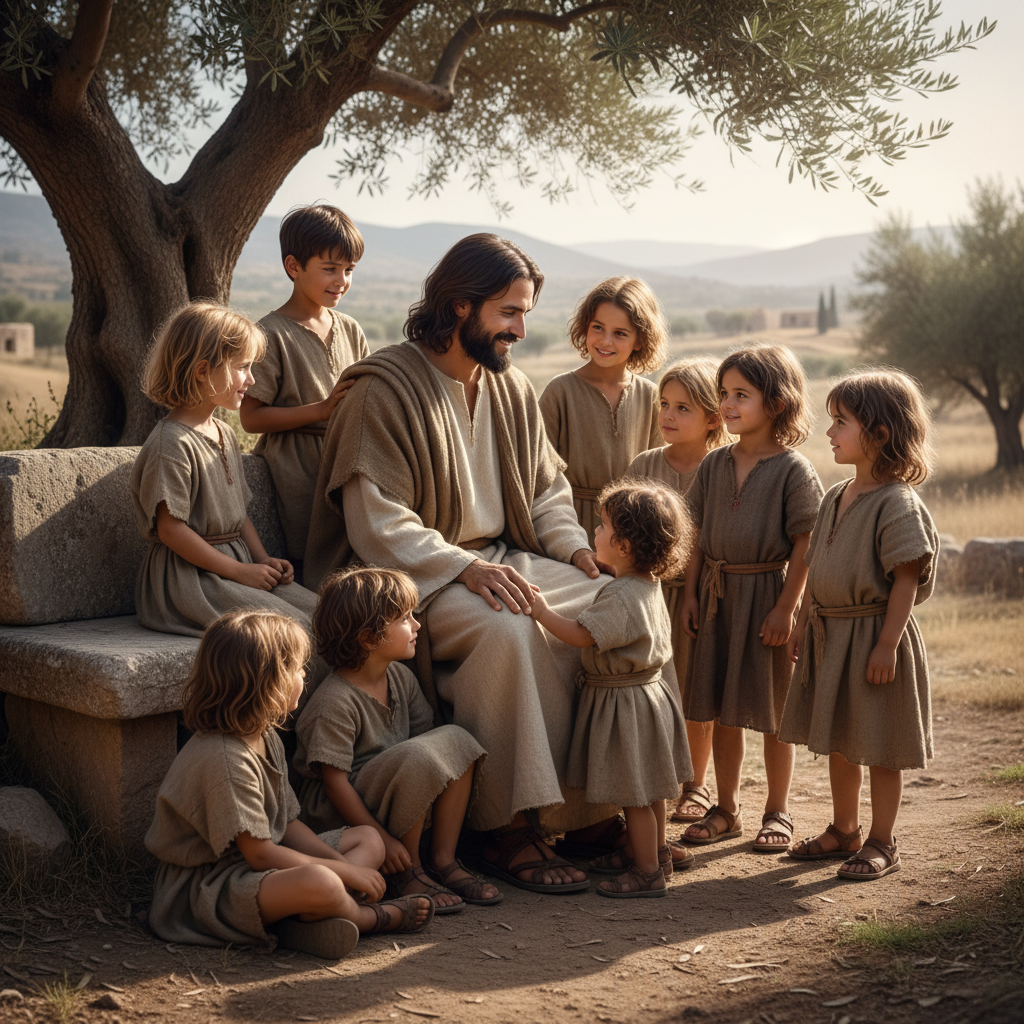
Luke 18:16 reveals a profound aspect of Jesus’ character in a beautiful scene where people were bringing infants for His touch and blessing—a common custom of the time. However, His disciples, believing the children were a distraction for someone so important, quickly rebuked the parents. In contrast, Jesus intervened with divine wisdom, calling the children to Him. His actions demonstrated boundless compassion as He welcomed them with open arms.
His welcome was truly divine, defying human expectations and revealing the very heart of God. Where others saw a nuisance, Jesus saw immense value. He did not dismiss the children; instead, He affirmed their significance. His declaration, “Let the little children come to me” (Luke 18:16), was not a mere invitation but a divine summons that demonstrated His perfect love for all people.
‘Do Not Hinder Them’: Removing Barriers
By trying to prevent access to Jesus, the disciples created a barrier born from a clear misunderstanding. In response, Jesus’ command to them was direct and firm: “Do not hinder them” (Luke 18:16). This powerful instruction carries deep spiritual weight, teaching the crucial lesson that we must never obstruct anyone’s path to Christ.
Consider the profound implications of this command:
- Spiritual Barriers: We should diligently remove anything that keeps people from Jesus, such as harsh judgment, legalism, or exclusivity.
- Attitudinal Barriers: Our attitudes must always reflect Christ’s unconditional welcome so that we do not make others feel unworthy or out of place.
- Practical Barriers: The church should strive to create accessible environments where all people, regardless of age or background, can encounter God’s love.
Because Jesus desires everyone to come to Him, there should be no obstacles in the way of true faith. Therefore, our mission as believers is to facilitate access to Him, showing the same loving embrace as Jesus Himself. We are called to be bridge-builders, not gatekeepers.
The Kingdom of God Belongs to Such as These
Jesus then explained why the children were so important, stating, “for to such belongs the kingdom of God” (Luke 18:16). This profoundly significant statement clarifies the very nature of God’s Kingdom. It does not belong to the powerful, self-sufficient, or proud, but rather to those who possess childlike qualities.
What are these essential qualities that Jesus highlights?
- Humility: Children naturally depend on others. Lacking self-importance, they are not concerned with worldly status (Matthew 18:3-4).
- Trust: They exhibit a simple, unwavering trust, believing what they are told without complex reservations.
- Openness: Children are open to new experiences and learning, unburdened by deep-seated cynicism or preconceived notions.
- Dependence: They fully rely on their caregivers for provision and protection, readily recognizing their need for help.
Ultimately, entering God’s Kingdom requires a humble heart, which means trusting Jesus completely and unconditionally. We must surrender our pride and self-reliance in favor of a simple, genuine faith. Jesus calls us to receive His Kingdom with the trusting, dependent spirit of a child, for this is the true path to eternal spiritual life.
What did Jesus mean when he said “Suffer the little children”?

Understanding the Archaic Meaning of ‘Suffer’
For modern English speakers, the phrase “Suffer the little children” can be confusing because we associate the word “suffer” with enduring pain. However, Jesus’ words were spoken long ago and preserved in ancient Greek. The English translation uses an older, or archaic, meaning of the word.
In this biblical context, “suffer” simply means “to allow,” “to permit,” or “to let.” This understanding is crucial, as it reveals Jesus’ true intent. When He said, “Suffer the little children to come to me, and forbid them not” (Luke 18:16 KJV), He gave a clear command. He explicitly told His disciples not to prevent children from approaching Him, showing His desire for their presence and His open invitation to all.
A Command to Permit and Allow Access to Christ
Jesus’ instruction was a loving command, prompted when He saw His disciples trying to send the children away. The disciples likely thought Jesus was too important or that children would be a distraction. However, Jesus saw things differently, recognizing the pure faith often found in children and desiring their access to His divine presence.
His subsequent words, “Do not hinder them” (Luke 18:16), are deeply powerful and reveal His compassionate heart. Jesus consistently welcomed those whom others might overlook, including the marginalized and the humble. He valued children in particular because they often approach with simple trust and without pretense.
This command extends beyond literal children, teaching us a vital lesson for today: we must never create barriers that keep people from Christ. Instead, our role is to facilitate access and invite others into His loving embrace. Jesus desires everyone to draw near to Him, welcoming all who come with childlike faith. As the Way, the Truth, and the Life (John 14:6), His divine invitation is universal and unwavering.
What did Jesus mean by little ones?
The Literal Children Present
When Jesus said, “Let the little children come to me,” He was speaking of the actual children present that day. Parents had brought their infants and young children to receive a blessing from Him (Luke 18:15). Although the disciples, in their misguided zeal, tried to turn them away, Jesus saw their value. He recognized their importance and commanded that they be allowed to approach Him.
This powerful moment reveals our Savior’s open heart for the vulnerable and those often overlooked by society. It highlights His deep compassion for the youngest among us and affirms His universal invitation to all who seek Him.
A Metaphor for Humility and Faith
Beyond the literal children, Jesus used this moment to teach a profound spiritual truth. The term “little ones” also serves as a powerful metaphor for the spiritual attitude all believers should adopt. In this way, Jesus was not just blessing children; He was illustrating the heart required to enter the Kingdom of God.
These “little ones” represent those who approach God with humility and simple, genuine faith. This spiritual childlikeness stands in stark contrast to the pride and self-sufficiency common in the world. As Jesus taught, the Kingdom belongs to those who humble themselves like children (Matthew 18:3-4).
The Qualities of a Childlike Heart
So, what specific qualities make up a “childlike heart”? This is not a call to be childish or immature but to embrace the profound spiritual characteristics essential for true faith. These qualities, which unlock the Kingdom for us, include:
- Humility: Children naturally lack pretense and self-importance. They are not concerned with status or worldly achievements. In the same way, a humble heart recognizes its complete dependence on God, not on personal merit (Philippians 2:3).
- Trust and Faith: A child places complete trust in their parents for provision and protection. Likewise, believers are called to have a simple, unwavering faith in Jesus, trusting His perfect plan and divine care for their salvation (Ephesians 2:8-9).
- Dependence: Children are completely reliant on adults for their needs because they cannot care for themselves. Spiritually, this means acknowledging our inability to save ourselves and relying entirely on God’s grace and mercy through Christ.
- Openness and Teachability: Young children are eager to learn and approach life with open minds. Similarly, a childlike heart is receptive to God’s Word, ready to be taught and transformed by the Holy Spirit (Psalm 119:105).
- Lack of Pretense: Children are typically authentic and do not hide behind masks. In our faith, this translates to genuine honesty before God and others, approaching Him without hidden agendas or false piety.
Jesus’ message is clear: to receive the Kingdom of God, we must shed our adult pride and complexity. We must instead embrace the simple, beautiful qualities of a childlike heart that depends fully on our Lord and Savior, Jesus Christ.
How Can We Apply Luke 18:16 to Our Faith Today?

Valuing Children in Our Communities
Luke 18:16 profoundly calls us to value children, just as Jesus did when He welcomed them with open arms, seeing their inherent worth. Children are not merely the church of tomorrow; they are vital members today, and our faith compels us to create nurturing environments for them.
In our homes and churches, prioritizing their spiritual growth means teaching them God’s Word while also protecting their innocence. Jesus warned severely against harming little ones (Matthew 18:6). Therefore, safeguarding children from all forms of neglect or abuse is a sacred duty for every believer.
Furthermore, actively involving children in our faith communities shows them their importance. This includes:
- Providing dedicated children’s ministries.
- Encouraging them to serve God.
- Listening to their questions and insights.
- Praying for and with them.
By taking these steps, we reflect Jesus’s heart and build a stronger, more vibrant body of Christ. Indeed, “Train up a child in the way he should go; even when he is old he will not depart from it” (Proverbs 22:6).
Cultivating a Humble, Trusting Faith
Jesus’s words also guide us toward personal transformation by teaching us to cultivate a childlike faith—one that embraces humility and profound trust in God. Children naturally exhibit these qualities, as they depend fully on their parents and approach the world with simple acceptance.
In contrast, as adults, we often become self-reliant and skeptical, allowing our pride to hinder our relationship with God. However, Jesus insists that the Kingdom belongs to those with a humble heart (Matthew 18:3-4). This humility is not weakness; instead, it is a recognition of God’s absolute sovereignty and our deep need for His grace.
A trusting faith means believing God’s promises and accepting His truth without argument. It requires us to surrender our own understanding and lean into His divine wisdom. Just as a child trusts their father, we must trust our Heavenly Father implicitly, for He is perfectly good and loving. “God opposes the proud but gives grace to the humble” (James 4:6).
Receiving the Kingdom of God Like a Child (Luke 18:17)
The crucial application point comes in Luke 18:17, where Jesus makes a profound declaration: “Truly, I say to you, whoever does not receive the kingdom of God like a child shall not enter it.” This statement clarifies exactly how we access God’s eternal reign.
Receiving the Kingdom “like a child” implies several key attitudes:
- Simple Acceptance: Children often accept gifts with simple, unquestioning joy. In the same way, we are to receive God’s gift of salvation, which is freely given through Jesus Christ.
- Dependence: Just as a child knows they cannot earn what a parent provides, we cannot earn our way into God’s Kingdom. It is a gift received by grace through faith (Ephesians 2:8-9).
- Trusting Obedience: Much like children who obey without fully understanding, our faith calls us to trust God’s commands, believing His path is always best.
This childlike reception bypasses intellectual barriers and overcomes self-righteousness, opening our hearts completely to Jesus. Ultimately, the Kingdom of God is not earned; it is a gift received through simple, humble faith in Jesus Christ, our Lord and Savior. We must come to Him with open hands and trusting hearts, just as the little children did.
Frequently Asked Questions
What is the meaning of Luke 18 16?
Luke 18:16 reveals Jesus’ profound love and welcoming heart, especially toward children. In this passage, people were bringing infants to Jesus for Him to touch. When His disciples tried to stop them, Jesus intervened and called the children to Him.
He declared, “Let the little children come to me, and do not hinder them, for the kingdom of God belongs to such as these” (Luke 18:16). This statement shows that Jesus wants everyone to approach Him freely. It also teaches that the Kingdom of God is for those with a childlike faith—one that is humble, trusting, and dependent.
Ultimately, the verse is a powerful affirmation of Jesus’ accessibility. It calls us to place simple, pure trust in Him as the Son of God, who welcomes all who come to Him in faith (John 3:16).
What did Jesus mean when he said “Suffer the little children”?
In older translations like the King James Version, Jesus says, “Suffer the little children to come unto me” (Mark 10:14). While the word “suffer” may sound harsh today, in archaic English it simply meant “allow” or “permit.”
So, Jesus’ command was a loving invitation, not an instruction for children to endure pain. He was telling His disciples to stop hindering the children and let them approach Him. This highlights His open and welcoming nature, revealing a Savior ready to receive all who seek Him (Matthew 11:28).
What did Jesus mean by little ones?
In Luke 18:16, “little ones” literally refers to the infants and young children who were present. While Jesus welcomed these children with open arms, the term also carries a deeper, metaphorical meaning.
Jesus used “little ones” to illustrate the spiritual qualities required to enter the Kingdom of God. These qualities include:
- Humility: Children often lack the pride and self-sufficiency that is common in adults.
- Dependence: Children rely on their parents or caregivers for everything. In the same way, we must depend completely on God.
- Trust: A child’s trust is often simple and absolute. We are called to trust Jesus with this kind of unwavering faith (John 14:1).
- Openness: Children are typically open to learning and receiving, often without cynicism or pretense.
Jesus expanded on this idea, saying, “Truly I tell you, anyone who will not receive the kingdom of God like a little child will never enter it” (Luke 18:17). This means that to embrace God’s Kingdom, we must set aside worldly pride and approach Him with a pure, trusting heart. This is the kind of faith that accepts Jesus Christ as Lord and Savior, the divine Son of God who offers salvation (Romans 10:9).