
In John 19:25-27, Jesus, while dying on the cross, entrusts the care of his mother, Mary, to the apostle John, the ‘disciple whom he loved.’ This powerful moment showcases Jesus’ divine compassion and His fulfillment of earthly responsibilities even in His final moments, establishing a new model of spiritual family for all believers.
The cross of Calvary is the eternal testament to God’s incomprehensible love and Jesus Christ’s ultimate sacrifice. It was there, amidst unimaginable suffering, that our Lord—fully God and fully man—willingly gave His life to secure our salvation. Yet, even in His final moments, Jesus’ profound compassion and attention to detail shone through. He revealed a deep love not only for all mankind but also for those immediately around Him. This sacred and sorrowful scene provides the context for a passage rich with meaning: John 19:25-27.
This powerful interaction, recorded in John 19:25, shows Jesus entrusting His mother, Mary, to the care of the “disciple whom He loved.” These were not merely words of personal farewell. Instead, His statements—”Woman, behold your son!” and “Behold your mother!”—carry profound theological significance. They speak to His perfect humanity and divine responsibility, even as He completed His redemptive work (Isaiah 53:5). These verses offer a window into Jesus’ heart, demonstrating His unwavering care, His commitment to earthly duties, and His design for a spiritual family that transcends biological ties.
This discussion unpacks the layers of meaning within John 19:25-27. We will identify who stood at the foot of the cross, examine the spiritual and practical implications of Jesus’ words, and discover how this poignant moment at Calvary continues to guide and encourage believers. Through this exploration, we can deepen our understanding of the Savior’s immense love and intentional plan, revealed just before His glorious resurrection.
What Happens in John 19:25-27 at the Cross?
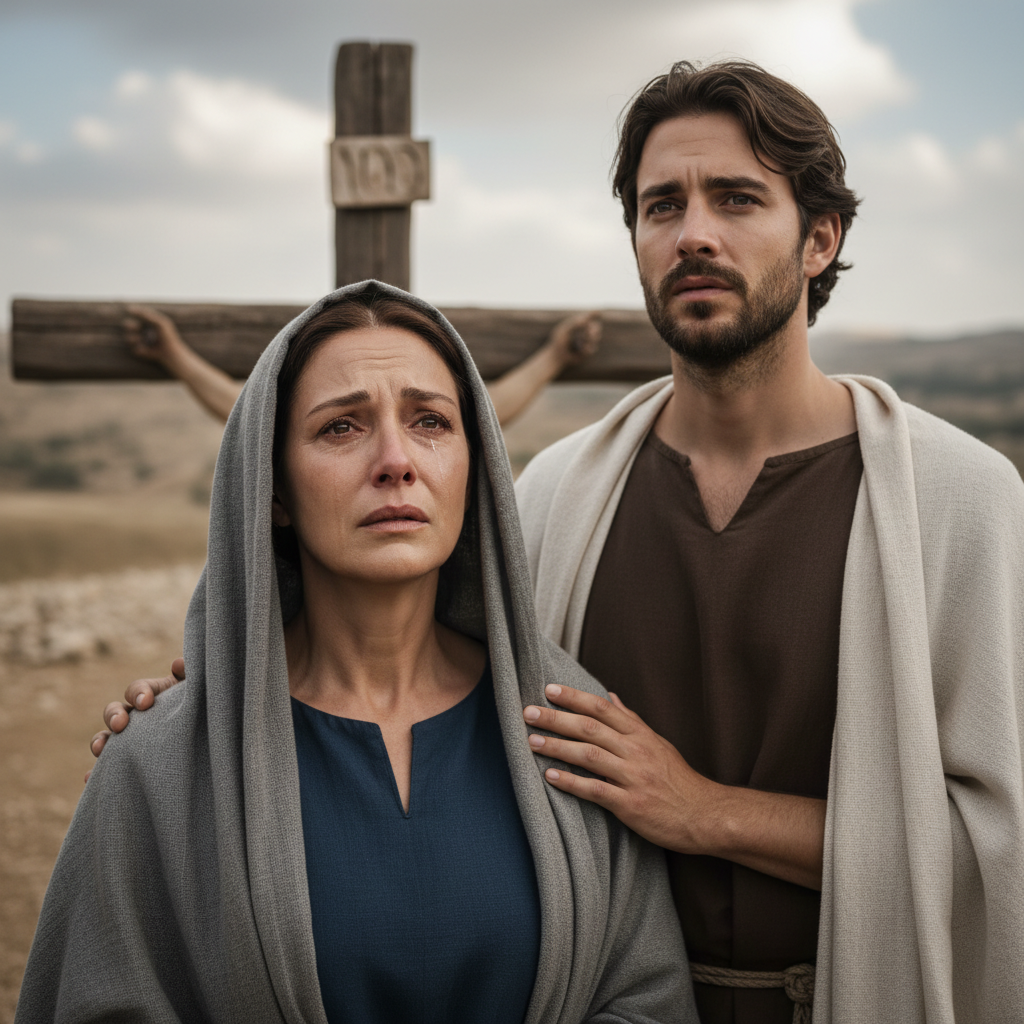
Even amidst His unimaginable agony on the cross, Jesus demonstrated profound love and care. The passage of John 19:25-27 captures one of the most poignant moments in the crucifixion narrative, revealing both Jesus’ humanity and His divine compassion. It offers a powerful glimpse into the heart of Christ as He faced death.
Specifically, John 19:25 details the group of faithful individuals standing near Jesus’ cross. Bravely remaining close to Him during His darkest hour, their presence highlights an unwavering devotion and underscores the deep personal connections Jesus had forged.
Those Standing by the Cross
The Gospel of John clearly identifies five individuals present:
- Mary, Jesus’ Mother: Her presence, watching her Son suffer immensely, is a testament to a mother’s enduring love.
- Mary’s Sister: The Bible mentions her sister, though her exact identity is debated among scholars. Many believe she was Salome, the mother of James and John, or Mary the wife of Clopas.
- Mary the Wife of Clopas: Another faithful follower, her presence signifies the widespread support for Jesus.
- Mary Magdalene: A devoted disciple who consistently stood by Jesus, she would later be the first to witness His resurrection.
- The Disciple Whom Jesus Loved: Traditionally understood to be John, the author of this Gospel, his presence makes his special relationship with Jesus evident.
Jesus’ Loving Command (John 19:26-27)
In John 19:26-27, Jesus performs an extraordinary act of love. Looking down from the cross, He saw His grieving mother and the beloved disciple, John. Despite His own immense suffering, His thoughts turned to their well-being, speaking volumes about His character and priorities.
Jesus then issues two profound commands:
- To His mother, He says, “Woman, behold your son!” (John 19:26). Far from being dismissive, this was a term of respect and endearment used to entrust her to a new guardian.
- To the disciple, He says, “Behold your mother!” (John 19:27). With this command, Jesus formally assigned John the responsibility of caring for Mary.
Scripture confirms John’s immediate obedience: “From that hour the disciple took her to his own home” (John 19:27). This simple act fulfilled Jesus’ instruction, ensuring Mary’s care and security after His departure.
The Profound Significance
This passage, often called the “Fifth Word from the Cross,” carries immense theological weight. First, it profoundly illustrates Jesus’ unwavering concern for His earthly family, showing His commitment to honoring His parents even in His final moments. By establishing a new familial bond between Mary and John, Jesus highlights the deep love and community that would define early Christianity. Furthermore, this act foreshadows the creation of a new spiritual family—the Church. It powerfully affirms that Jesus Christ is Lord, caring for His own even unto death. Through His sacrifice and resurrection, He offers new life and belonging to all who believe.
Who Was Standing by the Cross of Jesus?
Mary, the Mother of Jesus
Mary, the mother of Jesus, stood at the foot of the cross in a profoundly heartbreaking moment. As she witnessed the immense suffering of her Son, her presence fulfilled a prophecy spoken by Simeon decades earlier. He had warned her that a sword would one day pierce her soul (Luke 2:34-35).
In this dark hour, Mary’s unwavering love and devotion were on full display. Remaining faithful through unimaginable pain, her courage offers a powerful example of steadfast faith. She watched as her Son, the Son of God, endured the agonizing punishment of crucifixion.
Mary’s Sister, Mary the Wife of Clopas
The Gospel of John also notes that the sister of Jesus’s mother was present (John 19:25). Many scholars identify her as Mary, the wife of Clopas, which would make her Jesus’s aunt. Her presence alongside Mary demonstrates the strong family bonds that supported Jesus, even in His final moments.
This solidarity provided comfort amid the cruelty of the crucifixion. It also affirmed the humanity of Jesus Christ, who was born into a loving family.
Mary Magdalene
Another faithful follower at the cross was Mary Magdalene, who is consistently mentioned in the Gospels for her devotion. Jesus had delivered her from seven demons (Luke 8:2), and her life was transformed by His grace and power. As one of the women who helped fund Jesus’ ministry, her loyalty was steadfast to the end [1].
Mary Magdalene’s courage was remarkable, as she risked great danger to be near Jesus during His public execution. Significantly, she would also become the first witness to the resurrection (John 20:11-18), a fact that underscores her pivotal role in the early church. Her story serves as a testament to Jesus’s transformative love and His power to redeem and empower.
The Disciple Whom Jesus Loved
The Gospel of John also mentions the presence of “the disciple whom Jesus loved” (John 19:26), a title understood to refer to John, the author of the Gospel. As the only one of the twelve male disciples recorded at the cross, his presence demonstrates both a deep personal connection to Jesus and exceptional courage.
John stood bravely with the women, defying the danger of associating with a crucified man. In a gesture of tender compassion amidst His own suffering, Jesus entrusted His mother, Mary, into John’s care (John 19:27). This act established a new family bond and proved John’s faithfulness to the very end.
What is the significance of Jesus saying Woman behold your son?
A Testament to Jesus’ Human Compassion
Even while suffering unimaginable pain on the cross, Jesus showed profound human compassion. When He saw His mother, Mary, standing heartbroken nearby, His concern was not for Himself, but for her well-being.
This powerful moment reveals the depth of Jesus’ humanity. Though fully God, He was also fully man, capable of experiencing human emotions and relationships. His words to Mary, “Woman, behold your son!”, and to John, “Behold your mother!”, were a direct expression of love and care (John 19:26-27). In this act, a son ensured His mother’s future, revealing His tender heart even as He fulfilled His divine mission.
Furthermore, this act underscores His selflessness. He consistently placed the needs of others—even His persecutors—before His own. This same compassion extends to all believers, assuring us of how deeply Christ cares for us in our trials.
The Fulfillment of His Earthly Responsibility
Jesus’ instruction to John also fulfilled a vital earthly responsibility. In Jewish culture, the eldest son had a sacred duty to care for his widowed mother. Because Joseph, Mary’s husband, is not mentioned after Jesus’ childhood, it is widely believed he had passed away, leaving Jesus with the primary responsibility for Mary’s provision and protection.
By entrusting Mary to John, Jesus ensured her future care. This action perfectly aligns with the fifth commandment: “Honor your father and your mother” (Exodus 20:12). Even in His final moments, Jesus upheld God’s law, demonstrating perfect obedience. He did not abandon His filial duty; instead, He transferred it with love and intention. This act highlights the importance of family care within God’s divine order.
The Creation of a New Spiritual Family
Beyond personal compassion and earthly duty, Jesus’ words from the cross carry profound theological significance. He was creating a new definition of family—one that transcends biological ties. By uniting Mary and John, He foreshadowed the birth of His spiritual family: the Church.
Consider these implications:
- Broadening Kinship: Jesus frequently emphasized spiritual kinship over blood relations during His ministry (Mark 3:31-35). Here, He physically demonstrated this truth.
- A Model for the Church: A disciple, representing all believers, cares for Mary, the mother of Jesus. This illustrates how believers are to support one another as brothers and sisters in Christ. Through Him, we become one family (Galatians 3:28).
- New Covenant Bonds: This act cemented a spiritual bond, indicating that our ultimate family is in Christ. Our connections in faith are eternal, just as John took Mary into his home “from that hour” (John 19:27).
This passage reminds us that when we accept Jesus as Lord, we are adopted into God’s family. We gain spiritual mothers, fathers, brothers, and sisters who share an unbreakable bond in Christ.
Why Did Jesus Call Mary ‘Woman’?
The term “Woman” (Greek: gynai) can seem jarring to modern ears, leading some to wonder if it was disrespectful. However, this view overlooks the cultural and linguistic context of the time. In reality, Jesus’ use of “Woman” was a respectful and significant form of address, not a slight.
- A Common and Respectful Term: In ancient Greek, gynai was a polite and customary way to address a woman, similar to “Madam” or “dear lady.” It was not derogatory or dismissive. Jesus used this same term when speaking to His mother at the wedding in Cana (John 2:4).
- A Theological and Prophetic Echo: Some scholars believe Jesus’ use of “Woman” deliberately echoes Genesis 3:15, where God refers to Eve as “the woman.” In this interpretation, Mary is presented as the “new Eve,” whose Son is the one prophesied to crush the serpent’s head.
- Shifting Relationships: On the cross, Jesus was completing His earthly ministry and moving towards His divine glorification. By addressing Mary as “Woman,” He marked a transition from their earthly mother-son relationship to a broader spiritual relationship. She was no longer just His mother, but also a representative of all believers, entrusted to the care of the Church.
Far from being disrespectful, Jesus’ words were filled with dignity, love, and profound theological meaning. They affirm both His perfect character and His divine purpose, showing Him to be the compassionate Son of God, even in His final earthly moments.
How Does This Passage Guide Our Faith Today?

The poignant scene in John 19:25-27 offers profound lessons that can guide our Christian walk today. In this passage, we witness Jesus, even in His immense agony, fulfilling His earthly duties with deep compassion and unwavering obedience. From His final moments on the cross, we can draw valuable truths about love, family, and hope.
Honoring Our Parents
Even on the cross, Jesus exemplified perfect filial love by ensuring His mother, Mary, would be cared for. As John 19:25 notes, she stood faithfully by Him in His greatest hour of need. In response, Jesus entrusted her to the beloved disciple, John. This sacred act is a powerful reminder of our lifelong responsibility to honor and care for our own parents—addressing their physical, emotional, and spiritual well-being. This duty is rooted in Scripture, which commands us to “honor your father and mother” (Exodus 20:12)—the first commandment with a promise (Ephesians 6:2). By His actions, Jesus reaffirms this divine principle, setting the ultimate example of love and duty even amid His own suffering.
Embracing Our Church Family
In John 19:26-27, Jesus creates a new spiritual family. When He told Mary, “Woman, behold your son!” and John, “Behold your mother!” He established a bond that transcended biology. This act was more than just arranging personal care; it symbolized our adoption into God’s family through Christ. By faith, we all become children of God (Galatians 3:26), and our church family is a direct extension of this truth. Therefore, just as John cared for Mary, we are called to love and support our fellow believers. Within the church, we find community, encouragement, and spiritual growth. This belonging and strength we find in our brothers and sisters in Christ (Ephesians 2:19) is a testament to the new covenant family Jesus established from the cross.
- Mutual Support: We are to bear one another’s burdens (Galatians 6:2).
- Spiritual Nurturing: We help each other grow in faith and understanding.
- Unconditional Love: We are called to love as Christ loved us (John 13:34).
- Shared Hope: We journey together towards our eternal home.
Finding Hope in Christ’s Suffering
While the cross is a place of profound suffering, John 19:25-27 simultaneously reveals a powerful message of hope. Jesus’ concern for His mother amid His agony demonstrates His limitless compassion, assuring us that He cares for us even in our darkest moments. Furthermore, His suffering was not in vain, for it both secured our salvation and proved that He understands our pain. When we face trials, we can look to Christ’s example. His endurance gives us strength, and His ultimate victory over death gives us unshakable hope. We find comfort knowing that He walks with us (2 Corinthians 1:3-4). Ultimately, His sacrifice on the cross transformed despair into eternal life, reminding us that even in immense pain, God’s love prevails (Romans 5:8).
- Empathy from Christ: Jesus understands our pain and sorrow (Hebrews 4:15).
- Purpose in Pain: Our suffering can draw us closer to God.
- Eternal Perspective: Our present troubles are temporary compared to eternal glory (Romans 8:18).
- Assurance of Care: Jesus’ compassion for Mary assures us of His constant care for us.
Frequently Asked Questions about John 19
What is the meaning of John 19 26 27?
John 19:26-27 captures a deeply poignant moment where Jesus, even in His agony on the cross, shows profound human compassion. Seeing His mother, Mary, and the disciple John standing nearby, He entrusted Mary to John’s care. He said to His mother, “Woman, behold your son!” and then to John, “Behold your mother!” (John 19:26-27). This powerful act holds several layers of meaning for believers today.
Here are the key takeaways from this passage:
- Jesus’ Unwavering Love and Responsibility: Even while bearing the sins of the world, Jesus ensured His earthly mother would be cared for. This act demonstrates His perfect humanity and His devotion to family.
- The Formation of a New Spiritual Family: This moment transcends physical care, illustrating how believers are brought into God’s family through Christ. In this new family, John takes on the role of a son to Mary.
- An Example of Discipleship: John immediately took Mary into his home (John 19:27). This shows true discipleship in action: obedience, love, and practical care for others in Christ’s name.
- Fulfillment of Earthly Duties: As the perfect Son, Jesus fulfilled His duty to honor His mother, even while completing His divine mission to redeem humanity. This emphasizes the importance of honoring parents (Exodus 20:12).
Therefore, John 19:26-27 stands as a testament to Jesus’ loving heart and His unwavering commitment to both His earthly responsibilities and His spiritual mission. It reminds us to care for one another within the family of God, just as Jesus commanded.
Who is Mary’s sister in John 19:25?
John 19:25 lists several devout women at the foot of the cross, including “his mother’s sister,” whose identity has been a topic of scholarly discussion for centuries. The verse reads: “Now there stood by the cross of Jesus His mother, and His mother’s sister, Mary the wife of Clopas, and Mary Magdalene.”
The structure of the verse leads most theologians to believe it lists four distinct women. If “His mother’s sister” and “Mary the wife of Clopas” were the same person, it would mean Mary had a sister also named Mary, which was unlikely. Therefore, they are generally understood to be two different individuals.
Common interpretations regarding Mary’s sister include:
- Salome: Many scholars believe that Mary’s unnamed sister was Salome. Other Gospels identify Salome as the mother of James and John, the sons of Zebedee (Matthew 27:56, Mark 15:40). This would mean the Apostle John was Jesus’ cousin, adding another layer to their close relationship. [2]
- Another Unnamed Sister: Some believe she was simply an unnamed sister and that the Gospels provide insufficient information to identify her. However, her presence underscores the deep familial ties and unwavering support for Jesus during His crucifixion.
Regardless of her exact name, her presence at the cross is significant. She stood faithfully with Jesus’ mother during His most excruciating hour, demonstrating profound courage and devotion in the face of immense danger. Her unwavering loyalty is a powerful testament to the strength of faith.
What does John 19:25 say?
John 19:25 vividly describes the scene at the cross, focusing on the faithful women who remained with Jesus during His crucifixion. The verse states: “Now there stood by the cross of Jesus His mother, and His mother’s sister, Mary the wife of Clopas, and Mary Magdalene.”
This verse is profoundly significant for several reasons:
- Unwavering Devotion: While many disciples had fled in fear, these women, along with the disciple John, bravely stood by Jesus. Their presence symbolizes incredible loyalty and love amidst unimaginable sorrow and danger.
- Witness to Suffering: As direct witnesses to Jesus’ suffering and death, they saw firsthand the ultimate sacrifice for humanity’s salvation. Their testimony adds powerful authenticity to the Gospel account.
- The Centrality of Mary: Jesus’ mother, Mary, is present, experiencing the fulfillment of Simeon’s prophecy that a sword would pierce her soul (Luke 2:35). Her anguish is a central element of this scene.
- A Glimpse of the Early Church’s Foundation: These women, particularly Mary Magdalene, would become key figures in witnessing the resurrection. Their faithfulness at the cross foreshadows their crucial role in the early Christian movement.
Therefore, John 19:25 highlights the enduring faith of these women, their courageous loyalty, and their vital role as witnesses to the central events of our salvation. By standing firm with Christ in His darkest hour, they exemplified true discipleship and affirmed His identity as Lord and Savior.